
MSBA-120 · Lesson 10 of 12 · 20 min
Competitive and industry context
▶ Video coming soon A video version of this lesson is on the way.
Daria came to the tenth workshop with a printout of a competitor's new website. A national brokerage that competed with Quillfield for personal-lines clients now promised "instant answers about your policy, any time" and quotes in minutes. "Our clients will see this," she said. "Some of them already have. If we are doing AI for productivity only, are we missing the point?"
Value from AI does not exist in isolation. What a capability is worth depends on what customers expect, what competitors offer, what regulators allow, how fast the technology is improving and how quickly costs are falling. This lesson places the business case in that wider context.
How widely AI is being adopted
Adoption has moved quickly. Stanford's 2025 AI Index, drawing on a large global survey of businesses, reported that 78 percent of respondents said their organizations used AI in 2024, up from 55 percent in 2023, and that the share using generative AI in at least one business function rose from 33 to 71 percent over the same year. Using AI somewhere is not the same as getting value from it, as lesson 3 showed, but the figures mean that competitors, customers and employees increasingly assume AI is part of how work gets done.
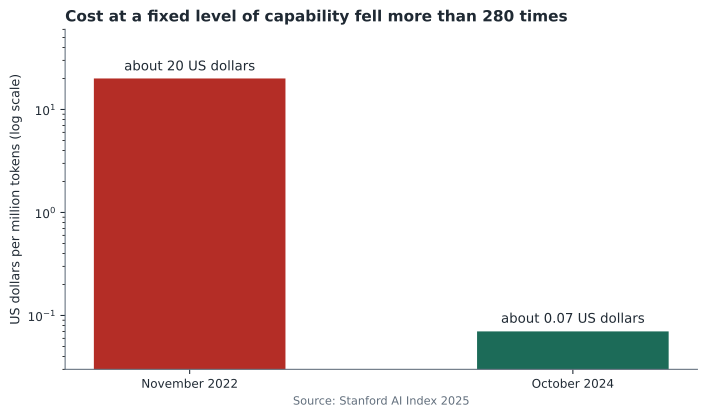
The same report described how quickly the cost of AI is falling. The price of using a model that performs at the level of an early ChatGPT model on a standard knowledge test fell from about 20 US dollars per million tokens in November 2022 to about 7 US cents per million tokens by October 2024, a drop of more than 280 times in under two years. Prices for the most capable models have not fallen as far, but the direction matters: what is expensive today will very likely be cheap tomorrow.
What falling costs mean for advantage
When a capability becomes cheap and widely available, it stops being a source of competitive advantage by itself. Everyone can summarize a document or draft an email with AI. Advantage moves to the things competitors cannot easily copy:
- Proprietary data and knowledge: the firm's own underwriting experience, client histories and know-how, made usable by AI.
- Redesigned processes: workflows rebuilt around AI so that the whole process is faster or better, not just one step.
- People and skills: staff who know how to use AI well, check it and improve it, and leaders who can manage the change.
- Client relationships and trust: the confidence that clients will get accurate, accountable advice, especially in regulated industries.
This is why lesson 7 recommended buying common capabilities and extending them with company knowledge. The common capability is a cost of doing business; the extension is where the advantage can be.
Industry exposure
Industries differ in how much generative AI changes them. Work that is mostly reading, writing, analyzing and advising is most exposed: insurance, banking, professional services, legal services, marketing, software and customer service. Work that is mostly physical is less directly affected, although its administration and planning are still exposed.
Insurance is highly exposed. Its core activities, assessing risk from documents, explaining complex contracts, handling claims and advising clients, are information work. Insurers are applying AI to claims handling, underwriting and fraud detection; brokers are applying it to client service, document preparation and market submissions. For a broker like Quillfield, two competitive pressures matter most: clients who expect faster, simpler service, and insurers who may expect brokers to submit cleaner, more complete information electronically.
| Force | How AI changes it for a brokerage | Quillfield response |
|---|---|---|
| Client expectations | Clients compare service with the fastest digital experiences they use | After-hours policy answers; same-day quotes |
| Direct and digital competitors | Online brokers and insurers offer instant quotes for simple risks | Compete on advice for complex risks; match speed on simple ones |
| Insurers | Insurers automate underwriting and expect clean electronic submissions | Use AI to prepare complete, consistent submissions |
| Talent | Staff expect modern tools; AI skills become a hiring factor | Training and champions programs |
| Regulators | Rules on advice, disclosure, privacy and AI governance tighten | Grounded, scoped client agents; compliance reviews |
First mover, fast follower or late adopter
Leaders often ask whether it is better to move first or to wait. Each position has trade-offs.
First movers gain experience, data and skills early, and can shape client expectations. They also pay more, absorb more risk from immature technology and sometimes build what vendors later give away.
Fast followers adopt once a capability has proven itself elsewhere, learning from others' mistakes and buying more mature products at lower prices. Their risk is that the leaders' advantage in data, process and skills is harder to catch up with than the technology itself.
Late adopters save money in the short term and face the largest catch-up later, including shadow AI among their own staff and clients who have already moved to competitors.
For most mid-size organizations, the sensible position is a fast follower for technology and an early mover for skills, data and process. Buy proven capabilities rather than building experimental ones, but start now on the data readiness, training and process redesign that take time and cannot be bought.
Scanning the competitive landscape
A short, regular scan keeps the business case grounded in reality. Useful sources include competitors' websites, client communications and job postings, which often reveal AI investments; industry association reports and conferences; insurers' and regulators' announcements; vendors' roadmaps; and, most valuable of all, what clients and staff say. Hamish set up a quarterly one-page scan for Quillfield with four headings: what clients now expect, what competitors offer, what insurers and regulators require, and what has become cheaper or available off the shelf since the last scan.
The vendor and model landscape
The technology itself is changing quickly. New models appear every few months, with better reasoning, longer context and lower prices. Platforms increasingly let customers choose among models from different providers for different tasks; Microsoft, for example, offers a choice of models in Microsoft Foundry and has added models from more than one provider to its Copilot products. For leaders, three implications follow. Avoid business cases that depend on one model's particular strengths. Prefer platforms that let the organization switch models without rebuilding solutions. And revisit cost assumptions at least yearly, because prices are likely to have fallen.
Customers, regulators and trust
In regulated, advice-based industries, trust is part of the product. Clients want speed, but they also want to know that someone is accountable for the advice they receive. Regulators expect firms to understand and control the tools they use, to treat customers fairly and to protect personal information. A competitor that adopts AI carelessly may win clients quickly and lose them, and its regulator's goodwill, just as quickly.
Daria's competitor's promise of "instant answers" was a useful prompt. Quillfield decided that it would match the speed for simple factual questions about a client's own policy, through the grounded and scoped agent from lesson 6, while making a point of offering a licensed broker for anything involving advice. "Fast for facts, human for judgment" became the line in its client communications.
Worked problem
Turning a competitive threat into a use case
A competitor promises instant policy answers and quotes in minutes. Using the ideas in this lesson, write Quillfield's response as a use case with a value family, a cost model and a key risk control.
Show solution
- Use case: personal-lines clients ask an after-hours agent factual questions about their own policies; anything involving advice is booked with a broker for the next business day.
- Value family: growth and quality, through retention of clients who value speed and fewer simple calls to the contact centre during the day.
- Cost model: consumption, measured in Copilot Credits per conversation, piloted on pay-as-you-go before any commitment.
- Key control: grounding in the client's own documents and scope limits on advice, with sampled review.
- Measure: client retention in the pilot group versus a comparison group, and daytime call volume for simple questions.
Answer: A scoped after-hours agent, valued for retention and reduced simple calls, paid by consumption and controlled by grounding and scope limits, answers the competitive threat without copying its risks.
Thinking in scenarios
Because the context is changing, the most robust business cases are tested against several possible futures rather than one. A simple set for Quillfield might be: AI capabilities keep improving and costs keep falling quickly; regulation of AI in financial services tightens sharply; competitors move faster than expected on client-facing automation; and adoption among staff is slower than planned. A good plan is one that still makes sense, perhaps with adjustments, in each scenario. If the plan only works in the most optimistic future, it is a bet, not a plan.
The workforce dimension
Competition for people is part of the competitive context. Employees increasingly expect to work with modern AI tools, and those who learn to use them well become more valuable, both to their current employer and to competitors. The support-agent study in lesson 1 found that AI helped newer workers most, which suggests that AI can shorten the time it takes new staff to become productive, an advantage in a tight labour market.
At the same time, AI changes the content of jobs. Some tasks shrink or disappear, others grow, and new ones appear, such as reviewing agent output, curating knowledge and owning agents. Organizations that plan these changes openly, retrain people and involve them in redesigning their work tend to see better adoption and less resistance than those that announce headcount reductions as the main benefit. Lorne's preference for avoided hiring and absorbed growth over layoffs was partly financial and partly about keeping the trust of experienced staff whose knowledge the AI depended on.
| Change in work | Example at Quillfield | Response |
|---|---|---|
| Tasks that shrink | Typing call notes; assembling renewal packs | Redeploy time to client contact |
| Tasks that grow | Advising on complex risks; handling exceptions | Training in advice and judgment |
| New tasks | Reviewing agent output; curating knowledge sources | Clear roles, time allocated, recognition |
| Skills in demand | Prompting, checking AI output, process redesign | Role-based training and champions |
Regulation as part of the landscape
Regulation shapes what competitors can do as much as what Quillfield can do. Rules on AI are developing quickly and differ between jurisdictions. Some apply specifically to AI, such as the European Union's AI Act, which entered into force in 2024 with obligations phased in over several years. Others are long-standing rules that apply to AI because they apply to the activity: privacy law, consumer protection, rules on financial advice and disclosure, anti-discrimination law and sector guidance from financial regulators. For a business case, the practical questions are which rules apply to each use case, what they require, and how they might change during the life of the investment.
Regulation can also be a source of advantage. A firm that can show regulators and clients that its AI is governed, tested and accountable may be allowed, and trusted, to do more than a competitor that cannot. Wendell put it simply: "Good governance is not only a brake. It is also the licence to drive faster."
Worked problem
Weighing a fast follower decision
A vendor offers Quillfield an early-access program for a new client-facing quoting agent at a 40 percent discount, with features still in preview. Using this lesson, list the arguments for and against joining now.
Show solution
- For: lower price, early experience, influence on the product, and a response to competitors' instant quotes.
- Against: preview features may change or be withdrawn; client-facing errors carry high impact; Quillfield's data readiness work is not finished.
- Middle path: join the program in a closed internal pilot with brokers, not clients, to build experience and data while the product matures.
- Decide on client-facing use only after the product is generally available and the internal pilot meets its criteria.
Answer: A fast follower on technology and an early mover on readiness: pilot internally now, go client-facing once the product and the controls are proven.
Common mistakes
MistakeTreating AI capabilities as a lasting competitive advantage in themselves.
InsteadCommon capabilities become cheap and universal; advantage comes from data, process, people and trust.
MistakeCopying a competitor's AI promise without assessing its risks.
InsteadMatch what clients value, within controls that protect accuracy and compliance.
MistakeWaiting for the technology to settle before doing anything.
InsteadBe a fast follower on technology but start early on data readiness, skills and process.
MistakeLocking a business case to one model's strengths and today's prices.
InsteadPrefer platforms with model choice and revisit cost assumptions regularly.
Summary and key terms
- AI adoption is widespread: the 2025 AI Index reported 78 percent of surveyed organizations using AI in 2024, up from 55 percent.
- The cost of AI at a fixed capability fell by more than 280 times between late 2022 and late 2024.
- As capabilities become common, advantage shifts to proprietary data, redesigned processes, skilled people and trust.
- Information-heavy industries such as insurance and banking are highly exposed; clients, competitors, insurers, talent and regulators all shift.
- A fast follower on technology and an early mover on readiness is a sensible position for most organizations; test plans against several scenarios.
- Competitive advantage
- Something that lets a business outperform rivals and that they cannot easily copy.
- First mover
- An organization that adopts a new capability before others, gaining experience but bearing more risk.
- Fast follower
- An organization that adopts once a capability is proven, buying more mature products at lower cost.
- Industry exposure
- How much an industry's core work is affected by a technology.
- Scenario planning
- Testing a plan against several possible futures rather than one forecast.
Practice problems
Work each problem on paper first, then reveal the answer to check.
Why does falling AI cost reduce the advantage of simply having AI?
Show answer
Because a cheap, widely available capability can be used by every competitor; advantage moves to what cannot be copied.
Name four things that remain sources of advantage as AI becomes common.
Show answer
Proprietary data and knowledge, redesigned processes, people and skills, client relationships and trust.
What was Quillfield's line for its client-facing approach?
Show answer
Fast for facts, human for judgment.
Lesson quiz · 5 questions
Score 60% or more to complete this lesson.
Create a free account to save your progress, take quizzes and earn a certificate.