
MSBA-120 · Lesson 8 of 12 · 20 min
Agents and process automation
▶ Video coming soon A video version of this lesson is on the way.
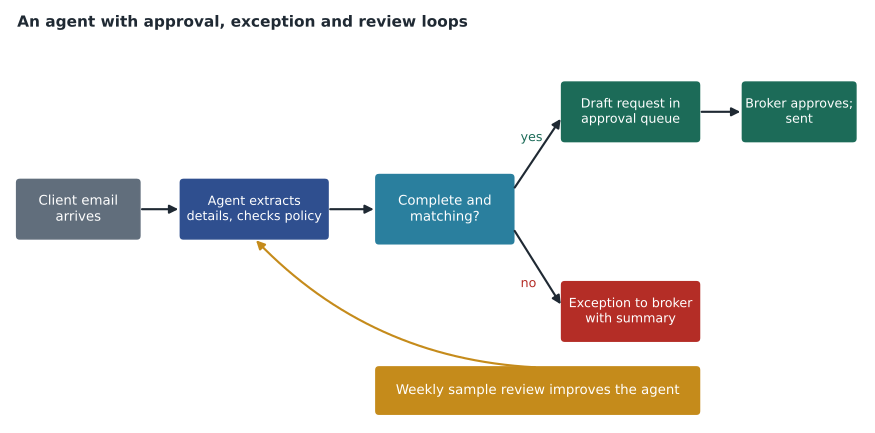
Yusra Kamaludin had built three small agents in Copilot Studio by the time she was invited to the eighth workshop. The most popular one answered staff questions about which insurers Quillfield placed business with for each type of risk. The one she was proudest of did not wait to be asked. Every morning it read the shared mailbox where clients sent certificates of insurance requests, pulled out the details, drafted each certificate request for the right insurer and put the drafts in a queue for a broker to approve.
"The first one saves people a search," she told the leadership team. "The second one does a job."
That distinction is the subject of this lesson. Most early generative AI value comes from assistance: a person asks and the AI helps. Agents that carry out multi-step work, sometimes triggered by events rather than by a person, can create much larger value because they change processes rather than individual tasks. They also change the risks, the costs and the management needed.
From assistant to agent
An assistant responds to a person's request within a conversation. It drafts, summarizes, answers and suggests, and the person decides what to do with the result.
An agent is given a goal, instructions, knowledge and tools, and works toward the goal by deciding which steps to take, calling tools to look things up or take actions, and checking its progress. Agents can be started by a person, or triggered automatically by an event such as a new email, a new record or a schedule. Some agents work alongside people in a conversation; others work in the background and bring people in only when needed.
Between these two ends lies a range of autonomy. It helps to describe agents by how much they do without a person.
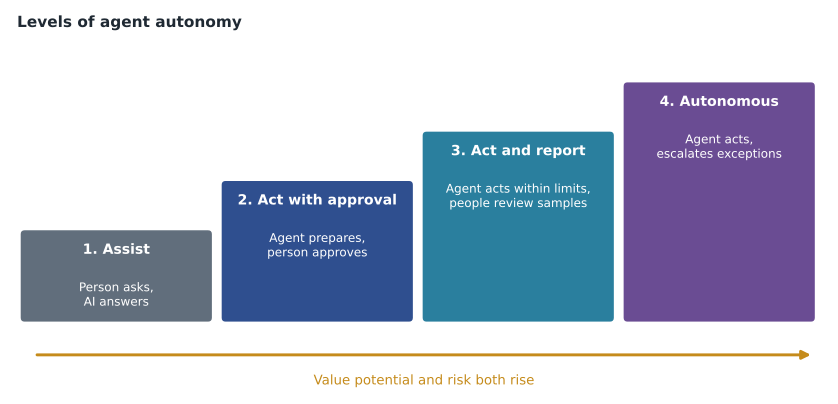
| Level | What the agent does | Quillfield example |
|---|---|---|
| 1. Assist | Answers or drafts when asked | Insurer-appetite question agent |
| 2. Act with approval | Prepares an action; a person approves before it happens | Certificate requests drafted for broker approval |
| 3. Act and report | Acts within set limits; people review a sample afterwards | Renewal reminder emails sent automatically, reviewed weekly |
| 4. Autonomous | Acts on its own and escalates exceptions | Not yet used at Quillfield |
Choosing the level is a business decision. Higher autonomy removes more human effort and speeds work up, but each error reaches the outcome without anyone catching it. A sensible approach is to start an agent at the level of autonomy the risk assessment allows, measure its accuracy, and raise its autonomy only when the evidence supports it.
What makes a process a good candidate for an agent
Not every process should be automated, and not every automation needs generative AI. A process is a strong candidate for an AI agent when it combines three features: it is repetitive and high-volume, so automation pays off; it involves unstructured information such as emails, documents or free text that older automation tools cannot read reliably; and its rules are mostly clear with a manageable number of exceptions that can be sent to a person.
Processes with fixed formats and no judgment, such as copying a field from one system to another, are often better served by conventional automation in tools such as Power Automate, which is cheaper and fully predictable. Processes that need deep judgment on every case, such as negotiating a complex commercial renewal, are better served by assistance than by an agent. The middle ground, where the work is reading and routing and drafting, is where agents shine.
| Process | Volume | Unstructured input | Clear rules | Best fit |
|---|---|---|---|---|
| Copy new policy numbers into the accounting system | High | No | Yes | Conventional automation |
| Draft certificate of insurance requests from client emails | High | Yes | Mostly | AI agent with approval |
| Answer staff questions about insurer appetite | Medium | Yes | Mostly | AI assistant or simple agent |
| Negotiate a large commercial renewal | Low | Yes | No | Assistance for the broker |
How agents create value
Agents create value in the same three families as other AI uses, but the balance shifts. Because an agent handles a whole sequence of steps, the time it saves is concentrated rather than scattered, which makes it far easier to capture. A broker who no longer reads, types and files certificate requests has recovered a block of time that can be measured and redeployed. Agents can also work outside office hours, handle surges without overtime and respond in minutes rather than hours, which creates growth and quality value as well.
The economics of an agent are often easiest to express as cost per completed task. The human cost per task is the time it takes multiplied by the fully loaded hourly rate. The agent cost per task is its consumption cost plus the time a person spends approving, correcting or handling exceptions. The difference, multiplied by volume, is the gross value; the build, testing and governance costs come off that.
Worked problem
Cost per task for the certificate agent
Brokers handle about 900 certificate requests a month, each taking about 9 minutes, at a fully loaded rate of 55 dollars an hour. Yusra's agent drafts each request using about 30 Copilot Credits at one US cent each. A broker then spends about 1.5 minutes approving each draft, and 10 percent of requests are exceptions that still take the full 9 minutes. What are the monthly costs before and after, ignoring build and governance costs?
Show solution
- Before: 900 x 9 minutes = 8,100 minutes = 135 hours; 135 x 55 = 7,425 dollars.
- Agent consumption: 900 x 30 credits = 27,000 credits = 270 dollars.
- Approvals for the 810 normal requests: 810 x 1.5 minutes = 1,215 minutes = 20.25 hours.
- Exceptions: 90 x 9 minutes = 810 minutes = 13.5 hours.
- Human time after: 20.25 + 13.5 = 33.75 hours; 33.75 x 55 = about 1,856 dollars.
- Total after: 1,856 + 270 = about 2,126 dollars a month.
Answer: Roughly 7,425 dollars a month before and about 2,126 after, a gross saving of about 5,300 dollars a month, or about 101 hours of broker time to be captured.
Designing the human role
Automation does not remove people from a process; it changes their role. In an agent-supported process, people typically do four things: approve actions the agent prepares, handle exceptions the agent cannot or should not resolve, review samples of completed work to check quality, and improve the agent by feeding back errors so its instructions or knowledge can be fixed.
Designing these roles well is what keeps quality high. Approvals should show the person what the agent did and why, with the source documents a click away. Exceptions should be routed to the right person with context, not dropped into a general inbox. Sampling should be regular and recorded. And there should be a named owner of each agent who is accountable for its results, its costs and its changes.
Agents in the Microsoft ecosystem
In Microsoft's offerings, agents appear at every point on the buy, extend and build spectrum from lesson 7. Microsoft 365 Copilot includes agents such as Researcher and Analyst. Business users can create simple agents in Copilot, and makers can create more capable ones in Copilot Studio, where agents can use knowledge sources, call tools and connectors, run agent flows and be started by autonomous triggers such as a new email or a schedule. Professional developers can build agents with Microsoft Foundry. Dynamics 365 includes agents for sales, service and finance processes.
Because agents can act, organizations need to know which agents exist, who owns them, what they can reach and what they cost. Microsoft provides inventory and management features for agents in the Microsoft 365 admin center and governance controls in the Power Platform admin center, and agents can be given their own identities so that their access can be managed like a user's. The details are covered in the administration courses; for a leader, the key point is that every agent should be on an inventory with an owner, a purpose and a budget.
Costs and risks specific to agents
Agents add three considerations to the cost and risk picture from lessons 4 and 6.
Consumption grows with volume and complexity. An agent that runs on every incoming email consumes credits on every email, including ones that turn out to be irrelevant. Designs that filter early, use simpler steps where possible and avoid unnecessary model calls keep costs down. Forecasts should be based on measured credits per task, not guesses.
Errors can compound. In a multi-step process, an error early on, such as extracting the wrong policy number, can carry through every later step. Validation checks between steps, such as confirming that an extracted policy number exists, catch many errors cheaply.
Actions need limits. An agent that can send emails, update records or start payments needs clear limits on what it may do without approval, and the ability to be paused instantly. Prompt injection, covered in lesson 6, is a particular concern for agents that read external content and can act.
Measuring agents
Agents need their own measures in addition to the business outcome measures of lesson 5. Useful ones include the completion rate (the share of tasks the agent finishes without escalation), the accuracy rate found in sample reviews, the exception rate, the approval change rate (how often a person edits or rejects the agent's proposal), the time to complete, and the cost per task. A rising approval change rate is often the first sign that something has changed, such as a new insurer form or a model update.
Worked problem
Deciding whether to raise autonomy
After three months, the certificate agent's drafts are approved without changes 97 percent of the time, exceptions are steady at 10 percent, and sample reviews find no errors that reached a client. Brokers ask whether routine renewals of existing certificates could be sent without approval. What should Celestine require before agreeing?
Show solution
- Limit the change to the lowest-risk subset: renewals of existing certificates with no changes in coverage.
- Agree the new controls: a weekly sample review, an automatic stop if any check fails, and an easy way for clients to query a certificate.
- Ask Wendell to confirm that sending these certificates without broker approval is acceptable to the regulator and the insurers.
- Run the higher autonomy as a time-limited pilot with its own success criteria before making it permanent.
Answer: Raise autonomy only for the lowest-risk subset, with compliance sign-off, stronger monitoring and a pilot with criteria, so the evidence supports each step up.
By the end of the session, the leadership team agreed a rule for every agent at Quillfield: it starts at level 2, approval before action, unless Wendell agrees otherwise in writing, and it moves up a level only after a pilot with success criteria.
Starting small with agents
Yusra's advice to the leadership team was to start every agent narrowly and widen it only when it had earned trust. The certificate agent began by handling only one insurer's certificate format, for one office, for four weeks. Once its drafts were approved without changes more than nine times in ten, she added the next two insurers, then the other offices. Each step was small enough that an error would be caught quickly and affect few clients, and each produced the measured credits per task and approval change rates that the business case needed.
This approach also makes agents easier to explain to the people whose work they change. Brokers saw the agent take over the dullest part of their day, one insurer at a time, while they kept the final say. When the agent made mistakes, they were the ones who caught them and fed them back, which gave them a stake in its success rather than a reason to resist it.
Common mistakes
MistakeGiving a new agent full autonomy because it worked in a demonstration.
InsteadStart at the autonomy level the risk allows and raise it only with evidence from a pilot.
MistakeUsing an AI agent for fixed-format data copying.
InsteadUse conventional automation where there is no unstructured input or judgment.
MistakeForecasting agent costs from a single test run.
InsteadMeasure credits per task across real volume and include approval and exception time.
MistakeLaunching agents without an owner or an inventory.
InsteadRecord every agent with an owner, purpose, access, limits and budget.
Summary and key terms
- Assistants respond within a conversation; agents work toward goals with knowledge and tools and can be triggered by events.
- Autonomy ranges from assist, to act with approval, to act and report, to autonomous; value and risk rise together.
- Good agent candidates are high-volume, involve unstructured information and have mostly clear rules.
- Agent economics are best expressed as cost per completed task, including approval and exception time.
- Agents need owners, inventories, limits, validation between steps and their own measures such as completion and approval change rates.
- Agent
- An AI system that works toward a goal using instructions, knowledge and tools, deciding which steps to take.
- Autonomy level
- How much an agent does without a person approving or reviewing it.
- Autonomous trigger
- An event, such as a new email or a schedule, that starts an agent without a person asking.
- Exception
- A case the agent cannot or should not handle, routed to a person.
- Approval change rate
- How often people edit or reject what an agent proposes.
- Cost per completed task
- Consumption cost plus human time per task, used to compare an agent with the manual process.
Practice problems
Work each problem on paper first, then reveal the answer to check.
Name the three features that make a process a strong candidate for an AI agent.
Show answer
Repetitive and high-volume, unstructured information, mostly clear rules with manageable exceptions.
What four things do people do in an agent-supported process?
Show answer
Approve actions, handle exceptions, review samples, and improve the agent.
Why can errors compound in a multi-step agent?
Show answer
Because a wrong value early on is used in every later step; validation checks between steps catch it.
Lesson quiz · 5 questions
Score 60% or more to complete this lesson.
Create a free account to save your progress, take quizzes and earn a certificate.