
MSBA-120 · Lesson 11 of 12 · 20 min
Writing an AI business case
▶ Video coming soon A video version of this lesson is on the way.
After ten workshops, Celestine had what she needed: prioritized use cases, pilot results, cost models, a measurement approach, a risk register, build and buy decisions, a data readiness plan and a view of the competition. What she did not yet have was the document the board would read. "The board will give this twenty minutes," she said. "Everything we have learned has to fit into something they can read, question and decide on in that time."
This lesson shows how to write that document: a business case for an AI program that a board or executive committee can approve with confidence. It brings together the ideas from the previous lessons into one structure.
What a business case is for
A business case is a document that asks for a decision, usually to commit money and people, and gives decision-makers what they need to make it. It is not a technology description, a vision statement or a sales pitch. A good business case states the decision requested, compares the realistic options, shows the expected benefits and costs with their uncertainty, sets out the risks and how they will be managed, and explains how success will be measured and reported.
For AI, three features deserve extra care because decision-makers are often sceptical of them: the link between time saved and financial value, the treatment of consumption costs, and the risks. A business case that handles these three honestly is far more likely to be approved, and far more likely to deliver what it promises.
A standard structure
1. Decision requested and executive summary. One page. What is being asked for, how much it costs, what it is expected to return, the main risks and the decision date. Many decision-makers read only this page closely, so it must stand alone.
2. Problem and opportunity. Why act now: the business problems, the opportunities and the competitive context from lesson 10. Link them to the organization's existing strategy, so the AI program is a means to goals the board already holds.
3. Options considered. At least three, always including "do nothing" or "continue as now". Typical options are a limited program focused on quick wins, a broader program, and doing nothing. Comparing options shows that the recommendation was chosen, not assumed.
4. Recommended option. What will be done: the use cases, their place on the buy, extend and build spectrum, the phasing, and the governance.
5. Benefits. Hard benefits with their calculation and assumptions; soft benefits listed separately without dollar values, as lesson 5 recommended.
6. Costs. Total cost of ownership from lesson 4: licences, consumption with forecasts, one-time preparation and building, training, governance and ongoing support.
7. Financial summary. ROI, payback and, for multi-year programs, net present value, in conservative, expected and optimistic scenarios, with the key assumption identified.
8. Risks and controls. The risk register from lesson 6, including the risks of doing nothing.
9. Implementation plan. Phases, milestones, gates and owners, following the pilot-to-scale approach from lesson 3.
10. Measurement and reporting. Leading and lagging indicators, the baseline, how attribution will be done and how often results will be reported.
Writing the executive summary
The executive summary is the most important page. It should answer five questions in plain language: what we propose, why, what it costs, what we expect in return and what could go wrong. Numbers should be rounded and consistent with the detailed sections. Jargon such as "agentic orchestration" or "RAG" should be replaced by what the thing does.
Worked problem
Quillfield's executive summary
Draft the core of Quillfield's executive summary from the program's figures: four use cases (call notes, renewal briefings, disclosure checks and the certificate agent); first-year cost about 129,000 dollars; expected first-year hard benefit about 171,000 dollars; full-year hard benefit from year two about 284,000 dollars; main risks data exposure and errors in client communications.
Show solution
- Decision: approve a 12-month AI program of four use cases at a first-year cost of about 129,000 dollars.
- Why: our contact centre and account teams spend large amounts of time on notes, document preparation and requests that AI can now handle, and clients increasingly expect faster service.
- Return: about 171,000 dollars of hard benefits in year one as use cases ramp up, rising to about 284,000 dollars a year from year two, mainly from avoided hiring and redeployed time.
- Risks: data exposure and errors in client communications, controlled by a completed permissions clean-up, human approval for client-facing output and weekly sampling.
- Measurement: results reported to the leadership team monthly and to the board quarterly against agreed baselines.
Answer: Five short paragraphs that a board member can read in two minutes, each supported by a detailed section.
Building the financial summary
The financial summary pulls together the benefits and costs. Two adjustments make it realistic.
The first is the ramp-up. Benefits do not start on day one. Pilots take weeks, rollouts take months and people take time to change how they work. A common approach is to assume a fraction of the full annual benefit in year one, based on the planned timing of each use case. Quillfield used 60 percent.
The second is the split between one-time and ongoing costs. One-time costs fall mostly in year one; ongoing costs continue. A program that looks marginal in year one may be strongly positive over three years, and decision-makers need to see both views.
| Item | Year 1 (dollars) | Year 2 (dollars) | Basis |
|---|---|---|---|
| Call notes: avoided hiring and overtime | 54,000 | 90,000 | Pilot with comparison group |
| Renewal briefings: redeployed time | 66,528 | 110,880 | 50 percent capture at loaded rate |
| Certificate agent: broker time | 38,160 | 63,600 | Cost per task, lesson 8 |
| Disclosure checks: remediation avoided | 12,000 | 20,000 | Prior two years' findings |
| Total hard benefits | 170,688 | 284,480 | Year 1 at 60 percent ramp |
| Copilot licences (120 users) | 43,200 | 43,200 | 30 US dollars per user per month |
| Agent consumption | 5,640 | 5,640 | Measured credits per task |
| Data clean-up and training (one-time) | 65,000 | 0 | Lesson 4 estimate |
| Agent building and testing (one-time) | 15,000 | 0 | Partner quote |
| Ongoing support and governance | 0 | 10,000 | Part-time owner time |
| Total costs | 128,840 | 58,840 |
Worked problem
ROI and payback for the program
Using the table, calculate the year 1 ROI, the year 2 ROI and the two-year cumulative net benefit.
Show solution
- Year 1 ROI: (170,688 minus 128,840) divided by 128,840 = about 0.32, or about 32 percent.
- Year 2 ROI: (284,480 minus 58,840) divided by 58,840 = about 3.83, or about 383 percent.
- Two-year benefits: 170,688 + 284,480 = 455,168. Two-year costs: 128,840 + 58,840 = 187,680.
- Two-year net benefit: 455,168 minus 187,680 = 267,488 dollars.
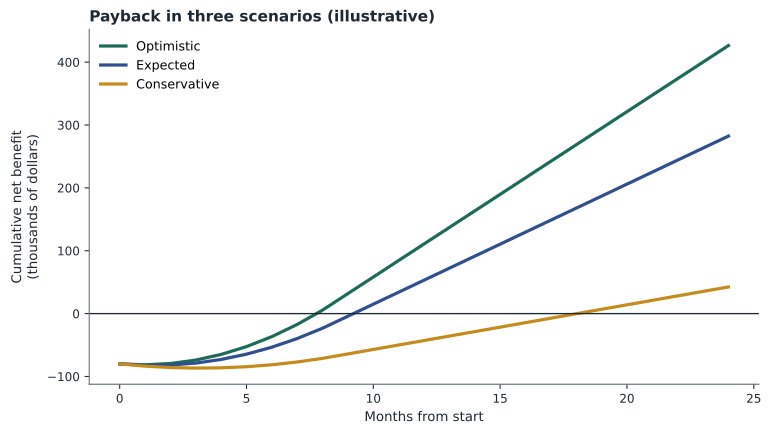
Answer: About 32 percent in year one, about 383 percent in year two, and a two-year net benefit of about 267,000 dollars. The program pays back within year one in the expected scenario.
The year 2 ROI looks dramatic because most costs are one-time. A careful writer points that out rather than leading with the biggest number, and shows the conservative scenario next to it. Quillfield's conservative scenario, with half the expected benefits, still paid back within the second year.
Making assumptions visible
Every number in a business case rests on assumptions. Collecting them in an assumptions table, each with its source and how it will be checked, does three things. It lets reviewers challenge the right things. It shows which assumptions came from measured pilots and which from estimates. And it becomes the checklist for measurement after approval: each assumption is something to confirm or correct.
| Assumption | Value | Source | How it will be checked |
|---|---|---|---|
| After-call work saved per call | 1.7 minutes | Pilot with comparison group | Monthly contact centre report |
| Capture rate for account managers | 50 percent | Finance standard | Retention-call log and renewal rates |
| Copilot Credits per certificate | 30 | Three months of agent data | Monthly consumption report |
| Year 1 ramp-up | 60 percent | Rollout plan | Milestone tracking |
| Licence price | 30 US dollars per user per month | Microsoft list price | Contract |
Writing for decision-makers
A few writing habits make a large difference. Lead with the decision, not the background. Use the organization's language, such as "renewals" and "client retention", rather than technology terms. Round numbers and keep them consistent everywhere they appear. Put detail in appendices. Show the "do nothing" option fairly. Say what you do not know. And make the ask specific: an amount, a period, a set of use cases and a date for the next decision, not an open-ended commitment.
Boards and executive committees often ask the same questions about AI. A good business case answers them before they are asked: How do we know the benefits are real? What happens to the people whose work changes? What if costs run higher than forecast? How do we stop if it does not work? Who is accountable?
Governance in the business case
The business case should also say how the program will be governed after approval. This usually means a small AI council or steering group that meets regularly, reviews the portfolio of use cases, approves new ones and agents against the risk appetite, reviews measured results and decides at each gate whether to scale, adjust, pivot or stop. The companion course on implementation and adoption strategy covers the council in depth; the business case only needs to name it, its members and how often it will report.
Celestine's final version was nine pages: a one-page summary, seven pages of detail and an appendix of assumptions. The board approved it with one condition, proposed by Lorne: that the first quarterly report show measured results against every assumption in the table.
Common objections and how to answer them
Before the board meeting, Celestine held a rehearsal in which Lorne and Wendell played the most sceptical board members. Their questions, and the answers the team prepared, are typical of what any AI business case faces.
| Objection | Answer drawn from the case |
|---|---|
| "These savings are just estimates." | The largest benefit comes from a pilot with a comparison group; the assumptions table shows which numbers are measured and which are estimated. |
| "What if usage costs run away?" | Consumption is forecast per agent from measured credits, with budgets, alerts and an owner who can pause any agent. |
| "Are we cutting jobs?" | No planned reductions; benefits come from avoided hiring as the business grows and from redeploying time to clients. |
| "What if a client gets wrong advice?" | Client-facing agents answer only factual questions from the client's own documents and refer advice to a licensed broker. |
| "Why not wait a year?" | Data readiness and skills take time to build; shadow AI is already happening without controls; competitors are moving. |
| "How do we stop if it fails?" | Each use case has a gate with criteria; the council can stop any use case and the licences can be reduced at renewal. |
The rehearsal changed the document as well as the presentation. Two answers needed evidence the draft did not yet contain, so the team added the consumption forecast per agent and a short note on the workforce plan to the appendix.
After approval
Approval is the start of the business case's working life, not the end. The approved document becomes the baseline against which the program is judged. Each quarterly report should show, for every use case, the planned and actual stage, the planned and actual costs, the measured benefits against the assumptions table, and any change in risks. When reality differs from the plan, the report says so and explains what will change. A program that reports a missed assumption early, with a corrective action, keeps the board's trust far better than one that reports only successes.
The business case should also be updated when the facts change significantly: a pilot that fails, a price change, a new regulation or a better product. Treating it as a living document, versioned and dated, makes these updates routine rather than embarrassing. Quillfield kept its business case in a SharePoint library with version history, and Hamish added a short change log to the front page each quarter so the board could see at a glance what had moved since the last report.
Common mistakes
MistakeLeading with a technology description.
InsteadLead with the decision requested, the cost, the return and the main risks.
MistakeLeaving out the "do nothing" option.
InsteadCompare at least three options, including continuing as now, with its own risks.
MistakeAssuming full benefits in year one.
InsteadApply a ramp-up and separate one-time from ongoing costs.
MistakeHiding assumptions inside calculations.
InsteadList them in an assumptions table with sources and how each will be checked.
Summary and key terms
- A business case asks for a decision and gives decision-makers what they need to make it.
- Standard sections: decision and summary, problem and opportunity, options, recommendation, benefits, costs, financial summary, risks, plan, measurement.
- Apply a ramp-up to benefits and separate one-time from ongoing costs; show scenarios.
- An assumptions table makes the case reviewable and becomes the checklist for measurement.
- Write for decision-makers: plain language, consistent numbers, a fair "do nothing" option, a specific ask and named governance.
- Business case
- A document that requests a decision and sets out options, benefits, costs, risks and measures.
- Executive summary
- A one-page summary of the decision requested, cost, return and risks.
- Ramp-up
- The gradual build-up of benefits as use cases are piloted, rolled out and adopted.
- Assumptions table
- A list of the assumptions behind the numbers, with sources and how each will be checked.
- AI council
- A cross-functional group that governs an AI program's portfolio, risks and results.
Practice problems
Work each problem on paper first, then reveal the answer to check.
Which option must every business case include among those considered?
Show answer
Do nothing, or continue as now.
Why does Quillfield's year 2 ROI look much higher than year 1?
Show answer
Because most costs, such as data clean-up, training and building, are one-time costs in year one, while benefits grow after the ramp-up.
Name three questions boards often ask about AI business cases.
Show answer
Any three: how we know benefits are real, what happens to people whose work changes, what if costs run higher, how we stop if it fails, who is accountable.
Lesson quiz · 5 questions
Score 60% or more to complete this lesson.
Create a free account to save your progress, take quizzes and earn a certificate.