
MSBA-120 · Lesson 12 of 12 · 23 min
Case study: a regional bank
▶ Video coming soon A video version of this lesson is on the way.
For the last session of the series, Celestine set the Quillfield leadership team a test. "We have built our own case. Now let us see whether we can do it for a business we do not know." She handed out a case about a fictional regional bank. The team worked in pairs for an afternoon, then compared answers. This lesson presents the case and works through it using every tool in the course. All names, figures and results in the case are invented for teaching.
The case: Northmere Savings Bank
Northmere Savings Bank is a regional bank with about 1,900 employees and 62 branches. It serves personal customers and small businesses. It uses Microsoft 365 across the company, a core banking system from a specialist vendor, and a separate customer relationship management system for its small-business team. Its contact centre has 140 agents and handles about 6,000 calls a day. Its small-business lending team of 85 people processes about 4,000 loan applications a year, each with financial statements, tax documents and a written credit memo. Its compliance team reviews marketing materials and customer letters before release.
Northmere's chief executive has been asked by the board for "an AI strategy with numbers". Competitors have launched digital assistants, and two large banks advertise loan decisions for small businesses within days rather than weeks. Northmere's average time from complete application to credit decision is 19 business days. Staff surveys show many employees already use free AI tools at home, and some admit to using them for work.
The bank operates under strict regulation. Its regulators expect it to manage the risks of the models it uses, including AI, to treat customers fairly, to protect personal information and to be able to explain credit decisions.
| Fact | Value (invented for the case) |
|---|---|
| Employees | About 1,900 |
| Contact centre | 140 agents, about 6,000 calls a day, about 4 minutes of after-call work per call |
| Small-business lending | 85 staff, about 4,000 applications a year, credit memo about 6 hours each |
| Time to credit decision | 19 business days on average |
| Compliance reviews | About 1,200 marketing items and letter templates a year |
| Fully loaded cost | About 50 dollars an hour (contact centre), 85 dollars an hour (lending) |
| Systems | Microsoft 365, core banking system, separate small-business CRM |
Task 1: Where is the value?
The pairs first sorted Northmere's opportunities into the three families from lesson 1. Productivity: after-call work in the contact centre, first drafts of credit memos, and compliance reviewers' time. Quality: more consistent credit memos, fewer missed disclosures in letters, and better call notes for complaint handling. Growth: faster credit decisions for small businesses, which could win loans from competitors, and after-hours answers for simple customer questions.
Daria noticed that the largest prize was not the biggest time saving. Cutting the time to a credit decision could bring in new lending, which is worth far more than analysts' hours. But it was also the least certain, because it depended on credit policy, customer behaviour and competitors.
Task 2: Use cases and priorities
Using lesson 2, the pairs wrote use case statements and scored them on value and feasibility.
| Use case | Value (1-5) | Feasibility (1-5) | Position |
|---|---|---|---|
| Contact centre call summaries | 4 | 5 | Quick win |
| Credit memo first drafts from application documents, reviewed by credit analysts | 5 | 3 | Strategic bet, start with a pilot |
| Compliance pre-check of letters and marketing against a checklist | 3 | 4 | Quick win |
| After-hours customer agent for account and product questions | 3 | 3 | Later, after controls are proven |
| Automated credit decisions | 5 | 1 | Not now: regulatory and explainability barriers |
The last row caused the longest discussion. Wendell pointed out that automated credit decisions by a generative AI model would raise serious questions about fairness, explainability and model risk, and that the business value of faster decisions could be captured more safely by speeding up the analyst's work rather than replacing the analyst's judgment. The pairs agreed to keep credit decisions with people and use AI to prepare their inputs.
Task 3: Build, buy or extend
Call summaries are a buy: Teams and Microsoft 365 Copilot already provide them, though the contact centre telephony platform needs to be checked for how calls reach Microsoft 365. The compliance pre-check is an extend: an agent grounded in the bank's own compliance checklist and approved wording. The credit memo draft is a substantial extend or a build: it needs to read financial statements and tax documents, extract figures accurately, compare them with credit policy and draft a memo in the bank's format. Bram recommended a pilot with Copilot Studio and document processing from Foundry Tools, with figures extracted by a document model and checked by calculation tools rather than by the language model alone, and a review of specialist vendors in parallel.
Task 4: Benefits
The pairs estimated hard benefits using lesson 5's methods: fully loaded rates, a capture rate and a clear statement of how time would become money.
Worked problem
Contact centre call summaries
AI summaries cut after-call work from about 4 minutes to about 1.5 minutes per call. The centre handles about 6,000 calls a day, 250 working days a year, at a fully loaded rate of 50 dollars an hour. The bank plans to absorb expected call growth without hiring, which finance accepts as a capture rate of 60 percent. What is the annual hard benefit?
Show solution
- Time saved per call: 4 minus 1.5 = 2.5 minutes.
- Per day: 6,000 x 2.5 = 15,000 minutes = 250 hours.
- Per year: 250 x 250 days = 62,500 hours.
- Captured: 62,500 x 0.6 = 37,500 hours.
- Value: 37,500 x 50 = 1,875,000 dollars a year.
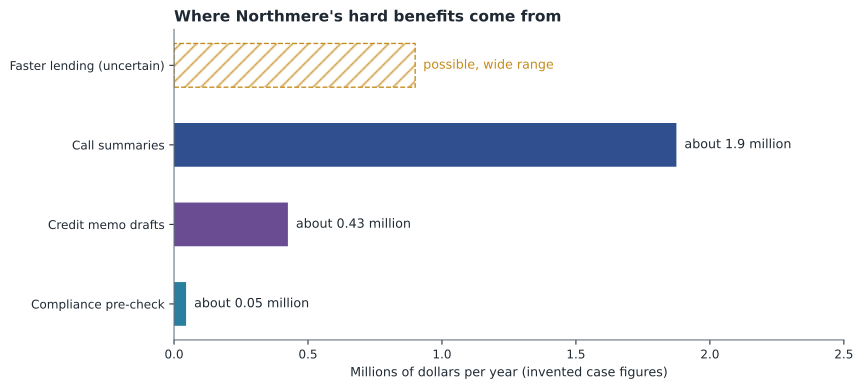
Answer: About 1.9 million dollars a year in hard benefit, through hiring avoided as call volume grows.
Worked problem
Credit memo first drafts
A pilot suggests that AI drafts reduce memo preparation from about 6 hours to about 3.5 hours, including the analyst's review and corrections. There are about 4,000 applications a year at a fully loaded rate of 85 dollars an hour. The bank would redeploy the time to handling more applications without adding analysts as lending grows; finance accepts a capture rate of 50 percent. What is the annual hard benefit from time alone, and what other benefit is possible?
Show solution
- Time saved per memo: 6 minus 3.5 = 2.5 hours.
- Per year: 4,000 x 2.5 = 10,000 hours.
- Captured: 10,000 x 0.5 = 5,000 hours.
- Value: 5,000 x 85 = 425,000 dollars a year.
- Growth benefit: if faster memos cut the time to decision and win more loans, the extra interest income could exceed the time saving, but it must be estimated separately with a wide range and measured with a comparison group.
Answer: About 425,000 dollars a year from time, plus a possible but uncertain growth benefit that should be shown as a separate, wider range.
The compliance pre-check was estimated more simply. Reviewers spend about two hours on each of the 1,200 items a year; a pre-check that catches routine issues before review could save about 30 minutes each, or 600 hours, worth about 45,000 dollars at the compliance team's loaded rate of 75 dollars an hour, assuming the team uses the time to clear its backlog rather than adding staff. The pairs marked this as a hard benefit only because the bank had budgeted a contract reviewer to clear the backlog, a cost the pre-check would avoid.
Task 5: Costs
Using lesson 4, the pairs built a first-year total cost of ownership.
| Cost item | First year (dollars, invented) | Notes |
|---|---|---|
| Microsoft 365 Copilot licences for 600 knowledge workers | 216,000 | 600 x 30 US dollars x 12 months |
| Agent consumption (compliance pre-check, credit memo pilot) | 60,000 | Forecast from pilot credits per task; pay-as-you-go first |
| Document processing in Foundry Tools | 25,000 | Pay-as-you-go, review commitment tier after six months |
| Data readiness: oversharing review, labels, retention | 180,000 | Large, older Microsoft 365 estate |
| Building and testing agents | 150,000 | Partner plus internal time |
| Model risk validation and compliance review | 90,000 | Required before production use |
| Training, champions and communications | 120,000 | Role-based training for 1,900 staff |
| Total | 841,000 |
Lorne noticed that the contact centre agents were not in the licence count. The pairs had assumed that call summaries for the 140 agents could be delivered through the contact centre platform's own AI features or through targeted licences; they added a note to confirm the cost, which could add up to about 50,000 dollars.
Task 6: Risks
The pairs built a risk register using lesson 6. The highest-rated risks were errors in credit memos leading to poor lending decisions, bias in how applicants' information was summarized, exposure of customer data through overshared sites, and regulatory concerns about the use of AI in credit. In Canada, the pairs noted, OSFI's Guideline E-23 on model risk management, which applies to federally regulated financial institutions from May 2027 and covers AI models, would shape how the bank validates and monitors the credit memo solution.
Controls included keeping all credit decisions with analysts, extracting figures with a document model and verifying them by calculation, showing the source page for every figure in the draft memo, testing summaries for differences across groups of applicants, completing the oversharing review before any broad Copilot rollout, and a formal model validation before the credit memo solution went into production. The risk of doing nothing was recorded too: shadow AI among staff and a widening gap with competitors on small-business lending speed.
Task 7: The financial summary
The pairs combined the benefits and costs with a 50 percent ramp-up in year one, because the credit memo pilot and the data work would take most of the first six months.
Worked problem
Year 1 and year 2 for Northmere
Full-year hard benefits: call summaries 1,875,000; credit memos 425,000; compliance pre-check 45,000 dollars. Year 1 costs are 841,000 dollars. Year 2 costs, without one-time items, are about 400,000 dollars. Calculate year 1 and year 2 ROI with a 50 percent ramp-up in year 1.
Show solution
- Full-year benefits: 1,875,000 + 425,000 + 45,000 = 2,345,000 dollars.
- Year 1 benefits at 50 percent: 1,172,500 dollars.
- Year 1 ROI: (1,172,500 minus 841,000) divided by 841,000 = about 0.39, or about 39 percent.
- Year 2 ROI: (2,345,000 minus 400,000) divided by 400,000 = about 4.86, or about 486 percent.
- Conservative check with half the benefits: year 1 benefits 586,250, below cost; year 2 benefits 1,172,500, well above cost. The program still pays back in year 2.
Answer: About 39 percent ROI in year one and much higher in year two in the expected case; even the conservative case pays back in year two. Most of the benefit depends on one assumption: that call growth is absorbed without hiring.
The sensitivity analysis made the key assumption obvious. Call summaries carried four-fifths of the benefit, and their value depended on the bank actually holding contact centre headcount flat as volume grew. The pairs made that a named commitment in the plan, owned by the head of the contact centre and reported monthly.
Task 8: The plan and the business case
Finally, the pairs drafted the plan and the one-page summary using lessons 3 and 11. Phase 1, the first three months: data readiness work, the call summaries pilot with a comparison group, and the compliance pre-check pilot. Phase 2, months four to nine: scale call summaries if the pilot passes, and run the credit memo pilot with model validation. Phase 3, months ten to twelve: scale the credit memo drafts if validation and the pilot both pass, and decide on the after-hours agent. An AI council with the chief operating officer, the chief risk officer, the head of compliance, the chief information officer and the heads of the two main business lines would review progress monthly and decide at each gate.
The pairs' executive summary read, in part: "We propose a 12-month program of three AI use cases at a first-year cost of about 0.84 million dollars, expected to deliver about 1.2 million dollars of hard benefits in year one and about 2.3 million dollars a year thereafter, mainly by absorbing contact centre growth without hiring and by speeding up credit memo preparation. Credit decisions stay with our analysts. The main risks, errors in credit memos and customer data exposure, are controlled by verified figure extraction, analyst review, model validation and a data clean-up before rollout. If the contact centre does not hold headcount flat as volume grows, most of the benefit will not be realized; that commitment is owned by the head of the contact centre."
What the case teaches
When the pairs compared answers, the differences were small and instructive. One pair had counted all saved time at full value and reached an ROI above 1,000 percent; Lorne asked them how the bank would bank it, and the number fell to the range above. Another had proposed automating credit decisions and was persuaded by Wendell that the risk and regulatory barriers made it a poor first move. Every pair had chosen call summaries as the first step.
Celestine closed the series by returning to the three rules from the first workshop: name the outcome, measure before and after, and decide in advance what the business will do with the time it saves. "Everything else," she said, "is arithmetic and honesty."
Common mistakes
MistakeLetting the largest possible benefit, such as automated credit decisions, drive the plan.
InsteadStart with feasible, controllable use cases and capture growth value by speeding up people's work.
MistakeLeaving regulatory validation out of the cost and the timeline.
InsteadInclude model validation and compliance review before production use in regulated industries.
MistakeHiding that most of the benefit depends on one assumption.
InsteadUse sensitivity analysis to find the key assumption and give it a named owner.
MistakeForgetting groups of users when counting licences.
InsteadCheck every group in each use case and how they will access the capability.
Summary and key terms
- The case applies every step: value families, use cases and priorities, build or buy, benefits, costs, risks, financial summary and plan.
- The largest hard benefit came from a simple, bought capability; the largest possible growth benefit was the least certain.
- In a regulated bank, credit decisions stay with people, and model validation is part of the cost and timeline.
- Sensitivity analysis showed that most of the benefit depended on holding contact centre headcount flat, so that became an owned commitment.
- Name the outcome, measure before and after, and decide in advance what will be done with the time saved.
- Credit memo
- A written analysis of a loan application that supports a lender's credit decision.
- Model validation
- An independent review of a model's design, data, performance and controls before and during use.
- Fair lending
- Rules and principles requiring lenders to treat applicants without unlawful discrimination.
- Key assumption
- The assumption on which a business case's result depends most.
- Phased plan
- An implementation plan divided into stages with gates and decisions between them.
Practice problems
Work each problem on paper first, then reveal the answer to check.
Why did the pairs keep credit decisions with analysts?
Show answer
Because automating credit decisions with generative AI raises serious fairness, explainability and model risk concerns; speeding up analysts' preparation captures much of the value more safely.
Which assumption carried most of Northmere's benefit?
Show answer
That contact centre call growth would be absorbed without hiring, so saved after-call time would become avoided cost.
How should the uncertain growth benefit from faster lending be shown?
Show answer
Separately from the hard benefits, as a wider range, measured later with a comparison group.
Lesson quiz · 5 questions
Score 60% or more to complete this lesson.
Create a free account to save your progress, take quizzes and earn a certificate.