
MCAT-101 · Lesson 8 of 12 · 19 min
A diagnostic test
▶ Video coming soon A video version of this lesson is on the way.
On Sunday, September 27, 2026, the three members of the Sunday Session shared their diagnostic results on screen. Each had taken the free, scored AAMC Practice Exam 1 the week before, in one sitting, on a weekend morning, with the real breaks. Devika scored 124 in Chem/Phys, 127 in CARS, 126 in Bio/Biochem and 126 in Psych/Soc, for 503. Elliot scored 128, 122, 128 and 128, for 506. Ezequiel scored 123, 124, 124 and 126, for 497.
Elliot was the first to speak. 'So I am ahead.' Thandiwe smiled. 'You are ahead on the total. That is the least interesting number on this screen. Today we are going to find out why each of you lost every point you lost. That is what a diagnostic is for.'
This lesson explains what a diagnostic test is, when and how to take one, which test to use, and, most importantly, how to analyse the results so they shape your plan. It introduces the error log, a tool you will use for the rest of your preparation.
What a diagnostic is for
A diagnostic test is a full-length practice test taken near the start of preparation, before much study. It has three purposes. First, it gives you a baseline, a starting point against which later progress can be measured. Second, it shows the shape of your strengths and weaknesses across sections, disciplines and question types. Third, it shows you what the test feels like, so the length, the interface and the pace are no longer abstractions.
A diagnostic is not a prediction. Students who score low on a diagnostic often improve a great deal; students who score high sometimes plateau. The score matters much less than the information inside it.
Choosing the test
The AAMC offers two free full-length practice tests: the Unscored Sample Test, which has the same length and format as the real exam but gives no scaled score or percentile, and Practice Exam 1, which gives scaled scores and percentile ranks. Five more scored practice exams, Practice Exams 2 to 6, are available at low cost and are included in fee assistance awards. All of them have 230 questions in the real format.
There is a real trade-off in choosing a diagnostic. Official AAMC exams are the most realistic practice available, and there are only six scored ones. Using one as a diagnostic spends a valuable resource before you can benefit from it fully. On the other hand, an official scaled score from the test maker is a much better baseline than an estimate from another source. Some coaches use the Unscored Sample Test as a diagnostic, scoring it by hand; others use a commercial full-length test and save all the official exams for later.
Thandiwe chose Practice Exam 1 for the group for two reasons. It is free, so it costs nothing to use, and its scaled score gave each member a clear baseline for setting targets. The Unscored Sample Test and Practice Exams 2 to 6 would be saved for the final months, when realism matters most.
Taking it under real conditions
A diagnostic only gives good information if you take it the way you will take the real test. That means one sitting, in the real section order, with the real timing and only the real breaks. It means no notes, no pausing, no phone and no calculator. Start at the same time of day as your test appointment, which on the 2027 calendar is usually 8:00 a.m. Use paper or a whiteboard and a fine marker instead of loose scrap paper if you can, to mimic the noteboard booklet.
It is tempting to take a diagnostic in pieces, one section a day, to avoid the fatigue. Resist it. Fatigue is one of the things you are measuring. Ezequiel's diagnostic showed exactly that: his Psych/Soc score of 126 was his best, but he answered the last two Psych/Soc passages almost entirely wrong. The content was not the problem; he had run out of focus.
Reading the results by section and discipline
Start with the five scores, then go deeper. Most practice platforms, including the AAMC's, let you review every question with explanations and break results down by section, discipline and content category. Look for patterns rather than single misses.
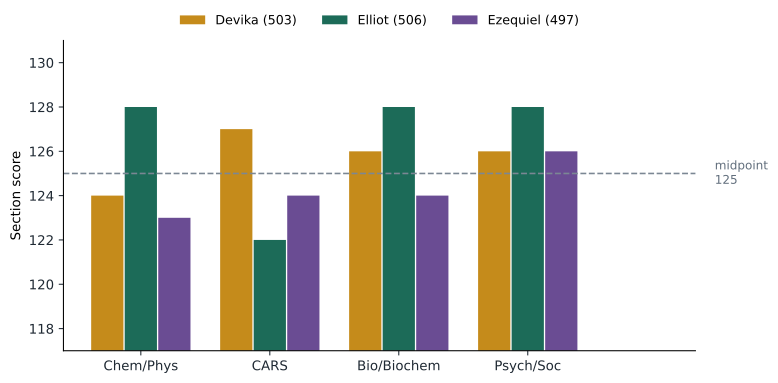
Devika's pattern was clear even at the section level: CARS and the biology-heavy sections were solid, Chem/Phys was weakest. When she looked at Chem/Phys by discipline, almost all her misses were physics and general chemistry calculations. She understood the concepts when she read the explanations; she was simply slow and error-prone with arithmetic under time pressure.
Elliot's science sections were strong, but his CARS score of 122 was far below the rest. His Bio/Biochem misses were scattered, but nearly all involved a figure or table he had skimmed. His CARS misses clustered in questions that asked what the author would most likely believe, the Reasoning Beyond the Text category.
Ezequiel's profile was flatter, but his misses had two strong clusters: organic chemistry topics in both Chem/Phys and Bio/Biochem, and a steep decline in accuracy in the second half of every section after the first.
Why you missed each question
The most important step is classifying every miss by its cause. Thandiwe's error log has five categories, and every wrong answer, and every right answer you guessed, goes into exactly one of them.
| Cause | What it looks like | Typical fix |
|---|---|---|
| Content | You did not know or remember the science needed. | Review the topic from the outline, then do targeted practice questions. |
| Reading | You missed or misread something in the passage, figure or question stem. | Slow down on key details; annotate variables, groups and units; reread the question before answering. |
| Reasoning | You knew the content and read correctly but drew the wrong conclusion or chose a tempting wrong answer. | Study why the right answer is right and why your choice was wrong; practise eliminating answers explicitly. |
| Timing | You rushed, guessed or ran out of time. | Work on pacing checkpoints and on leaving hard questions for later. |
| Careless | You knew the answer but clicked the wrong choice, made an arithmetic slip or misread a negative. | Build a final-check habit; for math, write steps on the noteboard. |
Classifying misses is harder than it sounds. It requires honesty. A student who is weak in a topic may prefer to call a miss careless rather than admit a content gap. A student who misread a graph may tell themselves they would have got it right with more time. Thandiwe asked the group to write one sentence explaining each miss in their own words before choosing a category. If the sentence did not convince her, the category was wrong.
Also review the questions you got right but were unsure about. A correct guess is not knowledge. Mark them in the log too; they are often the easiest points to gain.
Building the error log
An error log is a record of every missed or uncertain question, with enough detail to learn from it. The Sunday Session's template had columns for the date, the source, the section, the topic from the outline, the question type, the cause, a one-sentence explanation of why the right answer is right, a one-sentence explanation of why your answer was wrong, the fix, and a date to re-test that topic.
The log is only useful if you return to it. Each week, sort it by topic and by cause and look for the largest clusters. Those clusters become the week's priorities. Every few weeks, redo a sample of logged questions without looking at your notes. If you still miss them, the fix did not work.
Worked problem
Analysing a diagnostic
Devika missed 21 questions in Chem/Phys. Her error log classifies them as 9 content (mostly physics and general chemistry), 4 reading, 2 reasoning, 3 timing and 3 careless. Six of the 9 content misses and all 3 careless misses involved calculations. What should she prioritize?
Show solution
- Group by cause: content misses are the largest group (9 of 21), and calculation problems run across content and careless misses (9 of 21 in total).
- Look for the shared root: six content misses and three careless misses both involve arithmetic under time pressure.
- Choose fixes: review the physics and general chemistry topics behind the content misses, and add a daily 15-minute mental math drill with scientific notation, logs and unit conversions.
- Set a re-test: in four weeks, redo the 12 calculation questions without notes and take a Chem/Phys section from the Section Bank.
Answer: Her top priority is calculation fluency combined with physics and general chemistry review, because that one root cause accounts for nearly half her Chem/Phys misses.
Turning results into a plan
After classification, three questions shape the study plan. Which sections and topics have the most points available? Which causes of error are most common? And how much time is there before test day?
For Devika, the answers pointed to calculation fluency and Chem/Phys content first, with CARS maintenance and steady biology review. For Elliot, CARS was the clear priority, with a reading habit for figures in the sciences. For Ezequiel, organic chemistry content and full-length stamina were the priorities, with Psych/Soc maintenance. Three diagnostics produced three different plans. Lesson 9 shows how to turn those priorities into a schedule.
Thandiwe ended the review session with one instruction: 'Do not take another full-length test for at least six weeks. You already know what it will say. Spend the time fixing it.'
Reviewing right answers too
Review should not stop at wrong answers. For each passage, check that you can explain why every correct answer you chose is right, using evidence from the passage or a specific principle. If your explanation is vague, mark the question as uncertain. Students who review only misses often carry fragile knowledge into the real test, where a slightly different question exposes it. Reviewing right answers also builds speed, because reasoning that is clear in review becomes quicker under time.
Using the diagnostic to set targets
A diagnostic also helps set realistic targets. Compare your diagnostic profile with the targets from your school table. The size of the gap in each section, combined with the time before your test, suggests how ambitious your plan needs to be. A gap of two or three points in one section, with several months available, is usually closeable with focused work. A gap of eight or more points across several sections may require a longer timeline or a later test date.
Look at which kinds of misses make up the gap. Points lost to reading and timing problems often come back faster than points lost to content gaps, because habits can change in weeks while relearning content takes longer. Points lost to reasoning problems sit in between. Ezequiel's gap of eleven points between his diagnostic of 497 and his target of 508 looked large, but a careful look showed that nearly half his misses were reading errors in tables and timing losses in the second half of each section. With content review in organic chemistry and work on stamina, the target was ambitious but realistic over six months.
Elliot's gap was concentrated in one section. His science sections were already near his targets, so almost all of his six-point goal, from 506 to 512, had to come from CARS. That made his plan simple to describe and hard to carry out: daily CARS practice, careful review, and patience.
Devika's diagnostic was closest to her goals on paper, which carried its own risk. A student who is near target can be tempted to relax. Thandiwe asked her to treat the 124 in Chem/Phys as the most important number on her report, because a single section below threshold could rule out a school regardless of everything else.
Common mistakes
MistakeA diagnostic predicts my final score.
InsteadA diagnostic is a baseline and a map; scores often rise a great deal with preparation.
MistakeI can take the diagnostic one section at a time.
InsteadTake it in one sitting with real timing; fatigue is part of what you are measuring.
MistakeReviewing means reading the explanations for wrong answers.
InsteadClassify every miss and every lucky guess by cause and record a fix in an error log.
MistakeMost of my misses are careless.
InsteadWrite one sentence explaining each miss; many apparent careless errors are content or reading problems.
MistakeMore full-length tests will fix my weaknesses.
InsteadPractice tests measure; targeted review between them is what improves the score.
Summary and key terms
- A diagnostic is a full-length practice test taken early to give a baseline, a map of strengths and weaknesses, and a feel for the test.
- The AAMC offers a free Unscored Sample Test, a free scored Practice Exam 1, and five low-cost scored practice exams.
- Take a diagnostic in one sitting with real timing, order and breaks.
- Classify every miss and uncertain guess as content, reading, reasoning, timing or careless, with a one-sentence explanation.
- An error log turns those classifications into weekly priorities and re-tests.
- Diagnostic test
- A full-length practice test taken near the start of preparation to establish a baseline.
- Baseline
- The starting score and profile against which progress is measured.
- Error log
- A record of missed and uncertain questions with their causes, explanations and fixes.
- Unscored Sample Test
- A free, full-length AAMC practice test that gives no scaled score.
- Practice Exam 1
- The first of six scored AAMC full-length practice exams, available free.
Practice problems
Work each problem on paper first, then reveal the answer to check.
Elliot misses a Bio/Biochem question because he did not notice that the graph's y-axis was logarithmic. Which category is this?
Show answer
Reading. He misread the figure.
Ezequiel gets a question right by guessing between two choices. Should it go in the error log?
Show answer
Yes. Uncertain correct answers are logged too.
Why did Thandiwe choose Practice Exam 1 as the diagnostic?
Show answer
It is free and gives an official scaled score as a clear baseline, while the remaining official exams are saved for later.
How often should you review your error log for patterns?
Show answer
At least weekly, sorting by topic and cause, with periodic re-tests of logged questions.
Lesson quiz · 5 questions
Score 60% or more to complete this lesson.
Create a free account to save your progress, take quizzes and earn a certificate.