
MCAT-101 · Lesson 3 of 12 · 19 min
The content outline: foundational concepts and reasoning skills
▶ Video coming soon A video version of this lesson is on the way.
Before the diagnostic, Thandiwe sent the group one document to download: the AAMC's official content outline, published as "What's on the MCAT Exam?" Devika printed it and was startled by how long it was. Elliot opened it on his phone, scrolled for a minute and closed it. Ezequiel admitted he had never seen it before his first attempt.
'This is the single most useful document in MCAT preparation,' Thandiwe told them at the next session, 'and almost nobody reads it properly. It tells you exactly what can be tested and, just as important, what cannot. Every book and course you will ever buy is somebody's interpretation of this outline. Go to the source.'
This lesson explains how the outline is organized: foundational concepts, content categories, disciplines and the reasoning skills that apply across all of them. It shows how to use the outline as a checklist, and why the reasoning skills deserve as much attention as the content.
How the outline is built
The AAMC organizes the science content of the MCAT around ten foundational concepts. A foundational concept is a big idea in the sciences that underpins medicine, such as the idea that biomolecules have properties that determine how they contribute to the functions of living systems. Each foundational concept is divided into several content categories, and each content category lists specific topics and subtopics. The topics are the level at which you can make a checklist.
The ten foundational concepts are divided among the three science sections. Bio/Biochem draws on foundational concepts 1 to 3, Chem/Phys on concepts 4 and 5, and Psych/Soc on concepts 6 to 10. CARS has no foundational concepts because it has no science content; it is organized by reasoning skills alone.
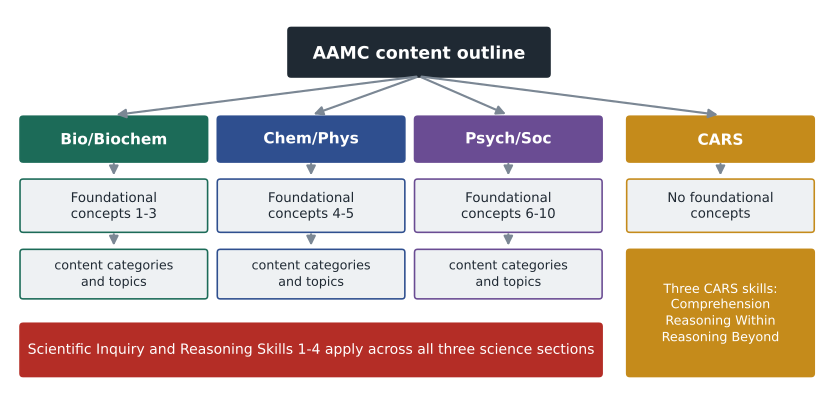
| Section | Foundational concepts | In brief |
|---|---|---|
| Bio/Biochem | 1, 2, 3 | Biomolecules and their functions; cells and organisms; organ systems and how they work together |
| Chem/Phys | 4, 5 | Physical principles in living systems (forces, fluids, energy, electricity, light); chemical principles in living systems (molecules, reactions, solutions, separations) |
| Psych/Soc | 6, 7, 8, 9, 10 | Perception and response to the world; behaviour and behaviour change; self and others; society and culture; social inequality |
The outline also tells you how much each foundational concept counts. For example, in Bio/Biochem, foundational concept 1, about biomolecules, accounts for roughly 55 percent of the section, concept 2, about cells and organisms, about 20 percent, and concept 3, about organ systems, about 25 percent. In Chem/Phys, the chemical principles concept counts somewhat more than the physical principles concept, roughly 60 percent to 40 percent. These weights are approximate and the AAMC presents them as guides, but they help you decide where to spend time.
Disciplines in each section
The outline also breaks each section down by the undergraduate courses the questions draw on. These breakdowns surprise many students, because they show that biochemistry appears in two sections and that biology appears in all three.
| Section | Approximate share by discipline |
|---|---|
| Chem/Phys | General chemistry 30 percent; first-semester biochemistry 25 percent; introductory physics 25 percent; organic chemistry 15 percent; introductory biology 5 percent |
| Bio/Biochem | Introductory biology 65 percent; first-semester biochemistry 25 percent; general chemistry 5 percent; organic chemistry 5 percent |
| Psych/Soc | Introductory psychology 65 percent; introductory sociology 30 percent; introductory biology 5 percent |
| CARS | Humanities 50 percent; social sciences 50 percent |
Two lessons follow from this table. First, biochemistry is about a quarter of two sections, so it is one of the most heavily tested subjects on the whole exam. A student who took biochemistry early in university, or not at all, should treat it as a priority. Second, physics is only one quarter of one section. A student who dreads physics, as Devika did, should still review it carefully, but should not let it consume the schedule at the expense of biochemistry and general chemistry.
Ezequiel did the arithmetic out loud. 'So in 2025 I spent three weeks on physics and two days on biochemistry.' Thandiwe nodded. 'That is the most common mistake I see. Students study what they find hardest or what their books give the most pages, not what the test weights most.'
The Scientific Inquiry and Reasoning Skills
The second half of the outline describes four Scientific Inquiry and Reasoning Skills that apply across the three science sections. Every science question tests some combination of a content topic and one of these skills. The AAMC gives approximate weights for each.
| Skill | What it asks you to do | Approximate share |
|---|---|---|
| Skill 1: Knowledge of scientific concepts and principles | Recognize, recall and apply concepts; identify relationships between closely related concepts | About 35 percent |
| Skill 2: Scientific reasoning and problem-solving | Reason about models, theories and evidence; make predictions; solve problems | About 45 percent |
| Skill 3: Reasoning about the design and execution of research | Identify hypotheses, variables, controls and flaws in studies; reason about ethics in research | About 10 percent |
| Skill 4: Data-based and statistical reasoning | Interpret tables, graphs and figures; reason about statistics, error and conclusions from data | About 10 percent |
Notice that skill 1, the one closest to pure recall, accounts for only about a third of science questions. Skill 2, applying knowledge to reason and solve problems, is the largest. Skills 3 and 4 together, research design and data interpretation, account for about one question in five. A student who studies only content, through flashcards and summaries, is preparing for perhaps a third of the test.
Research methods and statistics appear in all three science sections, not only in Psych/Soc. A Bio/Biochem passage about a drug trial may ask which group served as a control. A Chem/Phys passage may ask which conclusion is supported by a graph with error bars. A Psych/Soc passage may ask whether a study's design allows a causal conclusion. These questions do not require advanced statistics, but they require clear thinking about what evidence can and cannot show.
The CARS skills
CARS is organized around three reasoning skills, again with approximate weights. Foundations of Comprehension, about 30 percent of CARS questions, asks you to understand the basic components of the text: the main idea, the meaning of words and phrases in context, and what the author explicitly says. Reasoning Within the Text, about 30 percent, asks how the parts of a passage fit together: how claims are supported, what an author implies, how one idea relates to another. Reasoning Beyond the Text, about 40 percent, asks you to apply or extend the passage: how the author would respond to a new situation, or how new information would affect the argument.
The largest category, Reasoning Beyond the Text, is the one students find most uncomfortable, because the right answer is not stated anywhere. It must be inferred from the author's reasoning. The common mistake is to choose the answer you personally agree with. The right answer is the one most consistent with the author's position, even when you think the author is wrong.
Worked problem
Turning the outline into a checklist
Devika wants a practical way to track her content review. She has the outline and a spreadsheet. How should she set it up so that it reflects what the test weights?
Show solution
- Make one row per topic from the outline, grouped by foundational concept and content category.
- Add a column for the section(s) where the topic appears, since biochemistry and biology topics appear in more than one section.
- Add a confidence rating from 1 to 3 after first review, and update it after practice questions on that topic.
- Sort by section weight and confidence: high-weight, low-confidence topics first, such as enzyme kinetics and acid-base chemistry for her.
- Add a column for the date she last practised passages on the topic, so content review is linked to application.
Answer: A topic-level spreadsheet built from the outline, ranked by weight and confidence and linked to practice dates, keeps review focused on what the test actually measures.
What the outline excludes
The outline is also useful for what it leaves out. Topics that appear in some textbooks or university courses may not appear in the outline at all. The AAMC presents the outline as a complete description of the content you are expected to know. A passage may still describe something outside it, but then the passage supplies what you need to answer.
This matters because many commercial review books include extra material, either because they cover topics from older versions of the test or because the authors prefer to over-prepare. Thandiwe's rule is simple: if a topic is not in the outline, do not memorize it. Read passages about it if they come up in practice, but do not make flashcards for it.
There is one more caution. Commercial products sometimes describe certain topics as high-yield, meaning tested often. Those claims are guesses based on practice materials and student reports, not AAMC data. The outline's weights are the only official guide to emphasis.
Using the outline across the program
Each content review course in the MCAT Prep program maps its lessons to the outline. As you work through them, use your checklist to mark which topics you have reviewed and how confident you feel. Return to the checklist every few weeks and compare it with your practice results. Topics where you feel confident but keep missing questions are the most valuable to revisit, because they reveal knowledge that is shakier than it feels.
For the Sunday Session, the outline became a shared document. Each member kept a personal copy of Thandiwe's checklist template, and at the start of each session they reported one topic that had moved from a 1 to a 2 or a 2 to a 3. It was a small ritual, but it kept the outline at the centre of their work instead of on a shelf.
Using the outline with practice results
The outline is most powerful when it is joined to your practice data. Each time you review a practice set, tag every missed question with its foundational concept, content category and reasoning skill. After a few weeks, the tags show patterns that a section score cannot. A student might discover that her Bio/Biochem misses are not spread evenly across biology but concentrated in content categories on enzyme kinetics and metabolism, or that many of her misses across all three science sections fall under skill 4, data-based and statistical reasoning.
The two kinds of pattern call for different fixes. A content-category cluster calls for review of that content, followed by practice questions on it. A skill cluster calls for a different kind of practice: for skill 4, deliberate work with graphs, tables and statistics in passages; for skill 3, practice identifying variables, controls and design flaws; for skill 2, explaining aloud how you moved from the passage to the answer. Ezequiel's first tags showed that nearly a third of his science misses involved reading a table or graph, a skill 4 problem hiding inside what he had assumed were content gaps.
Thandiwe also asked the group to read one content category from the outline closely each week, slowly, as if it were a CARS passage. The outline's own descriptions often name the exact relationships the test cares about, such as how structure relates to function, or how a change in one variable affects another. Reading them carefully is a quick way to see what the test makers think matters.
Common mistakes
MistakeThe MCAT tests mainly recall of facts.
InsteadKnowledge of concepts is only about 35 percent of science questions; reasoning, research design and data skills make up the rest.
MistakeBiochemistry appears only in Bio/Biochem.
InsteadFirst-semester biochemistry is about a quarter of both Bio/Biochem and Chem/Phys.
MistakeResearch methods and statistics appear only in Psych/Soc.
InsteadSkills 3 and 4 apply across all three science sections.
MistakeA topic described as high-yield must be heavily tested.
InsteadOnly the AAMC outline gives official weights; high-yield labels are commercial estimates.
MistakeIn Reasoning Beyond the Text questions, choose the answer you agree with.
InsteadChoose the answer most consistent with the author's reasoning.
Summary and key terms
- The AAMC content outline is the official description of what the MCAT can test.
- Science content is organized into ten foundational concepts: 1 to 3 in Bio/Biochem, 4 and 5 in Chem/Phys, and 6 to 10 in Psych/Soc.
- Biochemistry is about a quarter of two sections; physics is about a quarter of one.
- Four Scientific Inquiry and Reasoning Skills apply across the sciences, with skill 2, reasoning and problem-solving, the largest at about 45 percent.
- CARS tests comprehension, reasoning within the text and reasoning beyond the text, with the last at about 40 percent.
- Foundational concept
- One of ten big ideas in the sciences around which the MCAT science content is organized.
- Content category
- A subdivision of a foundational concept that lists specific testable topics.
- Scientific Inquiry and Reasoning Skills
- Four skills (knowledge, reasoning, research design, data and statistics) tested across the science sections.
- Reasoning Beyond the Text
- The CARS skill of applying or extending a passage's ideas to new situations or information.
- Content outline
- The AAMC document "What's on the MCAT Exam?" listing all testable content and skills.
Practice problems
Work each problem on paper first, then reveal the answer to check.
Which foundational concepts does Chem/Phys draw on?
Show answer
Concepts 4 and 5: physical and chemical principles in living systems.
Roughly what share of Bio/Biochem comes from first-semester biochemistry?
Show answer
About 25 percent.
Which Scientific Inquiry and Reasoning Skill has the largest share?
Show answer
Skill 2, scientific reasoning and problem-solving, at about 45 percent.
A passage describes an unfamiliar enzyme not in the outline. Do you need prior knowledge of it?
Show answer
No. The outline describes the content you are expected to know; anything outside it is supplied by the passage.
Lesson quiz · 5 questions
Score 60% or more to complete this lesson.
Create a free account to save your progress, take quizzes and earn a certificate.