
MCAT-101 · Lesson 5 of 12 · 19 min
How medical schools use your score
▶ Video coming soon A video version of this lesson is on the way.
Devika came to the Sunday session in early October with a spreadsheet. Across the top were her four Ontario schools. Down the side were questions: Does it require the MCAT? Which sections count? Is there a minimum? How old can the score be? What happens if I test twice? Half the cells were filled in. The other half said "unclear".
'That spreadsheet is the most important thing you will make this year,' Thandiwe said, 'apart from your error log. Your target score should come from it, not from a forum post or from what your friends are aiming for.'
This lesson explains the main ways medical schools use MCAT scores: as thresholds, as weighted factors in a formula, as part of holistic review, and in combination with other assessments. It covers how schools treat multiple scores and how long scores stay valid, with examples from the United States and from the AFMC guide for 2027 entry to Canadian faculties. School policies change every year, so treat the examples as illustrations and always check the current rules for each school.
Four ways schools use the MCAT
Schools differ in how much weight they put on the MCAT and in how they use it. Most fall into one or more of four patterns.
| Approach | How it works | What it means for your target |
|---|---|---|
| Threshold | Applicants must meet a minimum total or section score; above it, the MCAT is not used to rank applicants. | Clear the threshold with a margin in every section that counts; extra points add little. |
| Weighted factor | The MCAT is converted into points and combined with grades and other measures in a formula. | Every point can matter; the weight tells you how much. |
| Holistic review | The MCAT is read alongside the whole application, often compared with the school's typical range. | Aim at or above the school's typical range; balance across sections helps. |
| Single section | Only one section, such as CARS, is used. | Concentrate extra effort on that section, without neglecting others needed elsewhere. |
Most American MD programs describe holistic review. They do not publish strict cut-offs, but they publish, through the AAMC's MSAR database and their own websites, the median and range of MCAT scores of admitted students. Those figures help an applicant judge where their score sits. An applicant well below a school's range is not automatically rejected, but needs other strengths to stand out; an applicant well above it is not automatically admitted, because other parts of the application still decide most outcomes.
Canadian faculties are more likely to publish explicit thresholds or formulas, partly because many have large applicant pools and limited places reserved for residents of their province. The AFMC guide for 2027 entry illustrates the range.
Examples from Canadian faculties for 2027 entry
| Faculty | How the MCAT is used (2027 entry, from the AFMC guide) |
|---|---|
| Toronto | Required; must be written within five years of the deadline; only the most recent score counts; threshold of 125 in each section, with 124 accepted in one section; not used competitively above that. |
| McMaster | Required; only the CARS score is used, with a minimum of 123. |
| Queen's | Required; must be taken within five years of the application deadline. |
| Western | Required; cut-offs vary from year to year. |
| Alberta | Required; Alberta applicants need at least 124 in all four sections; applicants from outside Alberta need at least 128 in CARS and 124 in the others. |
| Calgary | Required; out-of-province applicants need at least 128 in CARS. |
| Manitoba | Required; must be written between April 2023 and September 13, 2026; weighted at 50 percent of the composite score for the general applicant pools. |
| Memorial | Required; no minimum, but a total of 505 is recommended. |
| Dalhousie | Required; the minimum total varies with GPA on a sliding scale. |
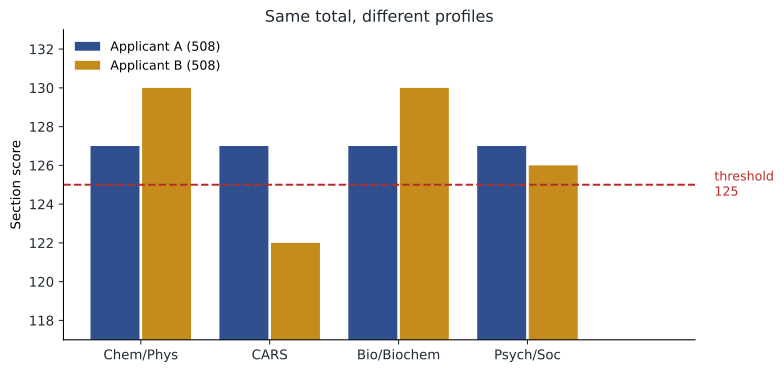
Look at how different these are. A Toronto applicant with sections of 125, 125, 125 and 125, a total of 500, meets the threshold. An out-of-province applicant to Calgary with a total of 515 but a CARS score of 126 does not meet Calgary's CARS minimum. A McMaster applicant's Chem/Phys score does not matter to McMaster at all, though it may matter to other schools on the same list. And Manitoba applicants who wrote the test after September 13, 2026 cannot use that score for 2027 entry; it would count only for a later cycle.
Devika's four schools were Toronto, McMaster, Queen's and Western. Toronto's rule meant no weak sections. McMaster's rule meant CARS mattered more than anything else for that school, and CARS was already her strongest section. Queen's and Western set requirements that change each year, so she would need to check them in summer 2027. Her conclusion was a balanced target: every section at least 127, with CARS as high as she could push it.
Multiple scores
Many applicants take the MCAT more than once. Schools differ in how they treat multiple scores, and the differences are worth knowing before you decide whether to retake.
Some schools consider only the most recent score. Toronto, for 2027 entry, uses only the most recent score. Others consider the highest score, the highest section scores across attempts, an average, or every score in context. Many American schools say they review all scores and look at the pattern: a clear upward trend usually reads well; a series of similar scores with no improvement reads less well; a sharp drop may raise questions.
Regardless of the school's policy, your scores are not hidden. Through AMCAS, every scored attempt from April 2003 onward is included. OMSAS requires applicants to disclose all MCAT scores from tests taken in the previous five years and to release scores again in each application year. A voided exam, discussed in lesson 7, is the only attempt that schools do not see, and it still counts toward your testing limits.
For Ezequiel, the question was concrete. His 2025 score of 499 would be visible to every school. Thandiwe was clear: 'One earlier score with no preparation, followed by a much higher score after a structured year, tells a good story. What you want to avoid is a second score that looks like the first.'
How long scores remain valid
MCAT scores do not expire in the AAMC's records, but schools decide how old a score they will accept. Many American schools accept scores from the previous two or three years; others accept older scores. Several Canadian faculties, including Toronto and Queen's for 2027 entry, require the MCAT to have been written within five years of the application deadline, and Manitoba sets a specific window. Western requires the post-April 2015 version of the test, and Queen's states that old-format scores are not accepted.
Validity windows matter when you plan your test date. A student who tests too early, for example in second year of an undergraduate degree, may find that the score has expired by the time a gap year or graduate degree is finished. A student who tests too late may miss a school's last accepted test date for that cycle. OMSAS, for example, required scores for the 2026 application cycle to be received before October 21, 2026, and recommended releasing them by October 15, 2026, because transfer takes a few business days.
The MCAT among other measures
For most schools, the MCAT is read alongside grades, which show performance over years rather than one day. Many schools also use situational judgment tests and structured interviews to assess professional attributes the MCAT does not measure. In the United States, some schools use the AAMC's PREview professional readiness exam; in Canada, several schools use the Casper situational judgment test or their own interview formats such as multiple mini interviews. Requirements vary, and a student needs to plan for each one, but those assessments are separate from the MCAT and outside the scope of this course.
The practical point is that MCAT preparation competes for time with everything else. A student who pushes the MCAT from 510 to 513 by giving up the clinical volunteering that would make the application compelling may not have gained anything. Thandiwe asked each member to decide in advance how many hours a week the MCAT would get and to protect the other commitments, too.
Worked problem
Setting a target from a school list
Elliot is applying to about twenty American MD programs. His MSAR research shows admitted-student medians between 509 and 517, with most around 512. His diagnostic was 128, 122, 128 and 128 (506). What target should he set, and where should he focus?
Show solution
- Use the school list: with most medians around 512, a total of 512 or higher puts him at or above the middle for most programs.
- Check balance: his CARS score of 122 is well below his other sections and could stand out even with a good total.
- Consider where points are easiest to find: his science sections are already strong; CARS has the most room to rise.
- Set section targets: maintain about 128 in the sciences and raise CARS to at least 126.
Answer: A target of 512 or higher, with CARS at least 126. Most of his improvement will come from CARS, so it should receive daily practice from now until test day.
Building your own school table
Every applicant should build a table like Devika's. List each school, then record whether the MCAT is required, which sections count, any minimums or typical ranges, how multiple scores are treated, the oldest accepted test date and the latest test date whose scores will arrive in time. Use the school's own admissions pages and the current AFMC guide in Canada or the MSAR in the United States as sources, and note the date you checked each entry. Rules change every year, often in spring or summer before the application cycle opens.
Once the table is complete, two numbers emerge: a target total and a minimum for each section. Those targets drive everything else in this course: the test date, the study schedule, the balance between content review and practice, and the decision about whether a retake is worthwhile.
When a retake makes sense
Understanding how schools use scores leads naturally to the question of when a retake is worth it. A retake makes sense when your score falls clearly below the targets in your school table, when you have a specific, credible reason to expect a meaningfully higher score, such as a content gap you have since fixed or a test day disrupted by illness, and when you have time to prepare properly before the score is needed. A retake is harder to justify when your score already meets your schools' thresholds or typical ranges, when your practice scores never rose above your real result, or when the retake would delay your application by a year without a clear gain.
Retakes also interact with school policies. At a school that considers only the most recent score, a lower second score replaces a higher first one. At a school that looks at every attempt, a small gain may not change much, while a decline may raise questions. At a threshold school, a retake matters only if the first score missed the threshold. Ezequiel's case was a strong one for a retake: his 2025 score came without real preparation, his school list included programs with typical ranges well above 499, and he had six months to prepare with a clear plan.
Elliot asked whether he should plan for two attempts from the start, one in January and one in spring. Thandiwe said no. 'Plan to be ready for one. If January goes badly, we will know why, and we will still have time. Planning for a second attempt from the start usually makes the first one less serious.'
Common mistakes
MistakeEvery school uses the total score in the same way.
InsteadSchools use thresholds, formulas, holistic review or single sections, and their rules differ.
MistakeIf I retake, schools will only see my best score.
InsteadAMCAS reports all scored attempts since April 2003; OMSAS requires disclosure of scores from the last five years.
MistakeMCAT scores are valid forever.
InsteadEach school sets its own validity window, often two to five years.
MistakeA high total makes up for a weak section everywhere.
InsteadSchools with section minimums, such as Toronto, Alberta and Calgary, can screen out a weak section regardless of the total.
MistakeLast year's requirements are good enough.
InsteadRequirements change; check each school's current rules and record the date you checked.
Summary and key terms
- Schools use the MCAT as a threshold, a weighted factor, part of holistic review, or by a single section.
- Canadian faculties for 2027 entry show this range: Toronto uses a section threshold, McMaster uses only CARS, Alberta and Calgary set CARS minimums for out-of-province applicants, and Manitoba weights the MCAT heavily.
- Schools treat multiple scores differently, but all scored attempts are visible to schools.
- Validity windows vary, commonly two to five years; plan test dates around them.
- Build a school table with requirements, ranges, validity and deadlines to set a total target and section minimums.
- Threshold
- A minimum score that applicants must meet, above which the MCAT is not used to rank applicants.
- Composite score
- A formula combining MCAT scores with grades and other measures.
- Validity window
- The period during which a school accepts an MCAT score.
- Situational judgment test
- An assessment of professional judgment in realistic scenarios, used alongside the MCAT by some schools.
- Holistic review
- Reading the MCAT alongside the full application rather than as a single cut-off.
Practice problems
Work each problem on paper first, then reveal the answer to check.
An out-of-province applicant to Calgary scores 129, 127, 130 and 129. Does she meet the CARS requirement in the AFMC guide for 2027 entry?
Show answer
No. Calgary requires at least 128 in CARS for out-of-province applicants; her CARS score is 127.
Which score does Toronto use when an applicant has tested twice, according to the 2027 guide?
Show answer
Only the most recent score.
Why might testing in second year of university be risky for some applicants?
Show answer
The score may fall outside a school's validity window by the time the student applies.
Where can US applicants find admitted-student MCAT medians?
Show answer
In the AAMC's MSAR database and on schools' admissions pages.
Lesson quiz · 5 questions
Score 60% or more to complete this lesson.
Create a free account to save your progress, take quizzes and earn a certificate.