
MCAT-101 · Lesson 11 of 12 · 19 min
CARS practice, review methods and wellbeing
▶ Video coming soon A video version of this lesson is on the way.
Two Sundays in November were given to the parts of preparation that students most often neglect. On November 8, 2026, the session was about CARS method. On November 15, it was about review, pacing and taking care of yourself through months of preparation. Thandiwe called them the habits sessions. 'Content can be crammed, badly,' she said. 'Habits cannot. They are what you will rely on when you are tired in the fourth section.'
Elliot came to the CARS session with a confession. He had been doing CARS passages, as instructed, but he timed himself on every one and checked the answers immediately. His accuracy had not moved. Thandiwe asked him to read the next passage aloud, slowly, and to say after each paragraph what the author was doing. He stopped after the second paragraph. 'I have no idea,' he said. 'I was looking for facts.'
This lesson covers a method for CARS, a daily CARS routine, the review methods that turn practice into improvement, pacing, and the wellbeing habits that keep months of preparation sustainable.
Reading CARS passages for the argument
CARS passages are arguments, not encyclopedia entries. The author has a position, makes claims, supports some of them, concedes or rejects others, and often argues against a view held by someone else. CARS questions ask about that structure. A reader who collects facts will struggle; a reader who follows the argument will usually find the answer.
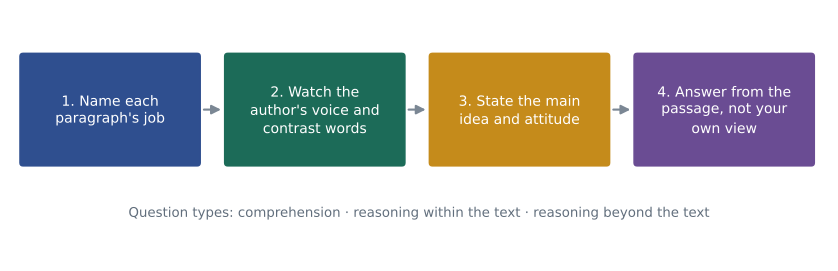
Thandiwe's method has four habits. First, after each paragraph, pause for a second and name its job in a few words: introduces the debate, gives the opposing view, offers an example, states the author's thesis. Second, watch for the author's voice: words that signal judgment, such as unfortunately, rightly, merely, or surprisingly, and contrast words such as however, yet and but. Third, by the end, state the main idea in one sentence and the author's attitude in one or two words. Fourth, answer each question from the passage, not from what you know or believe.
Here is a short passage in the CARS style, written for this course.
Museums have long presented themselves as neutral guardians of the past, places where objects simply speak for themselves. Yet no object speaks without a curator. Every exhibition is an argument: what is placed at the centre and what is left in storage, which label is written in the first person and which in the passive voice, which history begins in the first room and which is relegated to the last. To say this is not to accuse curators of bad faith. It is to ask them, and us, to give up the comforting fiction of neutrality and to judge exhibitions as we judge any other argument: by their evidence, their omissions and their honesty about their own point of view.
A reader collecting facts might note that museums hold objects and that curators write labels. A reader following the argument would notice that the first sentence states a view the author rejects (neutrality), that "Yet" introduces the author's position (every exhibition is an argument), that the examples support it, that the author explicitly denies accusing curators of bad faith, and that the conclusion recommends a new way of judging exhibitions. A Reasoning Beyond the Text question might ask how the author would view a museum that adds a sign explaining why its collection is arranged as it is. The answer most consistent with the passage is approval, because such a sign is honest about the exhibition's point of view.
A daily CARS routine
CARS rewards steady, daily practice more than any other section. Two or three passages a day, done carefully and reviewed properly, produce more improvement than a dozen passages once a week. The Sunday Session's routine had three parts.
First, do one or two passages untimed or loosely timed in the early weeks, focusing on the method, then move to about ten minutes per passage as accuracy rises. Second, review every question, including correct ones, asking where in the passage the answer was supported and why each wrong choice was wrong. Third, read something challenging that is not an MCAT passage for fifteen or twenty minutes a day: an essay, a long-form article, a book review or a chapter from a humanities or social science book. Reading widely makes difficult prose feel familiar.
Elliot rebuilt his CARS practice around this routine. For two weeks he did no timing at all. He wrote a one-line description of each paragraph and the main idea of each passage before answering. His accuracy rose first, then his speed returned. Thandiwe had expected that order. 'Accuracy first, then speed. Never the other way around.'
Reviewing practice so that it changes your score
Review is where improvement happens. Three review methods form the core of the Sunday Session's approach.
The first is blind review. After a timed set, before you check answers, go back to every question you were unsure about and rework it without the timer. Write down your final answer and your reasoning. Then check. Blind review separates two problems: questions you get right with more time are timing or reading problems; questions you still get wrong are content or reasoning problems. The gap between your timed score and your blind-review score tells you how much of your loss is pace and how much is understanding.
The second is wrong-answer analysis. For each wrong answer you chose, write why it was tempting and what made it wrong. Patterns appear quickly. In CARS, wrong answers are often too extreme, out of scope, true but irrelevant, or the opposite of the author's view. In the sciences, wrong answers often reverse a relationship, confuse two similar terms, or answer a different question from the one asked. Knowing the patterns helps you eliminate choices faster.
The third is the error log from lesson 8, which ties individual reviews into weekly priorities. Every reviewed question that reveals a gap goes into the log with a fix and a re-test date.
| Method | When to use it | What it reveals |
|---|---|---|
| Blind review | Immediately after a timed set, before checking answers | How much of your loss is timing versus understanding |
| Wrong-answer analysis | During review of every miss | Which traps and patterns catch you |
| Error log | After each review session, summarized weekly | Which topics and causes need priority, and whether fixes are working |
Pacing checkpoints
Pacing problems rarely come from being slow on every question. They come from spending too long on a few. The cure is checkpoints: specific places in the section where you check the clock and adjust. For CARS, a passage every ten minutes gives checkpoints of three passages at 30 minutes and six at 60 minutes. For a science section, roughly a quarter of the questions done in a quarter of the time is a reasonable guide.
Use the flag feature freely. If a question is taking much longer than average, choose your best answer, flag it and move on. Return at the end if time allows. Since every question counts the same, a hard question is worth no more than an easy one, and the easy ones later in the section should not be sacrificed for it.
Worked problem
Using blind review to diagnose a problem
Ezequiel does a timed 30-question Bio/Biochem set and scores 19. In blind review, he changes six answers and reaches 25 correct. What does this tell him?
Show solution
- Compare scores: blind review added 6 correct answers, from 19 to 25.
- Interpret the gain: six questions he could solve with more time or care were lost under timed conditions, a timing or reading problem.
- Interpret the remainder: five questions were still wrong without time pressure, which points to content or reasoning gaps.
- Plan the fix: work on pacing checkpoints and stamina for the first group; log the remaining five by topic for content review.
Answer: About half his losses are timing and reading under pressure, and half are content or reasoning. He needs both pacing practice and targeted content work, with blind review continuing to measure the balance.
Wellbeing over a long preparation
MCAT preparation usually lasts months and often overlaps with courses, work and applications. Students who treat it as a sprint frequently burn out halfway. Thandiwe spent most of the November 15 session on what she called the boring essentials, because they make the biggest difference.
Sleep comes first. Memory consolidation depends on sleep, and test-day performance depends on a regular schedule. Keep consistent sleep and wake times, especially in the final month, and shift toward your test-day wake time a couple of weeks ahead if you are not a morning person. Physical activity helps attention and mood; even short daily walks count. Regular meals matter on long study days and on test day.
Rest is part of the plan, not a break from it. A weekly rest day and lighter weeks every month or so prevent the slow decline in focus that many students mistake for a lack of ability. Social contact matters, too. Studying in a group, as the Sunday Session did, or simply having a friend who knows your test date, helps keep perspective.
Watch for signs of burnout: persistent exhaustion, dreading every study session, declining practice scores despite more hours, irritability, or losing interest in things you normally enjoy. If those signs appear, the right response is usually to reduce hours for a week or two, not to push harder. If stress or low mood becomes overwhelming or persistent, talk to someone you trust, and consider your school's counselling services or a health professional. Taking care of your health is never a setback in preparation.
Test anxiety is common and manageable. Familiarity reduces it: full-length tests under real conditions make test day feel routine. Simple breathing techniques, such as a few slow breaths before each section, can help. So can a short, fixed routine for the start of each section, which gives your mind something familiar to do. Students whose anxiety significantly affects their performance may wish to discuss it with a health professional, and documented conditions may qualify for accommodations, as lesson 7 explained.
Building a routine for the start of each section
A fixed routine at the start of each section reduces anxiety and sets a good pace. Thandiwe taught the group a three-step version. First, one slow breath, letting the shoulders drop. Second, note the time and set the first checkpoint, such as three CARS passages by 30 minutes. Third, read the first question stem or passage opening with full attention, and only that. The routine takes less than 20 seconds, but it moves attention from worry about the last section to the work in front of you.
Practise the routine at the start of every timed set, not only on full-length tests, so that it becomes automatic. On test day, use it after each break, too. Ezequiel, who had found his 2025 test overwhelming from the start, found the routine more helpful than any single content review. 'It gives me something to do instead of panicking,' he said.
Reviewing CARS without an answer key mindset
CARS review is different from science review. In the sciences, a missed question usually points to a fact or a method. In CARS, a missed question usually points to a reading habit. When you review a CARS miss, go back to the passage and find the exact words that support the correct answer. Then find the words, or the assumption you made, that led you to your choice. Over time you will see your habits: reading too quickly through the author's concessions, bringing in your own opinion, or missing a contrast word that changed the argument.
Keep a separate CARS section in your error log for these habits. Each week, pick one to watch for in your daily passages. Elliot's first habit was answering from his own view; his second was skimming the last paragraph, where authors often state their conclusion most clearly. By the end of November he had a short list of three habits, and his CARS accuracy had risen steadily.
Common mistakes
MistakeCARS cannot be improved with practice.
InsteadDaily practice with careful review and wide reading improves CARS steadily.
MistakeIn CARS, I should read for facts.
InsteadRead for the argument: each paragraph's job, the author's voice and the main idea.
MistakeChecking answers immediately after each question is good review.
InsteadBlind review before checking separates timing problems from understanding problems.
MistakeA hard question deserves extra time because it is worth more.
InsteadEvery question counts equally; flag and move on.
MistakeRest days slow down preparation.
InsteadRest, sleep and lighter weeks sustain focus and prevent burnout.
Summary and key terms
- CARS passages are arguments; name each paragraph's job, watch the author's voice, state the main idea and answer from the passage.
- Practise CARS daily with careful review and read challenging prose outside the MCAT.
- Blind review, wrong-answer analysis and the error log turn practice into improvement.
- Use pacing checkpoints and the flag feature rather than per-question timing.
- Sleep, activity, rest days and support protect performance; respond to burnout by reducing load and seeking help when needed.
- Blind review
- Reworking uncertain questions without the timer before checking answers.
- Wrong-answer analysis
- Explaining why each chosen wrong answer was tempting and what made it wrong.
- Pacing checkpoint
- A planned point in a section to check time and adjust.
- Author's voice
- Words and phrases that reveal the author's attitude or judgment in a passage.
- Burnout
- Exhaustion and declining performance from sustained overwork without adequate rest.
Practice problems
Work each problem on paper first, then reveal the answer to check.
In the museum passage, what view does the author reject?
Show answer
That museums are neutral and that objects speak for themselves.
What does a large gap between timed and blind-review scores suggest?
Show answer
Much of the loss comes from timing or reading under pressure rather than content gaps.
What are the CARS checkpoints at 30 and 60 minutes?
Show answer
About three passages done by 30 minutes and six by 60 minutes.
Name two common types of wrong answer in CARS.
Show answer
Any two of: too extreme, out of scope, true but irrelevant, opposite of the author's view.
Lesson quiz · 5 questions
Score 60% or more to complete this lesson.
Create a free account to save your progress, take quizzes and earn a certificate.