
MCAT-101 · Lesson 1 of 12 · 21 min
What the MCAT measures and who uses it
▶ Video coming soon A video version of this lesson is on the way.
On the second Sunday of September 2026, three people who had never met joined the same video call. Devika Rampersad logged in from the back room of the pharmacy in Mississauga, Ontario, where she works twelve hours a week while finishing a life sciences degree. Elliot Ishikawa was in a study room at his university in Sacramento, California, still wearing the lanyard from his morning shift at a free clinic. Ezequiel Barragan joined from his kitchen in Albuquerque, New Mexico, a stack of organic chemistry notes beside his laptop. He was the only one of the three who had taken the MCAT before.
Their coach, Dr. Thandiwe Tolliver, introduced herself in two sentences. She had taught undergraduate biochemistry labs for six years, then spent the next nine coaching students for the Medical College Admission Test, first in Detroit and now from Windsor, Ontario, across the river. Then she asked a question. 'What do you think this test is for?'
Elliot said it checks whether you remember your science courses. Devika said it is a filter, a way for medical schools to sort thousands of applicants quickly. Ezequiel said, a little ruefully, that it measures how long you can sit still. Thandiwe laughed. 'You are each partly right, and Ezequiel is more right than he thinks. Seven and a half hours in a chair is part of the test. But the main thing it measures is whether you can use science, not just recall it.'
This first lesson explains what the MCAT is, who writes it, what it is designed to measure, which schools use it in the United States and Canada, and what a score can and cannot tell anyone about you. The rest of the course follows the Sunday Session, as the group came to call itself, from their first diagnostic test in September to a short mini diagnostic in November.
A test with a long history and one purpose
The MCAT is a standardized, computer-based, multiple-choice test used in admission to medical school. It is developed and administered by the Association of American Medical Colleges, usually shortened to the AAMC, a not-for-profit association whose members include the accredited medical schools of the United States and Canada, teaching hospitals and academic societies. The AAMC also runs AMCAS, the American Medical College Application Service that most American MD programs use, and sells the official practice materials for the test.
Medical schools have used a version of the MCAT for close to a century; the AAMC describes it as part of the admissions process for more than 90 years. The test has been rewritten several times as medical education changed. The current version dates from April 2015, when the AAMC added a full section on the psychological, social and biological foundations of behaviour and increased the weight of biochemistry. Every score earned since April 2015 sits on the same scale, which is why you will see that date mentioned again when we discuss testing limits and how long schools accept scores.
The AAMC reports that more than 85,000 people take the MCAT each year. It is offered on a limited number of dates from January to September at test centres across the United States and Canada and at selected international locations. You cannot take it at home.
What the test is designed to measure
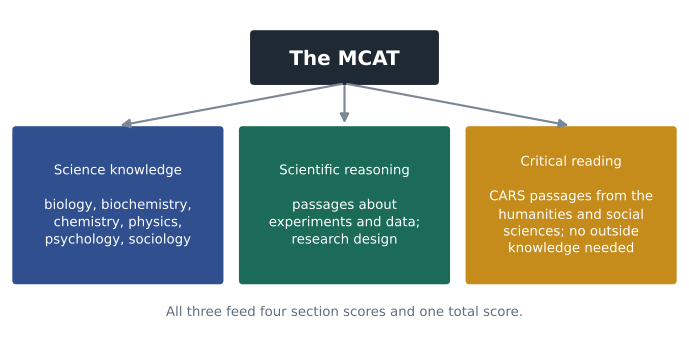
A common misunderstanding is that the MCAT is a giant final exam covering every premedical course. It does draw on those courses: introductory biology, general chemistry, organic chemistry, introductory physics, first-semester biochemistry, and introductory psychology and sociology. But the AAMC designs the questions so that knowing a fact is rarely enough. Most questions sit inside passages that describe an experiment, a clinical observation or a data set you have never seen. You have to read the passage, connect it to the science you know, and reason about what follows.
The AAMC describes this as combining content knowledge with scientific inquiry and reasoning skills. In practice, a question might ask you to predict what happens to an enzyme's reaction rate if the experimenters change the pH, to identify which variable in a study is the control, or to interpret a graph of drug concentration over time. Each of those tasks requires knowledge, but also the ability to read carefully, apply a principle to a new situation, and judge evidence.
One section, Critical Analysis and Reasoning Skills, usually called CARS, contains no science at all. Its passages come from the humanities and social sciences: philosophy, ethics, history, art, literature, cultural studies, economics and similar fields. CARS asks whether you can understand a complex argument, see how its parts fit together, and apply or extend its ideas. No outside knowledge is required, and in fact outside knowledge can get in the way if you answer from what you believe instead of what the passage says.
Thandiwe put it this way to the group. 'A first-year medical student reads research papers, interprets lab values, listens to a patient describe a problem in their own words, and has to reason from all of that to a decision. The MCAT is a rough rehearsal of those skills. It is not a perfect predictor of who will be a good doctor. Nothing is. But it is the one part of your application that every applicant completes under the same conditions.'
Who uses the MCAT in the United States
In the United States, the AAMC states that all medical schools require MCAT scores for regular admission. That covers the MD-granting schools, which mostly use AMCAS, and the Texas public schools, which use their own application service, TMDSAS. Osteopathic (DO) programs, which apply through AACOMAS, also use the MCAT. Some schools offer special pathways, such as early assurance programs for their own undergraduates, that waive the test, but those are exceptions with their own rules, not a general route.
Other health professions programs also accept MCAT scores. The AAMC notes that many health profession schools and graduate programs accept the MCAT in place of other standardized tests; examples include some podiatric medicine, physician assistant and public health programs. If you are considering several health careers, it is worth checking each program's current policy, because the MCAT can sometimes serve more than one application.
When a student applies through AMCAS, the AAMC pulls MCAT scores into the application automatically on the score release date. Under the AAMC's full disclosure policy, every scored MCAT from April 2003 onward is included. Schools therefore see your whole testing history, not just your best score. Lesson 5 explains how schools interpret several scores.
Who uses the MCAT in Canada
Canada is more varied. The Association of Faculties of Medicine of Canada (AFMC) publishes an annual guide to the admission requirements of the country's 19 faculties of medicine. In the guide for 2027 entry, most English-language faculties require the MCAT, but several faculties do not use it at all.
| MCAT required (2027 entry) | MCAT not required (2027 entry) |
|---|---|
| Memorial, Dalhousie, Queen's, Toronto, McMaster, Western | Laval, Sherbrooke, Montréal, McGill |
| Manitoba, Saskatchewan, Alberta, Calgary, UBC | Ottawa, NOSM University, Toronto Metropolitan University |
| Simon Fraser University: requirements not yet published in the guide |
Even among faculties that require it, the way the MCAT is used differs a great deal. McMaster uses only the CARS score. Toronto sets a threshold of 125 in each section (with 124 accepted in one section) and states that it does not use the MCAT competitively above that point. Alberta and Calgary set higher CARS minimums for applicants from outside their province. Manitoba gives the MCAT a heavy weight in its admission formula. Lesson 5 returns to these differences in detail, because they change how a Canadian applicant should set a target score.
The faculties that do not require the MCAT include the French-language faculties in Quebec, McGill, and the University of Ottawa, whose guide entry says plainly that the MCAT is not an admission requirement. McGill goes further for its MD-CM program and states that MCAT scores are not accepted. The Northern Ontario School of Medicine (NOSM University) and the new medical school at Toronto Metropolitan University also do not require it. A student who applies only to those schools does not need to take the test at all.
There is also a practical point for Quebec residents: the AAMC has announced that it will not administer the MCAT in Quebec in 2027, citing Quebec's language law, Bill 96. A Quebec student who needs the MCAT for schools elsewhere must test at a centre in another province or in the United States.
Devika's list was all Ontario schools that require the test: Toronto, McMaster, Queen's and Western, applied to through the Ontario Medical School Application Service (OMSAS). Elliot planned to apply to about twenty American MD programs through AMCAS. Ezequiel planned a mix of MD and DO programs. All three needed a score.
What a score can and cannot tell anyone
The MCAT produces five numbers: a score from 118 to 132 for each of the four sections and a total from 472 to 528. Lesson 4 explains how those numbers are built. For now, the important point is what they mean. A score is a measurement of how you performed on one day, on one form of the test, compared with other examinees. It is a useful measurement, because it was taken under standardized conditions, but it is not a verdict on your intelligence or your potential as a physician.
The AAMC says clearly that the MCAT is only one part of an application. Admissions committees also look at academic records, clinical and research experience, service, letters of reference, personal statements, interviews and, increasingly, situational judgment assessments. Many schools describe a holistic review in which the MCAT is used alongside everything else rather than as a single cut-off. Some schools use it mainly as a threshold, as Toronto does; others weigh it heavily; a few do not use it at all.
A score also has limits as a measurement. Every test has some measurement error, so two people whose scores differ by a point or two may not differ meaningfully in skill. A single practice test score can move several points from one week to the next for reasons unrelated to ability, such as sleep, stress or simply the mix of passages on that form. Throughout this course, we will treat scores as data points in a trend, not as single judgments.
The skills can be learned
The most encouraging fact about the MCAT is that its skills respond to good preparation. Content gaps can be filled. Passage reading becomes faster and more accurate with deliberate practice. CARS, which many students assume is fixed, improves with daily work and careful review. Stamina builds with full-length practice. Ezequiel's 499 in 2025 came after studying alone from outdated books, without a diagnostic, without an error log and without a single full-length practice under test conditions. Thandiwe was not worried about his starting point. She was interested in his process.
'The students who improve the most are not always the ones who study the most hours,' she told the group. 'They are the ones who take a practice test, find out exactly why they lost each point, and fix that. Practice tests measure. Review teaches.'
Worked problem
Reading an admission requirement carefully
Devika reads that one of her schools requires "an MCAT score of 125 in each section, with 124 accepted in one section" and that the score "is not used competitively". Her diagnostic scores are 124, 127, 126 and 126. What does this requirement mean for her planning?
Show solution
- Identify the rule: every section must be at least 125, except that one section may be 124.
- Check her diagnostic: one section (Chem/Phys) is 124 and the other three are above 125, so on paper she already meets the threshold.
- Consider measurement error: a diagnostic is one test on one day. A real score could easily land a point lower in a weak section.
- Consider her other schools: McMaster uses only CARS, but Queen's and Western have their own rules. One school's threshold should not set her whole target.
Answer: Meeting a threshold on a diagnostic is a good sign but not a safe margin. She should aim comfortably above the threshold in every section, especially Chem/Phys, and set her overall target from all four schools' requirements.
How this course fits the MCAT Prep program
This course is the starting point of the MCAT Prep program. It explains the test, the rules around it and how to plan your preparation. The content review courses that follow cover biochemistry, cell and molecular biology, organ systems, general chemistry, physics and math, organic chemistry, and the psychological and social foundations of behaviour. A separate course is devoted to CARS, and the final course brings everything together with full-length practice and test strategy.
You do not need to finish all the content courses before you start practising with passages. In fact, one of the main lessons of this course is that content review and passage practice should run side by side from early on. Lesson 9 shows how to build a schedule that does that.
Common mistakes
MistakeThe MCAT is a memory test of premedical science.
InsteadIt tests whether you can apply science knowledge to unfamiliar passages and data, plus critical reading in CARS.
MistakeEvery medical school in Canada requires the MCAT.
InsteadSeveral Canadian faculties, including Ottawa, McGill, the Quebec French-language faculties, NOSM University and Toronto Metropolitan University, do not require it for 2027 entry.
MistakeSchools only see your best score.
InsteadThrough AMCAS, all scored MCATs from April 2003 onward are reported; Ontario schools require disclosure of all scores from the last five years.
MistakeA high score guarantees admission.
InsteadThe MCAT is one part of a holistic review that also weighs grades, experience, references and interviews.
MistakeYou can take the MCAT at home.
InsteadThe MCAT is given only at test centres on scheduled dates from January to September.
Summary and key terms
- The MCAT is a computer-based, multiple-choice test written and administered by the AAMC and used in medical school admission for more than 90 years.
- It combines content from introductory sciences, biochemistry, psychology and sociology with scientific reasoning and, in CARS, critical reading.
- All US medical schools require it for regular admission; for 2027 entry, most English-language Canadian faculties require it but several do not.
- Schools use the MCAT in different ways: as a threshold, as a weighted factor, or for one section only.
- A score is a measurement on one day with some error, not a verdict on your potential; the skills it measures respond to good preparation.
- AAMC
- The Association of American Medical Colleges, which develops and administers the MCAT.
- AMCAS
- The AAMC's centralized application service used by most US MD programs.
- OMSAS
- The Ontario Medical School Application Service, used to apply to Ontario medical schools.
- AFMC
- The Association of Faculties of Medicine of Canada, which publishes the annual guide to Canadian admission requirements.
- CARS
- Critical Analysis and Reasoning Skills, the MCAT section built on humanities and social science passages.
- Holistic review
- An admissions approach that weighs academic metrics alongside experiences, attributes and other evidence.
Practice problems
Work each problem on paper first, then reveal the answer to check.
Name two kinds of programs other than MD schools that may accept the MCAT.
Show answer
Osteopathic (DO) programs, and some other health professions or graduate programs such as podiatric medicine, physician assistant or public health programs, depending on each school's policy.
A student in Montréal needs the MCAT for schools in Ontario. Where can she take it in 2027?
Show answer
At a test centre outside Quebec, for example in Ottawa or Toronto, because the AAMC will not administer the MCAT in Quebec in 2027.
Why does the April 2015 date matter?
Show answer
It is when the current version of the MCAT began; scores since then share the 472 to 528 scale, and lifetime testing limits count from that date.
Which Canadian faculty uses only the CARS score?
Show answer
McMaster.
Lesson quiz · 5 questions
Score 60% or more to complete this lesson.
Create a free account to save your progress, take quizzes and earn a certificate.