
MCAT-101 · Lesson 12 of 12 · 18 min
Capstone: a mini diagnostic and study plan
▶ Video coming soon A video version of this lesson is on the way.
On Sunday, November 22, 2026, the Sunday Session met for its last session of the planning block. Thandiwe had written a fifteen-question mini diagnostic: one CARS passage with five questions, one science passage with five questions, and five independent questions from across the sciences. The group had 25 minutes, roughly the pace of the real test, and then blind review before any answers were revealed.
'This is not a score,' she reminded them. 'Fifteen questions cannot tell us much about a total. It is a check on your habits. Did you read for the argument? Did you read the figure? Did you pace? Did you review honestly?'
This capstone lesson presents the same mini diagnostic so you can try it yourself, then walks through the answers, the group's debrief, and the study plans each member left with. Take the set under time, do blind review, and only then read the explanations.
Part 1: CARS passage (5 questions)
Passage. The idea of "wasted time" has a short history. For most of human history, work and rest were woven together by seasons, daylight and custom rather than measured against a clock. Only when wages came to be paid by the hour did time become something that could be spent, saved or squandered, and only then did idleness acquire its modern moral weight. Critics of contemporary productivity culture often describe it as a recent invention of the digital economy. That is too generous to the past. The habit of judging hours by their output is older than the telephone, let alone the smartphone.
Still, something has changed. Earlier industrial workers were measured at work; at home, their time was their own, however scarce. Today the tools that measure work follow us everywhere, and many people now apply the logic of productivity to their leisure: tracking steps, logging books read, optimizing sleep. It is tempting to see this as liberation, since we are free to choose our goals. But a goal chosen under constant measurement is not quite freely chosen. The question is not whether we should rest, but whether we can still recognize rest that produces nothing as valuable in itself.
Q1. The author's main purpose is to: (A) show that productivity culture began with smartphones; (B) argue that the moral judgment of time has old roots but has recently extended into leisure; (C) recommend specific ways to rest more efficiently; (D) prove that industrial workers had more leisure than modern workers.
Q2. The author describes the critics' view as "too generous to the past" because the critics: (A) overstate how hard earlier workers worked; (B) assume earlier eras did not judge time by output, when they did; (C) underestimate the benefits of digital tools; (D) ignore the role of seasons in agricultural work.
Q3. The second paragraph mainly serves to: (A) concede a point and then identify what is new; (B) restate the first paragraph's claim with new examples; (C) refute the idea that wages were paid by the hour; (D) describe the history of sleep research.
Q4. Based on the passage, the author would most likely view a person who walks daily only to reach a step target as: (A) fully exercising free choice; (B) illustrating productivity logic applied to leisure; (C) wasting time in the traditional sense; (D) rejecting modern measurement tools.
Q5. Which new information would most weaken the author's claim in the first paragraph? (A) Evidence that hourly wages were common long before the industrial era; (B) Evidence that medieval writers praised idleness; (C) Evidence that the moral condemnation of idleness was widespread in societies with no clocks or wages; (D) Evidence that many people today enjoy tracking their sleep.
Part 2: Science passage (5 questions)
Passage. Researchers studied a digestive enzyme, protease X, purified from a fish that lives in cold water. They measured the initial reaction rate at 10 degrees Celsius across a range of pH values, holding enzyme and substrate concentrations constant. In a second experiment at pH 7.5, they measured the initial rate at different substrate concentrations, with and without compound Q.
| pH | 5.5 | 6.5 | 7.5 | 8.5 | 9.5 |
|---|---|---|---|---|---|
| Relative initial rate | 0.15 | 0.55 | 1.00 | 0.60 | 0.10 |
| Substrate (millimolar) | 0.5 | 1 | 2 | 5 | 20 |
|---|---|---|---|---|---|
| Rate without Q (micromolar per minute) | 20 | 33 | 50 | 71 | 91 |
| Rate with Q (micromolar per minute) | 11 | 20 | 33 | 56 | 83 |
Q6. Based on Experiment 1, the pH optimum of protease X is closest to: (A) 5.5; (B) 6.5; (C) 7.5; (D) 9.5.
Q7. In Experiment 1, which was held constant? (A) pH; (B) initial rate; (C) temperature; (D) relative rate at pH 7.5 only.
Q8. In Experiment 2, compound Q lowers the rate most at low substrate concentration and much less at high concentration. This pattern is most consistent with Q acting as: (A) a competitive inhibitor; (B) an activator; (C) a substrate of the enzyme; (D) an irreversible denaturing agent.
Q9. At very low pH, the rate falls sharply. The best explanation is that low pH: (A) increases substrate concentration; (B) changes the ionization of amino acid side chains needed for structure or catalysis; (C) raises the temperature of the solution; (D) breaks peptide bonds in the enzyme instantly.
Q10. Which additional measurement would best test whether Q binds the active site? (A) Repeat Experiment 1 at 25 degrees Celsius; (B) Measure Vmax with Q at very high substrate concentrations; (C) Measure the pH of compound Q in water; (D) Remove the substrate entirely.
Part 3: Independent questions (5 questions)
Q11. A solution has a hydrogen ion concentration of 1 times 10 to the power negative 4 molar. What is its pH? (A) 0.4; (B) 4; (C) 10; (D) negative 4.
Q12. A cart moves at a constant velocity on a level track. What is the net force on it? (A) Zero; (B) Equal to its weight; (C) Equal to its mass times its velocity; (D) Increasing with time.
Q13. After a rat learns to press a lever for food, food is no longer delivered and pressing gradually decreases. This process is called: (A) generalization; (B) extinction; (C) negative reinforcement; (D) spontaneous recovery.
Q14. A bystander is less likely to help in an emergency when many others are present. This is best explained by: (A) diffusion of responsibility; (B) the fundamental attribution error; (C) cognitive dissonance; (D) social facilitation.
Q15. In which organelle does the citric acid cycle take place in eukaryotic cells? (A) Cytosol; (B) Nucleus; (C) Mitochondrial matrix; (D) Rough endoplasmic reticulum.
Answers and explanations
| Question | Answer | Why |
|---|---|---|
| Q1 | B | The passage argues the habit is old (paragraph 1) and identifies what is new (paragraph 2). A overstates; C and D are not the purpose. |
| Q2 | B | The critics call it a recent invention; the author says judging hours by output is much older. |
| Q3 | A | "Still, something has changed" concedes the old roots and then identifies the new extension into leisure. |
| Q4 | B | Tracking steps is the author's own example of productivity logic in leisure; A contradicts the author's doubt about free choice under measurement. |
| Q5 | C | The author ties the moral weight of idleness to hourly wages; finding it in societies without clocks or wages would undermine that link. |
| Q6 | C | The rate is highest at pH 7.5. |
| Q7 | C | The temperature was held at 10 degrees Celsius; pH was varied and rate was measured. |
| Q8 | A | Inhibition that is overcome at high substrate is the pattern of competitive inhibition. |
| Q9 | B | pH changes protonation of side chains, affecting folding and catalytic residues. |
| Q10 | B | If Vmax is essentially unchanged at very high substrate, the inhibition is consistent with competition at the active site. |
| Q11 | B | pH is the negative logarithm of the hydrogen ion concentration: negative log of 10 to the negative 4 is 4. |
| Q12 | A | Constant velocity means zero acceleration, so the net force is zero by Newton's second law. |
| Q13 | B | Extinction is the decline of a learned response when reinforcement stops. |
| Q14 | A | Diffusion of responsibility explains the bystander effect. |
| Q15 | C | The citric acid cycle occurs in the mitochondrial matrix. |
The group's results
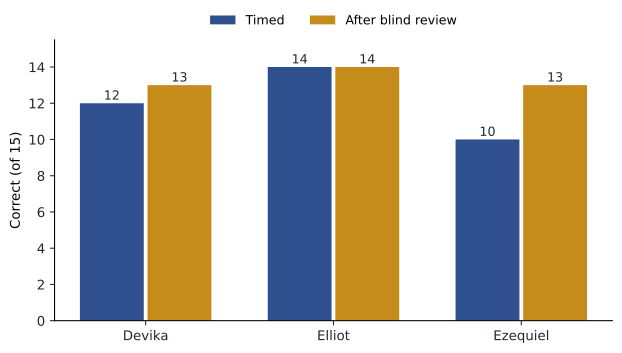
| Member | CARS (of 5) | Science passage (of 5) | Independent (of 5) | Total timed | Total after blind review |
|---|---|---|---|---|---|
| Devika | 5 | 4 | 3 | 12 | 13 |
| Elliot | 4 | 5 | 5 | 14 | 14 |
| Ezequiel | 3 | 3 | 4 | 10 | 13 |
Devika missed Q8, choosing "an irreversible denaturing agent", and two independent questions: Q11 on pH, where she wrote 0.4 after misplacing the logarithm, and Q12 on net force. In blind review she corrected Q11 when she slowed down. Her misses were the same cluster her September diagnostic had shown: calculation and physics fluency, plus one enzyme kinetics concept. Her CARS habits were solid.
Elliot's only miss was Q4 in CARS, where he chose A. Asked why, he said that people are free to choose their step goals. Thandiwe pointed out that the author explicitly doubts that "a goal chosen under constant measurement" is freely chosen. 'You answered from your view, not the author's.' But his CARS accuracy had improved from his diagnostic level, and he had read every table carefully. He noticed, too, that he finished the set with three minutes to spare and did not use them to check his work.
Ezequiel's blind review added three correct answers, the largest gain in the group. Two of the three were in the science passage, where he had misread the second table under time pressure and confused the rows. The third was a CARS question. The pattern matched his diagnostic: understanding was stronger than his timed score suggested; reading under pressure and stamina were the gaps.
From debrief to plan
Thandiwe asked each member to write a plan from now to test day using everything in this course: the target from their school table, the test date and score release date, the phases, the weekly hours, the resources and the review habits. Each plan fit on one page.
| Devika | Elliot | Ezequiel | |
|---|---|---|---|
| Target | Every section 127 or higher; CARS as high as possible | 512 or higher; CARS at least 126 | 508 or higher |
| Test date and score release | Target May 13, 2027 (scores June 15); book after AFMC decision on December 7 | January 21, 2027 (scores February 23) | April 17, 2027 (scores May 18) |
| Weekly hours | 15 in term; 25 after April exams | 25 | 18 |
| Top priorities | Calculation fluency; physics and general chemistry; enzyme kinetics | CARS daily; reading figures; using spare time to check work | Organic chemistry; reading tables under time; stamina |
| Full-length phase | Late March to early May, weekly | Mid-December to mid-January, weekly | Late February to early April, weekly |
| Checkpoints | Mid-March and late April | Mid-December and January 1 | Mid-February and late March |
The plans had something in common. None of them added hours in response to the mini diagnostic. Each changed what the hours were spent on. That, Thandiwe said, was the point of the whole planning block. 'You now know how the test works, how your schools use it, when you are testing, and what is costing you points. From here on, the job is the same every week: practise, review honestly, fix one thing, repeat.'
Your own plan
Use the same template for your own plan. Start with your school table and set a target total and section minimums. Choose a test date with a score release date that fits your application deadlines, and register as early as possible for the best choice of dates. Estimate your protected weekly hours honestly. Divide the time into foundation, application, full-length and taper phases, working backward from test day. Choose a small set of resources, with AAMC Official Prep at the core. Take a diagnostic and build an error log. Practise CARS daily, use blind review and wrong-answer analysis, and set two checkpoint dates to decide whether to continue, adjust or move your test.
Then begin the content review courses in this program, keeping passage practice running alongside them. The later courses cover each section's content in depth, a full course on CARS, and full-length practice and test strategy. The plan you write now will change as you go. What matters is that it exists, that it is based on evidence, and that you revise it on purpose.
Common mistakes
MistakeA fifteen-question set predicts my total score.
InsteadA short set checks habits and patterns; only full-length tests estimate scores.
MistakeAfter a weak practice set, I should add more hours.
InsteadChange what the hours are spent on, guided by the error log.
MistakeIf I finish early, I am done.
InsteadUse spare time to recheck flagged and uncertain questions.
MistakeIn CARS, my own view is a good guide to the author's.
InsteadAnswer from the author's reasoning, even when you disagree.
MistakeA plan should not change once it is written.
InsteadRevise the plan at checkpoints based on evidence from practice.
Summary and key terms
- The capstone mini diagnostic checks habits: reading for the argument, reading figures and tables, pacing and honest review.
- Blind review shows how much of a timed score is lost to time pressure rather than understanding.
- Each member's misses matched their September diagnostic, confirming their priorities.
- A one-page plan combines target, test date, weekly hours, phases, priorities, resources and checkpoints.
- The weekly cycle from here is: practise, review honestly, fix one thing, repeat.
- Mini diagnostic
- A short practice set used to check habits and patterns rather than to estimate a score.
- Competitive inhibitor
- A molecule that competes with substrate for the active site; its effect is overcome at high substrate concentration.
- Debrief
- A structured review of a practice set to identify patterns and decide on changes.
- Study plan
- A written schedule linking target, test date, phases, priorities and checkpoints.
- Checkpoint
- A planned date to compare progress with target and decide whether to adjust.
Practice problems
Work each problem on paper first, then reveal the answer to check.
In the mini diagnostic, why is Q4 answer A wrong?
Show answer
The author doubts that goals chosen under constant measurement are freely chosen, so the author would not see the step-counting walker as fully exercising free choice.
In Experiment 2, why is Q consistent with competitive inhibition?
Show answer
Its effect is largest at low substrate and shrinks at high substrate, so high substrate outcompetes it.
Ezequiel's blind review added three answers. What does that suggest?
Show answer
His understanding is stronger than his timed score; reading under time pressure and stamina are the gaps to work on.
Name four elements every study plan should include.
Show answer
Any four of: target total and section minimums, test date and score release date, weekly hours, phases, priorities, resources and checkpoint dates.
Lesson quiz · 5 questions
Score 60% or more to complete this lesson.
Create a free account to save your progress, take quizzes and earn a certificate.