
MBA-604 · Lesson 9 of 12 · 21 min
Negotiating across cultures and at a distance
For the ninth session, Dr. Fournier invites a guest: Teresa Lam, Cedarline Outdoor's vice-president of sourcing, who is preparing to negotiate a new three-year agreement with the company's largest contract factory, Thien Phuc Garment, near Ho Chi Minh City in Vietnam. Thien Phuc makes about a third of Cedarline's outerwear, including the parka the cohort analysed in MBA-513. Teresa grew up in Toronto, speaks Cantonese and English, and has negotiated with factories in Vietnam, Bangladesh and China for fifteen years. She tells the cohort that the hardest part of her job is not the price per jacket but the gap between what each side thinks it has agreed.
Her example is from her second year in the job. A factory's director had nodded and said yes throughout a long meeting about delivery dates. Teresa returned home believing the dates were agreed. The first shipment was three weeks late. When she asked why, the director explained, with some embarrassment, that he had meant yes, I understand what you are asking, not yes, we can do it; he had assumed she would see from his manner and from the questions his production manager asked that the dates were impossible. Teresa says she learned more from that late shipment than from any training course.
What culture is, and what it is not
Culture is the set of shared values, beliefs, norms and practices that distinguish one group from another. It shapes what people regard as appropriate in a negotiation: how direct to be, how much to rely on relationships, how decisions are made, how time is treated and what a contract means. Culture applies not only to nations but also to regions, industries, professions and organizations; an engineer at a German automaker and an engineer at a Japanese one may have more in common with each other than either has with a marketing manager in his own company.
Dr. Fournier begins with a caution. Cultural frameworks describe average tendencies of large groups. Within any country, individuals vary more than countries vary from one another on most measures. Applying a national profile mechanically to an individual is stereotyping, and it often leads to error: the Vietnamese factory director in front of you may have studied in Australia, worked for a Korean company and have views shaped more by his industry than by his nation. Frameworks are useful as hypotheses about what might be going on, to be tested by observation and questions, not as predictions.
Frameworks for cultural difference
Geert Hofstede's research, based originally on surveys of IBM employees in dozens of countries in the late 1960s and early 1970s, identified dimensions along which national cultures differ, of which four were in his first book in 1980: individualism versus collectivism, power distance, uncertainty avoidance, and what he called masculinity versus femininity, later often described as an emphasis on achievement versus care. Two more, long-term orientation and indulgence, were added later. Individualism and power distance matter most in negotiation. In more collectivist cultures, negotiators tend to represent groups and to weigh relationships and the group's reputation heavily; in cultures with high power distance, decisions are made higher up, and junior negotiators may lack authority to agree.
Edward Hall distinguished high-context from low-context communication. In low-context cultures, meaning is carried mainly by explicit words, and people say what they mean. In high-context cultures, much of the meaning lies in the setting, the relationship, tone, silence and what is not said. The factory director's yes was high-context communication read by a low-context listener. Neither was wrong; they were using different codes.
Jeanne Brett and her colleagues have proposed a framework of dignity, face and honour cultures that predicts negotiation behaviour well. In dignity cultures, common in Western Europe and North America, people's self-worth is seen as inherent, and negotiators tend to share information directly and trust strangers until given reason not to. In face cultures, common in East Asia, self-worth depends on others' respect, hierarchy is important and harmony is valued, so information tends to be exchanged indirectly, through offers and reactions to offers, rather than through direct questions. In honour cultures, found in parts of the Middle East, South Asia and Latin America, self-worth must be defended, trust is extended carefully, and reputation is guarded closely. Brett's research found that negotiators from face and honour cultures often discovered trades by making many offers and reading responses, while dignity-culture negotiators did so by asking questions; both approaches can work, but mixing them without understanding causes confusion.
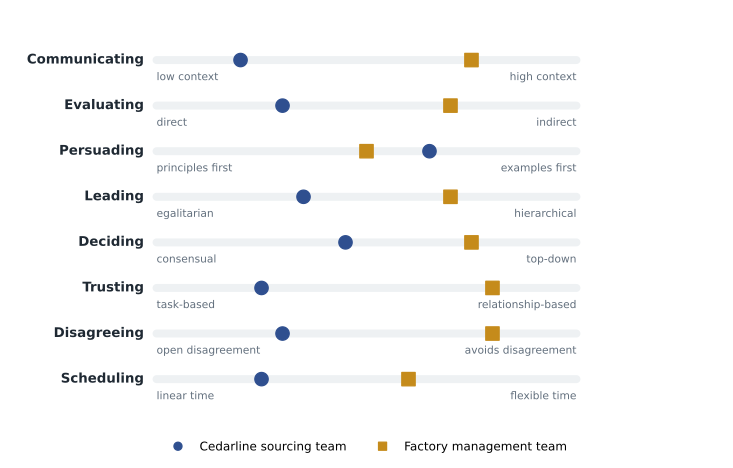
Erin Meyer's culture map, published in 2014, offers eight scales that managers find practical: communicating, from low-context to high-context; evaluating, from direct to indirect negative feedback; persuading, from principles first to applications first; leading, from egalitarian to hierarchical; deciding, from consensual to top-down; trusting, from task-based to relationship-based; disagreeing, from confrontational to avoiding confrontation; and scheduling, from linear time to flexible time. Meyer emphasizes that positions are relative: a negotiator from a culture in the middle of a scale will seem direct to one counterpart and indirect to another.
Trust, relationships and the meaning of a contract
Teresa says that the scale on which the gap matters most in her work is trusting. Cedarline's managers tend to build trust through competence and delivery: a factory that meets its dates earns trust. Many of her counterparts build trust through the relationship first: shared meals, visits, personal knowledge, loyalty over years. For them, a buyer who arrives, negotiates hard and leaves without any personal connection is not trustworthy, whatever the contract says. Teresa spends the first day of every visit on the factory floor and at dinner with the director and his managers, and she never raises price at the first meeting.
Cultures also differ in what a contract means. In North American practice, a contract is usually a detailed, complete document that defines obligations and remedies, and it is expected to be followed as written. In many relationship-based business cultures, a contract is a record of an intention to work together, a framework that the parties will adjust as circumstances change, and an insistence on enforcing every clause when conditions shift can be read as a breach of the relationship. Neither view is naive. Teresa's practice is to write detailed contracts, because Cedarline's systems and lawyers require them, but to discuss openly how the parties will handle changes, such as a sudden rise in fabric prices or a late design change, and to build those mechanisms into the agreement.
Adapting without imitating
How should a negotiator adapt to a counterpart from another culture? Research by Wendi Adair and Jeanne Brett and others suggests that moderate adaptation helps, while attempts to mimic another culture's style fully can seem insincere or even mocking. Some practical advice from Dr. Fournier and Teresa follows. Learn about the other culture's norms for introductions, hierarchy, meals, gifts and the pace of business before the visit. Spend time on the relationship before the substance. Check understanding explicitly but politely, for example by summarizing agreements in writing after each meeting and asking the other side to correct anything wrong. Ask open questions about feasibility rather than questions that invite a yes: what would make this date difficult for your team. Watch for indirect signals, such as long silences, changes of subject or references to needing to consult others, which may mean no. And allow decisions to be made in the other side's way, which may require time for consultation with senior people who are not in the room.
Teresa adds a point about face. Public criticism of a factory's performance in front of its staff, which a Cedarline manager might regard as straightforward feedback, can cause a loss of face that damages the relationship for years. She raises quality problems privately with the director, presents data rather than accusations, and frames improvement as a joint goal. When she needs to say no, she explains the reason and offers an alternative, rather than refusing flatly.
Interpreters and language
When negotiating through an interpreter, negotiators should brief the interpreter in advance on the subject and the technical terms, speak in short segments, avoid idioms and jokes that do not translate, address the counterpart rather than the interpreter, and allow time. They should also be aware that an interpreter employed by the other side has divided loyalties, and that even a professional interpreter may soften blunt statements to avoid giving offence. In Teresa's meetings, Thien Phuc's senior managers speak good English, but technical discussions with the production team use an interpreter whom Cedarline retains, and important terms are confirmed in writing in both languages.
Negotiating at a distance
Much of Teresa's negotiation happens by video and email, across a time difference of twelve hours from Toronto and thirteen from Chicago during the North American winter. Distance creates its own problems: fewer chances for informal conversation, the temptation to deal only with the person on the call, and slow cycles in which a question asked at the end of one side's day is answered at the start of its next. Teresa recommends scheduling calls in the few hours when working days overlap, rotating the inconvenience so that one side does not always join at night, using shared documents for complex terms, and sending a short written summary after each call.
# Find overlapping working hours (08:00 to 18:00 local) across offices, in winter time
offices = {"Toronto": -5, "Chicago": -6, "Ho Chi Minh City": 7, "Dhaka": 6}

def working_hours_utc(offset, start=8, end=18):
    return {(h - offset) % 24 for h in range(start, end)}

def overlap(names, start=8, end=18):
    hours = set(range(24))
    for n in names:
        hours &= working_hours_utc(offices[n], start, end)
    return sorted(hours)

for pair in (("Toronto", "Ho Chi Minh City"), ("Chicago", "Ho Chi Minh City"), ("Toronto", "Dhaka")):
    print(pair, "overlap in UTC hours:", overlap(pair))

# Stretch the North American day: 07:00 to 21:00 on the home side
def stretched(home, away):
    home_h = working_hours_utc(offices[home], 7, 21)
    away_h = working_hours_utc(offices[away], 8, 18)
    common = sorted(home_h & away_h)
    return [((h + offices[home]) % 24, (h + offices[away]) % 24) for h in common]

for home in ("Toronto", "Chicago"):
print(home, "local and Ho Chi Minh City start times:", stretched(home, "Ho Chi Minh City"))('Toronto', 'Ho Chi Minh City') overlap in UTC hours: []
('Chicago', 'Ho Chi Minh City') overlap in UTC hours: []
('Toronto', 'Dhaka') overlap in UTC hours: []
Toronto local and Ho Chi Minh City start times: [(20, 8)]
Chicago local and Ho Chi Minh City start times: [(19, 8), (20, 9)]The calculation shows that normal working days in Toronto or Chicago and Ho Chi Minh City, or Toronto and Dhaka, do not overlap at all in winter. Calls are possible only if one side starts very early or stays late. Even if the North American team stretches its day from 7 in the morning to 9 at night, the common time is tiny: an hour starting at 8 in the evening in Toronto, which is 8 the next morning at the factory, or two hours starting at 7 in the evening in Chicago. Any other call means the factory team staying late into its evening or the North American team joining in the middle of its night. Teresa's team alternates: one week the Cedarline team calls at 8 in the evening, the next the factory team stays until 7 in its evening while the Cedarline team joins at dawn. Small courtesies like this, she says, are noticed and returned.
When cultures meet in teams
Many negotiations involve multicultural teams on one or both sides. Cedarline's sourcing team includes managers born in four countries, and Thien Phuc's management includes Vietnamese, Taiwanese and Korean managers. Such teams can be an advantage, because members can interpret signals from different cultures, but they need to agree on their own norms first: how directly they will disagree in front of the other side, who speaks for the team, and how decisions will be made. Teresa holds a team meeting before every negotiation to agree on these points and a debrief afterwards to compare what each member noticed.
Worked problem
Planning Teresa's first meeting at Thien Phuc
Teresa will negotiate a new three-year agreement with Thien Phuc that changes how Cedarline buys outerwear: a smaller early order placed eight months ahead and a second, later order placed with a nearby partner after early sales, as designed in MBA-513. Thien Phuc's director, Mr. Nguyen Van Hai, has worked with Cedarline for nine years and may see the change as a loss of business and of trust. How should Teresa plan the first meeting?
Show solution
- Spend the first day on the relationship: a factory tour, recognition of Thien Phuc's long record of quality, and dinner with the director and senior managers. Do not raise numbers on the first day.
- Present the strategic context before the terms: explain why Cedarline is changing its supply model, emphasizing that core products, which are most of Thien Phuc's volume, will move to steady replenishment with more predictable orders.
- Ask open questions about Thien Phuc's concerns and constraints, such as capacity planning, fabric commitments and workforce stability, rather than questions that invite a polite yes.
- Be alert to indirect signals: if the director refers to needing to consult his owners or changes the subject, treat it as a concern to explore later in private.
- Summarize in writing, in English and Vietnamese, what was discussed, and invite corrections.
- Leave detailed bargaining for later meetings, after Thien Phuc's team has had time to analyse the proposal internally.
Answer: Teresa's plan respects the relationship-based, high-context style of her counterparts, protects the director's face by avoiding surprises and public disagreement, and gives the factory time to consult internally. The real negotiation, which the cohort will analyse in the capstone, begins with a shared understanding of why the change is happening and what it means for Thien Phuc.
Common mistakes
MistakeA national culture profile tells you how an individual will negotiate.
InsteadFrameworks describe group averages; test them against the person in front of you.
MistakeYes means agreement.
InsteadIn high-context communication, yes may mean I hear you; check understanding with open questions and written summaries.
MistakeAdapt fully to the other culture's style.
InsteadModerate adaptation helps; imitation can seem insincere.
MistakeDistance negotiation is the same as meeting in person.
InsteadFewer informal cues and slow cycles require deliberate rapport, scheduling and written summaries.
Summary and key terms
- Culture shapes communication, trust, decision making, time and the meaning of contracts, at national, regional, industry and organizational levels.
- Hofstede's dimensions, Hall's high and low context, Brett's dignity, face and honour cultures and Meyer's eight scales are useful hypotheses, not predictions about individuals.
- Relationship-based cultures build trust before business; detailed contracts should include mechanisms for handling change.
- Adapt moderately, protect face, check understanding explicitly and allow decisions to be made in the other side's way.
- At a distance, use the overlapping hours fairly, build rapport deliberately and confirm agreements in writing.
- High-context communication
- Communication in which much meaning lies in the setting, relationship and what is unsaid.
- Power distance
- The extent to which less powerful members accept unequal distribution of power.
- Face
- A person’s public self-image, which depends on the respect of others.
- Relationship-based trust
- Trust built through personal connection over time rather than through task performance alone.
- Stereotyping
- Applying a group’s average characteristics to an individual without checking.
- Overlap window
- The hours in which working days in two locations coincide.
Practice problems
Work each problem on paper first, then reveal the answer to check.
Why might a negotiator from a face culture prefer to exchange information through offers rather than direct questions?
Show answer
Direct questions about priorities can be intrusive or threaten harmony; offers and reactions reveal priorities indirectly.
Give two ways to check understanding when the other side may say yes to mean I hear you.
Show answer
Ask open questions about feasibility, and send a written summary inviting corrections.
What is one risk of using an interpreter supplied by the other side?
Show answer
The interpreter's loyalties are divided and may soften or shape what is said.
Why should multicultural teams meet before a negotiation?
Show answer
To agree on how they will disagree, who speaks and how decisions are made.
Lesson quiz · 5 questions
Score 60% or more to complete this lesson.
Create a free account to save your progress, take quizzes and earn a certificate.