
MBA-604 · Lesson 1 of 12 · 24 min
What negotiation is: interests, alternatives and value
The fourth course of the fall term in the second year of the weekend EMBA at the Lakeshore School of Business in Toronto is Negotiation. The cohort has spent a year and a half learning to analyse companies, value them, market to customers, run supply chains, set strategy and design people systems. Dr. Elise Fournier, who teaches this course, tells them on the first Friday evening that almost none of that work turns into results without a negotiation somewhere along the way. A supply chain redesign is a set of new contracts with factories and carriers. A strategy needs budgets agreed with colleagues who want the money for something else. A people strategy is carried out through offers, raises, collective agreements and, now and then, a difficult conversation with someone who is leaving. Dr. Fournier spent ten years as a commercial litigator, eight as head of procurement negotiations for a mining company that bought equipment, fuel and services on four continents, and the last six teaching and mediating commercial disputes.
She begins with an exercise. Each student writes down the last three negotiations they took part in. Most lists start with obvious ones: Daniel Osei's plant agreement at Northfield Components, which he helped prepare in MBA-601 and which was settled in October; Grace Mwangi's annual terms with a large packaged-food supplier at Fairway Grocers; Leo Brandt's contract talks with a national retailer that wants to license Kestrel Analytics' forecasting software. But the lists soon fill with other entries: a disagreement with a spouse about whose parents to visit at Thanksgiving, a talk with a teenager about curfew, a request to a manager for a project, a call to a cable company. Dr. Fournier's point is that negotiation is not a special event. It is the ordinary way people who depend on each other reach decisions when they want different things and neither can simply impose an answer.
A working definition
Negotiation is a process in which two or more parties who are interdependent, and whose interests are at least partly in conflict, try to reach an agreement that each prefers to what it could get without one. Each element of the definition matters. The parties are interdependent: each needs something the other controls. Their interests conflict at least in part, or there would be nothing to negotiate. And each has an alternative, even if it is a bad one, so agreement is voluntary. A negotiator who forgets the alternative tends to accept bad deals out of a feeling that some deal is required; a negotiator who forgets the interdependence tends to make demands as if the other side had no choices of its own.
Dr. Fournier introduces four building blocks that will organize the whole course. Interests are what each party actually cares about: needs, concerns, fears and hopes. Positions are what parties say they want: a price, a date, a demand. Alternatives are what each party will do if no agreement is reached; the best of them is the best alternative to a negotiated agreement, or BATNA, a term made popular by Roger Fisher and William Ury of the Harvard Negotiation Project in their 1981 book Getting to Yes. Options are the possible agreements the parties could reach, which are usually far more numerous than the first proposals on the table. A fifth element, legitimacy, refers to the standards and criteria, such as market prices, precedent or expert opinion, that parties use to argue that a proposal is fair.
Positions and interests
The classic illustration is two people quarrelling over an orange. Each insists on having it; they cut it in half. One then squeezes her half for juice and throws away the peel, while the other grates his peel for a cake and throws away the fruit. Had they asked why each wanted the orange, both could have had everything they needed. The story is simple, but the pattern recurs in serious negotiations. Positions are often incompatible while the interests underneath them are not.
Grace offers a real example. Last spring her supplier of breakfast cereals demanded a two per cent price increase, citing grain and freight costs. Fairway's position was no increase, because its own customers were sensitive to cereal prices. Talks stalled for three weeks. When Grace finally asked what was driving the request, she learned that the supplier's real problem was the cost of small, frequent deliveries to Fairway's stores. Fairway's real concern was the shelf price customers saw. The parties agreed that the supplier would deliver full truckloads to Fairway's warehouse every week rather than delivering to stores twice a week, which saved the supplier more than the price increase would have brought, and the shelf price did not move. Neither side's opening position had mentioned delivery at all.
Asking about interests is not soft. It is a way of finding where value lies. The questions are simple: why do you want that, what would that do for you, what worries you about our proposal, and what would have to be true for you to say yes. Dr. Fournier warns that people often do not know their own interests until they are asked, and that interests come in layers: substantive interests in money or terms, process interests in being heard and treated fairly, and relationship interests in how the parties will work together afterwards. A deal that meets substantive interests while trampling on process interests is often rejected, or honoured only grudgingly.
Alternatives and the bargaining zone
Every negotiator should know, before talks begin, what she will do if there is no agreement. Fisher and Ury's advice was to measure any proposal against the BATNA rather than against an arbitrary bottom line, because a bottom line fixed in advance can be either too low, leading to a bad deal, or too high, causing a negotiator to walk away from a good one. The BATNA determines the reservation price or reservation value: the least favourable deal a party would accept. For a seller it is the lowest price she will take; for a buyer it is the highest price he will pay. Anything worse than the reservation value is worse than walking away.
When the buyer's reservation price is above the seller's, there is a zone of possible agreement, or ZOPA, sometimes called the bargaining zone. Any price within the zone leaves both sides better off than their alternatives. If the seller's reservation price is above the buyer's, there is no zone, and the right outcome is no deal, however skilled the negotiators. Much of the craft of negotiation lies in estimating where the other side's reservation price lies, while protecting information about one's own.
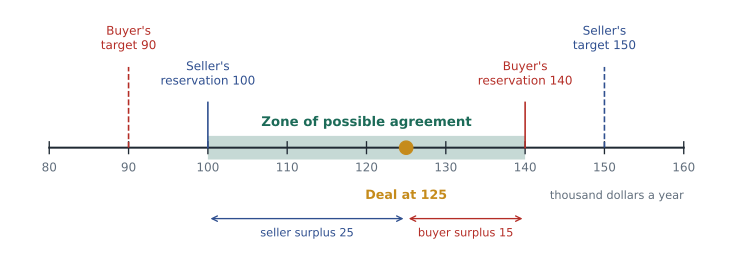
Leo's licence negotiation illustrates the idea. Kestrel's software would cost the retailer about 140 thousand dollars a year before the retailer's managers would rather build a simpler tool in-house; that is the buyer's reservation price, although Leo does not know the exact figure. Kestrel's costs of serving the client, plus the value of the reference account, mean Leo would rather walk away than accept less than about 100 thousand. The zone runs from 100 to 140 thousand. A deal at 125 thousand gives Kestrel a surplus of 25 thousand over its reservation price and the retailer a surplus of 15 thousand under its own. The total surplus, 40 thousand, is fixed by the two reservation prices; the price only decides how it is shared.
# Zone of possible agreement for Kestrel's annual fee (thousands of dollars)
seller_reservation = 100   # Kestrel would rather walk away below this
buyer_reservation = 140    # the retailer would rather build in-house above this

def zopa(seller_rv, buyer_rv):
    if buyer_rv < seller_rv:
        return None
    return seller_rv, buyer_rv

zone = zopa(seller_reservation, buyer_reservation)
print("zone of possible agreement:", zone, "size", zone[1] - zone[0])

for price in (95, 110, 125, 140, 145):
    seller_surplus = price - seller_reservation
    buyer_surplus = buyer_reservation - price
    ok = seller_surplus >= 0 and buyer_surplus >= 0
    print(f"price {price:4d}: seller surplus {seller_surplus:4d}, buyer surplus {buyer_surplus:4d}, deal beats both alternatives: {ok}")

# If the buyer's alternative improved (a cheaper rival at 95), there would be no zone
print("after a cheaper rival appears:", zopa(seller_reservation, 95))zone of possible agreement: (100, 140) size 40 price 95: seller surplus -5, buyer surplus 45, deal beats both alternatives: False price 110: seller surplus 10, buyer surplus 30, deal beats both alternatives: True price 125: seller surplus 25, buyer surplus 15, deal beats both alternatives: True price 140: seller surplus 40, buyer surplus 0, deal beats both alternatives: True price 145: seller surplus 45, buyer surplus -5, deal beats both alternatives: False after a cheaper rival appears: None
The output makes the arithmetic of the bargaining zone explicit. Prices of 95 and 145 lie outside it: one leaves Kestrel worse off than walking away, the other leaves the retailer worse off than building its own tool. Within the zone, every dollar Leo gains is a dollar the retailer loses. The last line shows why alternatives matter so much. If a rival offered comparable software for 95 thousand, the retailer's reservation price would fall below Kestrel's and no agreement would make sense, unless Leo could show that Kestrel's product is worth more than the rival's or reduce his own costs.
Claiming value and creating value
So far the negotiation has been about one issue, price, and the parties' gains are directly opposed. Negotiations of this kind are called distributive: the parties divide a fixed amount, and the main questions are who moves first, how far each concedes and who holds out longer. Haggling over a used car or the price of a commodity are typical cases. Lesson 3 studies the tactics of distributive bargaining in detail.
Most business negotiations involve more than one issue, and the parties value the issues differently. When that is true, they can trade: each concedes on what matters less to it in return for what matters more. Such negotiations are called integrative, and they create value, enlarging the total surplus rather than merely dividing it. In Leo's case the retailer may care most about a fast rollout before the holiday season, while Kestrel cares most about a three-year term that makes its revenue predictable for investors. A deal with a slightly higher price, a three-year term and a dedicated implementation team may leave both better off than a lower price with a one-year term. Lesson 4 develops the tools for finding such trades.
In practice nearly every negotiation is mixed-motive: the parties must both create value and claim it. This produces what David Lax and James Sebenius of Harvard called the negotiator's dilemma. Creating value requires sharing information about priorities, which exposes a party to being exploited; claiming value requires withholding information and making firm demands, which blocks the discovery of trades. A negotiator who only claims tends to leave joint gains undiscovered. A negotiator who only shares may create a larger pie and then watch the other side take most of it. Skilled negotiators manage the tension: they share information about priorities gradually and reciprocally, propose packages rather than single-issue concessions, and keep their reservation values to themselves.
Three ways to settle differences
Dr. Fournier adds a perspective drawn from the dispute resolution research of William Ury, Jeanne Brett and Stephen Goldberg. When people disagree, they can resolve their differences in three broad ways. They can reconcile their interests, which is what negotiation and mediation try to do. They can determine who is right according to some standard, such as a contract, a law or a precedent, which is what courts and arbitrators do. Or they can determine who is more powerful, through strikes, lawsuits used as threats, walking away from a supplier, or a vote. Interest-based approaches are usually cheaper and produce more durable outcomes, but rights and power remain in the background of every negotiation: they shape the parties' alternatives. Lesson 11 returns to this framework when the cohort studies disputes.
How negotiations unfold
Negotiations tend to move through recognizable phases. In preparation, each side clarifies its interests, alternatives, targets and information needs. In the opening, parties establish the relationship, agree on a process and exchange initial proposals. In the middle phase, they explore interests, trade information, generate options and make concessions. In the closing, they settle remaining issues, test the agreement against their alternatives and write it down. Implementation follows, and it is often where the real negotiation turns out to have been decided: vague clauses become arguments, and relationships built during the talks carry the parties through surprises. Lesson 2 is devoted to preparation because, in Dr. Fournier's experience, most negotiations are won or lost before the parties meet.
| Element | Question to ask | Northfield example |
|---|---|---|
| Interests | Why does each side want what it asks for? | The automaker wants lower cost per vehicle; Northfield wants stable volume and margin. |
| Alternatives | What will each side do if no deal is reached? | The automaker can re-source the bracket; Northfield can sell the capacity to equipment makers. |
| Options | What agreements could meet both sides’ interests? | Price reductions tied to design changes that lower Northfield’s cost. |
| Legitimacy | What standards could justify a proposal? | Steel price indexes, published cost models and past agreements. |
| Relationship | How should the parties work together afterwards? | A joint cost-reduction team that meets quarterly. |
Negotiation as a management skill
Is negotiation a talent or a skill that can be taught? The research is encouraging. Experimental studies by Leigh Thompson and others show that people who receive training and, especially, who compare several cases that share an underlying principle, transfer the principle to new situations far better than those who simply experience negotiations. Experience alone teaches less than people think, because negotiators rarely learn how much they left on the table. A person who sells a house for the asking price on the first day may conclude that she negotiated well, when in fact she priced the house too low. Feedback in negotiation is noisy and delayed, which is why this course combines frameworks, cases and role plays with structured debriefs.
Dr. Fournier describes how the course will work. Each Friday evening she will introduce the ideas of the lesson. Each Saturday morning the cohort will negotiate a role play in pairs or small groups, with confidential instructions that only one side sees, and then compare outcomes across groups. The comparison matters most. When six pairs negotiate the same case, the range of results shows what was possible, and the debrief shows which behaviours produced the better outcomes. The cases come from the cohort's own work: Northfield's price talks with an automaker, Fairway's supplier terms, Kestrel's licence deal, Lakeview Health's contract with a physician group, Prairie Ridge Energy's wind project with landowners and a nearby community, and, for the capstone, Cedarline Outdoor's new agreements with its main contract factory and with the workers at its distribution warehouse.
Worked problem
Diagnosing Grace's supplier negotiation
Fairway's supplier of private-label jams proposes a 6 per cent price increase at the annual review. Grace's category plan assumes no increase. The supplier says its fruit and glass costs have risen; Fairway could switch to another producer, but the alternative would need new labels, a quality audit and four months of lead time. Identify the positions, possible interests, alternatives and options.
Show solution
- Positions: the supplier asks for 6 per cent; Fairway wants no increase.
- Possible interests of the supplier: recover input costs, keep a large account, fill its production lines in slow months, avoid costly small runs.
- Possible interests of Fairway: protect shelf prices and margin, keep supply secure, maintain quality, reduce administrative work.
- Alternatives: the supplier can sell its capacity to other retailers, perhaps at lower volume; Fairway can switch producers at a cost of time and money, or carry a national brand at a lower margin.
- Options: a smaller increase tied to a fruit price index; longer production runs or larger orders in exchange for a lower price; a change in jar size or packaging that lowers glass costs; a two-year agreement with an index clause instead of an annual fight.
- Legitimacy: published fruit and glass price indexes, the supplier's share of those costs, and increases agreed by other private-label producers.
Answer: The negotiation is not simply a contest over 6 per cent versus zero. Both sides have alternatives that are costly, so a bargaining zone probably exists, and several issues besides price, such as run length, packaging and contract length, can be traded. Grace's preparation should focus on learning the supplier's cost structure and capacity situation, estimating the true cost of switching, and designing a package rather than simply resisting the increase.
Common mistakes
MistakeNegotiation is about winning.
InsteadIt is about reaching an agreement better than each side's alternative; the best deals often leave both parties much better off.
MistakeAny deal is better than no deal.
InsteadA deal worse than your BATNA should be rejected; sometimes no zone of possible agreement exists.
MistakePositions reveal what people need.
InsteadPositions are proposals; interests underneath them are what must be satisfied, and they are often compatible.
MistakeExperience alone makes good negotiators.
InsteadFeedback is noisy; frameworks, comparison of cases and structured debriefs build skill faster.
Summary and key terms
- Negotiation is a process for reaching agreement between interdependent parties whose interests partly conflict, each of which has an alternative to agreement.
- Interests, alternatives, options and legitimacy are the building blocks of any negotiation, along with the relationship between the parties.
- The BATNA sets each side's reservation value; a zone of possible agreement exists only when the reservation values overlap.
- Distributive negotiation divides a fixed surplus; integrative negotiation creates value by trading across issues the parties value differently.
- Most negotiations are mixed-motive and create the negotiator's dilemma between sharing information to create value and withholding it to claim value.
- BATNA
- Best alternative to a negotiated agreement: what a party will do if no deal is reached.
- Reservation value
- The least favourable terms a party will accept, set by its BATNA.
- ZOPA
- Zone of possible agreement: the range of outcomes better than both parties’ reservation values.
- Interests
- The needs, concerns and goals that lie behind a party’s positions.
- Distributive negotiation
- Negotiation over a fixed amount, where one side’s gain is the other’s loss.
- Integrative negotiation
- Negotiation that creates value by trading across issues of different importance to each side.
- Negotiator’s dilemma
- The tension between sharing information to create value and withholding it to claim value.
Practice problems
Work each problem on paper first, then reveal the answer to check.
A seller's reservation price is 42,000 and a buyer's is 47,500. What is the size of the zone of possible agreement, and how much surplus does each side get at a price of 45,000?
Show answer
The zone is 5,500 wide. At 45,000 the seller gains 3,000 over her reservation price and the buyer gains 2,500 under his.
Give one difference between a position and an interest, using an example from your own work.
Show answer
A position is a stated demand such as 'we need delivery by Friday'; the interest may be having stock for a weekend promotion, which could also be met by a partial delivery.
Why might a negotiator who gets everything she asked for still have negotiated badly?
Show answer
She may have asked for too little, or missed trades that would have created more value for both sides.
Explain the negotiator's dilemma in two sentences.
Show answer
Revealing priorities helps find trades that create value but exposes you to being exploited. Hiding them protects you but may leave joint gains undiscovered.
Lesson quiz · 5 questions
Score 60% or more to complete this lesson.
Create a free account to save your progress, take quizzes and earn a certificate.