
MBA-604 · Lesson 11 of 12 · 21 min
Disputes, mediation and difficult conversations
Daniel brings an unwelcome case to the eleventh session. In August, a batch of Northfield's battery tray brackets cracked during assembly at the automaker's plant, stopping its line for four hours. The automaker has charged Northfield 420 thousand dollars for the stoppage, the sorting of suspect parts and the extra inspection that followed, deducting the amount from its next payment. Northfield's own investigation traced the cracks to a coil of steel that did not meet the specified ductility, supplied by a steel service centre that Northfield buys from under a one-year contract. The automaker says the steel is Northfield's problem. The steel supplier says its test certificates were in order and that Northfield's forming process was too aggressive. Daniel's plant manager is furious and wants to fight on both fronts.
Dr. Fournier uses the case to move from deal making, the subject of the course so far, to dispute resolution. A dispute arises when a claim made by one party is rejected by another. Disputes are negotiations too, but they come with history, grievance and, often, legal rights. The skills of earlier lessons still apply, but the choices are wider: the parties can negotiate directly, use a mediator, ask an expert for an opinion, go to arbitration or go to court.
Interests, rights and power
William Ury, Jeanne Brett and Stephen Goldberg's 1988 book Getting Disputes Resolved, introduced in Lesson 1, offers a framework. Disputes can be resolved by reconciling interests, by determining who is right, or by determining who is more powerful. Interest-based approaches, such as negotiation and mediation, tend to be cheapest, to produce the most satisfying outcomes, to preserve relationships and to reduce the chance that the dispute recurs. Rights-based approaches, such as arbitration and litigation, are more costly and adversarial but are sometimes needed to settle a question of principle or to resolve a dispute that interests cannot reconcile. Power-based approaches, such as strikes, withheld payments or threats to end a relationship, are the most costly and destructive, although the possibility of using power shapes every negotiation.
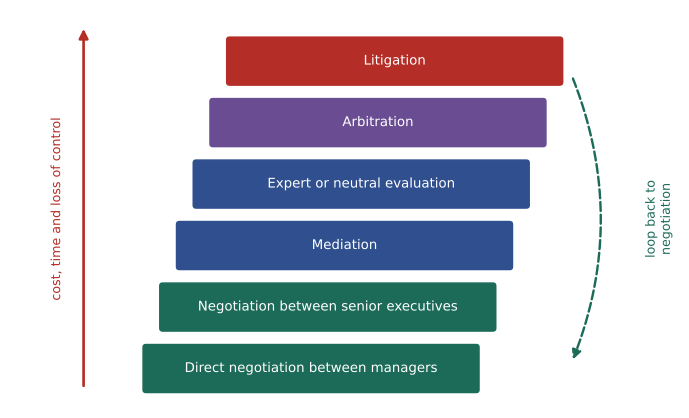
The authors argue that a healthy dispute resolution system resolves most disputes through interests, a few through rights and very few through power, and that organizations can design their systems to encourage this pattern. Their principles of dispute system design include putting the focus on interests, building in loop-backs to negotiation from rights and power procedures, providing low-cost rights and power backups, building in consultation before a dispute and feedback after it, and arranging procedures in a sequence from low cost to high cost. Collective agreements with grievance steps ending in arbitration, and commercial contracts that require negotiation between executives, then mediation, then arbitration, apply these principles.
Mediation
Mediation is negotiation assisted by a neutral third party who has no power to impose a decision. The mediator helps the parties communicate, identify interests, generate options and reach their own agreement. Mediators can do things the parties cannot do alone: they can meet with each side privately, in what is called a caucus, and learn about interests and reservation values that neither side would reveal to the other; they can deliver proposals without triggering the reactive devaluation described in Lesson 5; they can reality-test each side's expectations about what would happen in court; and they can manage emotion and process. Studies of commercial and court-connected mediation generally report settlement rates of well over half of cases, along with high party satisfaction.
Mediators differ in style. Facilitative mediators focus on process and communication, helping the parties reach their own solutions without offering views on the merits. Evaluative mediators, often retired judges or senior lawyers, assess the strengths and weaknesses of each side's case and may suggest a settlement range. Transformative mediators focus on improving the parties' relationship and their capacity to handle conflict. Many experienced mediators move between styles as a case requires. Dr. Fournier, who mediates commercial disputes, says the evaluative moment usually comes late, after the parties feel heard, when they are ready to consider what a court might do.
In Canada, mediation is widely used and in some places required. Ontario's rules of civil procedure have long made mediation mandatory early in many civil actions in Toronto, Ottawa and Windsor, and the province is now in the middle of a broad overhaul of those rules; Quebec's Code of Civil Procedure, revised in 2016, requires parties to consider private methods of preventing and resolving disputes before going to court. Labour relations make heavy use of mediation and conciliation, including by the federal mediation service in federally regulated industries.
Arbitration
Arbitration is a private, rights-based process in which a neutral arbitrator or panel hears evidence and arguments and issues a binding decision, called an award. Compared with litigation, it can be faster, more private, less formal and decided by experts in the field, and awards are usually final, with very limited grounds for appeal. It can also be expensive, particularly in large international cases, and the limited appeal rights cut both ways. Arbitration is common in construction, international trade, commercial supply contracts and, in the form of grievance arbitration, in unionized workplaces, where it is the usual way to resolve disputes about the interpretation of a collective agreement.
In Canada, commercial arbitration is governed by provincial arbitration statutes, such as Ontario's Arbitration Act of 1991, and by international commercial arbitration acts based on the model law of the United Nations Commission on International Trade Law. Canadian courts generally enforce arbitration clauses and awards, and Canada is a party to the 1958 New York Convention, which allows arbitral awards to be enforced in more than 170 countries.
Variations combine processes. In final-offer arbitration, sometimes called baseball arbitration because it is used in major league salary disputes, each side submits a final offer and the arbitrator must choose one or the other, with no compromise. The format encourages both sides to make reasonable offers, because an extreme offer is likely to lose, and it often leads to settlement before the hearing. In med-arb, a neutral first mediates and, if mediation fails, arbitrates; the parties save time but may be less candid during mediation, knowing the mediator may later decide. In arb-med, the neutral hears the case and writes an award in a sealed envelope, then mediates; if mediation fails, the envelope is opened.
Deciding whether to settle
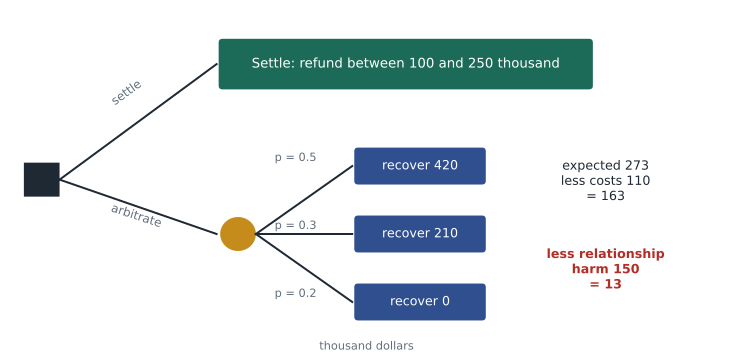
Disputes involve a choice between a negotiated settlement and a rights-based procedure whose outcome is uncertain. Decision analysis helps: estimate the possible outcomes of arbitration or litigation, their probabilities and their costs, including legal fees, management time and damage to relationships, and compare the expected result with what a settlement would provide. Daniel's lawyers estimate that if Northfield takes the automaker to arbitration under the supply contract, it has a 50 per cent chance of recovering the full 420 thousand, a 30 per cent chance of recovering about half, and a 20 per cent chance of recovering nothing; legal and expert costs would be about 110 thousand, and the process would take a year. Separately, Northfield has a claim against the steel supplier, which its lawyers think is stronger.
# Northfield's dispute: arbitrate against the automaker, or settle? (thousands of dollars)
claim = 420
arbitration = [(0.50, claim), (0.30, claim * 0.5), (0.20, 0)]
arb_costs = 110
relationship_cost = 150        # estimated effect on the next platform award of a formal fight

ev_arbitration = sum(p * x for p, x in arbitration) - arb_costs
print(f"expected recovery from arbitration, net of costs: {ev_arbitration:6.1f}")
print(f"... and after the relationship cost:              {ev_arbitration - relationship_cost:6.1f}")

# Settlement offers the automaker might accept: it returns part of the chargeback
for refund in (100, 150, 200, 250):
    better = refund > ev_arbitration - relationship_cost
    print(f"settlement refund {refund:3d}: better than arbitrating? {better}")

# Claim against the steel supplier: share of the 420 the supplier might bear
supplier = [(0.60, 0.8), (0.30, 0.4), (0.10, 0.0)]
expected_share = sum(p * s for p, s in supplier)
print(f"expected share recoverable from the steel supplier: {expected_share:.2f} of the loss")expected recovery from arbitration, net of costs: 163.0 ... and after the relationship cost: 13.0 settlement refund 100: better than arbitrating? True settlement refund 150: better than arbitrating? True settlement refund 200: better than arbitrating? True settlement refund 250: better than arbitrating? True expected share recoverable from the steel supplier: 0.60 of the loss
The analysis changes the plant manager's view. Arbitration against the automaker has an expected net recovery of about 163 thousand dollars, but once the likely harm to Northfield's chances on the next vehicle platform is counted, the figure falls to about 13 thousand. Almost any settlement in which the automaker returns part of the chargeback is better. The stronger claim is against the steel supplier, which might be expected to bear about 60 per cent of the loss. Daniel's plan is therefore to negotiate with the automaker, on interests, for a partial refund and a joint improvement plan, and to pursue the steel supplier through the dispute steps in its contract, beginning with negotiation between senior managers and moving to mediation if needed.
Negotiating the dispute
When Daniel meets the automaker's supplier quality manager, he uses the tools of earlier lessons. He begins by acknowledging the harm: the stoppage cost the automaker's plant real money and disrupted its schedule, and Northfield is sorry it happened. He separates the people from the problem and focuses on interests: the automaker wants assurance that it will not happen again and recovery of its costs; Northfield wants a fair share of the cost and to protect its standing for the next platform. He presents the data from Northfield's investigation, including the steel test results, as objective standards. And he proposes a package: Northfield will refund half the chargeback, install a ductility test on incoming coils, report results to the automaker monthly for a year, and pursue the steel supplier for its share. The automaker accepts, and its quality manager later tells Daniel that Northfield's response was the best he had seen from a supplier that year.
Difficult conversations
Not all disputes are commercial. Managers spend much of their time in difficult conversations: telling an employee that her performance is not acceptable, raising a concern with a peer, delivering bad news to a client, or confronting a manager about a decision. Douglas Stone, Bruce Patton and Sheila Heen of the Harvard Negotiation Project, in their 1999 book Difficult Conversations, observed that every such conversation is really three conversations at once. The what happened conversation concerns facts, intentions and blame. The feelings conversation concerns emotions, which are often present but unspoken. And the identity conversation concerns what the situation means for each person's sense of who they are: competent, good, worthy of respect.
Their advice for each is practical. In the what happened conversation, shift from arguing about the truth to exploring each other's stories, because each side usually has information the other lacks. Separate intent from impact: you may know the impact of the other person's action on you, but you do not know their intention, and assuming bad intent provokes defensiveness. Shift from blame to contribution: ask how each person contributed to the situation, which is more useful and less threatening than assigning fault. In the feelings conversation, acknowledge feelings, your own and the other person's, rather than letting them leak out as accusations. In the identity conversation, recognize that the conversation may threaten your self-image, and ground yourself before it begins.
They also recommend beginning from what they call the third story: a description of the problem that a neutral observer would recognize, rather than your own version. Instead of saying you have been missing deadlines and it is hurting the team, a manager might say: I want to talk about the project schedule, because the last three deliverables arrived late and I want to understand what is happening and figure out together how to get back on track. The second version invites the other person into a joint problem rather than putting them on trial.
Worked problem
Hana's conversation with Dr. Sandhu
Six months into the new physician contract, a patient's family complains that their father waited four hours in the emergency department and was treated dismissively. The complaint names Dr. Sandhu, the group's leader, who negotiated the contract with Hana. Hana must raise the complaint with him. She knows he has been working extra night shifts to cover a colleague's leave. How should she approach the conversation?
Show solution
- Prepare for all three conversations: what happened (the family's account, the department's records of the night), feelings (her own discomfort; his likely fatigue and defensiveness), and identity (he sees himself as a dedicated physician, and the complaint may feel like an attack on that).
- Open with the third story: the family's complaint, the records of a very busy night, and her wish to understand what happened and respond to the family well.
- Separate intent from impact: the family felt dismissed, whatever was intended.
- Ask about his contribution and the system's contribution: staffing that night, the scribe program's coverage, the triage queue.
- Acknowledge feelings, including the strain of extra shifts.
- Move to joint problem solving: a response to the family, and a change to night staffing during leaves, using the contract's quality committee.
Answer: Hana's approach lets Dr. Sandhu explain that he was the only physician on duty during a surge of patients, that he regrets how the family experienced the night, and that he would like to call them himself. Together they agree to ask the quality committee to review night coverage during staff leaves. The conversation strengthens rather than damages the working relationship built in the contract negotiation.
Common mistakes
MistakeDisputes are about who is right.
InsteadMost are best resolved by reconciling interests; rights and power procedures are backups.
MistakeMediation is a sign of weakness.
InsteadMediators help parties share information, test reality and avoid reactive devaluation; settlement rates are high.
MistakeIf we have a good legal case we should pursue it.
InsteadCount costs, time, probabilities and harm to relationships against a settlement.
MistakeIn a difficult conversation, start by stating the problem clearly from your side.
InsteadStart with a third story a neutral observer would recognize, and separate intent from impact.
Summary and key terms
- Disputes can be resolved by reconciling interests, determining rights or determining power; interest-based approaches are usually cheapest and most durable.
- Dispute system design sequences procedures from low to high cost, with loop-backs to negotiation.
- Mediators help through caucuses, reality testing and neutral proposals; styles include facilitative, evaluative and transformative.
- Arbitration is private and binding with limited appeal; final-offer arbitration, med-arb and arb-med combine processes.
- Use decision analysis to compare settlement with uncertain procedures, and handle difficult conversations through the third story, intent versus impact and contribution rather than blame.
- Dispute
- A claim made by one party and rejected by another.
- Mediation
- Negotiation assisted by a neutral third party without power to decide.
- Caucus
- A private meeting between a mediator and one party.
- Arbitration
- A private process in which a neutral issues a binding decision.
- Final-offer arbitration
- Arbitration in which the arbitrator must choose one side’s final offer.
- Loop-back
- A procedure that returns parties from rights or power contests to negotiation.
- Third story
- A description of a problem that a neutral observer would recognize.
Practice problems
Work each problem on paper first, then reveal the answer to check.
A claim of 300 has a 60 per cent chance of full recovery and a 40 per cent chance of nothing in arbitration costing 70. What settlement is worth accepting on expected value alone?
Show answer
Expected net recovery is 0.6 × 300 − 70 = 110; any settlement above 110.
Why does final-offer arbitration encourage reasonable offers?
Show answer
The arbitrator must choose one offer, so an extreme offer is likely to lose.
Rewrite 'You never listen to the team' as an opening based on the third story.
Show answer
'I would like to talk about how decisions are made in our meetings, because some of the team feel unheard, and I want to understand how you see it.'
What is a loop-back procedure?
Show answer
A step that returns parties in an arbitration, lawsuit or strike to negotiation, such as a cooling-off period or a mediation window.
Lesson quiz · 5 questions
Score 60% or more to complete this lesson.
Create a free account to save your progress, take quizzes and earn a certificate.