
MBA-604 · Lesson 7 of 12 · 21 min
Power, leverage and influence
Grace Mwangi brings the seventh session's case. Fairway Grocers, a regional chain of 85 stores, is negotiating annual trade terms with one of the world's largest snack food companies. The company's brands account for about 6 per cent of Fairway's sales in the snack aisle, and customers who cannot find them often shop elsewhere for the whole basket. For the snack company, Fairway is one of hundreds of retail customers, worth well under 1 per cent of its national sales. The company has proposed reducing the promotional allowances it pays Fairway by a fifth and raising list prices by 4 per cent. Grace's category manager colleagues at other regional chains have received similar letters and expect to accept them. Grace asks whether a small buyer has any leverage at all against a giant supplier.
Dr. Fournier says the question is the right one, but that size is a poor measure of power in negotiation. Power is the ability to influence the outcome in one's favour, and in negotiation it depends on alternatives, information, the other side's dependence and how skilfully each side uses what it has. Large organizations often have less negotiating power than their size suggests in any particular deal, because what matters is the specific relationship, not the totals.
Sources of power
John French and Bertram Raven's classic 1959 framework distinguished five bases of social power: reward power, the ability to provide benefits; coercive power, the ability to impose costs; legitimate power, which comes from a recognized position or right; expert power, which comes from knowledge; and referent power, which comes from being liked or admired. Negotiation scholars add others. Information power comes from knowing things the other side does not, such as its costs or its alternatives. Relationship and network power come from connections with people who can help or hurt. Time power comes from being able to wait longer. And coalition power comes from acting together with others.
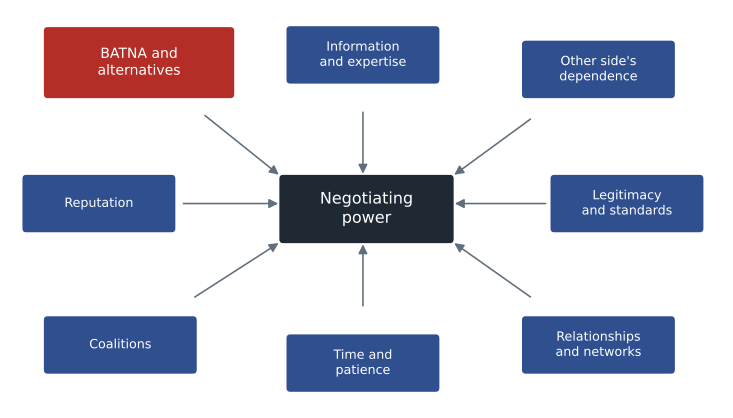
Of all these, the most important in most negotiations is the BATNA. A party with a strong alternative can walk away; a party with a weak one must make concessions or accept impasse. Power is therefore relative and specific: it depends on the alternatives each side has in this negotiation, not on overall size or wealth. Richard Emerson's power-dependence theory, published in 1962, expressed the idea precisely: A's power over B equals B's dependence on A, and B's dependence on A increases with the value B places on what A provides and decreases with the availability of that value from other sources. Power can be changed by changing values or alternatives on either side.
Diagnosing power in Grace’s case
Grace's first task is an honest assessment of dependence on both sides. Fairway depends on the snack company because its brands are popular and have few close substitutes. But the snack company also depends on Fairway, in ways that are easy to overlook. Fairway's stores are dominant in several small towns in its region, where no other chain operates; for shoppers in those towns, Fairway's shelves are the only route to the snack company's products. Fairway's promotional calendar and end-of-aisle displays have a large effect on the company's regional sales, and the company's sales team is measured on regional volume and display compliance. And the snack company is launching a new line of protein snacks for which it needs shelf space in every chain.
Grace also examines her alternatives. Fairway could reduce the shelf space given to the snack company's slower products and expand its private-label snacks, which earn higher margins; it could feature a smaller rival brand in its promotions; and it could delay the new protein line's listing. None of these would be costless, but together they make Fairway's BATNA much better than the regional chains' assumption that they must accept the letter.
| Source of dependence | Fairway on the snack company | The snack company on Fairway |
|---|---|---|
| Value of what is provided | Popular brands customers expect | Shelf space, displays and promotion in the region |
| Availability of alternatives | Private label, smaller brands | Few alternatives in towns where Fairway is the only grocer |
| Timing | Annual terms take effect in January | New protein line needs listings before spring |
| Information | Fairway’s scan data on brand switching | National data on category trends |
| People | Grace’s targets for category margin | Regional sales team measured on volume and display compliance |
Using power wisely
Having power is different from using it well. Dr. Fournier lists principles from her procurement career. First, power that is not perceived has no effect: the other side's view of your alternatives matters more than your own. Grace's scan data, which show that a third of the snack company's shoppers at Fairway switch to another brand rather than leave the store when their product is missing, is valuable only if the company's sales team sees it. Second, power is best used to improve the deal for both sides rather than simply to take value. Grace's proposal will combine resistance to the price increase with an offer of premium display space for the protein launch, which the company values highly.
Third, threats should be used rarely, stated as consequences rather than ultimatums, and only when credible and proportionate. Telling the company that Fairway will delist its brands would not be credible, because it would hurt Fairway too. Telling it that Fairway will allocate its spring display program according to the value suppliers offer, and that the protein line's listing will depend on the terms agreed, is credible and proportionate. Fourth, avoid humiliating a weaker party, which may have a long memory and better alternatives in future. Suppliers squeezed hard by powerful retailers sometimes respond by redirecting innovation, new products and scarce supply to retailers who treated them better.
Power also changes the person who holds it. Research by Adam Galinsky and colleagues found that people primed to feel powerful were more likely to make the first offer and to act on their own goals, which often helps in negotiation, but also less likely to take the other side's perspective, which can lead them to miss the other side's interests and to provoke resistance. The best negotiators combine the confidence that comes with a strong position with the curiosity of someone who still needs to learn.
Negotiating from a weaker position
What about Leo, whose small software company faces a national retailer with many suppliers to choose from? Deepak Malhotra has written about negotiating from weakness, and Dr. Fournier summarizes his advice and her own. Do not reveal your weakness: the other side may not know how badly you need the deal. Work on your BATNA before and during the negotiation, for example by talking to other potential clients. Focus on the value you create for the other side rather than on your need, because the other side's willingness to pay depends on the value of your offer compared with its alternatives, not on your alternatives. Identify the other side's constraints, such as deadlines, internal targets or the cost of switching, which may give you more leverage than you think. Build relationships with several people on the other side, so that you have allies. And consider changing the game: bringing in a partner, offering a pilot, or reframing the deal so that your strengths matter more.
Leo's position is weaker than the retailer's in general, but in this negotiation he has three advantages. Kestrel's results at another retailer are documented and impressive; the retailer's internal team has failed twice to build a forecasting tool of its own; and the retailer's supply chain vice-president, who sponsored the project, has told her board that a new forecasting system will be live before next year's holiday season. Each of these is a source of leverage, if Leo understands it and uses it with care.
Game theory and the split of the surplus
Economists have modelled how power shapes the division of value. John Nash's bargaining solution, published in 1950, starts from a simple idea: each party has a disagreement point, the payoff it gets if there is no deal. Nash showed that under a few reasonable assumptions, the agreement chosen maximizes the product of the two parties' gains over their disagreement points:
Here the u terms are each party's payoff from agreement x and the d terms are their disagreement points. When the parties are dividing a fixed sum, the Nash solution gives each party its disagreement payoff plus half of the remaining surplus. A better BATNA raises a party's disagreement point and therefore its share. Ariel Rubinstein's 1982 model of alternating offers adds time: the parties take turns making offers, and each prefers a deal sooner to one later, measured by a discount factor between 0 and 1. In equilibrium, the first party to make an offer receives a share of the surplus equal to
where the delta terms are the two parties' discount factors. The more patient party, with the higher discount factor, receives a larger share. When both are very patient, the shares approach one half each, the Nash solution. The models simplify reality, but their lessons are practical: the side with better alternatives and greater patience tends to receive more of the surplus, and anything that improves your alternative or reduces your cost of delay improves your share.
# Nash bargaining and Rubinstein alternating offers for dividing a surplus (thousands of dollars)
def nash_split(total, d1, d2):
    surplus = total - d1 - d2
    assert surplus >= 0, "no zone of agreement"
    return d1 + surplus / 2, d2 + surplus / 2

def rubinstein_share(delta1, delta2):
    return (1 - delta2) / (1 - delta1 * delta2)   # share of the first proposer

# Fairway and the snack company split the value of next year's promotion program, 900
for d_fairway, d_snack in ((100, 500), (300, 500), (300, 300)):
    f, s = nash_split(900, d_fairway, d_snack)
    print(f"disagreement points {d_fairway:3d} / {d_snack:3d}: Fairway {f:5.0f}, snack company {s:5.0f}")

# Patience matters: Fairway proposes first
for d1, d2 in ((0.9, 0.9), (0.95, 0.80), (0.80, 0.95), (0.99, 0.99)):
    share = rubinstein_share(d1, d2)
print(f"discount factors {d1:.2f} / {d2:.2f}: first proposer's share {share:.2f}")disagreement points 100 / 500: Fairway 250, snack company 650 disagreement points 300 / 500: Fairway 350, snack company 550 disagreement points 300 / 300: Fairway 450, snack company 450 discount factors 0.90 / 0.90: first proposer's share 0.53 discount factors 0.95 / 0.80: first proposer's share 0.83 discount factors 0.80 / 0.95: first proposer's share 0.21 discount factors 0.99 / 0.99: first proposer's share 0.50
The Nash results show that improving Fairway's alternative from 100 to 300 thousand, by developing private-label and rival-brand promotions, raises its share of the 900 thousand dollar program value from 250 to 350 thousand. The Rubinstein results show the effect of patience: with equal discount factors of 0.9 the first proposer gets 53 per cent of the surplus, and a proposer much more patient than its counterpart gets 83 per cent, while an impatient proposer facing a patient one gets only 21 per cent. Grace's timing matters for this reason: the snack company's protein launch gives it a deadline, which lowers its patience, while Fairway can wait.
Coalitions as a source of power
Weak parties can gain power by acting together. Regional grocery chains in many countries belong to buying groups that negotiate jointly with large suppliers, within the limits set by competition law. Grace cannot coordinate terms with rival chains, which would raise serious legal problems, but Fairway is a member of a lawful buying cooperative that negotiates certain national programs for its members. Lesson 8 studies coalitions in detail.
Worked problem
Grace's plan for the snack negotiation
Using the analysis of dependence and alternatives, outline Grace's approach to the snack company's proposal to cut promotional allowances by a fifth and raise list prices by 4 per cent.
Show solution
- Assess both sides' dependence honestly: Fairway needs the brands, but the company needs Fairway's shelves in its single-grocer towns and its displays for the protein launch.
- Strengthen and signal the BATNA: prepare a credible plan to expand private-label snacks and feature a smaller rival in promotions, and let the company see that the plan exists without issuing a threat.
- Share information that changes perceptions: present the scan data showing how many of the company's shoppers switch brands rather than stores.
- Link issues: offer premium display space and a guaranteed listing for the protein line in all 85 stores in exchange for keeping allowances at last year's level and limiting the price increase to 2 per cent.
- Use time: the company's spring launch deadline means it values an early agreement, while Fairway's current terms run until January.
- Protect the relationship: present the proposal as a way to grow both companies' sales in the region.
Answer: Grace enters the negotiation with a far stronger position than the chains that accepted the letter. The final agreement keeps allowances at 90 per cent of last year's level, limits the list price increase to 2.5 per cent and gives the protein line premium displays for its launch, an outcome both sides can report as a success.
Common mistakes
MistakeThe bigger party always has more power.
InsteadPower depends on alternatives and dependence in the specific relationship, not on total size.
MistakePower that I have will influence the other side.
InsteadOnly perceived power affects behaviour; make your alternatives and information visible.
MistakeThreats are the main way to use power.
InsteadUse power to shape a better deal; when needed, state consequences that are credible and proportionate.
MistakeA weak party should reveal its constraints to win sympathy.
InsteadDo not reveal weakness; focus on the value you create and the other side's constraints.
Summary and key terms
- Power in negotiation is relative and specific, resting mainly on each side's alternatives and dependence.
- French and Raven's bases of power, together with information, relationships, time, coalitions and reputation, shape influence.
- Emerson's power-dependence theory: A's power over B equals B's dependence on A, which falls when B has alternatives.
- Use power to improve the deal, make it visible, and use threats rarely and credibly; power can also reduce perspective taking.
- Nash and Rubinstein models show that better alternatives and greater patience earn a larger share of the surplus.
- Power
- The ability to influence an outcome in one’s favour.
- Dependence
- The degree to which a party needs what the other provides and lacks alternatives.
- Disagreement point
- The payoff a party receives if no agreement is reached.
- Nash bargaining solution
- The agreement that maximizes the product of the parties’ gains over their disagreement points.
- Discount factor
- The value of a delayed payoff relative to an immediate one, reflecting patience.
- Coalition
- A group of parties acting together to increase their influence.
Practice problems
Work each problem on paper first, then reveal the answer to check.
Two partners split 1,000. Their disagreement points are 200 and 400. What does the Nash solution give each?
Show answer
The surplus is 400, so 400 and 600.
Using Rubinstein's formula, what share does the first proposer get if both discount factors are 0.8?
Show answer
(1 − 0.8) / (1 − 0.64) = 0.56.
Give two ways a small supplier can increase its leverage with a large customer.
Show answer
Develop alternative customers, and document the value it creates relative to the customer's alternatives.
Why can feeling powerful harm a negotiator?
Show answer
It reduces perspective taking, so she may miss the other side's interests and provoke resistance.
Lesson quiz · 5 questions
Score 60% or more to complete this lesson.
Create a free account to save your progress, take quizzes and earn a certificate.