
MBA-604 · Lesson 4 of 12 · 21 min
Integrative negotiation: creating value through interests and trades
In the fourth session, Dr. Fournier asks the cohort to recall the orange. Two people with compatible interests divided it in half and each threw away what the other needed. That is the classic failure of integrative negotiation: an outcome that leaves both parties worse off than another available agreement. Economists call such an outcome inefficient. A deal is efficient, or Pareto efficient after the Italian economist Vilfredo Pareto, if no other deal would make one party better off without making the other worse off. Research by Leigh Thompson and Reid Hastie found that in negotiation exercises designed with integrative potential, a large share of negotiators reached inefficient agreements, and some even agreed on outcomes that both would have rejected had they compared them with another option on the table. Integrative skill is the ability to find agreements on or near the efficient frontier, before deciding how to share the gains.
Why value is left on the table
Integrative potential exists whenever parties differ: in how much they value issues, in their forecasts of the future, in their attitudes to risk, in their time preferences, or in their capabilities. Differences are the raw material of trades. Yet negotiators often fail to use them, for three main reasons. The first is the fixed-pie assumption: the belief, often unexamined, that whatever one side gains the other must lose. Studies by Thompson and Hastie found that most negotiators begin with this belief. The second is the habit of negotiating issue by issue, which turns a multi-issue negotiation into a series of distributive contests in which trades cannot be made. The third is the negotiator's dilemma described in Lesson 1: because sharing information about priorities is risky, negotiators share too little.
Dr. Fournier summarizes the remedy in a sentence: negotiate over packages, ask about priorities, and trade what you value less for what you value more.
Sources of joint gains
Dean Pruitt classified the ways parties can create value. In logrolling, each side concedes on the issues it cares about less in exchange for concessions on the issues it cares about more. In expanding the pie, the parties add resources, such as more volume, a longer contract or a new product, so that both can get more. In nonspecific compensation, one party gets what it wants and pays the other in some unrelated currency. In cost cutting, one party gets what it wants while the other's costs of conceding are reduced. And in bridging, the parties invent a new option that meets the interests behind both of their positions, as Grace's full-truckload deliveries did in Lesson 1.
Differences of other kinds create value too. When parties disagree about the future, they can write a contingent contract, a bet in which the terms depend on what happens. A seller who is confident that sales of a product will be strong and a buyer who doubts it can agree on a lower base price with a bonus if sales exceed a threshold; each prefers the deal by its own forecast. When parties differ in their attitude to risk, the less risk-averse party can take on more risk in return for a higher expected payoff. When they differ in time preferences, the party that values money now can receive an earlier payment in exchange for a larger total later.
Hana’s physician contract
The main case of the lesson returns to Hana Kowalski's negotiation with the twelve emergency physicians at Lakeview Health's community hospital, which she prepared in Lesson 2. In the first meeting, the group's leader, Dr. Amrit Sandhu, repeated the demand for a 9 per cent rate increase. Instead of responding with a number, Hana asked why the group wanted it. The answers revealed the interests behind the position. Several physicians were exhausted by night shifts, which ran twelve hours with a single physician on duty. They spent nearly a third of each shift charting in the electronic record. Two had been offered jobs in the city and were tempted. And the group felt that Lakeview's administration rarely consulted it about how the department was run.
Hana then shared some of Lakeview's interests: predictable costs, a contract long enough to plan around, and an end to the expensive locum physicians hired to fill gaps. Each side listed the issues: the rate increase, a premium for night shifts, a program of medical scribes, who type notes while the physician sees patients, and the length of the contract. Hana and Dr. Sandhu agreed to build a scoring system together, with each side assigning points privately to the options on each issue, totalling 100 for its most preferred package.
| Issue and option | Lakeview points | Physician group points |
|---|---|---|
| Rate increase 3 / 5 / 7 / 9 per cent | 40 / 27 / 13 / 0 | 0 / 13 / 27 / 40 |
| Night premium: none / 100 / 200 dollars a shift | 20 / 14 / 8 | 0 / 18 / 30 |
| Scribes: no / yes | 15 / 5 | 0 / 20 |
| Term: 1 year / 3 years | 0 / 25 | 10 / 6 |
The scores reveal the structure of the negotiation. Both sides care equally about the rate, so it is distributive. The group cares far more about the night premium and scribes than Lakeview does, because the night premium affects few shifts a year and scribes cost less than they save in physician time. Lakeview cares far more about a three-year term than the group, which only mildly prefers flexibility. That pattern is ideal for logrolling.
# Enumerate every package in the physician contract and find the efficient frontier
from itertools import product

issues = {
    "rate increase": {"3%": (40, 0), "5%": (27, 13), "7%": (13, 27), "9%": (0, 40)},
    "night premium": {"none": (20, 0), "100 a shift": (14, 18), "200 a shift": (8, 30)},
    "scribes": {"no": (15, 0), "yes": (5, 20)},
    "term": {"1 year": (0, 10), "3 years": (25, 6)},
}
names = list(issues)
packages = []
for combo in product(*[list(issues[n].items()) for n in names]):
    hospital = sum(v[0] for _, v in combo)
    group = sum(v[1] for _, v in combo)
    packages.append((hospital, group, [k for k, _ in combo]))

def dominated(p):
    return any(q[0] >= p[0] and q[1] >= p[1] and (q[0] > p[0] or q[1] > p[1]) for q in packages)

frontier = sorted(p for p in packages if not dominated(p))
print(len(packages), "packages,", len(frontier), "on the efficient frontier")
for h, g, terms in frontier:
    print(f"hospital {h:3d}  group {g:3d}  joint {h + g:3d}  {terms}")

compromise = (13 + 14 + 15 + 0, 27 + 18 + 0 + 10)     # 7%, 100 premium, no scribes, 1 year
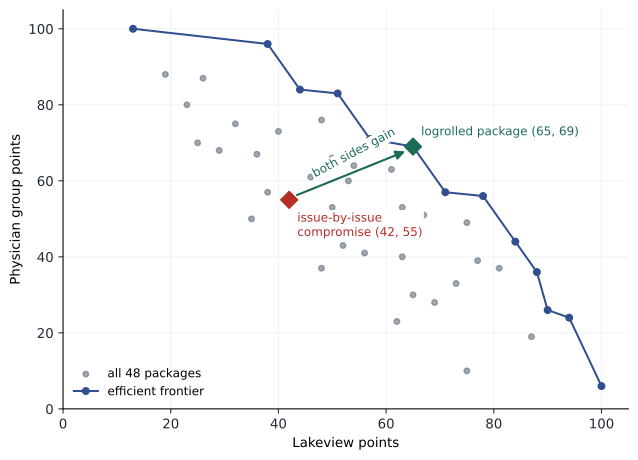
print("issue-by-issue compromise: hospital", compromise[0], "group", compromise[1], "joint", sum(compromise))48 packages, 13 on the efficient frontier hospital 13 group 100 joint 113 ['9%', '200 a shift', 'yes', '1 year'] hospital 38 group 96 joint 134 ['9%', '200 a shift', 'yes', '3 years'] hospital 44 group 84 joint 128 ['9%', '100 a shift', 'yes', '3 years'] hospital 51 group 83 joint 134 ['7%', '200 a shift', 'yes', '3 years'] hospital 57 group 71 joint 128 ['7%', '100 a shift', 'yes', '3 years'] hospital 65 group 69 joint 134 ['5%', '200 a shift', 'yes', '3 years'] hospital 71 group 57 joint 128 ['5%', '100 a shift', 'yes', '3 years'] hospital 78 group 56 joint 134 ['3%', '200 a shift', 'yes', '3 years'] hospital 84 group 44 joint 128 ['3%', '100 a shift', 'yes', '3 years'] hospital 88 group 36 joint 124 ['3%', '200 a shift', 'no', '3 years'] hospital 90 group 26 joint 116 ['3%', 'none', 'yes', '3 years'] hospital 94 group 24 joint 118 ['3%', '100 a shift', 'no', '3 years'] hospital 100 group 6 joint 106 ['3%', 'none', 'no', '3 years'] issue-by-issue compromise: hospital 42 group 55 joint 97
Of 48 possible packages, only 13 are efficient. The issue-by-issue compromise that many pairs reach in class, a 7 per cent increase with a 100 dollar night premium, no scribes and a one-year term, gives Lakeview 42 points and the group 55, a joint total of 97. It is inefficient: the package of a 5 per cent increase, a 200 dollar night premium, scribes and a three-year term gives Lakeview 65 points and the group 69, a joint total of 134, making both sides better off. The second package is logrolling in action. Lakeview gives up little on the premium and scribes, which the group values highly, and gets the long term it values; the group accepts a smaller rate increase, which it values only as much as Lakeview does.
Techniques for finding trades
How can negotiators discover each other's priorities without exposing themselves to exploitation? Dr. Fournier teaches five techniques. First, build trust and share information gradually and reciprocally: reveal one priority and ask about one of theirs. Second, ask diagnostic questions, such as which issues matter most and why, what a perfect agreement would look like, and what the other side's constraints are. Third, make multiple equivalent simultaneous offers, or MESOs, a technique studied by Victoria Medvec and colleagues: present two or three packages that are equally valuable to you, and see which the other side prefers. Its choice reveals its priorities without either side having to state them, and offering choices also makes the proposer seem flexible.
Fourth, propose packages rather than single-issue concessions, and use conditional language: if we agree on a three-year term, we could consider a larger night premium. Fifth, after reaching a tentative agreement, look for a post-settlement settlement, an idea associated with Howard Raiffa: with the agreement safely in hand, the parties ask whether any change could make both better off. Because the existing agreement serves as a fallback, the parties feel less exposed and share information more freely.
Hana uses MESOs in the second meeting. She offers three packages worth between 71 and 77 points to Lakeview: a 7 per cent increase with no premium and no scribes; a 5 per cent increase with a 100 dollar premium and scribes; and a 5 per cent increase with scribes but no premium, all on three-year terms. The group immediately prefers the second, which is worth 57 points to it against 33 and 39 for the others, confirming that night shifts and charting matter to its members more than the rate. The parties then improve on it together, raising the premium to 200 dollars, the efficient package found above.
Contingent agreements
One issue remains. The group says that scribes will free enough time for physicians to see more patients, shortening the department's waiting times, and therefore that Lakeview will recover the cost. Lakeview's finance team doubts it. Rather than argue about the forecast, Hana proposes a contingent clause: Lakeview will fund scribes for a year, and if median waiting times fall by at least 20 minutes, it will extend the program and add a quality bonus of 2 per cent of fees; if not, the parties will review the program. Each side expects to be proved right, so each values the clause by its own forecast, and the clause gives the group an incentive to make the scribes work. Contingent contracts like this one, also used in acquisitions as earn-outs, turn disagreement about the future into a source of value.
Dr. Fournier adds cautions. A contingent agreement must be based on a measure both sides can observe and neither can easily manipulate. It should be simple enough to administer. And it should not create incentives that distort behaviour, such as discouraging physicians from treating complex cases to keep waiting times down. The cohort suggests measuring waiting time from arrival to first assessment, which physicians influence but cannot easily game.
Creating and claiming together
Integrative negotiation is not the same as being nice. The parties in Hana's case still had to divide value: the rate increase, worth 40 points to each side, was purely distributive. A negotiator who reveals all her priorities at once, without reciprocity, can be exploited. A negotiator who refuses to reveal anything cannot find trades. The skilled approach combines the two: firm on interests and aspirations, flexible on how they are met, as Dean Pruitt described the stance he called firm flexibility. The final agreement, a 5 per cent increase, a 200 dollar night premium, a scribe program with the contingent quality bonus and a three-year term, gave both sides more than their compromise package and much more than their BATNAs.
Dr. Fournier asks the cohort to notice what made the result possible. The parties identified the issues before arguing about any one of them, they built the scoring systems privately, they negotiated packages, and they used a contingent clause to bridge a disagreement about the future. She also points out that the scoring system did not have to be shared. Each side kept its own points private; the trades were found by asking questions and testing packages.
Worked problem
Finding the bridge in Owen's land lease
Prairie Ridge Energy wants to lease 640 hectares from a farm family for six wind turbines over 30 years. The family's position is that it wants 10 thousand dollars per turbine per year, against Prairie Ridge's offer of 7 thousand. In conversation, Owen learns that the family worries about access roads cutting across fields during seeding and harvest, about the farm's value if the project is abandoned, and about having steady income in retirement. How could Owen create value?
Show solution
- Identify the issues beyond the payment per turbine: timing of construction, the route of access roads, decommissioning, payment schedule and inflation adjustment.
- Cost cutting: schedule construction to avoid seeding and harvest, and route roads along field edges, which costs Prairie Ridge little but removes a major concern for the family.
- Bridging: provide a decommissioning bond that guarantees removal of turbines and restoration of the land, addressing the family's fear about farm value.
- Trade on time preferences and risk: offer a payment of 7,500 dollars per turbine indexed to inflation, which the family values for retirement security, plus a share of revenue above a production threshold, a contingent element that costs Prairie Ridge only when the project does well.
- Present two or three packages of similar cost to Prairie Ridge and let the family choose.
Answer: By addressing the family's interests in field access, land value and secure retirement income, Owen can design a package that is worth more to the family than a simple 10 thousand dollar payment, while costing Prairie Ridge less. The integrative moves come from listening to the concerns behind the position.
Common mistakes
MistakeIf we both care about the same issue, we cannot create value.
InsteadValue comes from differences in priorities, forecasts, risk attitudes and timing across all the issues.
MistakeSettle the easy issues first to build momentum.
InsteadSettling issues one by one removes the trades that create value; negotiate packages.
MistakeIntegrative negotiation means revealing everything.
InsteadShare priorities gradually and reciprocally, keep reservation values private, and still claim value.
MistakeDisagreement about the future blocks agreement.
InsteadA contingent contract lets each side bet on its own forecast.
Summary and key terms
- Efficient agreements leave no deal that makes one side better off without hurting the other; many negotiators settle inside the frontier.
- The fixed-pie assumption, issue-by-issue agendas and fear of sharing information cause value to be left on the table.
- Joint gains come from logrolling, expanding the pie, nonspecific compensation, cost cutting and bridging.
- Scoring systems, diagnostic questions, MESOs and post-settlement settlements help find trades.
- Contingent contracts turn differences in forecasts into value, if they rest on simple, observable measures.
- Pareto efficient
- An agreement that cannot be improved for one side without harming the other.
- Logrolling
- Trading concessions across issues that the parties value differently.
- Bridging
- Inventing a new option that meets the interests behind both positions.
- MESO
- Multiple equivalent simultaneous offers: several packages of equal value to the proposer.
- Contingent contract
- An agreement whose terms depend on a future, observable event.
- Post-settlement settlement
- A search for joint improvements after a tentative agreement is reached.
- Fixed-pie assumption
- The belief that one side’s gain must be the other’s loss.
Practice problems
Work each problem on paper first, then reveal the answer to check.
In a two-issue negotiation, issue A is worth 30 points to you and 10 to the other side, and issue B is worth 10 to you and 30 to them. Which trade creates value?
Show answer
You take your preferred option on A and they take theirs on B; each gains 30 points for a cost of 10.
Why might a buyer and seller who disagree about next year's demand both prefer a contingent price?
Show answer
Each expects the contingency to resolve in its favour, so each values the deal more by its own forecast.
Describe how MESOs reveal priorities.
Show answer
The other side's choice among packages of equal value to you shows which issues matter more to it.
What makes a good measure for a contingent clause?
Show answer
One both sides can observe, neither can easily manipulate, and that does not distort behaviour.
Lesson quiz · 5 questions
Score 60% or more to complete this lesson.
Create a free account to save your progress, take quizzes and earn a certificate.