
MBA-604 · Lesson 3 of 12 · 21 min
Distributive bargaining: anchoring, offers and concessions
Dr. Fournier begins the third session by returning to Leo's licence negotiation. Kestrel and the retailer have discussed the scope of the deal, the rollout schedule and the support arrangements, and both sides now agree on everything except the annual fee. On that last issue, the negotiation is purely distributive: every thousand dollars more for Kestrel is a thousand dollars less for the retailer. Dr. Fournier says that even the most collaborative negotiators must eventually divide value, and that people who are uncomfortable with distributive bargaining tend to leave money on the table at exactly this moment. This lesson is about doing it well, and about recognizing and countering tactics used against you.
The first offer and the power of anchors
Should you make the first offer? Many negotiators prefer to wait, on the theory that the other side may reveal information or propose something better than they expected. The research mostly points the other way. In a well-known series of experiments, Adam Galinsky and Thomas Mussweiler found that whichever party made the first offer tended to obtain a better outcome, and that first offers explained much of the variation in final prices. The reason is anchoring: a number put on the table early becomes a reference point that pulls later judgements towards it, even when people know it was chosen by an interested party. Amos Tversky and Daniel Kahneman showed in the 1970s that even arbitrary numbers, such as the result of spinning a wheel, influenced people's estimates of unrelated quantities.
An anchor works by selective accessibility. When a buyer hears a high price, he begins, often without noticing, to search for reasons why the item might be worth that much. The opposite happens when he hears a low price. A first offer that is ambitious but defensible therefore shifts the whole negotiation. It also signals information about the offering party's expectations, and it shapes the counteroffer, because most counteroffers are made relative to the first number rather than independently.
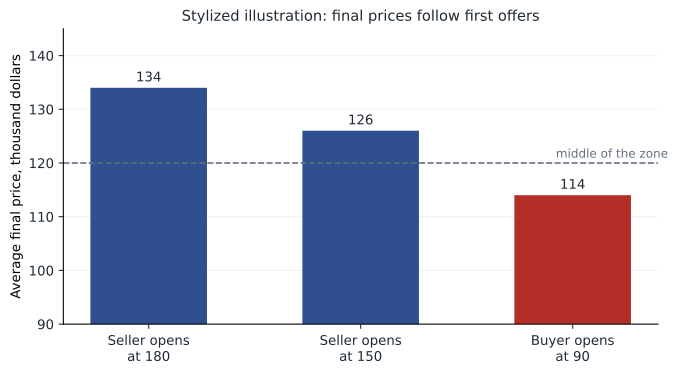
When should you not make the first offer? When you have very little information about the value of what is being negotiated, an early offer risks anchoring yourself in the wrong place. A first-time author who asks a publisher for a 10 thousand dollar advance may be giving up a much larger sum the publisher was willing to pay. The rule Dr. Fournier teaches is: if you have good information about the bargaining zone, open first and open ambitiously; if you do not, gather information first, and if the other side opens, do not let its number anchor you.
How ambitious should the first offer be?
An opening offer should be as ambitious as you can justify with a credible rationale, but not so extreme that the other side walks away or concludes you are not serious. An outrageous opening can insult the other party, damage the relationship and, in some cases, push it to its BATNA. A good opening sits near the boundary of what the other side might accept, accompanied by reasons. Leo plans to open at 165 thousand dollars a year, explaining that Kestrel's software reduced inventory by 12 per cent at a comparable retailer, which on this retailer's inventory would be worth more than 2 million dollars a year.
Precision matters too. Research by Malia Mason and colleagues found that precise first offers, such as 164,500 dollars rather than 165,000, are seen as more informed and attract smaller counteroffers, because the receiver assumes the number was carefully calculated. The effect disappears if the precise figure seems arbitrary or the offering party appears to know little. A precise figure supported by a short explanation of how it was calculated is usually the strongest form.
Responding to the other side’s anchor
If the other side opens first with an extreme number, the worst response is to treat it as a serious starting point and split the difference from there. Better responses include ignoring the number and refocusing on your own analysis, asking how it was calculated, which often shows that it rests on weak assumptions, or making a counteroffer that re-anchors the discussion on your terms. Dr. Fournier also advises negotiators to prepare their own anchors and to bring them to the table in writing, because it is much harder to be pulled by the other side's number when you have spent time with your own.
Leo's retailer, it turns out, opens first, with 85 thousand dollars, citing a smaller competitor's price list. Leo does not respond with a number immediately. He asks which features the competitor's product includes and whether its price covers implementation. He then presents Kestrel's results at another retailer and makes his counteroffer of 164,500 dollars, explaining that it reflects the value of the inventory reduction and the dedicated implementation team. The two anchors now bracket the zone of possible agreement, which Leo still estimates at 100 to 140 thousand.
Concessions
After opening offers come concessions. Three patterns tell the other side a great deal. The size of concessions signals how close a party is to its limit: large concessions suggest there is plenty of room left, while concessions that shrink in size suggest a party is approaching its reservation point. The timing of concessions signals urgency. And reciprocity, the norm that concessions should be matched, governs the rhythm of most bargaining. People feel obliged to respond to a concession with one of their own; a negotiator who makes several unreciprocated concessions teaches the other side that waiting pays.
Dr. Fournier recommends a few rules. Never concede without getting something in return, or at least without asking for something. Make concessions in decreasing amounts, so that the pattern signals a limit. Label concessions explicitly, explaining what they cost you, because research by Deepak Malhotra shows that unlabelled concessions are often undervalued or not noticed at all. And avoid conceding twice in a row: after a concession, wait for the other side to move.
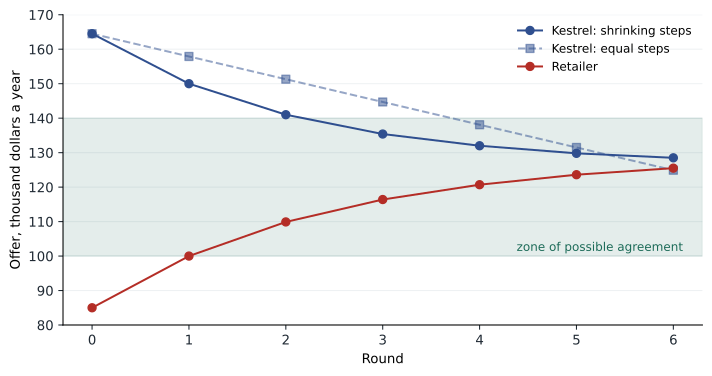
# Concession schedules for Kestrel and the retailer (thousands of dollars a year)
seller_open, seller_rv = 164.5, 100
buyer_open, buyer_rv = 85, 140

def shrinking(open_, first_step, ratio, rounds):
    offers, step, x = [open_], first_step, open_
    for _ in range(rounds):
        x -= step
        offers.append(round(x, 1))
        step *= ratio
    return offers

def rising(open_, first_step, ratio, rounds):
    offers, step, x = [open_], first_step, open_
    for _ in range(rounds):
        x += step
        offers.append(round(x, 1))
        step *= ratio
    return offers

seller = shrinking(seller_open, 14.5, 0.62, 6)
buyer = rising(buyer_open, 15, 0.66, 6)
for r, (s, b) in enumerate(zip(seller, buyer)):
    gap = s - b
    print(f"round {r}: Kestrel {s:6.1f}  retailer {b:6.1f}  gap {gap:5.1f}")
    if gap <= 3:
        print(f"close at the midpoint: {round((s + b) / 2, 1)}")
        break

# The midpoint of the opening offers predicts the deal when concessions are symmetric
print("midpoint of the openings:", (seller_open + buyer_open) / 2)round 0: Kestrel 164.5 retailer 85.0 gap 79.5 round 1: Kestrel 150.0 retailer 100.0 gap 50.0 round 2: Kestrel 141.0 retailer 109.9 gap 31.1 round 3: Kestrel 135.4 retailer 116.4 gap 19.0 round 4: Kestrel 132.0 retailer 120.7 gap 11.3 round 5: Kestrel 129.8 retailer 123.6 gap 6.2 round 6: Kestrel 128.5 retailer 125.5 gap 3.0 close at the midpoint: 127.0 midpoint of the openings: 124.75
The schedule shows how the opening offers shape the outcome. With both sides conceding in shrinking steps, the gap closes after six rounds and the deal lands near 127 thousand dollars, close to the midpoint of the two openings, about 125. Had Leo opened at 140, with the same pattern of concessions, the final price would have been much lower. The arithmetic illustrates a regularity seen in practice: when concessions are roughly symmetric, the midpoint of the two first offers is a good predictor of the final price, which is one more reason the first offer matters. It also explains why splitting the difference, though it feels fair, simply rewards whoever anchored more aggressively.
Deadlines and time pressure
Time pressure tends to produce concessions, because the cost of continuing rises as a deadline nears. Most concessions in many negotiations occur in the last ten per cent of the available time. Conventional wisdom says that a negotiator should hide her deadline, but research by Don Moore suggests that revealing a deadline can help, because the other side, knowing that time is short, makes concessions faster; both sides usually face the same deadline, since if one walks away both lose the deal. The practical lesson is to ask what deadlines the other side faces, to avoid accepting artificial deadlines without testing them, and to plan the agenda so that important issues are not left to the last minutes, when fatigue and pressure produce poor decisions.
Hardball tactics and how to respond
Some negotiators rely on tactics designed to pressure the other side. Dr. Fournier lists the common ones and the standard responses. With good cop, bad cop, one member of a team is aggressive and the other appears friendly, in the hope that the target will make concessions to the friendly one. The response is to name the tactic calmly and to treat both members as one party. With highball or lowball offers, the response is to refuse to treat the number as an anchor and to re-anchor with justification. A bogey is an issue the tactic's user pretends to care about in order to trade it away later; careful preparation and questions about priorities help expose it. The nibble is a small extra demand made just as the deal is closing, such as free training or faster delivery; the response is to treat it as a new issue and ask for something in return. Exploding offers, which expire within hours, aim to block the target from checking alternatives; the response is to ask for more time or to treat the deadline as a sign that the offer would not survive scrutiny.
Take-it-or-leave-it bargaining has a history in labour relations. In the 1950s General Electric's labour relations chief, Lemuel Boulware, developed a practice of researching what employees wanted, making a single firm offer and refusing to move from it. Labour boards and courts later found that the approach, as GE applied it, could violate the duty to bargain in good faith. The name boulwarism survives for any strategy of making one offer and refusing to negotiate. It can work when a party's alternatives are very strong, but it insults the other side, removes the sense of participation that makes people accept outcomes, and often produces impasse.
In general, the most effective response to hardball is to recognize it, to avoid reacting emotionally, and to redirect the negotiation to interests and standards. Fisher and Ury's advice was to negotiate about the rules of the negotiation itself: to say, for example, that you are happy to continue but will not make decisions under an artificial deadline. Hardball tactics rarely work against well-prepared negotiators, and they damage relationships and reputations that matter in repeated dealings.
Closing the deal
As the gap narrows, negotiators must decide when to stop. Techniques include proposing a final package with an explanation of why it is fair, offering a small concession contingent on closing immediately, and splitting the remaining difference when both sides have moved in good faith. A useful check before closing is to compare the deal with the BATNA one last time, and to ask whether anything important has been left out. Leo and the retailer settle at 128 thousand dollars a year for three years, with the retailer agreeing to serve as a public reference account. The price is above the midpoint of the zone Leo estimated, and the reference account is worth a good deal to Kestrel's next sales.
Dr. Fournier warns about one more trap. When the other side accepts your first offer immediately, you may feel you should have asked for more, and you may be right. Experiments show that negotiators whose first offers are accepted immediately are less satisfied than those who reach the same outcome after some bargaining, a pattern sometimes called the winner's curse of negotiation. The lesson is not to make lower offers but to prepare well enough that you are confident your offer was ambitious, and to remember that satisfaction and outcome are different things.
Worked problem
Grace's distributive move on a slotting fee
A snack food company wants shelf space for a new line of crackers in all of Fairway's stores. Fairway charges slotting fees for new products to cover the cost and risk of resetting shelves. The company's sales manager has asked Grace what fee Fairway would expect. Grace's analysis shows that resetting shelves and removing a slower item cost about 1,100 dollars per store across 85 stores, and that comparable chains charge between 1,800 and 3,000 dollars per store for a new line of this size. How should Grace handle the opening and concessions?
Show solution
- Grace has good information about the bargaining zone, so she should make the first offer rather than wait.
- She should open near the top of the defensible range with a precise figure and a rationale: 2,950 dollars per store, about 250,800 dollars in total, based on reset costs, the risk of a slow-moving product and the rates charged by comparable chains.
- If the sales manager counters at a low figure, she should not treat it as an anchor. She can ask how it was calculated and restate Fairway's costs and risk.
- She should plan shrinking concessions, each tied to something in return: a lower fee if the company funds an in-store promotion, or if it guarantees to buy back unsold stock after six months.
- She should keep the reservation point, about 1,100 dollars per store plus a margin for risk, to herself.
Answer: By opening first with an ambitious, precise and justified figure, Grace anchors the negotiation at the top of the market range. Tying each concession to a benefit for Fairway, such as promotion funding or a buy-back guarantee, turns a purely distributive fee negotiation into a small package and protects Fairway's margin.
Common mistakes
MistakeNever make the first offer.
InsteadMake it when you have good information about the bargaining zone; it anchors the outcome in your favour.
MistakeSplitting the difference is always fair.
InsteadIt rewards whoever anchored more aggressively; check that the midpoint is reasonable before agreeing.
MistakeA concession shows goodwill, so the other side will reciprocate.
InsteadUnreciprocated concessions teach the other side to wait; label concessions and ask for something in return.
MistakeHide every deadline.
InsteadRevealing a shared deadline can speed the other side's concessions; test artificial deadlines rather than accepting them.
Summary and key terms
- First offers anchor negotiations; open first when well informed, ambitiously and with a rationale.
- Precise, justified first offers attract smaller counteroffers; extreme, unjustified ones can provoke impasse.
- Respond to extreme anchors by questioning their basis and re-anchoring rather than splitting the difference.
- Concede in shrinking, labelled steps and seek reciprocity; the pattern of concessions signals your limits.
- Recognize hardball tactics such as good cop, bad cop, the nibble and exploding offers, and redirect to interests and standards.
- Anchor
- A number introduced early that pulls later judgements towards it.
- Counteranchor
- A counteroffer designed to re-establish the reference point on your terms.
- Concession pattern
- The size and timing of successive concessions, which signal a party’s limits.
- Reciprocity
- The norm that a concession should be matched by the other side.
- Nibble
- A small extra demand made as a deal is closing.
- Boulwarism
- Making a single firm offer and refusing to bargain from it.
Practice problems
Work each problem on paper first, then reveal the answer to check.
A seller opens at 260 and the buyer at 180. If both concede symmetrically, where will the deal probably land?
Show answer
Near the midpoint of the openings, 220.
Why might a precise first offer be more effective than a round one?
Show answer
It seems carefully calculated, so the other side makes a smaller counteroffer, provided the precision is credible.
The other side asks for free training just as you are about to sign. How should you respond?
Show answer
Treat it as a new issue: ask for something in return, such as a longer term or faster payment.
When should a negotiator avoid making the first offer?
Show answer
When she has little information about the value or the bargaining zone and risks anchoring herself badly.
Lesson quiz · 5 questions
Score 60% or more to complete this lesson.
Create a free account to save your progress, take quizzes and earn a certificate.