
LVT-320 · Lesson 9 of 12 · 21 min
Public safety radio coverage (ERRCS and BDAs)
Firefighters inside a burning building depend on their portable radios. They call for help, report conditions, hear evacuation orders and coordinate with the incident commander outside. When radios fail inside buildings, people die; investigations after several major fires and building collapses found that responders could not hear or be heard. That is why many jurisdictions now require new buildings, and existing buildings that are altered, to provide adequate radio coverage for emergency responders, and why a public safety system is often the most closely regulated wireless system in a building. This lesson covers why public safety coverage is required, the codes and standards in Canada and the United States, coverage and performance requirements, critical areas, how emergency responder radio coverage systems work, signal boosters and their approvals, power, monitoring and survivability, and the first stages of the Juniper Point garage project.
What an ERRCS is
An emergency responder radio coverage system, ERRCS, sometimes called an emergency responder communication enhancement system, ERCES, or in-building public safety DAS, is a system that ensures public safety radios work throughout a building. In most buildings it is a bi-directional amplifier, BDA, fed from a donor antenna on the roof aimed at the public safety radio system's nearest site, feeding a DAS of indoor antennas. In very large buildings or campuses, or where the outside signal is too weak, it may use a fibre-fed DAS or even a dedicated base station provided by the radio system operator. In the simplest case, a building with good outside coverage passes the coverage test without any system at all; codes require the test, not the amplifier.
Codes and standards
In Canada, requirements for in-building public safety radio coverage come mainly from municipalities and fire services rather than from one national rule. Many cities, especially in British Columbia, have bylaws requiring radio amplification in new buildings above a certain size or height, and fire services publish technical requirements. Kamloops' program, for example, sets coverage of at least 90 per cent of each floor, 100 per cent of fire command centres, stairwells and other critical areas, and a delivered audio quality of at least 3.4. Other municipalities write requirements into building permit conditions or project specifications. For St. Brendan's and Juniper Point, the requirements are those of Ottawa's fire service and radio system manager, written into the project specifications, and they follow the structure of the US standards described below, which many Canadian programs adapt. Every component must be certified by ISED, and the system must be authorized under ISED's licensing rules for the radio system it repeats.
The documents differ in detail and are amended locally, so a designer always works from the version the authority having jurisdiction has adopted, and from the authority's own written requirements, which often add frequencies, test methods and documentation rules. Installers should keep a copy of those requirements on site; they are the checklist against which the acceptance test will be judged.
Coverage and performance requirements
Most requirements share a common structure. Coverage is expressed as a percentage of each floor where the signal meets the requirements: in the US model codes, 95 per cent of general areas and 99 per cent of critical areas; in many Canadian bylaws, 90 per cent of general areas and 100 per cent of critical areas. Signal strength is set as a minimum level at the radio: the US model codes and many local requirements use −95 dBm for the downlink into the building, and require the uplink from the building to be received at the system's site at a stated level. Quality is set as delivered audio quality, DAQ.
| DAQ | Meaning |
|---|---|
| 1 | Unusable, speech present but not understandable |
| 2 | Understandable with considerable effort, frequent repetition |
| 3 | Speech understandable with slight effort, occasional repetition |
| 3.4 | Speech understandable with repetition only rarely; some noise or distortion |
| 4 | Speech easily understood, occasional noise |
| 5 | Speech easily understood, no noise or distortion |
The US model codes require a DAQ of at least 3.0 in both directions; many jurisdictions, and many Canadian programs, require 3.4. DAQ is judged by listening, during talk tests between a radio in the building and one at a control point, or estimated from measured signal quality for digital systems, where an equivalent signal-to-noise or bit error rate figure stands in for listening. Lesson 11 describes the test methods.
Critical areas
Critical areas are the places where responders must have communication: fire command centres, fire pump rooms, interior exit stairways, exit passageways, elevator lobbies, standpipe cabinets, sprinkler valve rooms and other areas the authority designates. Stairwells are the hardest, because they are enclosed in concrete with fire-rated doors, and they are exactly where firefighters stage and climb. Many designs put an antenna in each stairwell every few floors, and some codes require it. Parking garages, basements, mechanical rooms and elevator machine rooms are often the next hardest.
How the system works
The donor antenna on the roof, a directional antenna such as a Yagi or high-gain panel, is aimed at the nearest public safety site chosen by the radio system manager. It feeds the BDA, which amplifies the downlink, the signals from the radio system to the portables, and sends them into the indoor DAS. On the uplink, the BDA amplifies signals from portables inside and sends them out through the donor antenna. A Class A BDA amplifies only specific channels, filtered narrowly, so it cannot amplify neighbouring users' channels; a Class B BDA amplifies a whole band. The radio system manager decides which class is acceptable; many require Class A, and some allow Class B only within limits.
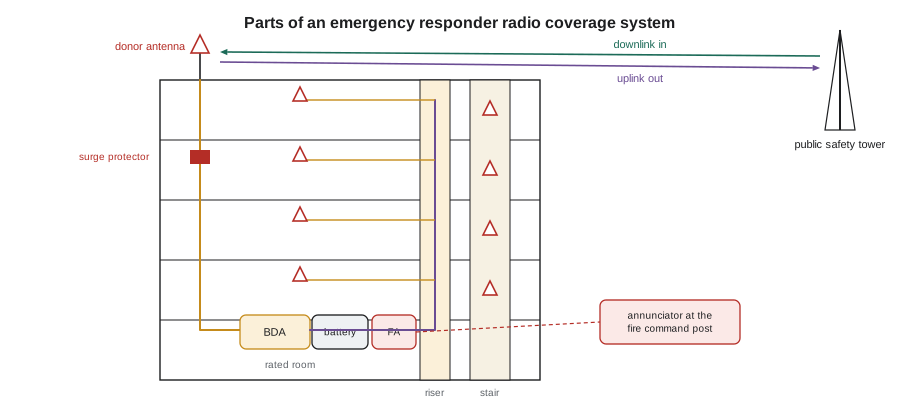
Isolation between the donor antenna and the indoor antennas is critical. If the indoor signal leaks back into the donor antenna with less loss than the BDA's gain, the amplifier feeds its own output back to its input and oscillates, transmitting a powerful unwanted signal that can jam the public safety system over a wide area. Requirements commonly ask that isolation exceed the BDA's gain by at least 15 to 20 dB under all conditions; the US model codes and many local requirements now ask for 20 dB. Isolation is achieved by distance, by the donor's front-to-back ratio, by building structure between the antennas, and by keeping indoor antennas away from the roof. It is measured at commissioning, and modern BDAs detect oscillation and reduce their gain or shut down.
# BDA gain and isolation check, with the downlink level the gain delivers
DONOR_RX = -62         # dBm per channel received at the donor antenna output
DONOR_CABLE = 2.5        # dB, donor coax and lightning protector
GAIN = 75            # dB, BDA downlink gain setting
ISOLATION = 88        # dB, measured donor-to-indoor-antenna isolation
MARGIN_REQ = 20          # dB, isolation must exceed gain by this much (local requirement)
out = DONOR_RX - DONOR_CABLE + GAIN
print(f"BDA downlink output per channel: {out:.1f} dBm")
print(f"Isolation {ISOLATION} dB vs gain {GAIN} dB: margin {ISOLATION - GAIN} dB (need {MARGIN_REQ})")
if ISOLATION - GAIN < MARGIN_REQ:
    max_gain = ISOLATION - MARGIN_REQ
    print(f"Not acceptable: reduce gain to {max_gain} dB or improve isolation")
    print(f"At {max_gain} dB gain, output falls to {DONOR_RX - DONOR_CABLE + max_gain:.1f} dBm per channel")
else:
print("Isolation acceptable")BDA downlink output per channel: 10.5 dBm Isolation 88 dB vs gain 75 dB: margin 13 dB (need 20) Not acceptable: reduce gain to 68 dB or improve isolation At 68 dB gain, output falls to 3.5 dBm per channel
In this example the measured isolation leaves only 13 dB of margin, so the gain must come down to 68 dB, lowering the downlink output by 7 dB. The designer then checks whether the link budgets from lesson 3 still meet −95 dBm at the far points; if not, isolation must be improved, perhaps by moving the donor antenna to the far side of the roof or adding a metal screen behind it, rather than accepting less margin.
Approvals
Before a public safety amplifier is switched on, the radio system's licensee, here the city's radio system manager, must consent in writing to the retransmission of its channels, and the installation must be authorized under ISED's rules: ISED treats boosters as zone enhancers certified to RSS-131, and for public safety and other non-cellular systems requires site- and frequency-specific authorization, held by or arranged with the licensee. Kamloops' program, for example, requires that the system be licensed by ISED and renewed annually at the owner's expense. The authority having jurisdiction then reviews and accepts the system after testing.
Many authorities also require the active equipment to be listed to UL 2524, the safety standard for in-building two-way emergency radio communication enhancement systems, and require installers and testers to hold particular qualifications, such as a general radiotelephone operator licence, a manufacturer's certification or a certification in emergency responder communication systems. Cobalt Line's acceptance tests will be done by Frank, who holds the qualifications Ottawa's fire service lists, with Maya assisting.
Power, monitoring and survivability
A public safety system must work when the building's normal power has failed. The US model codes require standby batteries that run the system at full capacity for at least 12 hours, or 2 hours of batteries plus a generator that can carry the load for 12 hours; Canadian programs set similar or project-specific durations. The BDA and its batteries go in an enclosure rated for the conditions, often a NEMA 4 type for the BDA and at least NEMA 3R for batteries in many requirements, in a room the authority approves.
# Standby battery check for a BDA and DAS remotes: hours available at full load
loads = [("BDA, full output", 180), ("Fibre remote units x3", 3 * 45), ("Fire alarm interface", 6)]
total_w = sum(w for _, w in loads)
BATT_V, BATT_AH = 48, 100
USABLE = 0.8                 # usable share of rated capacity at end of life (illustrative)
INV_EFF = 0.9                # power conversion efficiency
hours = BATT_V * BATT_AH * USABLE * INV_EFF / total_w
for n, w in loads: print(f"{n:24s} {w:5d} W")
print(f"Total {total_w} W; battery {BATT_V} V {BATT_AH} Ah gives about {hours:.1f} h")
need = 12
print("meets 12 h" if hours >= need else f"short: need about {total_w*need/(BATT_V*USABLE*INV_EFF):.0f} Ah")BDA, full output 180 W Fibre remote units x3 135 W Fire alarm interface 6 W Total 321 W; battery 48 V 100 Ah gives about 10.8 h short: need about 111 Ah
Monitoring connects the system to the building's fire alarm system, which reports system faults as supervisory signals. Typical supervised conditions include loss of normal power, battery charger failure, low battery capacity, donor antenna malfunction, BDA malfunction and oscillation. A dedicated annunciator at the fire command centre or fire alarm control panel shows the system's status to arriving firefighters. The fire alarm contractor makes the connections at the fire alarm control panel; Cobalt Line provides the dry contacts at the BDA and the cable between them, and both contractors test the signals together.
Survivability means the system keeps working long enough during a fire. Many requirements call for the riser cables, at least, to be in two-hour rated enclosures or pathways, or to use cable with a two-hour fire rating, and for the BDA and battery room to be protected. NFPA's standards describe pathway survivability levels for this purpose. Survivability can drive the whole cable design, which lesson 10 covers.
The Juniper Point garage
Juniper Point's condo tower was built without a public safety system. The board's plan to convert part of the third garage level into storage lockers needs a building permit, and the fire service's review of the permit asked for responder radio coverage in the garage and its stairwells, to the fire service's written requirements. Frank's existing-signal test showed −97 to −105 dBm on most of the three underground levels, failing everywhere except near the ramp entrance. The design: a Class A BDA in a room near the main electrical room, a donor panel on the tower roof aimed at the radio system's nearest site, a two-hour rated riser down to the garage, and panel antennas along each driving aisle, with radiating cable in the two exit stairwells that serve the garage. Lesson 10 follows the installation.
Worked problem
A BDA that interfered with dispatch
Shortly after another contractor's BDA in a nearby building was switched on, the radio system manager reports that the site serving that area has a raised noise floor on several channels, and dispatch is hearing broken transmissions. What is likely, and what is the fix?
Show solution
- A raised noise floor on several channels from one direction suggests an oscillating or overdriven booster, or one amplifying uplink noise toward the site.
- Possible causes include too little isolation between donor and indoor antennas, gain set too high, or a Class B booster with too much uplink gain.
- The radio system manager can require the booster to be shut down until fixed; the regulator can require it too.
- The fix is to measure isolation, set uplink and downlink gain to the minimum that meets the coverage requirement, confirm oscillation detection works, and verify the site's noise floor returns to normal, with the licensee's sign-off.
Answer: Boosters with insufficient isolation or excessive gain harm the system they serve; gain is set to the minimum needed and isolation verified.
Common mistakes
MistakeSwitching on a public safety BDA before written consent and authorization.
InsteadObtain the licensee's consent and the regulator's authorization first.
MistakeAssuming every building needs a BDA.
InsteadTest the existing coverage; the requirement is coverage, not equipment.
MistakeSetting BDA gain to maximum.
InsteadSet gain to the minimum that meets the requirement, with isolation at least 15 to 20 dB above it as required.
MistakeLeaving stairwells for last.
InsteadDesign and test stairwells first; they are critical areas and the hardest to cover.
MistakeWiring the fire alarm interface without testing each signal.
InsteadTest every supervisory signal with the fire alarm contractor.
Summary and key terms
- An ERRCS ensures public safety radios work throughout a building; codes require coverage, not necessarily amplifiers.
- In Canada, requirements come mainly from municipal bylaws and fire services; in the US, from IFC Section 510, NFPA 1225 and NFPA 72, with local amendments.
- Requirements set coverage percentages, minimum signal levels such as −95 dBm, and DAQ of 3.0 or 3.4.
- Critical areas, including stairwells and fire command centres, need the highest coverage.
- Class A BDAs amplify specific channels; isolation must exceed gain by the required margin to prevent oscillation.
- The licensee's consent and the regulator's authorization come before the system transmits.
- Standby power, fire alarm supervision and survivable pathways keep the system working during an emergency.
- ERRCS
- Emergency responder radio coverage system.
- DAQ
- Delivered audio quality: a 1 to 5 scale of how understandable speech is.
- Critical area
- An area, such as a stairwell or fire command centre, where communication is essential.
- Class A booster
- A booster that amplifies only specific channels.
- Isolation
- The loss between a booster's donor antenna and its indoor antennas.
- Oscillation
- Feedback in which an amplifier's output reaches its input, producing a strong unwanted signal.
- Annunciator
- A display showing system status, located where firefighters arrive.
Practice problems
Work each problem on paper first, then reveal the answer to check.
What does DAQ 3.4 mean?
Show answer
Speech understandable with repetition only rarely.
A BDA has 70 dB of gain and the requirement is isolation 20 dB above gain. What isolation is needed?
Show answer
At least 90 dB.
Name three critical areas.
Show answer
Any three of fire command centre, fire pump room, interior exit stairways, elevator lobbies and others the authority designates.
Why must a BDA be supervised by the fire alarm system?
Show answer
So faults such as power loss, low battery or oscillation are reported to the building and responders.
Lesson quiz · 5 questions
Score 60% or more to complete this lesson.
Create a free account to save your progress, take quizzes and earn a certificate.