
LVT-320 · Lesson 2 of 12 · 19 min
RF fundamentals: frequency, wavelength and power
Frank's first lesson for Maya is not about equipment at all. He draws a wave on the whiteboard in the east wing site trailer and asks her what the fire department's radio and a nurse's Wi-Fi badge have in common. Both, she says, send information as radio waves. Then he asks why the fire department's signal reaches the basement of a building across town while the badge struggles two rooms from its access point. The answer, he says, is mostly in three numbers: frequency, wavelength and power. This lesson explains them, how they relate, how radio carries information, and how power is measured and limited.
Radio waves
A radio wave is an electromagnetic wave: electric and magnetic fields that change together and travel through space at the speed of light, about 300,000 kilometres per second. A transmitter makes the wave by driving an alternating current into an antenna; a receiving antenna turns the passing wave back into a tiny alternating current. Radio waves need no medium, so they cross air, vacuum and, with losses, walls. Light, X-rays and heat radiation are electromagnetic waves too, at much higher frequencies; radio is the low-frequency end of the same family.
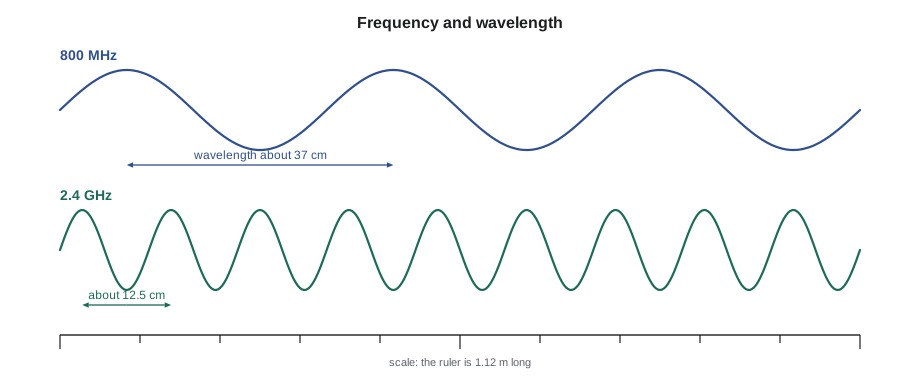
The frequency of a wave is how many times per second it completes a cycle, measured in hertz. Building radio systems work in megahertz, millions of cycles per second, and gigahertz, billions. A firefighter's 800 MHz portable radio completes 800 million cycles every second; a Wi-Fi access point on 5 GHz completes five billion. The wavelength is the distance the wave travels during one cycle. Because every radio wave travels at the same speed, frequency and wavelength are tied together: higher frequency means shorter wavelength.
Here c is the speed of light, about 3 × 10⁸ metres per second, f is the frequency in hertz and λ, lambda, is the wavelength in metres. An 800 MHz wave is about 37 cm (15 in) long; a 2.4 GHz Wi-Fi wave about 12.5 cm (5 in); a 6 GHz wave about 5 cm (2 in). The wavelength sets the size of antennas: a simple antenna is often a quarter or half of a wavelength long, which is why a public safety portable has a longer antenna than a phone, and why Wi-Fi antennas can hide inside a small access point.
How frequency changes behaviour indoors
Frequency affects how a signal behaves in a building in several ways. Lower frequencies lose less power spreading out over a given distance, as lesson 3 shows, and pass through and around many building materials better. Higher frequencies lose more in free space and are absorbed or reflected more by walls, people and furniture. That is why the fire department's 700 and 800 MHz system covers more of a building from outside than a phone's 3.5 GHz 5G signal does, and why 6 GHz Wi-Fi cells are smaller than 2.4 GHz cells from the same access point.
Higher frequencies have advantages too. They offer much wider channels, so they carry more data; the 6 GHz band alone has more spectrum for Wi-Fi than all earlier bands together. Their shorter range, often seen as a weakness, lets designers reuse the same channel in nearby rooms without interference. A hospital floor with access points in every second or third patient room can serve hundreds of devices precisely because the cells are small. Choosing a band is always a trade between reach and capacity.
Radio signals reach a receiver by several mechanisms at once. They travel directly when there is a clear line of sight. They reflect from walls, floors, metal doors and ceilings. They diffract, bending around edges such as the end of a corridor wall. And they penetrate materials, losing power on the way through. Indoors, the signal at any point is usually the sum of many paths, which lesson 4 calls multipath.
Bands used in buildings
Radio spectrum is divided into bands, and the regulators assign each band to particular uses. Canada and the United States coordinate closely, so most bands match, but there are differences, especially in the newer cellular bands. The table lists the bands an installer meets most often.
| Band | Frequency range | Used for |
|---|---|---|
| VHF | 136 to 174 MHz | Some fire, police and business radio |
| UHF | 400 to 512 MHz | Business radio, some public safety |
| 600 and 700 MHz | 617 to 806 MHz | Cellular low band; 700 MHz public safety and broadband |
| 800 MHz | 806 to 869 MHz | Public safety trunked radio, cellular 850 |
| 1.7 to 2.2 GHz | AWS and PCS | Cellular mid-band |
| 2.4 GHz | 2,400 to 2,483.5 MHz | Wi-Fi, Bluetooth, IoT |
| 3.5 GHz | 3,450 to 3,980 MHz (varies) | 5G mid-band |
| 5 GHz | 5,150 to 5,850 MHz | Wi-Fi |
| 6 GHz | 5,925 to 7,125 MHz | Wi-Fi 6E and Wi-Fi 7 |
The table is a starting point, not a design reference. Each carrier holds particular blocks within each band, and each public safety agency holds particular channels; the RF designer gets the exact frequencies from the licensee before choosing equipment. A BDA or DAS that covers a band the licensee does not use wastes gain and can amplify someone else's signal.
How radio carries information
A plain wave at one frequency, a carrier, carries no information. To send voice or data, the transmitter changes the carrier, a process called modulation. Early radio changed its amplitude (AM) or its frequency (FM); many public safety radios still use FM for analog voice. Digital systems change the carrier's amplitude and phase in combinations, sending several bits with each change, or symbol. Quadrature amplitude modulation, QAM, is the common scheme: 16-QAM sends 4 bits per symbol, 256-QAM sends 8, and the 4096-QAM used by Wi-Fi 7 sends 12.
More bits per symbol means more data from the same channel, but the receiver must tell apart many closely spaced amplitude and phase states, which it can only do when the signal is strong and clean compared with the noise. This is why Wi-Fi speed falls with distance: as the signal weakens, the access point and client step down to simpler modulation and lower rates. Lesson 3 puts numbers on this relationship through signal-to-noise ratio.
Digital public safety radio systems in North America mostly follow the P25 standard, developed for interoperability between agencies. Trunked P25 systems on 700 and 800 MHz share a pool of channels among many talk groups, controlled by a control channel that every radio monitors. In-building coverage tests, as lesson 11 describes, often measure the control channel's signal strength along with the quality of voice.
Power and its limits
Transmitter power is measured in watts. A firefighter's portable radio transmits up to about 3 to 5 watts; a phone, well under 1 watt; a Wi-Fi access point, typically 20 to 200 milliwatts per radio chain. Cell sites transmit tens of watts per carrier. These numbers span a huge range, which is why radio engineers usually express power in decibels, as lesson 3 explains.
What matters to coverage is not only the transmitter power but how it leaves the antenna. An antenna that focuses energy in one direction increases the effective power in that direction. The combination is expressed as equivalent isotropically radiated power, EIRP: the power a perfect antenna radiating equally in all directions would need to produce the same signal in the antenna's strongest direction. Regulators limit EIRP, not just transmitter power, so adding a higher-gain antenna to a certified radio can push it over its legal limit. Equipment certification under ISED's radio standards in Canada and the FCC's rules in the United States covers specific antennas; changing to an uncertified antenna can void that certification.
# Wavelength and simple antenna lengths for common in-building bands
C = 299_792_458          # speed of light, m/s
bands = [("VHF public safety", 155e6), ("UHF business", 460e6), ("700 MHz public safety", 770e6),
         ("800 MHz public safety", 855e6), ("Wi-Fi 2.4 GHz", 2.437e9), ("Wi-Fi 5 GHz", 5.5e9), ("Wi-Fi 6 GHz", 6.5e9)]
TO_UNIT = 100             # cm per metre
for name, f in bands:
    lam = C / f
print(f"{name:22s} {f/1e6:7.0f} MHz wavelength {lam*TO_UNIT:6.2f} cm quarter-wave {lam/4*TO_UNIT:5.2f} cm")VHF public safety 155 MHz wavelength 193.41 cm quarter-wave 48.35 cm UHF business 460 MHz wavelength 65.17 cm quarter-wave 16.29 cm 700 MHz public safety 770 MHz wavelength 38.93 cm quarter-wave 9.73 cm 800 MHz public safety 855 MHz wavelength 35.06 cm quarter-wave 8.77 cm Wi-Fi 2.4 GHz 2437 MHz wavelength 12.30 cm quarter-wave 3.08 cm Wi-Fi 5 GHz 5500 MHz wavelength 5.45 cm quarter-wave 1.36 cm Wi-Fi 6 GHz 6500 MHz wavelength 4.61 cm quarter-wave 1.15 cm
The quarter-wave figures explain the antennas Maya will handle: the VHF whip on a fire department portable is long, the 800 MHz antennas on a public safety DAS are about the length of a hand, and the Wi-Fi elements inside an access point are smaller than a coin.
# EIRP: transmitter power, cable loss and antenna gain, in watts
import math
def dbm(mw): return 10 * math.log10(mw)
def mw(dbm_val): return 10 ** (dbm_val / 10)
setups = [  # name, transmitter power (mW), cable and connector loss (dB), antenna gain (dBi)
    ("Access point, internal antenna", 100, 0.0, 4),
    ("Access point, external patch", 100, 1.0, 9),
    ("BDA downlink to DAS antenna", 1000, 18.0, 3),
    ("Portable radio, whip", 3000, 0.0, 0),
]
for name, p, loss, gain in setups:
    e = dbm(p) - loss + gain
print(f"{name:32s} {dbm(p):5.1f} dBm in, EIRP {e:5.1f} dBm = {mw(e):7.1f} mW")Access point, internal antenna 20.0 dBm in, EIRP 24.0 dBm = 251.2 mW Access point, external patch 20.0 dBm in, EIRP 28.0 dBm = 631.0 mW BDA downlink to DAS antenna 30.0 dBm in, EIRP 15.0 dBm = 31.6 mW Portable radio, whip 34.8 dBm in, EIRP 34.8 dBm = 3000.0 mW
The external patch antenna nearly triples the access point's effective power in its main direction; the BDA's watt of output is mostly spent in the cable before it reaches the antennas, which is normal in a DAS and one reason designers watch cable losses closely.
Noise and interference
Every receiver hears noise along with the wanted signal: thermal noise generated in its own circuits and in the antenna, plus man-made noise from motors, lighting ballasts, switching power supplies and other electronics. Interference is unwanted signal from other transmitters, such as a neighbouring Wi-Fi network on the same channel, a carrier's signal leaking from a nearby building's DAS, or an oscillating booster. A receiver can only decode a signal that is far enough above the noise and interference. Much of in-building wireless work is about raising the wanted signal where it is weak and keeping unwanted signal out.
Interference can be created by poor installation. Passive intermodulation, PIM, happens when two or more strong signals pass through a non-linear junction, such as a loose, dirty or corroded connector, a rusty bolt near an antenna, or a mixed-metal joint. The junction generates new signals at combinations of the original frequencies, and some of those fall into receive bands, raising the noise for everyone. Clean, tight, correctly torqued connectors are a radio performance issue, not only a neatness issue.
Worked problem
A badge that drops in the stairwell
During the east wing's existing-signal survey, Maya notes that a nurse's Wi-Fi badge, borrowed from the existing hospital to test with, drops its call in stairwell C, while her phone keeps a weak 700 MHz LTE signal there. Why might the low-band cellular signal survive where the Wi-Fi does not?
Show solution
- The badge is on 5 GHz Wi-Fi from access points in the corridor; the stairwell is behind a concrete wall and a fire-rated steel door.
- Higher-frequency signals lose more spreading out and more passing through concrete and steel.
- The 700 MHz cellular signal comes from outside through the stairwell's windows and loses less per wall.
- The design must add Wi-Fi coverage in the stairwell, either with an access point inside it or by planning the corridor access points to reach it, and must test the badge there.
Answer: Frequency explains most of the difference; the stairwell needs its own Wi-Fi coverage in the design.
Common mistakes
MistakeThinking higher frequency always means better performance.
InsteadHigher bands carry more data but cover less; choose by the job.
MistakeFitting a higher-gain antenna to a certified radio without checking.
InsteadCertification covers specific antennas; EIRP limits can be exceeded.
MistakeDesigning a booster for a whole band when the licensee uses a few channels.
InsteadGet the exact frequencies from the licensee.
MistakeTreating connector torque as cosmetic.
InsteadLoose or dirty connectors cause PIM that degrades every signal on the system.
MistakeConfusing frequency with power.
InsteadFrequency is cycles per second; power is energy per second. A strong signal can be any frequency.
Summary and key terms
- Radio waves travel at the speed of light; wavelength equals the speed of light divided by frequency.
- Higher frequencies have shorter wavelengths, smaller antennas, shorter range and more capacity.
- Signals reach receivers by direct paths, reflection, diffraction and penetration.
- Canada and the United States coordinate most bands, with differences in some newer cellular bands.
- Modulation such as QAM carries data; more bits per symbol need a stronger, cleaner signal.
- EIRP combines transmitter power, losses and antenna gain, and regulators limit it.
- Noise and interference limit what a receiver can decode; PIM from poor connectors adds interference.
- Frequency
- The number of cycles a wave completes each second, in hertz.
- Wavelength
- The distance a wave travels in one cycle.
- Modulation
- Changing a carrier wave to carry information.
- QAM
- Quadrature amplitude modulation, which varies amplitude and phase to send several bits per symbol.
- EIRP
- Equivalent isotropically radiated power: the effective power in an antenna's strongest direction.
- P25
- The North American standard for digital public safety radio.
- PIM
- Passive intermodulation: interference created when strong signals meet a non-linear joint.
Practice problems
Work each problem on paper first, then reveal the answer to check.
What is the wavelength of a 700 MHz signal?
Show answer
About 43 cm.
A 5 GHz signal has a wavelength of about 6 cm. What is a quarter wave?
Show answer
About 1.5 cm.
Why does Wi-Fi drop to lower data rates far from an access point?
Show answer
The signal-to-noise ratio falls, so simpler modulation with fewer bits per symbol is used.
What does a loose connector on a DAS add to the system?
Show answer
Passive intermodulation, which raises noise in receive bands.
Lesson quiz · 5 questions
Score 60% or more to complete this lesson.
Create a free account to save your progress, take quizzes and earn a certificate.