
LVT-320 · Lesson 11 of 12 · 19 min
Testing and documenting coverage
A wireless system is accepted on measurements, and the measurements are only as good as the method. For Wi-Fi, the owner's network team accepts a validation survey. For a cellular DAS, each carrier accepts walk tests and component tests. For a public safety system, the authority having jurisdiction accepts a grid test done to its written method, often witnessed by a fire inspector, and then requires the test to be repeated every year. Frank tells Maya that more public safety systems fail their first acceptance test because of how the test was planned than because of how the system was built. This lesson covers acceptance testing for each kind of system, the grid test method, DAQ and talk-back tests, measurement equipment, annual testing, troubleshooting a failed test, and the documents that close out a wireless project.
Before any acceptance test
Acceptance tests are scheduled when the building is substantially complete, with ceilings, doors, glass and fit-outs in place, because those all affect coverage. All installation tests from lesson 10 should be complete and passed, and the system optimized: antenna powers balanced, BDA gains set, Wi-Fi power and channel plans settled. For public safety systems, the licensee's consent and the regulator's authorization must be in hand, the radio system manager must know the test date, and the fire alarm interface must be connected and tested. Frank's pre-test checklist for the Juniper Point garage runs to two pages; the last item is a dry run of the grid test by Cobalt Line's own crew a week before the inspector's visit.
Wi-Fi validation
Wi-Fi validation is a post-installation passive and active survey, as described in lesson 6, against the owner's requirements. The surveyor uses the same equipment and adapter offsets as the design survey, covers every area, and adds tests for the critical devices. At St. Brendan's, this means walking every corridor and room with a voice badge on a test call and a survey adapter recording, checking roaming in stairwells and elevator lobbies, and confirming location accuracy for tags in sample rooms. The report compares each requirement with the measured result and lists any area that falls short.
Cellular acceptance
Carrier acceptance includes the component tests from lesson 10, sweep, distance-to-fault, PIM and fibre results for every run, plus a coverage walk test for each carrier's bands with a scanner, a receiver that measures many carriers and bands at once, and test phones that record RSRP, SINR, throughput and handovers. The carrier's own engineers usually integrate the base station equipment, set power levels and run their tests, including leakage outside the building, before accepting the system on air.
The public safety grid test
Public safety acceptance usually follows a grid method set by the code or the authority. In the method of the US model code, each floor is divided into 20 approximately equal test areas, with a maximum area per grid; larger floors get more grids. A test is made at a location near the centre of each grid area, and only that location counts: the tester may not move around to find a better spot. A floor passes if the failed areas are no more than the code allows, which with 20 grids and 95 per cent means at most one failed area; critical areas must meet their own, higher requirement. If a floor has two failed areas, many requirements allow it to be re-tested with 40 grids, passing if no more than two non-adjacent areas fail. Canadian programs use similar grid methods with their own percentages; Kamloops', for example, allows no more than two non-adjacent failed grid areas per floor.
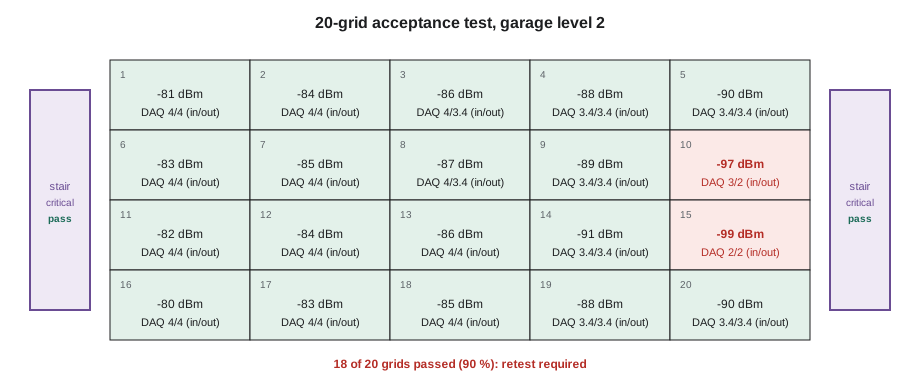
At each test location the tester measures downlink signal strength on the specified channels, usually the control channels of a trunked system, using a calibrated receiver, and makes a talk test: a voice transmission from a radio at the test point to a radio at a control point outside or at the fire command centre, and back, each rated for DAQ. The radios are held as a firefighter would carry them, typically at hip or shoulder height, and the antenna is not extended or aimed. Results are recorded on the authority's form, with the grid number, signal level, DAQ in each direction, time and tester.
# Evaluate a grid test for one floor: 95 per cent of general areas, 99 per cent of critical areas
MIN_DBM, MIN_DAQ = -95, 3.4
grids = [  # grid, critical?, downlink dBm, DAQ in, DAQ out
    (1, False, -81, 4, 4), (2, False, -84, 4, 4), (3, False, -86, 4, 3.4), (4, False, -88, 3.4, 3.4),
    (5, False, -90, 3.4, 3.4), (6, False, -83, 4, 4), (7, False, -85, 4, 4), (8, False, -87, 4, 3.4),
    (9, False, -89, 3.4, 3.4), (10, False, -97, 3, 2), (11, False, -82, 4, 4), (12, False, -84, 4, 4),
    (13, False, -86, 4, 4), (14, False, -91, 3.4, 3.4), (15, False, -99, 2, 2), (16, False, -80, 4, 4),
    (17, False, -83, 4, 4), (18, False, -85, 4, 4), (19, False, -88, 3.4, 3.4), (20, False, -90, 3.4, 3.4),
    ("Stair 1", True, -78, 4, 4), ("Stair 2", True, -82, 4, 4),
]
def ok(g): return g[2] >= MIN_DBM and min(g[3], g[4]) >= MIN_DAQ
general = [g for g in grids if not g[1]]
crit = [g for g in grids if g[1]]
gpass = sum(ok(g) for g in general)
print(f"General areas: {gpass}/{len(general)} pass = {100*gpass/len(general):.0f}% (need 95%)")
print(f"Critical areas: {sum(ok(g) for g in crit)}/{len(crit)} pass (need all)")
for g in grids:
    if not ok(g): print(f"  failed grid {g[0]}: {g[2]} dBm, DAQ {g[3]}/{g[4]}")
fails = len(general) - gpass
if fails == 2: print("Two failures: retest with 40 grids is allowed under many requirements")General areas: 18/20 pass = 90% (need 95%) Critical areas: 2/2 pass (need all) failed grid 10: -97 dBm, DAQ 3/2 failed grid 15: -99 dBm, DAQ 2/2 Two failures: retest with 40 grids is allowed under many requirements
The dry run at Juniper Point found exactly this: two failed grids at the far corner of level 2, behind a block of storage rooms built after the design survey. The design had assumed open parking there. Rather than rely on a 40-grid retest, Frank added a panel antenna on the corner column, fed from a spare tapper port the design had provided for future changes, and the next dry run passed all 20 grids.
Uplink and talk-back
Signal strength measurements show the downlink; the talk test shows both directions. The uplink is where many systems fail, because a portable's limited power must reach the indoor antenna and then the BDA must deliver it to the distant site with enough level, without overloading the site with noise. Some requirements specify a minimum uplink signal received at the site, measured by the radio system manager. Frank arranges with the radio system manager for a technician to monitor the site receivers during the test, so uplink problems can be identified grid by grid.
Measurement equipment
Public safety tests use receivers or test radios calibrated within the period the authority requires, with their calibration certificates attached to the report. Wi-Fi validation uses survey adapters and software; cellular tests use scanners and test phones. For all of them, the tester records the equipment model, serial number, calibration date and any offsets used. Using a phone's bars or a consumer app as a test instrument is never acceptable.
| Test | Instrument | Records |
|---|---|---|
| Wi-Fi validation | Survey adapters and software | Signal, SNR, overlap, throughput, roaming |
| Cellular walk test | Scanner and test phones | RSRP, SINR, throughput, handovers, leakage |
| Public safety grid | Calibrated receiver, test radios | Signal per grid, DAQ in and out |
| Coax and antenna | Cable and antenna analyzer | Return loss, distance-to-fault |
| PIM | PIM analyzer | Intermodulation level at set power |
| Fibre | Light source and meter, OTDR | Loss, events |
Annual testing
Public safety systems must be tested every year, and after building changes that could affect coverage, such as additions, new walls or new storage. The annual test typically includes a coverage test, often a full grid test or a reduced test of the weakest grids and all critical areas; verification of BDA gain and output levels; a load test of the batteries; a check of fire alarm supervision; and inspection of other components. The results are submitted to the authority, in some places through an online reporting system. The board at Juniper Point must arrange the annual test; Cobalt Line's service contract offers to do it, and the handover binder includes the schedule. Wi-Fi and cellular systems have no code requirement for annual tests, but owners often schedule periodic surveys, especially after renovations.
Troubleshooting a failed test
When a grid fails, the cause can be the system, the building or the test. System causes include a failed remote unit, a damaged or disconnected coax run, a mis-set BDA gain, or an antenna removed by another trade. Building causes include new walls, storage, coated glass or metal partitions not in the design. Test causes include an uncalibrated receiver, a radio with a damaged antenna, testing on the wrong channels, or a test point moved from the grid centre. Maya's first step is to check the system's own monitoring for alarms, then the cable sweep and remote status for that area, then walk the area with the receiver to find where the signal falls off, and only then consider design changes.
Documentation
The closeout package for a wireless system usually includes: as-built drawings showing every antenna, remote, passive component, cable route, riser and head-end layout, with identifiers matching the labels; equipment lists with models, serial numbers and firmware; settings, such as BDA gains, channel lists and Wi-Fi power and channel plans; installation test results, sweeps, PIM and fibre tests; acceptance test reports with heatmaps or grid forms; approvals, including the licensee's consent, the regulator's registration or authorization, and the authority's acceptance; warranty and maintenance information; and, for public safety systems, the annual test schedule. Frank keeps the native survey and test files as well as PDFs, so a future surveyor can compare like with like.
Worked problem
A failed grid that was a test problem
During the inspector's acceptance test at Juniper Point, grid 7 on level 1, which passed the dry run at −85 dBm, measures −98 dBm. The system shows no alarms. What should Frank and Maya check before anything else?
Show solution
- No alarms and a good dry-run result suggest the test, not the system.
- Maya checks the test radio and finds its antenna was swapped earlier for a shorter one from another radio, which has lower gain on 800 MHz.
- They agree with the inspector to repeat the test with the correct antenna on the calibrated radio, at the same grid centre.
- The grid measures −86 dBm, consistent with the dry run, and the inspector accepts the result, noting the equipment change on the form.
Answer: Check the test equipment and method first; a mismatched antenna can fail a good system.
Retesting after a failure
When a grid or a critical area fails, the fix and the retest follow a set order so the record stays honest. First the cause is found and recorded: a missing or misplaced antenna, a damaged cable, a component installed backwards, a BDA gain set too low, or simply a part of the building that attenuates more than the design assumed. Then the change is designed and, if it alters the approved design, sent to the authority and the radio system manager before it is installed. After the change, the failed grids are retested, but so are the grids next to them and any area the change could affect, because adding an antenna or raising gain can change levels, noise and oscillation margins elsewhere. A change at the BDA, such as new gain or new filters, usually means repeating the whole test, not only the failed grids.
Frank keeps every test, including the failed ones, in the record he hands over. An inspector who sees a clean report with no failures on a large building may suspect that the failures were simply left out. A report that shows the first result, the cause, the change and the retest shows that the system was tested properly and fixed properly. At Juniper Point the dry-run sheets showing the two failed grids behind the storage rooms stay in the binder, followed by the note on the new corner panel antenna and the sheets from the next dry run, in which all 20 grids passed.
Common mistakes
MistakeTesting before the building is complete.
InsteadTest when ceilings, doors, glass and fit-outs are in place.
MistakeMoving within a grid to find a better reading.
InsteadTest at the grid centre only, as the method requires.
MistakeTesting only the downlink.
InsteadMake talk tests in both directions and check uplink at the site.
MistakeUsing uncalibrated instruments or phone bars.
InsteadUse calibrated instruments and record their certificates.
MistakeHanding over PDFs only.
InsteadInclude as-builts, settings, native test files and approvals.
Summary and key terms
- Acceptance tests follow installation tests and optimization, in a substantially complete building.
- Wi-Fi is validated with passive and active surveys against the owner's requirements, including critical devices.
- Carriers accept DAS after component tests, walk tests, leakage tests and their own integration.
- Public safety grid tests use about 20 grids per floor, one test point at each centre, with signal and DAQ in both directions.
- Failed grids may allow a 40-grid retest under some requirements, but fixing the cause is better.
- Public safety systems are tested every year and after building changes.
- Closeout documents include as-builts, settings, test results, approvals and maintenance schedules.
- Grid test
- A coverage test made at the centre of each of a set number of equal areas on a floor.
- Talk test
- A two-way voice transmission rated for delivered audio quality.
- Scanner
- A receiver that measures signals from many carriers and bands at once.
- Calibration
- Checking an instrument against a standard and certifying its accuracy.
- Annual test
- The yearly test of a public safety system required by codes.
- As-built drawings
- Drawings showing the system as actually installed.
- Closeout package
- The documents handed to the owner at the end of a project.
Practice problems
Work each problem on paper first, then reveal the answer to check.
How many test areas does a typical public safety grid test use per floor?
Show answer
20, with more for very large floors.
With 20 grids and a 95 per cent requirement, how many may fail?
Show answer
One.
What must the tester record about the instruments?
Show answer
Model, serial number, calibration date and any offsets.
Name three items in an annual public safety test.
Show answer
Any three of coverage test, gain verification, battery load test, fire alarm supervision check and component inspection.
Lesson quiz · 5 questions
Score 60% or more to complete this lesson.
Create a free account to save your progress, take quizzes and earn a certificate.