
LSAT-120 · Lesson 7 of 12 · 23 min
Organization and structure questions
▶ Video coming soon A video version of this lesson is on the way.
After the break on October 28, Harriet put up an answer choice that the whole group had found confusing on a practice section: "A traditional interpretation is described, an alternative interpretation is presented and supported, and the alternative is then qualified." Dani said it read like a riddle. Marcus said it read like an abstract for a paper nobody wanted to read. Thomas said it was the correct answer, and that he had chosen it because it matched his roadmap move for move.
'Organization questions are written in abstract language on purpose,' Harriet said. 'They test whether you can see the shape of a passage without its content. If you built a roadmap, you have already done the translation. Tonight we practise doing it quickly and accurately.'
Kinds of organization questions
Organization and structure questions come in three main forms.
- Whole-passage organization: "Which one of the following most accurately describes the organization of the passage?" The answers describe the sequence of moves in abstract terms.
- Paragraph-level structure: "The second paragraph is primarily concerned with..." or "Which one of the following best describes the organization of the third paragraph?"
- Relationships between parts: "The third paragraph relates to the second paragraph in which one of the following ways?" or "The author's discussion of X in the fourth paragraph serves to..."
The third form overlaps with function questions, which lesson 10 covers in detail. All three depend on the same skill: describing what parts of a passage do, in general terms.
Abstract language
Organization answers translate concrete content into abstract moves. "Literary historians long treated serialization as regrettable" becomes "a traditional view is described." "More recent scholarship has questioned this judgment" becomes "the view is challenged." "The revisionist account has its own limits" becomes "the challenge is qualified."
The vocabulary of these answers is limited and learnable. Common nouns include view, position, interpretation, theory, hypothesis, claim, phenomenon, explanation, objection, criticism, example, evidence, consequence, proposal and qualification. Common verbs include describe, present, introduce, raise, challenge, defend, support, qualify, reject, reconcile, illustrate and evaluate.
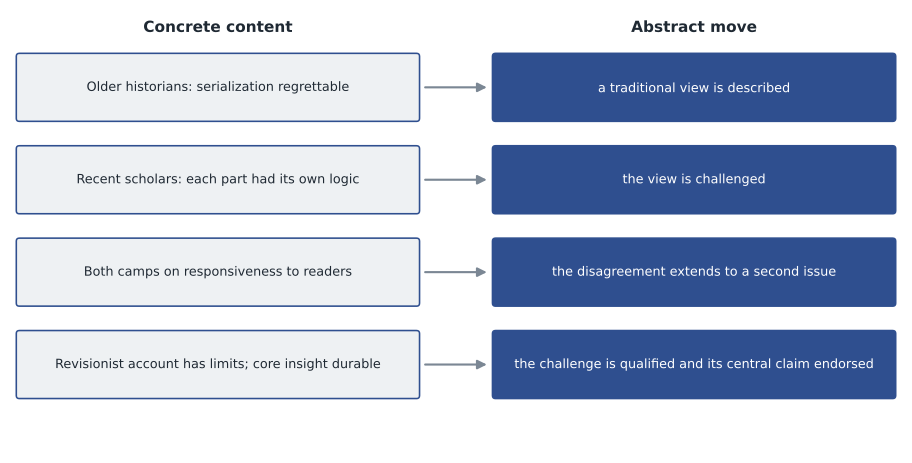
Ji-won said the translation felt like turning test cases into a test plan. 'The test plan doesn't say "enter the date 12/31"; it says "enter a boundary value",' she said. Harriet said that was exactly the level of abstraction the answers use.
The move-by-move check
Whole-passage organization answers usually describe three or four moves. The credited answer gets every move right, in order. A wrong answer usually gets most moves right and one wrong. Harriet's method is to check each move against the roadmap, in order, and eliminate an answer as soon as one move fails.
Common failures:
- Wrong move: the answer says a view is "rejected" when the author qualifies it, or "defended" when the author only reports it.
- Missing move: the answer omits a major paragraph, such as the author's concluding judgment.
- Extra move: the answer includes something that does not happen, such as "a solution is proposed" in a passage that only analyses a problem.
- Wrong order: the answer lists the right moves in the wrong sequence.
- Wrong number: the answer says "two competing explanations" when the passage gives one explanation with several parts.
Dani said the method reminded her of checking a client's timeline against their documents: every event had to be there, in the right order, with nothing added. Harriet said that was a useful comparison, since the wrong answers are designed like a timeline with one wrong date.
Practice passage
Here is the serial novel passage from lesson 5. Write an abstract roadmap: one abstract move per paragraph.
Passage D (humanities): the serial novel (written for this course)
Readers today usually encounter the great nineteenth-century English novels as single volumes, but many of them first appeared in instalments. Charles Dickens's Pickwick Papers, issued in monthly parts beginning in 1836, demonstrated the commercial potential of the format, and for the next several decades much of the era's most celebrated fiction reached its first readers a chapter or two at a time, in monthly numbers or in the pages of magazines.
Literary historians long treated serialization as a regrettable commercial pressure. Writing to deadlines, the argument went, encouraged padding, sensational chapter endings and loose construction; the serial novelist could not revise early chapters once they were in print, and plots meandered as authors improvised. On this account, the finest novels of the period succeeded in spite of their mode of publication.
More recent scholarship has questioned this judgment. Critics have pointed out that the instalment was not merely a container for fiction but a unit of composition with its own logic. Because readers waited weeks between parts, writers learned to give each instalment a shape of its own, an arc of rising interest and partial resolution, while sustaining larger patterns across months. Recurring characters, verbal tags and parallel scenes, sometimes dismissed as repetitive, helped readers hold a sprawling story in mind over an extended period.
Serialization also changed the relationship between authors and audiences. Novelists could learn how readers were responding while a work was still in progress, through sales figures, reviews and letters, and some adjusted their plans accordingly. To earlier critics, such responsiveness was evidence of pandering. Revisionist scholars see it differently: as a form of conversation in which a novel developed partly in dialogue with the community that read it, much as a long-running television drama does today.
The revisionist account has its own limits. It can romanticize the conditions under which authors worked, many of whom described serial deadlines as exhausting, and it risks treating every structural feature of a serial novel as a deliberate artistic choice when some were plainly accidents of haste. Still, its central insight has proved durable. To read these novels well, scholars now generally agree, one must recover something of how they were first read: in pieces, over time, and among others who were reading them too.
An abstract roadmap
Harriet's version:
- P1: background: a historical practice is introduced.
- P2: a traditional negative evaluation of the practice is described.
- P3: a more recent view challenges the traditional evaluation.
- P4: the two views are contrasted on a second issue.
- P5: the author qualifies the more recent view but endorses its central claim.
Worked problem
Sample question (written for this course)
Question: "Which one of the following most accurately describes the organization of Passage D?" (A) A practice is introduced, a traditional negative assessment of it is presented, that assessment is challenged on two fronts, and the challenge is itself qualified while its central insight is endorsed. (B) A literary practice is introduced, its commercial origins are traced, and its decline is explained. (C) Two competing assessments of a practice are presented, and the author rejects both in favour of a third. (D) A traditional assessment of a practice is defended against a recent challenge. (E) A practice is described, its advantages are listed, and a proposal for reviving it is offered.
Show solution
- (A) is correct. Each move matches: introduction (P1), traditional negative assessment (P2), challenge on composition (P3) and on audience relationship (P4), qualification with endorsement of the core insight (P5).
- (B) has an extra move: the passage never explains a decline of serialization.
- (C) is wrong on the last move: the author does not reject the revisionist view but endorses its central insight.
- (D) reverses the direction: the traditional assessment is challenged, not defended.
- (E) adds a proposal that never appears.
Answer: (A). Check each move in order; one wrong move eliminates an answer.
Paragraph-level questions
Questions about a single paragraph ask what it is "primarily concerned with" or how it is organized. The answer must cover the whole paragraph, not one sentence of it. For Passage D's fifth paragraph, "to identify limits of the revisionist account and affirm its central insight" covers both halves; "to criticize revisionist scholars" captures only the first half and misses the turn at "Still."
A particular trap in paragraph questions is the answer that correctly describes a neighbouring paragraph. Test writers know that readers sometimes lose track of paragraph boundaries. Your roadmap protects you: check the number of the paragraph in the question against your notes before reading the choices.
Relationship questions
Questions about how two paragraphs relate ask you to name the connection. Typical relationships include:
- The second paragraph provides evidence for a claim in the first.
- The second paragraph challenges the view described in the first.
- The second paragraph extends the discussion to a related issue.
- The second paragraph illustrates a general claim from the first with an example.
- The second paragraph qualifies a conclusion reached in the first.
In Passage D, the fourth paragraph relates to the third by extending the disagreement between the two camps to a second issue: from how novels were constructed to how authors related to readers. The structural signal is "also" in "Serialization also changed the relationship."
Élodie noticed that the relationship answers used almost the same verbs as the purpose answers in lesson 6. Harriet said that was no accident. 'A purpose is a relationship between the whole passage and its reader,' she said. 'A relationship question asks for the purpose of one part relative to another.'
Organization questions on other passages
Harriet had the group translate the earlier passages into one-line abstract organizations.
- Passage A: A legal doctrine is introduced and an objection posed; two justifications are given; critics argue that changed conditions weaken both; reforms are described; the author offers a cautious assessment.
- Passage B: A finding that conflicts with standard theory is described; the theory's difficulty is explained; a policy movement based on the finding is described; criticisms are presented; defenders reply.
- Passage C: A phenomenon is defined and explained; a change in how it is regarded is noted; its uneven effects are described; responses are discussed and a caution is offered.
Marcus said that writing these made him realize he could answer most organization questions in under thirty seconds, because the roadmap had done the work during reading. Harriet said that was the point of the whole first half of the course.
The second October 28 set
The session ended with six organization and paragraph questions. Ji-won answered all six correctly, Thomas, Élodie and Marcus five, and Dani four. Three of the group's five misses were answers with one extra move, which Harriet said was the most common trap in this family. Dani's two misses were both paragraph questions answered with descriptions of the neighbouring paragraph; she decided to say the paragraph number aloud before reading choices.
Practice: a relationship question
Harriet finished the lesson with a relationship question on the heat island passage from lesson 4, which the group had already mapped.
Worked problem
Sample question (written for this course)
Question: "In Passage C, the fifth paragraph is related to the second paragraph in which one of the following ways?" (A) The fifth paragraph rejects the explanation offered in the second. (B) The fifth paragraph provides evidence that the causes described in the second have been exaggerated. (C) The fifth paragraph introduces a new cause not mentioned in the second. (D) The fifth paragraph describes measures that address the mechanisms identified in the second. (E) The fifth paragraph restates the second paragraph in more technical terms.
Show solution
- The second paragraph lists the causes: heat-absorbing surfaces, trapped radiation and blocked wind, lost evaporation, and waste heat. The fifth says strategies "target the same mechanisms that produce it": reflective surfaces, shade and evaporation from trees, green roofs.
- (D) is correct: the fifth paragraph describes responses aimed at the second paragraph's mechanisms.
- (A) is wrong: the fifth paragraph accepts the explanation and builds on it.
- (B) is wrong: nothing suggests the causes have been exaggerated.
- (C) is wrong: the fifth paragraph discusses responses, not new causes.
- (E) is wrong: the fifth paragraph is about solutions, not a restatement of causes.
Answer: (D). Relationship questions name the connection between two parts; here, mechanisms and the measures that target them.
Marcus said this was the question he had predicted in lesson 4, when he noticed the internal echo between the two paragraphs. Harriet said that noticing an echo while reading is the best possible preparation for a relationship question, because the test writer noticed it too.
Ji-won asked whether relationship questions always involved neighbouring paragraphs. Harriet said no: as this example shows, they often connect paragraphs that are far apart, which is another reason to keep a roadmap rather than relying on memory of the paragraph you have just read.
Common mistakes
MistakeChoosing an organization answer that gets most moves right.
InsteadCheck every move in order; one wrong, missing or extra move eliminates the answer.
MistakeDescribing only one sentence when the question asks about a paragraph.
InsteadThe answer must cover the whole paragraph, including any turn within it.
MistakeAnswering with a description of the neighbouring paragraph.
InsteadCheck the paragraph number against your roadmap before reading the choices.
MistakeBeing put off by abstract wording.
InsteadTranslate your roadmap into abstract moves before reading the choices.
MistakeAccepting "rejects" when the author qualifies.
InsteadMatch the strength of each move as well as its direction.
Summary and key terms
- Organization questions ask about the sequence of moves in the whole passage, the structure of a paragraph or the relationship between parts.
- Answers use abstract language; translate your roadmap into abstract moves before reading them.
- Check each move in order; wrong, missing, extra and misordered moves eliminate answers.
- Paragraph questions require an answer that covers the whole paragraph.
- Relationship questions name the connection between two parts: evidence, challenge, extension, illustration or qualification.
- Abstract move
- A general description of what a part of a passage does, such as "a traditional view is challenged."
- Organization question
- A question about how a passage or paragraph is put together.
- Relationship question
- A question about how one part of a passage connects to another.
- Extra move
- An answer element describing something that does not happen in the passage.
- Qualification
- A move that limits or adjusts a claim without rejecting it.
Practice problems
Work each problem on paper first, then reveal the answer to check.
Translate into an abstract move: "Critics respond that both justifications fit poorly with modern conditions."
Show answer
Objections are raised against the justifications previously described.
What structural signal shows that Passage D's fourth paragraph extends the discussion?
Show answer
"Also" in "Serialization also changed the relationship."
Why is "to criticize revisionist scholars" an incomplete description of Passage D's fifth paragraph?
Show answer
It omits the turn at "Still," where the author endorses the revisionists' central insight.
An answer says Passage C "presents two competing explanations." What kind of error is this?
Show answer
A wrong-number or wrong-move error: the passage gives several complementary causes, not competing explanations.
Write a one-line abstract organization for Passage B.
Show answer
A surprising finding is described, its conflict with theory explained, a policy movement it prompted is described, and criticisms and replies are presented.
Lesson quiz · 5 questions
Score 60% or more to complete this lesson.
Create a free account to save your progress, take quizzes and earn a certificate.