
LSAT-120 · Lesson 3 of 12 · 21 min
Annotation and note-taking
▶ Video coming soon A video version of this lesson is on the way.
The second reading lab, on Wednesday, October 7, began with a screenshot. Harriet had asked everyone to send her an image of the first passage from their latest LawHub practice section, highlighted the way they had highlighted it under timed conditions. She put all five side by side.
Dani's passage was almost entirely yellow. Marcus had highlighted every number and every technical term. Élodie had highlighted nothing, because she said it slowed her down. Thomas had highlighted about six phrases, most of them turning points. Ji-won had highlighted the first sentence of every paragraph, which she had read was a good shortcut.
'If everything is highlighted, nothing is,' Harriet said, pointing at Dani's screen. 'And if nothing is highlighted, you are carrying the whole structure in your head while the clock runs.' She turned to Ji-won's. 'First sentences are a good place to look, but they are not always where the important thing is. Today is about marking what matters and only that.'
What annotation is for
Annotation is a tool for active reading, not a substitute for it. Its purpose is to make the structure you have understood visible, so that when a question asks about the critics' view or the author's attitude or the third paragraph, you can find the relevant text in seconds. Good annotation is sparse, consistent and fast. It marks a small number of things that the questions are likely to ask about.
Annotation also keeps you engaged. Deciding whether a phrase deserves a mark forces you to ask what it is doing, which is the central habit of active reading. Élodie's approach of marking nothing works for some strong readers, but it removes this check, and it makes returning to the passage slower.
The tools on the test
The LSAT is taken on a computer, and the testing interface lets you highlight text in the passage. LSAC's official tutorial and the practice tests on LawHub show the current tools, including how to apply and remove highlighting; practise with them so that using them costs no thought on test day. Rules about scratch paper and note-taking materials depend on how and where you test, so check LSAC's current instructions for your test rather than relying on what a friend did in an earlier year.
Because the tools may differ from what you are used to on paper, Harriet recommended building the habit around ideas rather than around a particular colour or symbol: decide what you will mark and why, then use whatever the interface offers.
What to mark
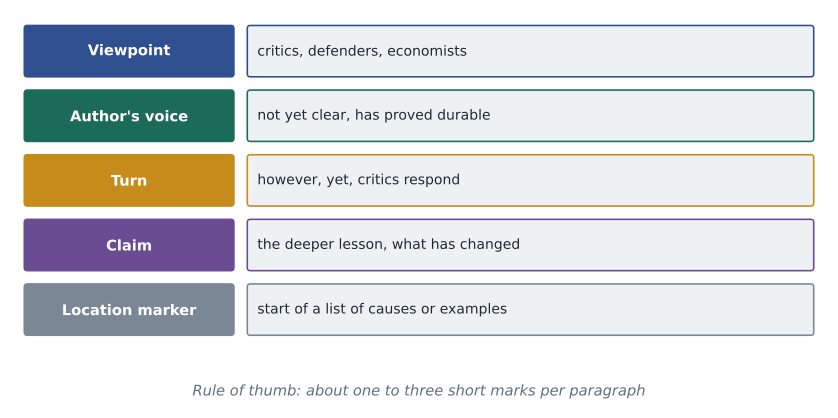
Harriet's rule of thumb was to mark no more than about one to three short phrases per paragraph. She gave the group five categories that deserve a mark.
- Viewpoints. The names or descriptions of people or groups who hold a position: "defenders," "critics," "economists," "revisionist scholars," "some researchers." Mark the label, not the whole sentence.
- The author's voice. Words that reveal the author's own judgment: "persuasive," "flawed," "not yet clear," "more plausible," "unfortunately." These are often a single adjective or adverb and easy to miss.
- Turns. Words that change direction: "but," "however," "yet," "critics respond," "this view has changed." A turn often marks the boundary between two viewpoints.
- Conclusions and claims. The main claim of the passage and the main claim of each viewpoint. Often signalled by "thus," "therefore," "the lesson is," "what has changed."
- Lists and examples, by location only. If a paragraph lists three causes or gives an example, mark the start so you can return to it. Do not mark every item.
What not to mark
Do not mark background facts, definitions you understood, or details that merely support a point you have already marked. Do not mark whole sentences. Do not mark something because it sounds important or because it contains a number. Marcus said this last rule hurt. Harriet pointed out that in the passage he had highlighted, none of the eleven numbers he had marked was asked about, while two questions had turned on a single word, "partly," that he had not marked.
Paragraph notes
In addition to marking the text, many strong readers keep a brief note for each paragraph: three to six words describing what the paragraph does. Whether you write these notes on scratch paper or hold them in your head depends on your testing situation and your preference. The notes together form a roadmap of the passage, which lesson 4 develops further.
Good paragraph notes describe function, not content. "Economists expected terms to matter; defaults mattered more" is a content note. "Surprising finding vs. standard theory" is a function note. Function notes are shorter and more useful, because most structural questions ask what a paragraph does.
Practice passage
Read the following passage once, marking it according to the five categories and writing (or thinking) a function note for each paragraph. Then compare your marks with the walkthrough.
Passage B (social science): defaults and retirement saving (written for this course)
When employers began offering retirement savings plans to which workers could contribute part of their wages, economists expected participation to depend on the plans' terms: the higher the employer's matching contribution and the greater the tax advantage, the more workers would join. Yet studies of individual firms in the late 1990s revealed something the standard account could not easily explain. When a company changed nothing about its plan except the default, enrolling new employees automatically unless they chose to opt out rather than requiring them to opt in, participation among new hires rose dramatically, in some studies from well under half to more than four in five.
Standard economic theory has difficulty with this result. If a worker's decision to save reflects a careful weighing of present and future consumption, the effort required to tick a box on a form should be trivial by comparison, and the default should make little difference. That it makes a large difference suggests that many decisions are shaped by forces the theory had treated as negligible: inertia, procrastination, and a tendency to treat the default as an implicit recommendation from the employer.
These findings helped launch a policy movement. Advocates argued that if defaults influence behaviour so strongly, policymakers and employers should choose defaults deliberately, steering people toward choices they would likely endorse on reflection while leaving them free to choose otherwise. Several countries have since built automatic enrolment into national pension policy, and many employers have adopted it voluntarily.
The approach has not escaped criticism. Some critics object on grounds of principle, arguing that designing choices to exploit predictable lapses in attention is manipulative even when the goal is benign. Others raise practical concerns. The same inertia that keeps workers in a plan may also keep them at the default contribution rate, which designers often set low to discourage opting out; a worker who would have chosen a higher rate under an opt-in system may end up saving less. Still others note that automatic enrolment raises participation most among workers least able to afford reduced take-home pay, for whom saving may not be the wisest use of scarce income.
Defenders reply that these objections argue for better defaults rather than none. Every plan must have some default; even requiring an active choice is a design decision. The question, then, is not whether to influence choices but how. A low default rate can be paired with automatic annual increases, and workers with pressing needs can opt out at any time. The deeper lesson of the research, on this view, is not that people are irrational but that context matters more than the older models assumed, and that those who design institutions bear responsibility for the contexts they create.
Walking through the marks
Here is how Harriet marked the passage, with her reasons.
First paragraph. She marked "economists expected" (a viewpoint) and "Yet" (a turn), and flagged the start of the finding ("participation among new hires rose dramatically"). She did not mark the figures "well under half to more than four in five"; they support the finding and can be found if needed. Function note: "expectation vs. surprising default result."
Second paragraph. She marked "Standard economic theory has difficulty" (viewpoint plus claim) and the list "inertia, procrastination, and a tendency to treat the default as an implicit recommendation" by location only. Function note: "why theory can't explain it."
Third paragraph. She marked "Advocates argued" (viewpoint). Function note: "policy movement built on findings."
Fourth paragraph. She marked "criticism," and the three groups of critics by their labels: "on grounds of principle," "practical concerns," "Still others." Function note: "three criticisms."
Fifth paragraph. She marked "Defenders reply" (viewpoint and turn) and "The deeper lesson" (a claim). Function note: "defenders' reply; context matters."
Dani counted. Harriet had made eleven short marks in five paragraphs. Dani's own copy had about forty highlighted lines. 'And mine took longer,' Dani said.
Where is the author?
Ji-won raised a sharp question: in Passage B, where is the author's voice? Harriet asked the group to look. The passage reports the views of economists, advocates, critics and defenders, and the final sentence gives the defenders' "deeper lesson" with the qualifier "on this view." The author never clearly endorses either side.
That observation is itself important. A passage that presents a debate and reports both sides' best arguments without endorsing either is common on the test. If a question asks about the author's attitude toward automatic enrolment, the best answer will describe a balanced or neutral presentation, not enthusiasm or hostility. An annotation system that marks the author's voice also tells you when that voice is absent.
Thomas noted that the passage seemed slightly more sympathetic to the defenders, since they get the last word. Harriet agreed that ordering can suggest emphasis but warned against reading it as endorsement. 'Last word is not the same as the author's word,' she said. 'If a question asks what the author believes, you need words in the text, not position.'
Annotation under time pressure
The whole point of a sparse system is speed. Harriet timed the group reading and marking Passage B. Thomas took 3 minutes 10 seconds. Élodie, marking for the first time, took 3 minutes 40, compared with 3 minutes 20 without marking, but she then answered the six questions Harriet had prepared in 4 minutes, a minute faster than she had managed on similar sets without marking. Dani, holding herself to three marks per paragraph, read in 4 minutes flat instead of her usual 5. Ji-won, with extended time, took 5 minutes 20 seconds and said that marking turns rather than first sentences made her notice the critics' paragraph, which she would otherwise have skimmed.
Marcus took the longest, because he kept deciding not to mark numbers and then hesitating. Harriet told him that the hesitation would disappear with practice, and that it was the sound of a habit changing.
Worked problem
Sample question (written for this course)
Question: "According to Passage B, which one of the following is a concern raised by critics of automatic enrolment?" (A) Workers who are enrolled automatically may remain at a low default contribution rate. (B) Automatic enrolment reduces the tax advantages of retirement plans. (C) Employers have refused to adopt automatic enrolment voluntarily. (D) Automatic enrolment has no effect on participation rates. (E) Workers cannot opt out of plans once they have been enrolled automatically.
Show solution
- (A) is correct. The fourth paragraph says the inertia that keeps workers in a plan may also keep them at a default rate that designers often set low.
- (B) is never mentioned; tax advantages appear only in the economists' original expectations.
- (C) contradicts the third paragraph, which says many employers have adopted it voluntarily.
- (D) contradicts the first paragraph's finding that participation rose dramatically.
- (E) contradicts the fifth paragraph, which says workers can opt out at any time.
Answer: (A). With the critics' paragraph marked by its three labels, this answer takes seconds to confirm.
A word about comparative sets
Comparative reading sets, covered in LSAT-121, present two shorter passages on a related topic. The same annotation system works, with one addition: keep track of which passage each view comes from. A short function note for each passage as a whole ("Passage A: case for reform; Passage B: doubts about it") is often more useful than notes for each paragraph, because most comparative questions ask how the passages relate. Harriet asked the group to practise their annotation on single passages first and to add the comparative habit only once the basic system felt automatic.
Ji-won asked whether she should mark more in a comparative set because there were two authors to track. Harriet said the opposite was usually true: each passage is shorter, so fewer marks are needed, and the extra work happens in the passage notes, not in the highlighting.
Common mistakes
MistakeHighlighting most of the passage.
InsteadMark about one to three short phrases per paragraph: viewpoints, the author's voice, turns, claims and the location of lists.
MistakeHighlighting numbers and technical terms by reflex.
InsteadMark details by location only, and only when they belong to a list or example you may need to find.
MistakeWriting paragraph notes that summarize content.
InsteadWrite short function notes: what the paragraph does in the argument.
MistakeAssuming the side with the last word is the author's side.
InsteadLook for words in which the author speaks for themselves; if there are none, the passage may be balanced.
MistakeRelying on remembered rules about scratch paper.
InsteadCheck LSAC's current instructions for your testing situation, and practise with the official interface.
Summary and key terms
- Annotation makes the structure you understood visible so you can return to the right place quickly.
- Mark viewpoints, the author's voice, turns, main claims and the location of lists and examples, about one to three short phrases per paragraph.
- Do not mark background, whole sentences or numbers by reflex.
- Paragraph notes should describe function, not content.
- An annotation system that looks for the author's voice also reveals when the author stays neutral.
- Sparse marking can add a few seconds to reading and save more time on the questions.
- Annotation
- Brief marks on a passage that record its structure and key positions.
- Function note
- A few words describing what a paragraph does in the passage.
- Location marker
- A mark that shows where a list or example begins, so you can return to it.
- Viewpoint label
- The word or phrase that identifies who holds a position, such as "critics" or "economists."
- Balanced passage
- A passage that presents a debate without the author endorsing either side.
Practice problems
Work each problem on paper first, then reveal the answer to check.
Name the five categories of things worth marking.
Show answer
Viewpoints, the author's voice, turns, main claims, and the location of lists and examples.
Write a function note for the second paragraph of Passage B.
Show answer
Why standard theory cannot explain the result. (Any close function note.)
Why did Harriet not mark the participation figures in the first paragraph?
Show answer
They support the finding and can be found if needed; marking them adds time without improving the map.
In Passage B, what tells you the final "deeper lesson" is not necessarily the author's own view?
Show answer
The phrase "on this view," which attributes it to the defenders.
How many marks per paragraph does Harriet's rule of thumb allow?
Show answer
About one to three short phrases.
Lesson quiz · 5 questions
Score 60% or more to complete this lesson.
Create a free account to save your progress, take quizzes and earn a certificate.