
LSAT-120 · Lesson 12 of 12 · 59 min
Capstone: a timed set of two passages
▶ Video coming soon A video version of this lesson is on the way.
On Friday evening, November 20, 2026, two days after the last regular reading lab, the Thursday Circle met for the capstone of the reading series. Harriet had written two new passages, one about how courts read statutes and one about dating wood by tree rings, each with seven questions. That made two of the four sets of a real section, with the matching time: 17 minutes 30 seconds for everyone except Ji-won, whose accommodated time was 26 minutes 15 seconds.
It was a crowded week for the group: the Thursday mini diagnostic the night before, this drill on Friday, and the capstones of the Tuesday workshop series and the Sunday clinic still to come on the weekend. Harriet said she had stacked them on purpose. 'On test day you will read four passages and two Logical Reasoning sections in one sitting,' she said. 'Tired reading is a skill too.'
Élodie had a particular reason to care about the result. On the Thursday mini diagnostic she had answered four of seven Reading Comprehension questions correctly and run out of time again. Tonight she would test her new pacing plan: read actively in about three and a half minutes, check her time at the end of the first set, flag rather than agonize.
This lesson contains the full drill, with an explanation for every answer choice, followed by the group's results and Harriet's debrief. Take the drill yourself, timed, before reading the explanations.
How to take the drill
- Set a timer for 17 minutes 30 seconds (or your own accommodated time for two sets).
- Read each passage actively, building a roadmap and marking viewpoints, the author's voice and turns.
- State the main point and the author's position to yourself before starting each set of questions.
- Your checkpoint is the end of the first set at about 8 minutes 45 seconds.
- Answer every question. Flag any you are unsure of and, when time is up, do blind review on the flagged questions before reading the explanations. Record your timed and blind review scores separately.
Set 1
Capstone passage 1 (law): reading statutes (written for this course)
When a court must decide what a statute means, it rarely lacks for evidence. There is the text itself; the structure of the statute as a whole; the problem the legislature was evidently trying to address; the record of debates and committee reports; and the consequences of each competing reading. The hard question is not where to look but how much weight each source deserves when they point in different directions.
One influential answer gives decisive weight to the text. Its proponents argue that the words of a statute are the only thing the legislature actually enacted. Committee reports and floor statements reflect the views of some legislators, not the body as a whole, and the purpose of a statute is often contested: legislation frequently results from compromise, so a provision may deliberately stop short of the goal its supporters wanted. A judge who extends a statute to serve its supposed purpose may therefore undo the compromise that made its passage possible. Textualists add a concern about legitimacy: elected legislators, not appointed judges, are entitled to make policy, and fidelity to the enacted words keeps judges within their role.
Critics reply that this answer promises more than it can deliver. Words acquire meaning only in context, and deciding which context matters, whether ordinary usage, technical usage, the rest of the statute or the circumstances of enactment, requires judgment of exactly the kind textualism claims to avoid. Moreover, legislatures cannot foresee every situation; when a statute written for one world meets circumstances its drafters never imagined, a reading confined to dictionary meanings may produce results no one intended and few would defend.
In practice the opposition is less stark than the debate suggests. Most judges who describe themselves as textualists consult structure and context, and most who emphasize purpose begin with the words. The Supreme Court of Canada has for decades endorsed a "modern principle" under which the words of an Act are read in their entire context, in their grammatical and ordinary sense, harmoniously with the scheme and object of the Act and the intention of the legislature. In the United States, by contrast, the Supreme Court in recent decades has moved toward a more text-centred approach, though its members continue to disagree about how far that approach should go.
What divides the camps, then, is less a choice between text and purpose than a disagreement about defaults: about which source should prevail when the others are uncertain, and about who should bear the risk that a statute fails to anticipate a case. Seen this way, interpretive theory is partly a theory of institutional responsibility, an account of whether the courts or the legislature should correct a statute that has misfired.
Worked problem
Drill question 1 (main point)
Question: "Which one of the following most accurately expresses the main point of the passage?" (A) Judges should give decisive weight to the text of a statute because only the text is enacted. (B) Legislative history is an unreliable guide to the meaning of statutes. (C) The disagreement between text-centred and purpose-centred approaches is less about which sources to consult than about which should prevail and which institution should bear the risk of a statute's failure. (D) Courts in Canada and the United States interpret statutes in the same way. (E) Textualism has been abandoned by most judges because it cannot account for context.
Show solution
- (C) is correct. It captures the final paragraph's reframing of the debate ("less a choice between text and purpose than a disagreement about defaults") and the idea of institutional responsibility, which is where the author's own view appears.
- (A) states the textualists' position from the second paragraph, a wrong-voice answer.
- (B) is a narrower point attributed to textualists (committee reports reflect only some legislators).
- (D) contradicts the fourth paragraph, which contrasts the two countries' approaches.
- (E) is too strong and unsupported: the passage says most self-described textualists consult context, not that textualism has been abandoned.
Answer: (C). The main point is the author's reframing in the last paragraph, prepared by the fourth.
Worked problem
Drill question 2 (detail)
Question: "According to the passage, proponents of giving decisive weight to the text argue that committee reports and floor statements" (A) reflect the views of some legislators rather than the legislature as a whole (B) are more reliable than the text when a statute is ambiguous (C) are rarely available to judges (D) usually confirm the purpose a statute was meant to serve (E) were endorsed as interpretive sources by the Supreme Court of Canada
Show solution
- (A) is correct; the second paragraph says exactly this.
- (B) reverses the textualists' view.
- (C) is never stated; the first paragraph lists the record of debates and committee reports among the available evidence.
- (D) is unsupported; textualists say purpose is often contested.
- (E) misattributes: the modern principle mentions the scheme, object and intention, not committee reports, and it is not part of the textualists' argument.
Answer: (A). Locate the textualists' paragraph and match the paraphrase.
Worked problem
Drill question 3 (function)
Question: "The author refers to the "modern principle" endorsed by the Supreme Court of Canada primarily in order to" (A) argue that Canadian courts interpret statutes more accurately than American courts (B) provide an example of a purely textual approach to interpretation (C) show that the Canadian approach ignores the words of statutes (D) explain why legislatures cannot foresee every situation (E) illustrate an approach that combines attention to the words with attention to context and purpose
Show solution
- Find the part: the fourth paragraph. The point it serves: "In practice the opposition is less stark than the debate suggests." The modern principle illustrates that point.
- (E) is correct: the principle reads words in context, in their ordinary sense, harmoniously with the scheme and object of the Act.
- (A) is an evaluation the author never makes.
- (B) reverses the example: the principle is not purely textual.
- (C) contradicts it: the principle begins with the words.
- (D) belongs to the critics' argument in the third paragraph.
Answer: (E). Function, not content: name the point the example serves.
Worked problem
Drill question 4 (inference (group view))
Question: "The passage suggests that the proponents described in the second paragraph would be most likely to agree with which one of the following?" (A) A statutory provision may deliberately go less far than its supporters wanted. (B) Judges should extend statutes to cover situations their drafters did not foresee. (C) The meaning of a statute's words cannot be determined without its legislative history. (D) Appointed judges are better placed than legislators to make policy. (E) Every statute has a single, uncontested purpose.
Show solution
- Locate: "legislation frequently results from compromise, so a provision may deliberately stop short of the goal its supporters wanted."
- (A) is correct: a modest paraphrase of their argument.
- (B) is the critics' concern and the opposite of the textualists' warning about undoing compromises.
- (C) contradicts their skepticism about legislative history.
- (D) reverses their legitimacy argument.
- (E) contradicts their claim that purpose is often contested.
Answer: (A). Read only the group's sentences and test what they are committed to.
Worked problem
Drill question 5 (meaning in context)
Question: "As used in the last sentence of the passage, "misfired" most nearly means" (A) been repealed by the legislature (B) been struck down by a court (C) been enforced too rarely (D) operated in a way its drafters did not intend or anticipate (E) been translated incorrectly
Show solution
- Reread: the preceding sentence speaks of "the risk that a statute fails to anticipate a case." A statute that has misfired is one that produces results its drafters did not intend or foresee.
- (D) is correct; substituting it preserves the meaning.
- (A) and (B) describe ways a statute ends or is invalidated, which the passage does not discuss.
- (C) concerns enforcement, not interpretation.
- (E) borrows an idea from an unrelated context.
Answer: (D). Use the sentence before as the key, then substitute.
Worked problem
Drill question 6 (organization)
Question: "Which one of the following most accurately describes the organization of the passage?" (A) A question about interpretation is posed, one answer and its rationale are described, objections to it are presented, the practical difference between the camps is shown to be smaller than it seems, and the debate is reframed. (B) Two interpretive methods are described, and the author argues that one of them should be adopted by all courts. (C) A historical survey of statutory interpretation is presented, followed by predictions about its future. (D) A problem with legislative drafting is described and a reform of legislative procedure is proposed. (E) A theory of interpretation is introduced and then refuted by evidence from Canadian and American courts.
Show solution
- Abstract roadmap: P1 the question of weight; P2 the textualist answer and its reasons; P3 critics' objections; P4 the opposition is less stark; P5 reframing as defaults and institutional responsibility.
- (A) matches move for move.
- (B) is wrong on the last move: the author does not argue for one method.
- (C) adds a historical survey and predictions that do not appear.
- (D) adds a reform proposal.
- (E) misdescribes the fourth paragraph, which narrows the opposition rather than refuting a theory.
Answer: (A). Check every move in order.
Worked problem
Drill question 7 (inference (author))
Question: "The author of the passage would be most likely to agree with which one of the following statements?" (A) Textualism is the only legitimate method of statutory interpretation. (B) Legislative history should never be consulted by judges. (C) Choosing an interpretive approach involves deciding, in part, whether courts or legislatures should correct statutes that fail to anticipate a case. (D) Judges who emphasize purpose ignore the words of statutes. (E) The interpretive debate has been resolved in favour of purpose-centred approaches.
Show solution
- Author's voice: the final paragraph calls interpretive theory "partly a theory of institutional responsibility."
- (C) is correct.
- (A) and (B) are stronger than any position in the passage, and the author takes no such side.
- (D) contradicts the fourth paragraph: "most who emphasize purpose begin with the words."
- (E) is unsupported; the author describes an ongoing disagreement.
Answer: (C). The author's view is in the last paragraph, stated cautiously ("partly").
Set 2
Capstone passage 2 (science): dating by tree rings (written for this course)
Trees in temperate climates add a layer of wood each growing season, and because the width of each annual ring reflects that year's conditions, wide in favourable years and narrow in dry or cold ones, a sequence of rings forms a pattern as distinctive as a bar code. Dendrochronology, the science of dating by tree rings, exploits this fact. Its central technique, cross-dating, matches patterns of wide and narrow rings among different trees from the same region. Once a living tree's rings are counted back from the present, its pattern can be matched against older timbers whose outer rings overlap with its inner ones, and those timbers in turn against still older wood, extending a continuous calendar far into the past.
The method was developed in the early twentieth century by the American astronomer A. E. Douglass, who hoped that tree rings would reveal cycles in solar activity. That hope was never fully realized, but his techniques proved invaluable elsewhere. In the American Southwest, cross-dating of beams from ancient pueblos allowed archaeologists to assign construction dates to individual years, transforming a chronology that had previously rested on rough estimates.
Since then, regional chronologies have been extended for thousands of years in parts of Europe and North America, using wood preserved in bogs, riverbeds and old buildings. These records have become essential to other sciences. Radiocarbon dating, which estimates age from the decay of carbon-14, depends on calibration: because the amount of carbon-14 in the atmosphere has varied over time, raw radiocarbon ages must be corrected using samples of known age, and tree rings dated to the exact year provide many of those samples.
Ring widths, together with measurements of wood density and chemical composition, also serve as records of past climate. Because the instrumental temperature record covers only the last century and a half or so in most places, tree-ring series offer one of the few archives of earlier conditions that can be read year by year, revealing droughts and cold spells that written sources mention only in passing, if at all.
Dendrochronologists are careful to note the method's limits. Trees respond to whatever factor most constrains their growth: moisture in dry regions, temperature near the treeline. A ring series is therefore a reliable climate record only where that limiting factor can be identified and has stayed the same over time. In some high-latitude forests, researchers have found that the close relationship between ring width and temperature observed in earlier decades has weakened in recent ones, for reasons still under study. Such findings do not undermine cross-dating itself, which depends only on shared patterns, but they counsel caution in reading climate from wood.
Worked problem
Drill question 8 (main point)
Question: "Which one of the following most accurately expresses the main point of the passage?" (A) A. E. Douglass failed to find evidence of solar cycles in tree rings. (B) Tree rings are the most accurate source of information about past climate. (C) Radiocarbon dating has replaced dendrochronology in archaeology. (D) Cross-dating tree rings yields precise chronologies that have become valuable to several sciences, although reading climate from rings requires caution. (E) The width of tree rings is determined entirely by temperature.
Show solution
- (D) is correct. It covers the method (P1), its development and archaeological use (P2), its role in radiocarbon calibration and climate study (P3 and P4), and the caution in the final paragraph.
- (A) is too narrow: one fact from the second paragraph.
- (B) is too strong: rings are "one of the few" annual archives, and the passage counsels caution.
- (C) reverses the relationship: radiocarbon dating depends on tree rings for calibration.
- (E) contradicts the final paragraph: rings respond to whatever factor limits growth, moisture or temperature.
Answer: (D). The right answer covers the method, its uses and its limits.
Worked problem
Drill question 9 (detail)
Question: "According to the passage, raw radiocarbon ages must be corrected because" (A) tree rings decay at an uneven rate (B) the amount of carbon-14 in the atmosphere has varied over time (C) archaeologists disagree about how to count tree rings (D) wood preserved in bogs is contaminated (E) the instrumental temperature record is short
Show solution
- Locate: the third paragraph. "Because the amount of carbon-14 in the atmosphere has varied over time, raw radiocarbon ages must be corrected."
- (B) is correct.
- (A), (C) and (D) are never stated.
- (E) echoes the fourth paragraph, about climate records, not radiocarbon.
Answer: (B). Locate, read, predict, match.
Worked problem
Drill question 10 (function)
Question: "The author mentions that Douglass hoped tree rings would reveal cycles in solar activity primarily in order to" (A) criticize Douglass for pursuing an unscientific goal (B) show that solar activity determines the width of tree rings (C) explain how cross-dating works (D) suggest that dendrochronology has been more useful to astronomy than to archaeology (E) indicate that the method proved valuable for purposes other than the one that motivated its development
Show solution
- The point it serves: "That hope was never fully realized, but his techniques proved invaluable elsewhere."
- (E) is correct.
- (A) is an evaluation the author never makes.
- (B) contradicts the passage: the hope was never fully realized.
- (C) belongs to the first paragraph.
- (D) reverses the passage, which gives the archaeological use as the success.
Answer: (E). Name the relationship between the detail and the turn that follows it.
Worked problem
Drill question 11 (inference)
Question: "It can be inferred from the passage that a newly discovered old timber could be added to an existing regional chronology only if" (A) its ring pattern overlaps with and matches part of the existing chronology (B) it comes from a tree that is still living (C) it was preserved in a bog (D) its age has first been established by radiocarbon dating (E) it grew near the treeline
Show solution
- Locate: the first paragraph. The chronology is extended by matching timbers "whose outer rings overlap with" the inner rings of wood already dated.
- (A) is correct: matching depends on overlap.
- (B) is wrong: older timbers are matched against living trees, but they need not be living.
- (C) is one source of preserved wood, not a requirement.
- (D) reverses the dependence: tree rings calibrate radiocarbon dates.
- (E) concerns climate sensitivity, not cross-dating.
Answer: (A). A small step from how the passage describes cross-dating.
Worked problem
Drill question 12 (detail (EXCEPT))
Question: "The passage mentions each of the following as a use of tree-ring records EXCEPT:" (A) assigning construction dates to ancient buildings (B) calibrating radiocarbon dates (C) predicting future droughts in a region (D) revealing past droughts and cold spells (E) providing climate information for periods before instrumental records
Show solution
- Confirm each choice in the passage.
- (A): the second paragraph (pueblo beams). (B): the third paragraph. (D) and (E): the fourth paragraph.
- (C) is correct: the passage discusses past droughts, not predictions of future ones.
Answer: (C). On EXCEPT questions, confirm each choice against the text rather than memory.
Worked problem
Drill question 13 (inference)
Question: "The author would be most likely to agree with which one of the following about the weakened relationship between ring width and temperature in some high-latitude forests?" (A) It shows that cross-dating is unreliable. (B) It proves that temperature no longer affects tree growth. (C) It has been fully explained by researchers. (D) It does not cast doubt on dates that cross-dating has assigned to tree rings. (E) It means that tree rings cannot be used as climate records anywhere.
Show solution
- Locate: the last two sentences of the passage. "Such findings do not undermine cross-dating itself, which depends only on shared patterns, but they counsel caution in reading climate from wood."
- (D) is correct.
- (A) contradicts the passage directly.
- (B) is far too strong: the relationship has weakened, not disappeared.
- (C) contradicts "for reasons still under study."
- (E) is a scope shift and too strong: the finding concerns some high-latitude forests and counsels caution.
Answer: (D). Watch strength and scope.
Worked problem
Drill question 14 (meaning in context)
Question: "As used in the final paragraph, the phrase "limiting factor" refers to" (A) the number of rings a tree can produce in its lifetime (B) the environmental condition that most constrains a tree's growth in a given place (C) a rule that restricts where dendrochronologists may collect samples (D) the maximum age of wood that can be cross-dated (E) the cost of measuring wood density
Show solution
- Reread: "Trees respond to whatever factor most constrains their growth: moisture in dry regions, temperature near the treeline."
- (B) is correct; the sentence before defines it.
- (A), (C), (D) and (E) give senses of "limit" that the passage never uses.
Answer: (B). The definition is in the sentence before.
Answer key
Answers by question number: 1 C, 2 A, 3 E, 4 A, 5 D, 6 A, 7 C, 8 D, 9 B, 10 E, 11 A, 12 C, 13 D, 14 B.
By family: main point 1 and 8; detail 2, 9 and 12; function 3 and 10; inference 4, 7, 11 and 13; meaning in context 5 and 14; organization 6.
Results and debrief
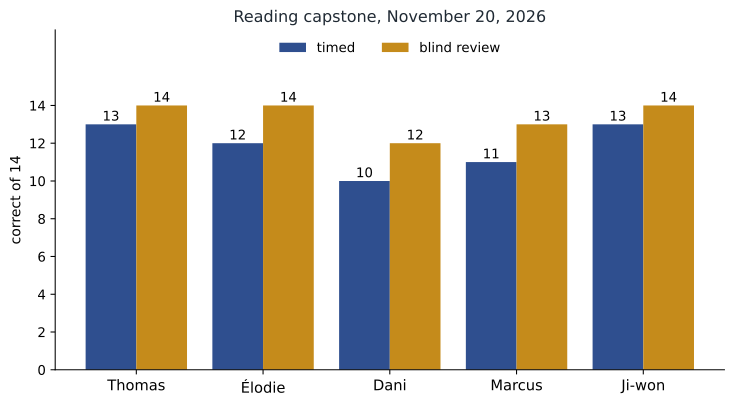
The timed scores, out of fourteen, were: Thomas 13, Ji-won 13, Élodie 12, Marcus 11 and Dani 10. After blind review: Thomas 14, Ji-won 14, Élodie 14, Marcus 13 and Dani 12.
Élodie finished both sets with forty seconds to spare and did not guess on a single question. Her checkpoint at the end of the first set read 8 minutes 30 seconds. She said the plan had worked mostly because she had stopped rereading paragraphs she already understood. Harriet pointed out that her blind review score matched the best in the group, and that her two timed misses were reading errors, not timing errors, which was exactly the change she had been aiming for since September 30.
Harriet went through the misses, grouped by the habit that would have prevented them.
- Wrong voice. Élodie and Marcus both missed question 4 by choosing the critics' concern about unforeseen situations. Élodie caught it in blind review once she reread only the second paragraph; Marcus did not, and said he would start every group-view question by finding the group's sentences first. Dani missed question 7 the same way, choosing the textualist position as the author's.
- Too narrow. Dani missed question 1 by choosing the point about legislative history. In blind review she still preferred it, until Harriet asked her whether it covered the fourth and fifth paragraphs.
- Content instead of function. Dani missed question 3 by choosing the answer about legislatures failing to foresee situations, which is true but belongs to the third paragraph. Marcus missed question 10 the same way. Both fixed it in blind review by asking "why is this here?"
- An extra move. Marcus missed question 6 by choosing the answer that included a historical survey. He caught it in blind review by checking each move against his roadmap.
- Over-reading. Élodie missed question 13 by choosing that tree rings could no longer serve as climate records, turning "counsel caution" into "cannot." She laughed and said "surinterprétation" before Harriet could, and fixed it in blind review.
- Misreading under pressure. Thomas's only miss was question 5, where he hesitated between two answers and chose "been enforced too rarely" after misreading the final sentence under time pressure. He corrected it in blind review by rereading the sentence before.
- Memory on EXCEPT. Dani missed question 12 by recalling that the passage mentioned droughts and choosing the drought answer without noticing the word "future." She got it in blind review by checking each choice against the text.
- One true miss. Ji-won's only timed miss was question 11. She chose the answer about radiocarbon dating, reversing the dependence between the two methods, and corrected it in blind review by rereading the first paragraph's description of cross-dating.
What the gaps mean
Harriet ended with the same reading of the numbers she used in the Logical Reasoning courses. A large gap between timed and blind review scores means the understanding is there and the habits are not yet automatic. A small gap with a lower score means content or method needs work. Élodie's gap had shrunk from a timing problem to two reading slips. Dani's two remaining blind review misses (questions 1 and 7) were both about whose voice an answer expressed, which gave her a single, clear focus. Marcus had scored eleven on a law passage and a science passage, with two of his three misses fixed in blind review, which he called progress. Thomas and Ji-won were consistent enough that Harriet suggested they spend most of their remaining Reading Comprehension time on the harder families in LSAT-121.
What comes next
LSAT-121 continues with comparative reading, the author's attitude in depth, analogy and application questions, effect-of-new-information questions, and techniques for dense science and law passages. Harriet asked each student to keep a Reading Comprehension section of their error log with two columns: the question family and the habit that would have prevented the miss. 'By January,' she said, 'the second column should have the same three or four habits on repeat. Those are the ones we will drill.'
Common mistakes
MistakeAnswering a question about a group with the critics' or the author's view.
InsteadFind the group's sentences first and test what they are committed to.
MistakeTurning a cautious statement ("counsel caution") into a strong one ("cannot").
InsteadCompare strength word for word before choosing.
MistakeAnswering EXCEPT questions from memory.
InsteadConfirm each choice against the text, and watch qualifiers such as "future."
MistakeTreating a timed drill score as the whole story.
InsteadCompare timed and blind review scores to separate habit problems from understanding problems.
Summary and key terms
- The capstone simulated two sets of a real section: two passages and fourteen questions in 17 minutes 30 seconds.
- Every question in the drill was answerable with the methods from this course: prediction for big-picture questions; locate, read, predict and match for detail, inference and function questions; substitution for meaning in context.
- The most common misses were wrong voice, content instead of function, extra moves, over-reading and EXCEPT questions answered from memory.
- Timed and blind review scores together show whether a miss reflects habit or understanding.
- LSAT-121 covers comparative reading, attitude, analogy, new information and dense passages.
- Capstone drill
- A timed practice set that combines all of a course's question families.
- Blind review
- Reworking flagged questions untimed, before seeing the answers.
- Habit error
- A miss that disappears in blind review because the method was known but not applied under time pressure.
- Understanding error
- A miss that remains in blind review, showing a gap in method or comprehension.
Practice problems
Work each problem on paper first, then reveal the answer to check.
Which two families appear most often among the group's misses?
Show answer
Inference questions about a group or the author (wrong voice) and function questions (content instead of function).
In set 2, why is "Tree rings are the most accurate source of information about past climate" wrong as the main point?
Show answer
It is too strong; the passage calls tree rings one of the few annual archives and counsels caution.
How does the passage about statutes reframe the debate?
Show answer
As a disagreement about defaults (which source prevails when others are uncertain) and about which institution should correct a statute that misfires.
What does a gap of four points between timed and blind review scores suggest?
Show answer
The understanding is largely there; the habits are not yet automatic under time pressure.
Write the error-log entry for missing question 13 by choosing "cannot be used as climate records anywhere."
Show answer
Family: inference. Habit: compare strength and scope; "counsel caution" is not "cannot," and "some forests" is not "anywhere."
Lesson quiz · 5 questions
Score 60% or more to complete this lesson.
Create a free account to save your progress, take quizzes and earn a certificate.