
LSAT-120 · Lesson 5 of 12 · 21 min
Viewpoints and the author's voice
▶ Video coming soon A video version of this lesson is on the way.
The fourth reading lab, on Wednesday, October 21, was the one Marcus had been dreading: Harriet had promised a humanities passage. She handed it out with a single instruction. 'Do not tell me what the passage says about serial novels. Tell me who says it.'
It took the group a while. Marcus listed the facts about Dickens and monthly instalments and then stopped. Dani found two groups, "literary historians" and "recent scholarship." Élodie found a third voice, the author, who appears at the end and disagrees with both groups in different ways. Ji-won found a fourth: the novelists themselves, who "described serial deadlines as exhausting." Thomas found all four and then said, slightly embarrassed, that this was the kind of passage he had written essays about.
'Humanities passages are rarely hard because of the facts,' Harriet said. 'They are hard because several people are talking, and the author's own view hides behind theirs. Tonight is about telling the voices apart.'
Why viewpoints matter
Many Reading Comprehension questions are really questions about who believes what. "According to the passage, critics of serialization believed..." "The author would most likely agree with which one of the following?" "Which one of the following best describes the revisionist scholars' view of..." If you know which sentences belong to which voice, these questions are quick. If you have merged the voices into one blurred summary, they become traps, because the wrong answers are often accurate statements of a view held by someone other than the person the question asks about.
Passages can contain several kinds of voices:
- Named individuals or groups: "A. E. Douglass," "economists," "critics," "revisionist scholars."
- Unnamed holders of a common view: "many people," "it is often said," "the standard account."
- Hypothetical objectors: "One might object that..."
- Subjects quoted or reported: the novelists who described deadlines as exhausting.
- The author.
Finding the author
The author is present in every passage, but not always as an advocate. Harriet described a scale. At one end is a purely descriptive author who explains a phenomenon or reports a debate without evaluating it. At the other is an argumentative author who states a thesis and defends it. Most passages fall somewhere between, often presenting several views and then offering a measured judgment.
The author's voice shows itself in a few kinds of language:
- Evaluative words: "persuasive," "flawed," "durable," "romanticize," "regrettable," "insight," "plainly." Adjectives and adverbs carry most of the author's attitude.
- Hedges and qualifications: "not yet clear," "less stark than the debate suggests," "partly," "some." Qualified judgments are the most common kind of authorial view on the test.
- Concessions: "admittedly," "to be sure," "the revisionist account has its own limits." A concession shows that the author sees the force of a view they do not fully share.
- Conclusions in the author's voice: "Still, its central insight has proved durable." "What has changed is the burden of justification."
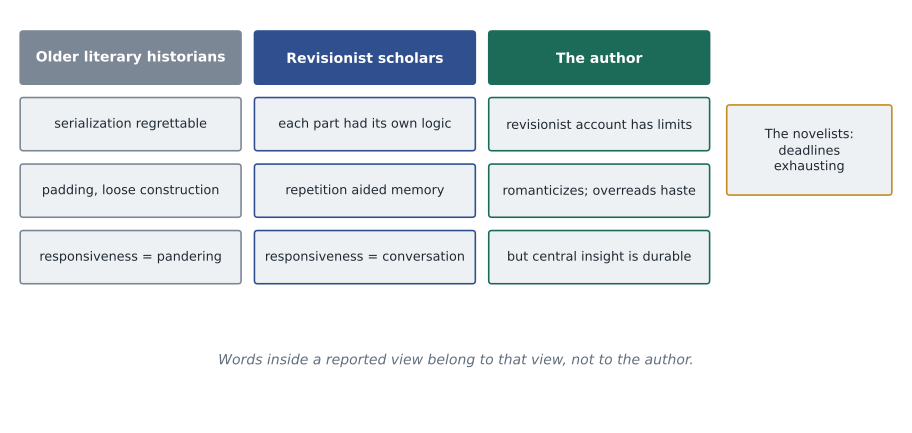
An important subtlety: words that appear inside a reported view belong to that view, not to the author. In Passage D, "regrettable commercial pressure" and "pandering" are the older critics' words. The author does not call serialization regrettable; the author reports that others did.
Practice passage
Read Passage D with one task in mind: build a viewpoint map. For each voice, note its position and the words that reveal it.
Passage D (humanities): the serial novel (written for this course)
Readers today usually encounter the great nineteenth-century English novels as single volumes, but many of them first appeared in instalments. Charles Dickens's Pickwick Papers, issued in monthly parts beginning in 1836, demonstrated the commercial potential of the format, and for the next several decades much of the era's most celebrated fiction reached its first readers a chapter or two at a time, in monthly numbers or in the pages of magazines.
Literary historians long treated serialization as a regrettable commercial pressure. Writing to deadlines, the argument went, encouraged padding, sensational chapter endings and loose construction; the serial novelist could not revise early chapters once they were in print, and plots meandered as authors improvised. On this account, the finest novels of the period succeeded in spite of their mode of publication.
More recent scholarship has questioned this judgment. Critics have pointed out that the instalment was not merely a container for fiction but a unit of composition with its own logic. Because readers waited weeks between parts, writers learned to give each instalment a shape of its own, an arc of rising interest and partial resolution, while sustaining larger patterns across months. Recurring characters, verbal tags and parallel scenes, sometimes dismissed as repetitive, helped readers hold a sprawling story in mind over an extended period.
Serialization also changed the relationship between authors and audiences. Novelists could learn how readers were responding while a work was still in progress, through sales figures, reviews and letters, and some adjusted their plans accordingly. To earlier critics, such responsiveness was evidence of pandering. Revisionist scholars see it differently: as a form of conversation in which a novel developed partly in dialogue with the community that read it, much as a long-running television drama does today.
The revisionist account has its own limits. It can romanticize the conditions under which authors worked, many of whom described serial deadlines as exhausting, and it risks treating every structural feature of a serial novel as a deliberate artistic choice when some were plainly accidents of haste. Still, its central insight has proved durable. To read these novels well, scholars now generally agree, one must recover something of how they were first read: in pieces, over time, and among others who were reading them too.
Building the viewpoint map
Harriet worked through the passage with the group.
First paragraph. Background in a neutral voice: the novels first appeared in instalments, and Pickwick Papers showed the format's commercial potential. No evaluation yet.
Second paragraph. The older view: "Literary historians long treated serialization as a regrettable commercial pressure." "The argument went" marks the rest as reported: padding, sensational endings, loose construction, novels succeeding "in spite of" serialization.
Third paragraph. The newer view: "More recent scholarship has questioned this judgment." Critics argue that the instalment was "a unit of composition with its own logic." Features once dismissed as repetitive are reinterpreted as aids to memory.
Fourth paragraph. Both views on a second issue, the author-audience relationship. Earlier critics saw "pandering"; revisionists see "a form of conversation." Each word belongs to its camp.
Fifth paragraph. The author speaks: "The revisionist account has its own limits." Two criticisms follow: it can romanticize working conditions, and it can treat accidents as artistic choices. Then the author's conclusion: "Still, its central insight has proved durable." The final sentence reports a broad scholarly agreement ("scholars now generally agree") that the author evidently shares.
The author, then, is neither an older critic nor a full revisionist. The author accepts the revisionists' core claim but criticizes their excesses. That kind of qualified agreement is one of the most common authorial positions on the test.
Marcus said that once he had the map, the passage stopped feeling like an art history lecture and started feeling like a design review. 'Old spec, new spec, reviewer's comments,' he said. Harriet said that was a perfectly good way to think about it.
Degrees of agreement
Questions about the author's view often offer answers that differ only in strength. For Passage D, compare:
- "The author believes that the revisionist account is entirely correct." Too strong: the author identifies limits.
- "The author believes that the revisionist account is fundamentally mistaken." Wrong direction: the author calls its central insight durable.
- "The author believes that the revisionist account, despite some overstatements, has improved scholars' understanding of serialized fiction." Matches the qualified agreement.
Ji-won asked how to tell "overstatements" from "limits." Harriet said the test rewards meaning, not matching words: romanticizing working conditions and treating accidents as deliberate choices are both ways of overstating the case, so the paraphrase is fair. What the test punishes is a change in strength or direction.
Tone
Tone is the attitude the author's language conveys toward a subject: approving, critical, skeptical, admiring, neutral, cautious. Test writers rarely give authors extreme tones. Most authors are measured, and the credited answer to an attitude question is usually moderate: "qualified approval," "cautious skepticism," "measured appreciation." Strong words like "scornful," "enthusiastic," "outraged" or "dismissive" are almost always wrong unless the passage contains equally strong language. LSAT-121 covers attitude questions in depth; for now, the habit to build is noticing evaluative words while you read.
Élodie said she had always been told that academic writing was neutral. Harriet said that was true of the voice but not of the content. 'Academic authors take positions all the time,' she said. 'They just do it with hedges instead of exclamation marks. "Has its own limits" is a criticism. "Has proved durable" is praise. Train your ear for quiet judgments.'
Tracking viewpoints in other passages
Harriet briefly revisited the earlier passages. In Passage A (adverse possession), the voices are defenders, critics, reforming jurisdictions and the author, who is cautious and concludes that the doctrine now bears a burden of justification. In Passage B (defaults), the voices are economists, advocates, three groups of critics and defenders, and the author stays balanced throughout. In Passage C (heat islands), the voices are mostly "researchers," and the author is largely explanatory, endorsing caution in the final paragraph.
Thomas observed that each of the four passages had a different kind of author: cautious judge, neutral reporter, explainer and qualified ally. Harriet said that was the point of choosing them.
The cost of merging voices
Dani admitted that on her diagnostic, she had chosen an answer that said the author believed something the passage attributed to critics. Harriet asked the group how common that mistake was in their error logs. Every one of them had at least one. Dani had four.
Harriet's fix was simple: when a question asks about a particular voice, find that voice's label in the passage before reading the answers, and read only the sentences that belong to it. If the question asks about the author, look first at the sentences with evaluative language in the author's own voice, usually in the first or last paragraph.
Worked problem
Sample question (written for this course)
Question: "The author of Passage D would be most likely to agree with which one of the following statements?" (A) Serialization was a commercial pressure that prevented the period's novelists from producing well-constructed fiction. (B) Every recurring character and parallel scene in a serial novel was a deliberate artistic choice. (C) Readers' responses had no effect on how serial novels developed. (D) Novelists who wrote for serial publication found the work less demanding than writing complete volumes. (E) Understanding how serial novels were first published can improve how they are read today.
Show solution
- (E) is correct. The final paragraph says the revisionist insight is durable and that scholars now agree one must recover how these novels were first read.
- (A) is the older critics' view, which the author does not adopt.
- (B) is the excess the author criticizes: some features were "plainly accidents of haste."
- (C) contradicts the fourth paragraph, which says some novelists adjusted their plans in response to readers.
- (D) contradicts the fifth paragraph: many authors described serial deadlines as exhausting.
Answer: (E). The tempting wrong answers are accurate statements of other voices (A) or of the view the author criticizes (B).
Practice: sorting voices in a short paragraph
Harriet gave the group a short paragraph, written for the course, and asked them to identify every voice and the author's position.
"Some legal historians have argued that the jury trial survived in the common law world chiefly because it served the interests of the Crown, which used juries to share responsibility for unpopular verdicts. The argument has an appealing cynicism, and it explains certain episodes well. But it struggles to account for the long periods in which juries acquitted defendants the Crown badly wanted convicted, and those who advance it have tended to pass over such cases quickly. A fuller account must recognize that the jury also endured because ordinary people came to regard it as their own."
The voices are "some legal historians" (the Crown-interest argument) and the author. The author concedes something ("an appealing cynicism," "explains certain episodes well"), then criticizes ("struggles to account for," "pass over such cases quickly"), then states a position ("A fuller account must recognize"). The author's attitude toward the historians' argument is partial acceptance with significant reservations, and the author's own view adds a further explanation rather than replacing theirs entirely.
Élodie noticed the phrase "appealing cynicism" and asked whether it was praise or criticism. Harriet said it was both, which is why it was worth noticing: "appealing" grants the argument some force, and "cynicism" suggests it is too narrow. Dani said she would have marked only "But" and missed the concession completely, which was the point of the exercise.
Common mistakes
MistakeAttributing a reported view to the author.
InsteadWords inside attributed views ("the argument went," "critics contend") belong to those views.
MistakeChoosing an extreme description of the author's attitude.
InsteadMost authors are measured; prefer moderate, qualified descriptions unless the passage uses strong language.
MistakeAssuming academic writing has no point of view.
InsteadListen for quiet evaluative words, hedges and concessions.
MistakeAnswering a question about one group with a statement that is true of another group.
InsteadFind the group's label in the passage and read only its sentences before choosing.
Summary and key terms
- Passages often contain several voices: named groups, unnamed common views, hypothetical objectors, reported subjects and the author.
- The author's voice appears in evaluative words, hedges, concessions and conclusions.
- Words inside reported views belong to those views, not to the author.
- Qualified agreement or disagreement is the most common authorial position on the test.
- Answers about the author's view often differ only in strength or direction; match both.
- A viewpoint map records who holds each position and which words reveal it.
- Viewpoint
- A position held by a person or group in the passage.
- Author's voice
- Language in which the author speaks for themselves rather than reporting others.
- Hedge
- A word that limits the strength of a claim, such as "partly" or "not yet clear."
- Concession
- An acknowledgement of a point on the other side, such as "admittedly."
- Tone
- The attitude toward a subject conveyed by the author's language.
Practice problems
Work each problem on paper first, then reveal the answer to check.
In Passage D, whose word is "pandering"?
Show answer
The earlier critics'; the author reports it.
Which sentence in Passage D most clearly expresses the author's own judgment of the revisionist account?
Show answer
"Still, its central insight has proved durable." (Also: "The revisionist account has its own limits.")
Describe the author's attitude toward revisionist scholarship in three words.
Show answer
Qualified agreement (or measured approval with reservations).
Why is "enthusiastic" a poor description of the author's attitude?
Show answer
The author identifies limits of the revisionist account; the language is measured, not strong.
What two criticisms does the author make of the revisionist account?
Show answer
It can romanticize authors' working conditions, and it can treat accidents of haste as deliberate artistic choices.
Lesson quiz · 5 questions
Score 60% or more to complete this lesson.
Create a free account to save your progress, take quizzes and earn a certificate.