
LSAT-120 · Lesson 2 of 12 · 22 min
Active reading
▶ Video coming soon A video version of this lesson is on the way.
After a short break on September 30, Harriet gave the group their first passage of the lab, a passage about adverse possession that she had written for the course. She asked them to read it as they normally would, without a timer, and then to close it and answer three questions from memory: What is the passage mostly about? What does the author think? What happens in the fourth paragraph?
Thomas answered all three. Dani could say what the passage was about but not what the author thought. Marcus could recall the requirements for adverse possession in detail but could not say what the fourth paragraph did. Élodie said she had been so focused on not missing anything that she could not have said whether the author agreed with the critics or not.
'That gap is what this lesson is about,' Harriet said. 'Most of you read to collect information. On this section, you need to read to understand an argument: who is saying what, why, and where the author stands. That is active reading.'
Passive and active reading
Passive reading treats a passage as a container of facts. The reader moves from sentence to sentence, absorbing what each says, and hopes that the questions will ask about facts they remember. Passive readers often feel that they understood every sentence and yet cannot say what the passage was for. They also tend to reread, because nothing in their first reading tells them which details matter.
Active reading treats a passage as the work of an author with a purpose. The active reader asks questions while reading: Why is the author telling me this? Is this the author's view or someone else's? How does this paragraph relate to the last one? Where is this going? Those questions turn a stream of sentences into a structure, and the structure is what most questions test.
Harriet compared the difference to watching a trial. A passive observer remembers what each witness said. An active observer knows which side called each witness, what each witness was supposed to prove, and whether the cross-examination succeeded. 'The questions on this section are the judge's questions,' she said. 'They ask what was proved, by whom and how.'
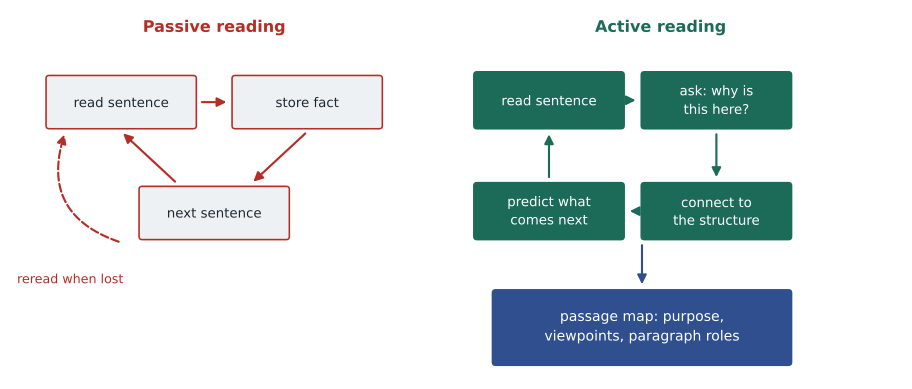
The questions an active reader asks
Harriet gave the group five questions to keep in mind while reading. They are not meant to be written down or answered formally. They are habits of attention.
- What is the topic, and what is the issue? The topic is what the passage is about (adverse possession). The issue is the question the passage is addressing (whether the doctrine is still justified).
- Who holds which view? Passages often present the views of defenders, critics, earlier scholars or a particular researcher. Keep track of each, and of whether the author shares it.
- What is the author doing? Is the author explaining, arguing, comparing, criticizing, evaluating or proposing? The purpose usually becomes clear in the first paragraph or two and is confirmed at the end.
- How does this paragraph connect to the last one? Look for continuation (also, moreover, similarly), contrast (but, however, yet, critics respond), illustration (for example, in one study) and conclusion (therefore, thus, what has changed).
- Where is this going? Predict. A paragraph that presents defenders' arguments usually leads to critics' replies. A paragraph that introduces an old view usually leads to a newer one.
Dani said the questions sounded like what she did at work when she read an immigration decision. 'I always want to know what the officer decided and why before I read the details,' she said. Harriet said that was exactly the instinct to bring to the test.
The passage
Here is the passage the group read. Read it once, actively, asking the five questions as you go. Then read the walkthrough below.
Passage A (law): adverse possession (written for this course)
For centuries, the common law has allowed a person who occupies another's land openly and without permission for a long enough period to become its owner. The doctrine of adverse possession, as it is called, strikes many people on first encounter as a reward for trespass. Why, they ask, should the law transfer property from an owner who has done nothing wrong to an intruder who has?
Defenders of the doctrine usually begin with the statute of limitations. An owner who fails to bring an action to recover land within the period the law allows loses the right to do so, and the occupant's possession, once beyond challenge, ripens into title. On this view, adverse possession is less a reward for the possessor than a penalty for the owner's neglect: the law protects owners who watch over their land and declines to protect those who do not. The requirements that courts traditionally impose, namely possession that is actual, open, continuous, exclusive and hostile to the owner's claim, are designed to ensure that a reasonably attentive owner would have noticed the intrusion in time to act.
A second justification looks forward rather than backward. Land that has been used by one person for decades, the argument runs, should not be thrown into dispute by stale claims whose evidence has faded, whose witnesses have died and whose documents have been lost. Settling title in the long-term occupant protects not only that occupant but also the buyers, lenders and neighbours who have relied on the apparent state of affairs.
Critics respond that both justifications fit poorly with modern conditions. The neglect rationale assumed an owner who lived on or near the land and could easily observe it; today, land is often held by absentee owners, estates and corporations for whom constant inspection is impractical. And the reliance rationale has lost much of its force where governments maintain public registers of title. If a register accurately records who owns each parcel, a buyer need not rely on appearances at all; the register itself supplies the certainty that adverse possession was once needed to provide.
Partly for these reasons, several jurisdictions with registered title systems have restricted the doctrine. Some have abolished it for registered land altogether; others require a possessor to apply for registration and give the registered owner notice and an opportunity to object before the possessor's claim can succeed. These reforms preserve a role for long possession in resolving genuine boundary mistakes while removing the doctrine's capacity to surprise an owner who has relied on the register.
Whether such reforms represent the doctrine's future is not yet clear. Where registers are incomplete or inaccurate, the older rationales retain real force, and courts continue to treat long, open possession as strong evidence of where boundaries actually lie. What has changed is the burden of justification: once taken for granted, adverse possession must now explain why it is needed in a world of registered title.
Walking through it
Harriet led the group through the passage paragraph by paragraph, focusing on what an active reader notices.
First paragraph. The topic is adverse possession. The paragraph ends with a question that critics ask: why should the law reward a trespasser? An active reader notices that the passage has posed a question and expects the rest to answer it. The word "strikes many people on first encounter" signals that the author is describing a common reaction, not endorsing it.
Second paragraph. "Defenders of the doctrine usually begin with" tells you that this paragraph gives the defenders' view, not necessarily the author's. The first justification is backward-looking: the owner who sleeps on their rights loses them. The list of requirements (actual, open, continuous, exclusive, hostile) is detail; an active reader notes where it is and why it is there (to ensure the owner could have noticed) without memorizing the list.
Third paragraph. "A second justification" signals continuation: more of the defenders' case. This one is forward-looking: certainty for the occupant and for others who rely on the apparent situation.
Fourth paragraph. "Critics respond" signals a turn. Now the passage gives the other side, and it answers both justifications in order: absentee owners undercut the neglect rationale, and registers undercut the reliance rationale. An active reader notices the pairing: two justifications, two replies.
Fifth paragraph. "Partly for these reasons" connects the critics' arguments to real-world reforms. This paragraph reports what some jurisdictions have done.
Sixth paragraph. "Whether such reforms represent the doctrine's future is not yet clear" is the author's own voice, and it is cautious. The author does not side fully with the critics: the older rationales "retain real force" where registers are unreliable. The final sentence states the author's conclusion: the doctrine now bears a burden of justification it once did not.
Marcus said he had read the same words but had not noticed the pairing in the fourth paragraph. 'I was busy remembering the five requirements,' he said. Harriet pointed out that no question in her set asked about the requirements at all, while three questions depended on the structure of the fourth paragraph.
Reading for the author
The single most important thing an active reader tracks is the author's own position. In many passages the author presents others' views at length and reveals their own only in a few words. In Passage A, those words are concentrated in the last paragraph: "not yet clear," "retain real force," "what has changed is the burden of justification." Earlier, the author's voice appears only in neutral framing.
Some passages are purely descriptive: the author explains a phenomenon or a debate without taking a side. Others are argumentative from the first sentence. Many fall in between, presenting a debate and then offering a measured judgment, as Passage A does. Knowing which kind of passage you are reading helps with nearly every question family, especially main point and attitude questions. Lesson 5 returns to this in detail.
Engagement, not speed
Élodie asked whether active reading would slow her down. Harriet said that in her experience it did the opposite, for two reasons. First, engaged readers rarely reread, because they know why each sentence is there. Second, they answer questions faster, because they already know where in the passage each kind of information lives.
She suggested one practical technique for staying engaged: paraphrase each paragraph in a few words before moving on. For Passage A, the paraphrases might be: (1) doctrine looks like rewarding trespass; (2) defense one: owner's neglect; (3) defense two: certainty and reliance; (4) critics answer both; (5) reforms in registered systems; (6) author: unclear future, burden has shifted. Lesson 3 turns this into a system of annotation.
Ji-won said that her attention drifted most in the middle of a passage, after she had understood the topic but before she knew where the argument was going. Harriet said that was common and that the prediction question helps most at that point. 'If you are asking what comes next, you are not drifting,' she said.
Difficult prose
Some passages are hard not because the ideas are complex but because the sentences are. Long sentences with embedded clauses, abstract nouns and double negatives slow every reader. Active readers handle them by finding the core of the sentence (its subject and main verb) and then attaching the qualifications. In "The requirements that courts traditionally impose, namely possession that is actual, open, continuous, exclusive and hostile to the owner's claim, are designed to ensure that a reasonably attentive owner would have noticed the intrusion in time to act," the core is "The requirements are designed to ensure that an attentive owner would have noticed." The list in the middle can be skipped on the first pass and found later if a question needs it.
Thomas said he did this instinctively with nineteenth-century historians. Marcus said he did it with building codes. Harriet said both of them had just described the same skill.
Worked problem
Sample question (written for this course)
Question: "Based on Passage A, which one of the following most accurately describes the function of the fourth paragraph?" (A) It provides additional support for the justifications presented in the second and third paragraphs. (B) It describes the reforms that several jurisdictions have adopted. (C) It presents the author's final assessment of the doctrine. (D) It responds to each of the two justifications presented earlier by arguing that changed conditions have weakened it. (E) It introduces a third justification for adverse possession.
Show solution
- (D) is correct. "Critics respond" introduces replies to both justifications in order: absentee ownership weakens the neglect rationale, and registers weaken the reliance rationale.
- (A) reverses the paragraph's direction: it challenges the justifications rather than supporting them.
- (B) describes the fifth paragraph, not the fourth.
- (C) describes the sixth paragraph, where the author's own voice appears.
- (E) is wrong because the paragraph introduces criticisms, not a new justification.
Answer: (D). Function questions reward readers who tracked what each paragraph does, not just what it says.
Common mistakes
MistakeReading to collect facts and hoping the questions ask about them.
InsteadRead to understand the argument: who holds which view, why, and where the author stands.
MistakeTreating the defenders' or critics' views as the author's view.
InsteadWatch attribution phrases such as "defenders argue" and "critics respond," and find where the author speaks in their own voice.
MistakeMemorizing lists and examples on the first read.
InsteadNote where details are and why they are there; return to them only if a question asks.
MistakeRereading every hard sentence immediately.
InsteadFind the core of the sentence first, attach the qualifications, and keep moving.
Summary and key terms
- Passive reading collects facts; active reading builds a structure of purpose, viewpoints and paragraph roles.
- Ask while reading: what is the topic and issue, who holds which view, what is the author doing, how does this paragraph connect, and where is this going?
- Structural words (but, however, critics respond, a second justification) signal how paragraphs relate.
- Track the author's own position, which may appear in only a few words.
- A short mental paraphrase of each paragraph keeps you engaged and builds your map.
- In difficult sentences, find the subject and main verb first, then attach the qualifications.
- Active reading
- Reading that asks why each sentence is there and how it fits the author's purpose.
- Topic
- What a passage is about.
- Issue
- The question a passage addresses about its topic.
- Attribution
- Language that assigns a view to someone (defenders argue, critics respond).
- Structural signal
- A word or phrase that shows how a sentence or paragraph relates to what came before.
Practice problems
Work each problem on paper first, then reveal the answer to check.
What is the difference between the topic and the issue of Passage A?
Show answer
Topic: adverse possession. Issue: whether the doctrine is still justified given modern conditions.
Which words in the second paragraph show that the views are not necessarily the author's?
Show answer
"Defenders of the doctrine usually begin with."
Paraphrase the third paragraph in six words or fewer.
Show answer
Second defense: certainty and reliance. (Any close paraphrase.)
Where does the author's own voice appear most clearly in Passage A?
Show answer
In the last paragraph ("not yet clear," "retain real force," "what has changed is the burden of justification").
What is the core of the sentence "Reforms, which several jurisdictions with registered title systems have adopted in recent decades, preserve a role for long possession"?
Show answer
"Reforms preserve a role for long possession."
Lesson quiz · 5 questions
Score 60% or more to complete this lesson.
Create a free account to save your progress, take quizzes and earn a certificate.