
LSAT-120 · Lesson 6 of 12 · 26 min
Main point and purpose
▶ Video coming soon A video version of this lesson is on the way.
On Wednesday, October 28, the reading lab turned from reading to questions. Harriet started with the question family that almost every passage carries: the main point. She put a single question on the screen, about the adverse possession passage the group had read on September 30, and asked everyone to answer it in their own words before looking at the choices.
Élodie wrote: "Adverse possession is controversial." Dani wrote: "Critics think registers make adverse possession unnecessary." Marcus wrote: "Adverse possession has five requirements and two justifications." Thomas wrote: "Changes in land ownership and registration have weakened the traditional justifications for adverse possession, so the doctrine now has to justify itself." Ji-won wrote something close to Thomas's answer but added "and it should be abolished."
'Five answers,' Harriet said. 'One too broad, one that gives a single group's view, one that lists details, one that matches, and one that goes further than the author. Those are the five ways main point answers go wrong, and you have just written all of them yourselves.'
The two questions
Main point and primary purpose questions are closely related, and many passages carry one or the other as their first question.
- Main point questions ask for the central claim or idea of the whole passage. Typical stems: "Which one of the following most accurately expresses the main point of the passage?" "Which one of the following most accurately states the central idea of the passage?"
- Primary purpose questions ask what the author is trying to do. Typical stems: "The primary purpose of the passage is to..." "The author's main purpose in the passage is to..." The answers usually begin with a verb: describe, explain, argue, evaluate, challenge, defend, compare.
The difference is between what the passage says and what it does. Thomas's answer above is a main point. The matching purpose would be something like "to explain how changed conditions have weakened the traditional justifications for a legal doctrine and to assess the consequences."
Predict first
Main point questions reward prediction more than any other family. If you read actively and built a roadmap, you already know the answer before looking at the choices: it is the claim that the whole roadmap supports. The author's final judgment, often in the last paragraph, and the issue posed in the first paragraph are the two places to look.
Harriet's method: before reading the answer choices, say the main point in one sentence that (1) covers the whole passage, (2) reflects the author's view, not a single group's, and (3) keeps the author's level of certainty. Then look for the answer that matches.
The five wrong-answer patterns
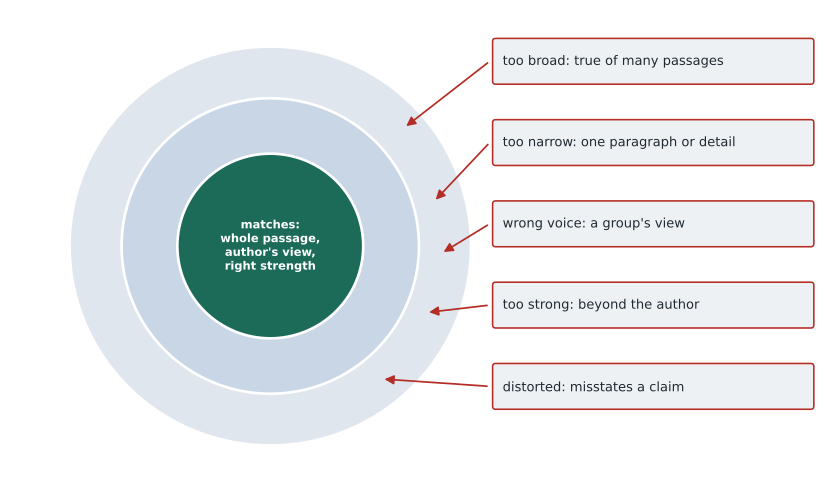
- Too broad. The answer is true but could describe many passages: "Adverse possession is controversial." It does not capture the passage's particular claim.
- Too narrow. The answer accurately states something in one paragraph or a detail: "Adverse possession has five requirements." The passage contains it, but it is not the point.
- Wrong voice. The answer states a view held by one group in the passage: "Critics think registers make adverse possession unnecessary." True of the critics, but not the author's overall point.
- Too strong. The answer goes further than the author: "...and it should be abolished." The author says the doctrine's future is "not yet clear."
- Distorted. The answer misstates a relationship or reverses a claim, for example saying that registers have strengthened the reliance rationale.
Ji-won said she knew why she had added "should be abolished": the critics' arguments were the most persuasive part of the passage to her. Harriet said that is how most too-strong answers get chosen. 'You agreed with the critics, so you promoted their view to the author's,' she said. 'The author is more cautious than you are, and the question asks about the author.'
Practice: Passage A
Here is the adverse possession passage again. Try the question below before reading the explanation.
Passage A (law): adverse possession (written for this course)
For centuries, the common law has allowed a person who occupies another's land openly and without permission for a long enough period to become its owner. The doctrine of adverse possession, as it is called, strikes many people on first encounter as a reward for trespass. Why, they ask, should the law transfer property from an owner who has done nothing wrong to an intruder who has?
Defenders of the doctrine usually begin with the statute of limitations. An owner who fails to bring an action to recover land within the period the law allows loses the right to do so, and the occupant's possession, once beyond challenge, ripens into title. On this view, adverse possession is less a reward for the possessor than a penalty for the owner's neglect: the law protects owners who watch over their land and declines to protect those who do not. The requirements that courts traditionally impose, namely possession that is actual, open, continuous, exclusive and hostile to the owner's claim, are designed to ensure that a reasonably attentive owner would have noticed the intrusion in time to act.
A second justification looks forward rather than backward. Land that has been used by one person for decades, the argument runs, should not be thrown into dispute by stale claims whose evidence has faded, whose witnesses have died and whose documents have been lost. Settling title in the long-term occupant protects not only that occupant but also the buyers, lenders and neighbours who have relied on the apparent state of affairs.
Critics respond that both justifications fit poorly with modern conditions. The neglect rationale assumed an owner who lived on or near the land and could easily observe it; today, land is often held by absentee owners, estates and corporations for whom constant inspection is impractical. And the reliance rationale has lost much of its force where governments maintain public registers of title. If a register accurately records who owns each parcel, a buyer need not rely on appearances at all; the register itself supplies the certainty that adverse possession was once needed to provide.
Partly for these reasons, several jurisdictions with registered title systems have restricted the doctrine. Some have abolished it for registered land altogether; others require a possessor to apply for registration and give the registered owner notice and an opportunity to object before the possessor's claim can succeed. These reforms preserve a role for long possession in resolving genuine boundary mistakes while removing the doctrine's capacity to surprise an owner who has relied on the register.
Whether such reforms represent the doctrine's future is not yet clear. Where registers are incomplete or inaccurate, the older rationales retain real force, and courts continue to treat long, open possession as strong evidence of where boundaries actually lie. What has changed is the burden of justification: once taken for granted, adverse possession must now explain why it is needed in a world of registered title.
Worked problem
Sample question (written for this course)
Question: "Which one of the following most accurately expresses the main point of Passage A?" (A) Adverse possession rewards trespassers and should be abolished in every jurisdiction. (B) The traditional justifications for adverse possession depend on conditions that have changed, so the doctrine, though still useful in some settings, must now be justified rather than assumed. (C) Owners who neglect their land deserve to lose it, and adverse possession is the law's way of ensuring that they do. (D) Courts require possession to be actual, open, continuous, exclusive and hostile before an occupant can acquire title. (E) Public registers of title have made it unnecessary for buyers to inspect land before purchasing it.
Show solution
- (B) is correct. It covers the defenders' justifications, the critics' argument from changed conditions, the reforms and the author's cautious conclusion, and it keeps the author's level of certainty ("though still useful in some settings").
- (A) is too strong: the author calls the doctrine's future "not yet clear."
- (C) gives the defenders' first justification, not the author's overall point.
- (D) is too narrow: it repeats a detail from the second paragraph.
- (E) states part of the critics' reasoning in the fourth paragraph, too narrow and attributed to one group.
Answer: (B). Prediction does most of the work: the right answer is the one that matches a sentence covering the whole roadmap.
Primary purpose: the verb test
Primary purpose answers are usually short phrases that begin with a verb. The verb is often the fastest way to eliminate wrong answers, because it must match what the author actually does. A passage that reports a debate without taking sides cannot have the purpose "to argue for" one side. A passage that explains a phenomenon cannot have the purpose "to refute" a theory.
| Verb | Fits a passage that... | Does not fit a passage that... |
|---|---|---|
| describe, explain | sets out what something is or how it works | takes a strong side |
| discuss, examine | explores an issue from several angles | argues one thesis throughout |
| argue, contend, defend | advances a claim in the author's voice | only reports others' views |
| evaluate, assess | weighs strengths and weaknesses | merely describes |
| challenge, criticize, question | disputes a view | endorses that view |
| compare, contrast | sets two things side by side | focuses on one thing |
| propose, recommend | offers a solution or course of action | only analyses a problem |
Every word in the answer must fit, not only the verb. "To defend a traditional doctrine against its critics" fails for Passage A twice: the author does not defend, and the passage does not focus on the doctrine's defense.
Dani said the verb test made purpose questions feel almost mechanical. Harriet agreed that the verb eliminates two or three answers quickly, but warned that the remaining answers often share a verb and differ in their objects. '"To explain a policy" and "to explain the research behind a policy and the debate it prompted" both start with explain,' she said. 'Only one of them covers the whole passage.'
Practice: Passage B
Here is the defaults passage from lesson 3 again. Decide on the primary purpose before reading the choices.
Passage B (social science): defaults and retirement saving (written for this course)
When employers began offering retirement savings plans to which workers could contribute part of their wages, economists expected participation to depend on the plans' terms: the higher the employer's matching contribution and the greater the tax advantage, the more workers would join. Yet studies of individual firms in the late 1990s revealed something the standard account could not easily explain. When a company changed nothing about its plan except the default, enrolling new employees automatically unless they chose to opt out rather than requiring them to opt in, participation among new hires rose dramatically, in some studies from well under half to more than four in five.
Standard economic theory has difficulty with this result. If a worker's decision to save reflects a careful weighing of present and future consumption, the effort required to tick a box on a form should be trivial by comparison, and the default should make little difference. That it makes a large difference suggests that many decisions are shaped by forces the theory had treated as negligible: inertia, procrastination, and a tendency to treat the default as an implicit recommendation from the employer.
These findings helped launch a policy movement. Advocates argued that if defaults influence behaviour so strongly, policymakers and employers should choose defaults deliberately, steering people toward choices they would likely endorse on reflection while leaving them free to choose otherwise. Several countries have since built automatic enrolment into national pension policy, and many employers have adopted it voluntarily.
The approach has not escaped criticism. Some critics object on grounds of principle, arguing that designing choices to exploit predictable lapses in attention is manipulative even when the goal is benign. Others raise practical concerns. The same inertia that keeps workers in a plan may also keep them at the default contribution rate, which designers often set low to discourage opting out; a worker who would have chosen a higher rate under an opt-in system may end up saving less. Still others note that automatic enrolment raises participation most among workers least able to afford reduced take-home pay, for whom saving may not be the wisest use of scarce income.
Defenders reply that these objections argue for better defaults rather than none. Every plan must have some default; even requiring an active choice is a design decision. The question, then, is not whether to influence choices but how. A low default rate can be paired with automatic annual increases, and workers with pressing needs can opt out at any time. The deeper lesson of the research, on this view, is not that people are irrational but that context matters more than the older models assumed, and that those who design institutions bear responsibility for the contexts they create.
Worked problem
Sample question (written for this course)
Question: "The primary purpose of Passage B is to" (A) argue that automatic enrolment should be required of all employers. (B) criticize economists for failing to predict the effect of defaults. (C) describe research on the effect of defaults in retirement plans and the policy debate it has prompted. (D) explain why workers are irrational about saving for retirement. (E) recommend that default contribution rates be increased automatically each year.
Show solution
- (C) is correct. The passage reports a research finding, the policy movement it launched, criticisms and defenders' replies, without taking a side. "Describe" fits a balanced passage, and the object covers the whole passage.
- (A) is wrong on the verb: the author never argues for a requirement.
- (B) is too narrow and too critical: the second paragraph notes that theory "has difficulty" with the result, but the passage is not an attack on economists.
- (D) contradicts the final paragraph, where the defenders say the lesson is "not that people are irrational."
- (E) is too narrow and wrong on the verb: automatic increases are mentioned as part of the defenders' reply, not recommended by the author.
Answer: (C). For a balanced passage, look for a neutral verb (describe, discuss, examine) with an object that covers every major move.
Where the main point lives
Harriet listed the usual locations. In argumentative passages, the main point often appears near the end of the first paragraph or in the last paragraph. In old-view, new-view passages, it is usually the new view, as qualified by the author. In balanced passages, there may be no single thesis, and the main point is a description of the debate. In explanatory passages, the main point is the phenomenon together with its explanation.
Marcus asked whether the last sentence of a passage was always the main point. Harriet said it was a good place to look, but not a rule. In Passage A the last sentence is the main point. In Passage B, the last sentence is the defenders' view, introduced with "on this view," so choosing it as the main point would be a wrong-voice error.
The October 28 set
Harriet closed the first half of the session with six main point and purpose questions, two each on Passages A, B and C. Thomas and Ji-won answered all six correctly. Élodie and Marcus answered five; both missed a purpose question on Passage C by choosing "to argue for" a policy. Dani answered four, missing one too-narrow answer and one wrong-voice answer. Everyone agreed that predicting first had helped; Dani said she would write her prediction down on her next practice section to make sure she did it.
Common mistakes
MistakeReading the answer choices before forming a prediction.
InsteadState the main point in one sentence that covers the whole passage, reflects the author's view and keeps the author's certainty.
MistakeChoosing an answer that is true but describes only one paragraph.
InsteadThe main point must cover the whole passage.
MistakePromoting a group's view to the author's main point.
InsteadCheck whose voice the answer represents.
MistakeChoosing an answer stronger than the author's language.
InsteadMatch the author's hedges and qualifications.
MistakeIgnoring the verb in purpose answers.
InsteadEliminate answers whose verb does not fit what the author does, then compare objects.
Summary and key terms
- Main point questions ask what the passage says overall; primary purpose questions ask what the author is doing.
- Predict before reading the choices, using your roadmap, the issue posed early and the author's final judgment.
- Wrong answers are too broad, too narrow, in the wrong voice, too strong or distorted.
- Purpose answers start with a verb that must match what the author does; then the object must cover the whole passage.
- The last sentence is a good place to look for the main point but not a rule.
- Main point
- The central claim or idea of the whole passage, as the author holds it.
- Primary purpose
- What the author is mainly trying to do in the passage.
- Too narrow
- An answer that states something from part of the passage only.
- Too broad
- An answer so general that it fails to capture the passage's particular claim.
- Wrong voice
- An answer that states a view held by someone other than the author.
Practice problems
Work each problem on paper first, then reveal the answer to check.
State the main point of Passage C in one sentence.
Show answer
Cities are warmer than their surroundings for well-understood reasons, and because the heat island harms health and strains energy systems unevenly, responses must be matched to local conditions. (Any close version.)
Which purpose verb fits a passage that reports a debate without taking sides?
Show answer
Describe, discuss or examine.
Why is "to defend adverse possession" a poor primary purpose for Passage A?
Show answer
The author does not defend the doctrine; the author reports both sides and concludes cautiously that it must now be justified.
Classify the answer "Retirement plans offer tax advantages" for Passage B's main point.
Show answer
Too narrow (a detail from the economists' expectations).
In Passage B, why is the last sentence not the main point?
Show answer
It is the defenders' view ("on this view"), not the author's.
Lesson quiz · 5 questions
Score 60% or more to complete this lesson.
Create a free account to save your progress, take quizzes and earn a certificate.