
LSAT-112 · Lesson 9 of 12 · 23 min
Parallel flaw questions
▶ Video coming soon A video version of this lesson is on the way.
In the second half of the November 8 session, Harriet raised the stakes. 'Parallel reasoning asks you to match a structure. Parallel flaw asks you to match a mistake. And mistakes, it turns out, are easier to match than structures, because you already have a catalogue of them.'
The catalogue she meant was the flaw map from the Tuesday workshops of LSAT-111: causal flaws, sampling and statistical flaws, conditional and part-whole flaws, and the attacks, circles and shifting words. Parallel flaw questions put that catalogue to work. The stimulus contains a flawed argument; the credited answer contains the same flaw.
This lesson explains how parallel flaw questions differ from ordinary parallel reasoning, gives a method that starts by naming the flaw, and shows how test writers build answer choices that commit a different flaw, or no flaw at all.
Recognizing the question
Parallel flaw stems explicitly mention a flaw:
- "The flawed pattern of reasoning in which one of the following is most similar to that in the argument above?"
- "Which one of the following arguments exhibits flawed reasoning most similar to that exhibited by the argument above?"
- "Which one of the following contains questionable reasoning most similar to that in the argument above?"
The word "flawed," "questionable" or "erroneous" tells you two things. First, the stimulus has a flaw. Second, the credited answer has the same flaw, which means any choice whose reasoning is valid is automatically wrong.
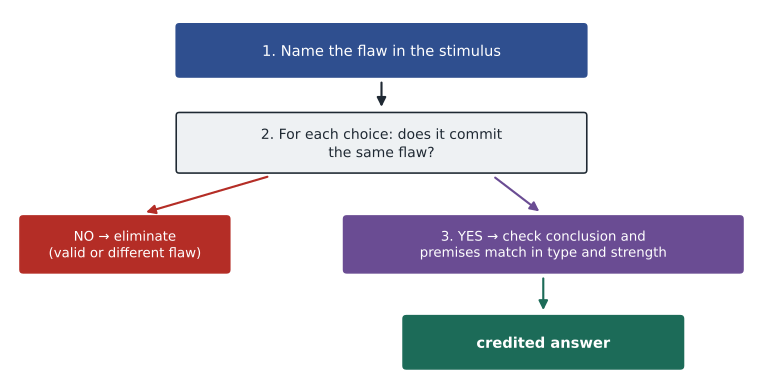
Step 1: name the flaw
Before abstracting the full structure, identify the flaw in the stimulus and name it, using the vocabulary of LSAT-111. "Treats a necessary condition as sufficient." "Infers causation from correlation." "Generalizes from an unrepresentative sample." "Composition." "Chains two 'most' statements."
Naming the flaw gives you a powerful filter. Any answer choice that does not commit that flaw can be eliminated, however similar its structure looks. Any answer that commits it is a strong candidate.
Harriet called this "flaw first." 'With ordinary parallel questions you compare skeletons, which is slow. With parallel flaw, you have a label. Read each choice asking only: does it make this mistake?'
Step 2: filter by flaw
Read each choice and ask whether it commits the named flaw. Four kinds of choices appear:
- Same flaw, same structure: the credited answer.
- Different flaw: the choice is flawed, but in another way. If the stimulus confuses necessary and sufficient conditions, a choice that relies on an unrepresentative sample is wrong.
- Valid argument: the choice reasons correctly. Test writers often include a valid version of the stimulus's structure, for example the stimulus affirms the necessary condition and the choice affirms the sufficient condition. Valid choices are always wrong on parallel flaw questions.
- Same flaw, different structure: rarer, but on hard questions two choices may commit the same type of flaw, and one has an extra difference (a stronger conclusion, a different quantity). Step 3 separates them.
Step 3: confirm the structure
For the choices that survive the flaw filter, check the conclusion type and strength and the premise types, exactly as in lesson 8. On most parallel flaw questions, only one choice survives step 2 and step 3 is a quick confirmation.
Worked problem
Sample question (written for this course)
Stimulus: "Every employee who completed the advanced safety course received a bonus this year. Carla received a bonus this year, so she must have completed the advanced safety course." Stem: "The flawed pattern of reasoning in which one of the following is most similar to that in the argument above?" (A) Every apartment on the top floor has a balcony. Unit 14 is on the top floor, so it has a balcony. (B) Most of the apples from this orchard are organic. This apple is from the orchard, so it must be organic. (C) All the novels on this shelf are signed by their authors. This novel is signed by its author, so it must be from this shelf. (D) Every runner who trained with the club finished the race. Omar did not finish the race, so he did not train with the club. (E) The city's three largest parks have playgrounds, so most parks in the city have playgrounds.
Show solution
- Name the flaw: Course → Bonus; the argument goes from Bonus to Course. It treats a sufficient condition as if it were necessary (equivalently, it affirms the necessary condition, the consequent).
- Filter: (A) affirms the sufficient condition (Top floor → Balcony; top floor, so balcony). Valid. Eliminate. (D) uses the contrapositive correctly. Valid. Eliminate.
- (B) is flawed, but differently: it treats "most" as "all" and draws a certain conclusion from a majority statement. Eliminate. (E) generalizes from a small, unrepresentative sample. Different flaw. Eliminate.
- (C): Shelf → Signed; this novel is signed, so it is from the shelf. Same flaw. Confirm: certain conclusion ("must be") matching "must have."
Answer: (C). Naming the flaw first eliminated four choices in one pass: two valid and two with different flaws.
The valid twin
The most common trap on parallel flaw questions is a choice that copies the stimulus's structure almost exactly but fixes the flaw. If the stimulus reverses a conditional, the valid twin uses the contrapositive. If the stimulus generalizes from a small sample, the valid twin generalizes from a large random one. If the stimulus confuses correlation with causation, the valid twin includes a controlled comparison.
Valid twins are tempting because they look the most similar on the surface. Students who compare skeletons without naming the flaw often pick them. Students who name the flaw first eliminate them immediately, because a valid argument cannot commit the flaw.
Dani said she had fallen for the valid twin twice in her practice tests before the session. 'It looks exactly right. Same words almost. Then I realize it is the one that works.' Harriet suggested she circle "flawed" in the stem every time, as a reminder that the right answer has to be broken.
The wrong-flaw choices
Test writers also include choices that are flawed in a different way. The danger here is a vague sense that "this argument is bad too, so it matches." On parallel flaw questions, bad is not enough. The badness has to be the same.
Common wrong-flaw pairings:
- Stimulus treats necessary as sufficient; choice treats sufficient as necessary. Both are conditional errors, but they run in opposite directions.
- Stimulus commits composition; choice commits division. Both are part-whole errors, but in opposite directions.
- Stimulus generalizes from a small sample; choice infers causation from correlation.
- Stimulus chains two "most" statements; choice reverses an "all" statement.
The first two pairings are the hardest, because the flaws belong to the same family. Precision in naming the flaw ("necessary treated as sufficient," not just "conditional error") is what separates them.
| Stimulus flaw | Matching flaw | Look-alike that does not match |
|---|---|---|
| Necessary treated as sufficient (A → B; B; so A) | Same: affirms the necessary condition | Sufficient treated as necessary (A → B; not A; so not B) |
| Composition (parts to whole) | Composition | Division (whole to parts) |
| Causation from correlation | Causation from correlation | Sequence or sample flaws |
| Small, unrepresentative sample | Generalizing from a biased sample | A valid generalization from a random sample |
| Chaining "most" through a middle term | Same quantity error | Reversing an "all" statement |
When the flaw is hard to name
Occasionally a stimulus has a flaw that does not fit neatly into the catalogue, or has two flaws at once. In those cases, fall back on the skeleton method from lesson 8: abstract the structure, including its flaw, and compare. A description such as "uses a property of one member of a group to draw a conclusion about the whole group, then applies that conclusion to another member" can serve as both skeleton and flaw label.
Ji-won preferred to write both, a flaw name and a skeleton, on every parallel flaw question. It took her about fifteen seconds longer, which her extended time comfortably covered, and she had not missed one since she started doing it.
Marcus's last Sunday
Harriet ended the November 8 session with a mixed set: three parallel reasoning and three parallel flaw questions, shuffled, in nine minutes (Ji-won had thirteen and a half). Élodie and Ji-won got six. Thomas got five. Dani got five, and noted with satisfaction that she had not chosen a single valid twin. Marcus got six, his first perfect set on parallel questions. Harriet told him to keep Tuesday's workshop light, stop studying on Wednesday afternoon, sleep well, and treat Thursday as one more drill. His score, he reminded everyone, would not be released until December 2.
Practice: a parallel flaw question with a quantity flaw
Worked problem
Sample question (written for this course)
Stimulus: "Most of the members of the Ashmere chess club are university students. Most university students in Ashmere live in the north end. So most members of the chess club live in the north end." Stem: "Which one of the following arguments contains flawed reasoning most similar to that in the argument above?" (A) Most of the musicians in the orchestra play string instruments. All string players in the orchestra trained at the conservatory. So most of the orchestra's musicians trained at the conservatory. (B) All of the hotel's guests are business travellers. So most business travellers in the city stay at the hotel. (C) Some of the hotel's guests are business travellers, so some business travellers are hotel guests. (D) The hotel is the city's most popular, so each of its rooms must be the city's most popular. (E) Most of the hotel's guests are business travellers. Most business travellers in the city stay for only one night. So most of the hotel's guests stay for only one night.
Show solution
- Name the flaw: chaining two "most" statements through a middle term (university students), concluding "most."
- (E) does the same: most guests are business travellers; most business travellers stay one night; so most guests stay one night. Same flaw.
- (A) is valid: "most" through "all" gives "most." The valid twin.
- (B) reverses an "all" statement into a "most" claim, a different flaw. (C) reverses a "some" statement, which is valid. (D) is division.
Answer: (E). Naming the flaw precisely ("chains two 'most' statements") separated it from the valid "most-plus-all" twin.
Practice: a causal parallel flaw
Worked problem
Sample question (written for this course)
Stimulus: "Since the town of Corrin installed new street signs, the number of tourists visiting it has risen. Clearly the new signs attracted the tourists." Stem: "The flawed pattern of reasoning in which one of the following is most similar to that in the argument above?" (A) The bakery's sales rose and its costs fell, so its profits rose. (B) Since the bakery began advertising on the radio, its sales have risen, so the radio advertising must have increased its sales. (C) Most bakeries that advertise on the radio have rising sales, so this bakery's sales will probably rise. (D) The bakery's owner says its bread is the best in town, so it must be the best. (E) Every loaf the bakery sells is cheap, so its total sales must be small.
Show solution
- Name the flaw: concluding that one thing caused another merely because it came first (sequence taken as cause).
- (B) commits the same flaw: sales rose after the advertising began, so the advertising caused the rise.
- (A) is valid arithmetic reasoning. (C) is a probabilistic generalization, not a causal flaw.
- (D) is an appeal to an interested authority. (E) is composition (cheap parts, so a small whole). Neither is a causal flaw.
Answer: (B). The subject matter (tourists versus bread) is irrelevant; the shared mistake is everything.
Thomas remarked that the second question had felt almost too easy. Harriet said that parallel flaw questions are often easier than their length suggests, once you name the flaw. 'The length is designed to scare you,' she said. 'The logic is usually one of the flaws you already know by heart.'
When two choices share the flaw
On harder parallel flaw questions, two choices may commit the same named flaw. Then the structural check from lesson 8 decides. Compare the conclusions: one choice may conclude with certainty where the stimulus concludes with probability, or one may draw a negative conclusion where the stimulus draws a positive one. Compare the premises: one choice may use "most" where the stimulus uses "all." The credited choice will match on the flaw and on every one of these details. Ji-won's habit of writing both a flaw name and a skeleton was designed for exactly these questions.
Common mistakes
MistakeChoosing the choice that looks most like the stimulus on the surface.
InsteadThe closest-looking choice is often the valid twin; name the flaw first.
MistakeAccepting a choice because it is also flawed.
InsteadThe flaw must be the same one, named precisely.
MistakeConfusing flaws from the same family (composition and division; necessary and sufficient).
InsteadName the direction of the error, not just its family.
MistakeForgetting that valid arguments are always wrong on parallel flaw questions.
InsteadCircle "flawed" in the stem; the credited answer must be broken in the same way.
Summary and key terms
- Parallel flaw questions credit the choice that commits the same flaw as the stimulus.
- Name the flaw first, using the LSAT-111 vocabulary, and filter the choices by it.
- Valid arguments are always wrong; watch for the valid twin.
- Flaws from the same family can fail to match if they run in opposite directions.
- Confirm the survivor by checking conclusion type and strength.
- Parallel flaw question
- A question asking which choice contains reasoning flawed in the same way as the stimulus.
- Flaw first
- The method of naming the stimulus's flaw before reading the choices and filtering by it.
- Valid twin
- A choice that copies the stimulus's structure but corrects its flaw.
- Affirming the consequent
- The flaw of inferring A from A → B and B.
Practice problems
Work each problem on paper first, then reveal the answer to check.
Name the flaw: "Each player on the team is excellent, so the team is excellent."
Show answer
Composition: assuming the whole has a property because each part has it.
Does this match the flaw above? "The company is profitable, so each of its divisions is profitable."
Show answer
No. That is division, the opposite direction.
Name the flaw: "If it snows, the school closes. It did not snow, so the school is open."
Show answer
Sufficient treated as necessary (denying the antecedent): the school might close for other reasons.
Lesson quiz · 5 questions
Score 60% or more to complete this lesson.
Create a free account to save your progress, take quizzes and earn a certificate.