
LSAT-112 · Lesson 2 of 12 · 22 min
Conditional logic
▶ Video coming soon A video version of this lesson is on the way.
The second half of the October 4 session moved from the map to the machinery. In LSAT-110, the group had learned to translate conditional statements into arrows and to tell necessary conditions from sufficient ones. In LSAT-111, they had learned to spot arguments that run the arrows backwards. Now Harriet wanted them to do something more ambitious: combine several conditionals into chains, and draw every valid conclusion those chains allow.
'On an inference question, conditionals are not traps,' she said. 'They are tools. Three or four "if" statements in a stimulus are the test writer handing you a machine that produces conclusions. You just have to run it correctly.'
This lesson reviews the basics of conditional translation, then covers the two operations that matter most for inference: forming the contrapositive and linking conditionals into chains. It ends with the special difficulties of "unless," "or" and negated conditions.
Translation in one minute
A conditional statement says that one thing guarantees another. In "If a package weighs more than twenty kilograms, it ships by freight," weighing more than twenty kilograms is the sufficient condition, and shipping by freight is the necessary condition. We write: Over 20 kg → Freight.
The sufficient condition goes on the left of the arrow, the necessary condition on the right. Many English phrases introduce each side:
- Sufficient (left side): "if," "when," "whenever," "every," "all," "any," "each," "in order to … must."
- Necessary (right side): "then," "only if," "only," "requires," "must," "depends on," "cannot … without," "is essential for."
The word "only" deserves special care, because it flips the direction. "Only members may vote" means Vote → Member, not Member → Vote. The word after "only" (members) is the necessary condition. "Only if" works the same way: "You may vote only if you are a member" also gives Vote → Member.
Dani, who had been drilling translation since the September sessions, recited her card: '"If" introduces the left. "Only if" introduces the right. "Only" introduces the right.' Harriet said that the card had probably already earned Dani a few points.
The contrapositive
Every conditional has exactly one valid reversed form, called the contrapositive. To form it, you reverse the arrow and negate both sides. From A → B, you get not B → not A.
Over 20 kg → Freight becomes not Freight → not over 20 kg. If a package does not ship by freight, it does not weigh more than twenty kilograms. The contrapositive says exactly the same thing as the original statement; it is not a new fact, just the same fact viewed from the other end.
Two other reversed forms look similar and are invalid:
- The converse, B → A: "If it ships by freight, it weighs over twenty kilograms." Not guaranteed. A light but bulky package might also ship by freight.
- The inverse, not A → not B: "If it weighs twenty kilograms or less, it does not ship by freight." Also not guaranteed, for the same reason.
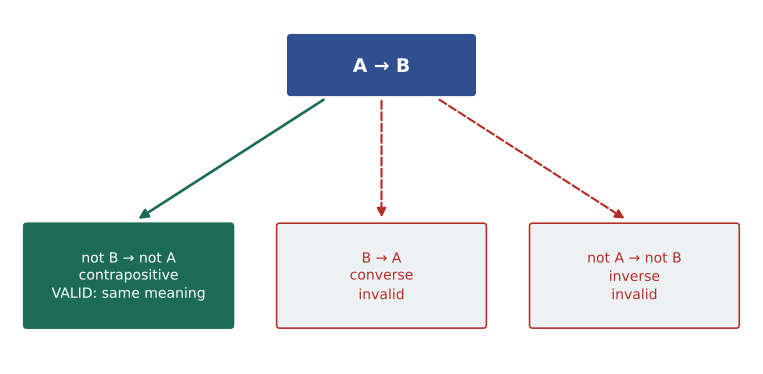
In an inference question, the contrapositive is often the key to the credited answer. A stimulus might say "Every route that crosses the river requires a toll." An answer saying "Any route without a toll does not cross the river" is simply the contrapositive, and therefore must be true. The test writers like this answer because it looks new while saying nothing new.
Negating correctly
Forming a contrapositive requires negating both sides, and negation has a few traps.
- Negate the whole condition, not just a word in it. The negation of "arrives before noon" is "does not arrive before noon," which includes arriving at noon or later and not arriving at all.
- The negation of "and" is "or." If the condition is "has a passport and a visa," its negation is "lacks a passport or lacks a visa" (or both).
- The negation of "or" is "and." If the condition is "is a student or a senior," its negation is "is neither a student nor a senior."
- The negation of "all" is "not all" (that is, "some are not"), not "none." We will return to this in lesson 3.
The "and"/"or" switch catches many students. Consider: "If a tenant has a pet and lives on the ground floor, the tenant pays a cleaning fee." The contrapositive is: "If a tenant does not pay a cleaning fee, then the tenant either has no pet or does not live on the ground floor." It is not "has no pet and does not live on the ground floor."
Chains
When the necessary condition of one statement is the sufficient condition of another, the two statements link into a chain. From A → B and B → C, you may infer A → C.
Harriet gave the group a stimulus about a fictional hospital: "Every nurse at Tarnwick General who works in the intensive care unit has advanced cardiac certification. Everyone with advanced cardiac certification completes an annual skills review. No one who completes an annual skills review is exempt from the hospital's continuing education requirement."
Translated:
- ICU nurse → Certified
- Certified → Annual review
- Annual review → not Exempt
Linked: ICU nurse → Certified → Annual review → not Exempt. So every ICU nurse at Tarnwick General is not exempt from the continuing education requirement. And by the contrapositive of the whole chain: anyone who is exempt is not an ICU nurse.
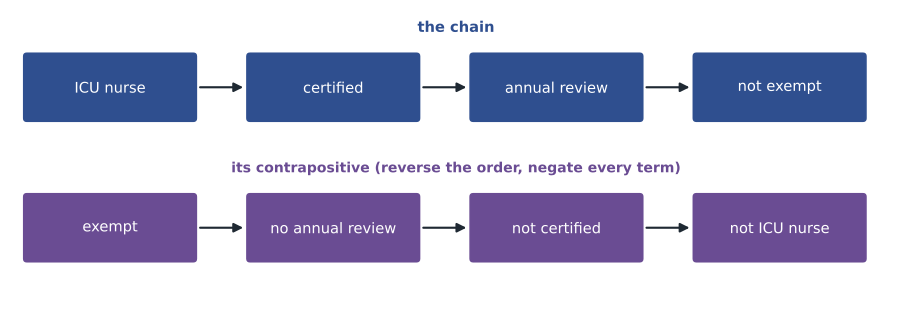
Marcus compared it to tracing load paths in a structure. 'Each link carries the force to the next one. If any link is missing, nothing gets through.' Harriet liked the comparison, with one warning: a chain only runs one way. You can go from ICU nurse to not exempt, but you cannot go from not exempt back to ICU nurse. Plenty of people who are not exempt work elsewhere in the hospital.
Building chains from scrambled statements
Test writers rarely present conditionals in chain order. They scatter them across the stimulus and disguise them in different wording. The process for building the chain is mechanical:
- Translate each conditional separately.
- Look for a term that appears on the right of one arrow and the left of another. That term is the link.
- If a term appears negated in one statement and positive in another, take the contrapositive of one statement so that the terms match.
- Write the full chain, then write its contrapositive.
The third step is where most errors happen. Suppose the stimulus says "Anyone who plays in the orchestra must attend every rehearsal" and "No one who attends every rehearsal can hold a weekend job." Translated: Orchestra → Rehearsals; Rehearsals → not Weekend job. These already link. But suppose instead the second statement were "Anyone with a weekend job misses at least one rehearsal." Translated: Weekend job → not Rehearsals. To link, take its contrapositive: Rehearsals → not Weekend job. Now the chain runs: Orchestra → Rehearsals → not Weekend job.
Worked problem
Sample question (written for this course)
Stimulus: "At Kestrel Ridge College, every student who lives in residence must buy a meal plan. Only students who buy a meal plan may use the dining hall after 8 p.m. Any student who uses the dining hall after 8 p.m. is eligible for the late-study discount. Priyanka Rao does not have a meal plan." Stem: "If the statements above are true, which one of the following must also be true?" (A) Priyanka Rao does not live in residence. (B) Priyanka Rao is not eligible for the late-study discount. (C) Every student with a meal plan uses the dining hall after 8 p.m. (D) Priyanka Rao lives off campus with family. (E) Every student eligible for the late-study discount lives in residence.
Show solution
- Translate: Residence → Meal plan. Dining after 8 → Meal plan ("only" introduces the necessary side). Dining after 8 → Discount eligible.
- Fact: not Meal plan. Contrapositive of the first rule: not Meal plan → not Residence. So Priyanka does not live in residence. That is (A).
- Also: not Meal plan → not Dining after 8. But not dining after 8 tells us nothing about the discount; eligibility might come other ways. So (B) does not follow (it denies a sufficient condition).
- (C) reverses the second rule: a meal plan is necessary for late dining, not sufficient. (D) adds detail ("with family") the stimulus never gives; not living in residence does not tell us where she lives.
- (E) links nothing valid: discount eligibility is a necessary condition of late dining, so we cannot move from it back to residence.
Answer: (A). The contrapositive of the first rule, applied to the stated fact, guarantees it.
"Unless," "without" and "or"
Three kinds of wording cause more trouble than any others.
"Unless" and "without": the reliable translation is to negate the term that follows "unless" or "without" and make it the sufficient condition. "The concert will be cancelled unless at least five hundred tickets are sold" becomes: not 500 sold → Cancelled. Its contrapositive: not Cancelled → 500 sold. "Without" works the same way: "No permit is issued without an inspection" becomes not Inspection → not Permit, or equivalently Permit → Inspection.
Élodie had a bilingual trick for this. 'In French, "à moins que" sounds like it is giving you an exception. So I just rewrite every "unless" as "if not" before I do anything else.' Harriet endorsed the method for everyone, French speakers or not.
"Or": on the LSAT, "or" is inclusive unless the stimulus says otherwise ("but not both," "exactly one"). "Either A or B" means at least one of them, possibly both. As a conditional, "A or B" becomes not A → B (and its contrapositive, not B → A). "Every applicant must submit either a transcript or a portfolio" means: an applicant without a transcript must submit a portfolio, and an applicant without a portfolio must submit a transcript. An applicant may submit both.
Negated conditions: "No A is B" becomes A → not B, and its contrapositive B → not A. "No member of the board may vote on a contract with a company in which the member holds shares" becomes: Holds shares → not Vote. Note that "no" statements are symmetric in a way that "all" statements are not: "No A is B" and "No B is A" say the same thing.
| Wording | Translation | Contrapositive |
|---|---|---|
| If A, then B | A → B | not B → not A |
| Only A are B | B → A | not A → not B |
| A only if B | A → B | not B → not A |
| A unless B | not B → A | not A → B |
| No A without B | A → B | not B → not A |
| No A is B | A → not B | B → not A |
| A or B (at least one) | not A → B | not B → A |
When a chain does not link
Many wrong answers to inference questions come from forcing a link that is not there. Two statements link only if a term is on the right of one arrow and the left of the other (after any contrapositives you need). If both statements share a necessary condition (A → C and B → C), there is no link between A and B; they simply share a requirement. If both share a sufficient condition (A → B and A → C), you may infer that A brings both B and C, but nothing about the relationship between B and C.
Ji-won found this distinction the clearest of the session. 'Two arrows pointing at the same box do not connect the things they come from,' she said. She drew it as a diagram in her notes: two arrows converging on a single box, with a large red X between their tails.
Thomas runs the machine
Thomas had struggled with formal logic in September; by early October he was translating faster than anyone except Ji-won. At the end of the session, Harriet gave the group a six-question set of conditional inference questions, with eight and a half minutes on the clock (Ji-won had twelve and three-quarter minutes). Thomas got five right. The one he missed had an "unless" in its third sentence; he had translated it without negating. 'One rule,' Harriet said. '"Unless" becomes "if not." Every single time.'
Practice: a chain with a disguised link
Worked problem
Sample question (written for this course)
Stimulus: "No one may serve on the Fenwick housing board unless they live in the city. Every resident of the city who owns rental property must register with the housing office. Board members are not permitted to own rental property in the city. Wren Adler serves on the housing board." Stem: "If the statements above are true, which one of the following must also be true?" (A) Wren Adler is registered with the housing office. (B) Everyone who lives in the city may serve on the housing board. (C) Wren Adler lives in the city and does not own rental property there. (D) No resident of the city owns rental property. (E) Wren Adler owns rental property outside the city.
Show solution
- Translate: not Lives in city → not Board (equivalently, Board → Lives in city). Lives in city AND owns rental → Registers. Board → not Owns rental in city.
- Fact: Wren is on the board. So she lives in the city and does not own rental property there. That is (C).
- (A) does not follow: registration is required of residents who own rental property, and Wren does not own any in the city, so the rule never applies to her.
- (B) reverses the first rule. (D) overreaches: only board members are barred from owning rental property.
- (E) adds a fact about property outside the city that the stimulus never mentions.
Answer: (C). Two rules triggered by the same fact combine into one conclusion. Note how the "unless" rule had to be translated before it could be used.
Marcus pointed out that the second rule had two sufficient conditions joined by "and," which meant it applied only to people who met both. Harriet said that compound conditions like this are a favourite source of trap answers: the wrong answer applies the rule to someone who meets only one of the conditions.
Common mistakes
MistakeTreating the converse (B → A) as equivalent to A → B.
InsteadOnly the contrapositive (not B → not A) is equivalent.
MistakeNegating "A and B" as "not A and not B."
InsteadThe negation of "and" is "or": not A or not B.
MistakeLinking two conditionals that share a necessary condition.
InsteadA → C and B → C give no relationship between A and B.
MistakeTranslating "unless" without negating.
Instead"A unless B" means "if not B, then A."
MistakeReading "or" as "one but not both."
InsteadOn the LSAT, "or" includes the possibility of both unless the stimulus says otherwise.
Summary and key terms
- A conditional links a sufficient condition (left) to a necessary condition (right).
- "Only" and "only if" introduce the necessary condition.
- The contrapositive reverses and negates both sides; it is the only equivalent reversed form.
- Chains link when the right side of one conditional matches the left side of another.
- "Unless" and "without" become "if not"; "or" becomes "if not one, then the other."
- Negating "and" gives "or," and negating "or" gives "and."
- Contrapositive
- The equivalent form of A → B obtained by reversing and negating: not B → not A.
- Converse
- The invalid reversal B → A.
- Inverse
- The invalid negation not A → not B.
- Chain
- Two or more conditionals linked through a shared term, producing a longer conditional.
- Inclusive or
- The reading of "or" that allows both alternatives to be true.
Practice problems
Work each problem on paper first, then reveal the answer to check.
Translate and give the contrapositive: "The bridge opens only if the river level is below the warning line."
Show answer
Opens → Below line. Contrapositive: not Below line → not Opens.
Translate: "No refund is given unless the receipt is presented."
Show answer
not Receipt → not Refund (equivalently, Refund → Receipt).
From "Every editor reads the style guide" and "Everyone who reads the style guide knows the citation rules," what follows about someone who does not know the citation rules?
Show answer
They are not an editor. Chain: Editor → Style guide → Citation rules; contrapositive: not Citation rules → not Editor.
Lesson quiz · 5 questions
Score 60% or more to complete this lesson.
Create a free account to save your progress, take quizzes and earn a certificate.