
LSAT-112 · Lesson 3 of 12 · 21 min
Quantifiers: some, most, all and none
▶ Video coming soon A video version of this lesson is on the way.
The Sunday clinic on October 11, 2026 opened with a question Harriet had been saving. 'Most of the people in this group are American,' she said. 'Most of the people in this group are under thirty. Does it follow that some American in this group is under thirty?'
There was a pause. Dani said yes, then no, then yes again. Marcus did the arithmetic out loud: five people, three Americans, four under thirty (everyone but him). 'In this group, yes. Dani and Ji-won.' Harriet nodded. 'In this group, yes, and the general rule says yes too, but for a reason you need to understand. Today is about the small words that decide what follows: some, most, all, none, and their cousins.'
This lesson covers how quantity statements work on the LSAT, which combinations of them produce valid conclusions, and which common combinations do not. It finishes with the special care needed when quantity statements and conditionals appear in the same stimulus.
What the words mean on the test
Everyday English is loose about quantity. The LSAT is strict. Each quantity word has a fixed meaning:
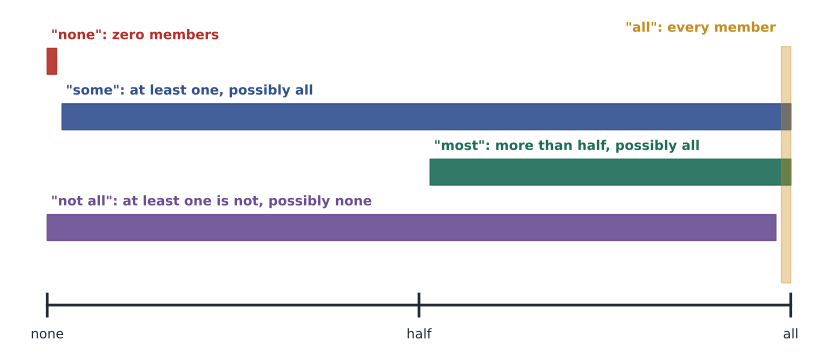
- "All" (also "every," "each," "any"): without exception. "All the drafts were reviewed" means not one was missed.
- "None" (also "no"): not a single one.
- "Most": more than half. Not "almost all," not "the vast majority"; simply more than fifty percent. "Most" is consistent with "all."
- "Some" (also "at least one," "several," "a few," "there are"): at least one, possibly all. "Some of the drafts were reviewed" does not imply that some were not.
- "Not all" (also "some … not"): at least one is not. It is consistent with "none."
- "Many": an indefinite number, not necessarily a majority. On the LSAT, treat "many" as equivalent to "some" for the purpose of drawing conclusions.
The trickiest of these is "some." In conversation, "Some of my colleagues came to the party" suggests that not all did. On the LSAT it suggests nothing of the kind. "Some" sets a floor (at least one) and no ceiling.
Élodie said this was the hardest adjustment for her. 'If a professor tells me "some of you passed," I start worrying. On the LSAT, that sentence could mean everyone passed.' Harriet said that was exactly the point.
Negating quantity statements
Negation matters on inference questions because cannot-be-true answers and contrapositives both depend on it. The pairs are fixed:
- The negation of "all are" is "some are not" (not "none are").
- The negation of "none are" (or "no A is B") is "some are."
- The negation of "some are" is "none are."
- The negation of "most are" is "half or fewer are" (that is, "at least half are not").
Harriet put it simply: 'If someone says "all the bridges are safe," you do not need to show that every bridge is dangerous to prove them wrong. One unsafe bridge does it.'
Combining two statements: the rules that work
Most quantity-based inference questions require combining two statements about overlapping groups. Some combinations produce a valid conclusion; many do not. The safest approach is to learn the handful that work.
- All A are B; all B are C. So all A are C. (This is just a conditional chain: A → B → C.)
- All A are B; some C are A. So some C are B. Those C that are A are, by the first statement, B as well.
- All A are B; no B is C. So no A is C. (A → B → not C.)
- Most A are B; all B are C. So most A are C. The majority of A that are B are all C.
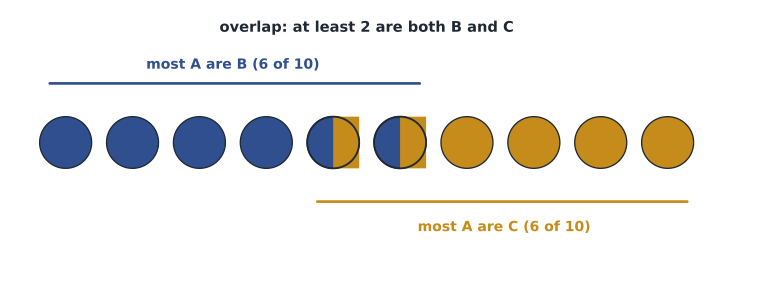
- Most A are B; most A are C. So some B are C. This is the one Harriet opened with. If more than half of the A are B and more than half of the A are C, the two majorities must overlap by at least one member. Both groups must be drawn from the same base group, A.
That last rule surprises people, and it has a strict condition: both "most" statements must be about the same group. "Most A are B; most A are C" gives an overlap. "Most A are B; most B are C" does not.
The combinations that fail
Wrong answers on quantity questions are built from combinations that feel valid but are not. These are the main ones:
- Some A are B; some B are C. Nothing follows about A and C. The A that are B might be entirely different from the B that are C.
- Most A are B; most B are C. Nothing follows about A and C. Suppose 60 of 100 lawyers read the news, and 60 percent of the city's 10,000 news readers distrust politicians. The 60 lawyers could all be in the 40 percent who trust them.
- All A are B; some B are C. Nothing follows about A and C. All violinists are musicians and some musicians are drummers, but no violinist need be a drummer.
- Some A are B; no B is C. You may conclude that some A are not C (those A that are B). You may not conclude that no A is C.
Marcus summarized the failures in engineer's terms. '"Some" and "most" do not chain through the middle term. They only combine when they start from the same group, or when one of the links is an "all."'
| Premises | Valid conclusion | Tempting but invalid |
|---|---|---|
| All A are B; all B are C | All A are C | All C are A |
| All A are B; some C are A | Some C are B | Some B are not A |
| Most A are B; all B are C | Most A are C | Most C are A |
| Most A are B; most A are C | Some B are C | Most B are C |
| Some A are B; some B are C | Nothing about A and C | Some A are C |
| Most A are B; most B are C | Nothing about A and C | Most A are C |
| Some A are B; no B is C | Some A are not C | No A is C |
Reversing quantity statements
Some quantity statements can be reversed without changing their meaning, and others cannot.
- "Some A are B" reverses to "Some B are A." If at least one lawyer is a cyclist, then at least one cyclist is a lawyer.
- "No A is B" reverses to "No B is A."
- "All A are B" does not reverse. All surgeons are doctors; not all doctors are surgeons.
- "Most A are B" does not reverse. Most of the city's cyclists may wear helmets without most helmet wearers being cyclists (motorcyclists and construction workers wear them too).
Reversal is a common source of answers that look new but are guaranteed. If a stimulus says "Some of the clinic's volunteers are retired nurses," an answer saying "Some retired nurses volunteer at the clinic" must be true.
Worked problem
Sample question (written for this course)
Stimulus: "Most of the restaurants that entered the Ashmere food festival this year serve vegetarian dishes. Every restaurant that entered the festival this year has been open for at least three years. Some restaurants that have been open for at least three years have closed for renovations at some point." Stem: "If the statements above are true, which one of the following must also be true?" (A) Most restaurants that have been open for at least three years serve vegetarian dishes. (B) Some festival restaurants have closed for renovations at some point. (C) Most restaurants that serve vegetarian dishes entered the festival. (D) No restaurant open for less than three years serves vegetarian dishes. (E) Some restaurants that serve vegetarian dishes have been open for at least three years.
Show solution
- Translate: Most Festival are Vegetarian. All Festival are Three years. Some Three years are Renovated.
- Combine the first two: the majority of festival restaurants that serve vegetarian dishes have all been open three years. So at least some vegetarian-serving restaurants have been open three years. That is (E).
- (A) reverses and overreaches: the festival restaurants may be a small fraction of all restaurants open three years.
- (B) chains "all" with "some" through the middle term (Three years). The renovated restaurants may be entirely outside the festival.
- (C) reverses "most." (D) says something about restaurants under three years old, which the stimulus never addresses.
Answer: (E). "Most A are B" plus "all A are C" guarantees that some B are C.
Quantities and conditionals together
Stimuli often mix quantity statements with conditionals. The safest technique is to translate every "all" and "no" statement into a conditional arrow, and to keep "some" and "most" statements as separate notes, then look for places to combine them.
Harriet gave the group a stimulus: "Every member of the Tarnwick Rowing Club swims competently. No one who swims competently is required to wear a life jacket on the club's training boats. Some members of the club are under sixteen."
Translated: Member → Swims; Swims → not Required jacket; some Members are Under 16. Chain: Member → Swims → not Required jacket. Combine with the "some" statement: the members who are under sixteen are also members, so they swim competently and are not required to wear a life jacket. Valid conclusion: some people under sixteen are not required to wear a life jacket on the club's training boats.
Note what does not follow: nothing about under-sixteens in general (most of them are not club members), and nothing about whether any swimmer who is not a member must wear a jacket.
"Most" and "some" in the answer choices
Answer choices that use "most" deserve suspicion. A "most" conclusion needs either a "most" premise passed through an "all," or a direct statement. Answer choices that use "some" are safer bets, because "some" is a weak claim, but they must still be supported: "some" is not "possibly some."
Dani made a rule for her error log: 'When the answer says "most," I need a "most" in the stimulus and a clean path to it. When the answer says "some," I need at least one guaranteed member.' Harriet said this was the best summary of the session.
Ji-won's grid
Ji-won, who worked as a software tester, preferred grids to diagrams. For quantity stimuli she drew a small table with ten imaginary members of the main group and filled in the cells to test whether a conclusion could fail. If she could fill the table so that the premises were true and the conclusion false, the conclusion was not guaranteed. She called it "trying to break it," the same way she tested code.
Harriet thought this was an excellent habit, with one caution: it takes time, and on most questions the rules in the table above are faster. Ji-won agreed to use the grid only when a combination was not on the list.
The October 11 set
The session ended with a set of eight quantity-inference questions in eleven minutes (Ji-won had sixteen and a half). Élodie and Ji-won each got seven. Marcus got six; both his misses involved reversing a "most." Thomas got six. Dani got five, and said she had at least stopped believing that "some" meant "some but not all," which she counted as progress.
Practice: combining "most" with "all"
Worked problem
Sample question (written for this course)
Stimulus: "Most of the volunteers at the Corrin food bank are retired teachers. Every retired teacher who volunteers at the food bank has completed its safe food handling course. Some people who have completed the safe food handling course work in restaurants." Stem: "If the statements above are true, which one of the following must also be true?" (A) Some of the food bank's volunteers work in restaurants. (B) Most of the food bank's volunteers have completed the safe food handling course. (C) Most people who have completed the course are retired teachers. (D) No restaurant worker volunteers at the food bank. (E) Every volunteer at the food bank is a retired teacher.
Show solution
- Translate: Most Volunteers are Retired teachers. Retired teacher volunteer → Course. Some Course-completers work in restaurants.
- Most volunteers are retired teachers, and all of those have completed the course, so most volunteers have completed the course. That is (B).
- (A) chains through the middle term (course completers); the restaurant workers may not be volunteers. (C) reverses "most."
- (D) is not supported; nothing rules out a restaurant worker volunteering. (E) turns "most" into "all."
Answer: (B). "Most A are B" passed through "all B are C" gives "most A are C."
Ji-won ran her grid on this one for practice and confirmed the shortcut: with ten imaginary volunteers, six retired teachers who all took the course already make a majority of course completers among the volunteers, whatever the other four did.
Common mistakes
MistakeReading "some" as "some but not all."
InsteadOn the LSAT, "some" means at least one and is consistent with all.
MistakeChaining "some" or "most" statements through a middle term.
Instead"Some A are B; some B are C" and "Most A are B; most B are C" give nothing about A and C.
MistakeReversing "all" or "most" statements.
InsteadOnly "some" and "no" statements reverse.
MistakeNegating "all are" as "none are."
InsteadThe negation of "all are" is "some are not."
MistakeOverlooking the overlap of two majorities of the same group.
Instead"Most A are B" and "most A are C" guarantee that some B are C.
Summary and key terms
- "Some" means at least one; "most" means more than half; both are consistent with "all."
- Negations: all → some not; none → some; some → none; most → half or fewer.
- Valid combinations need an "all" link or two "most" statements about the same group.
- "Some" and "most" do not chain through a middle term.
- "Some" and "no" statements reverse; "all" and "most" statements do not.
- Translate "all" and "no" into conditionals; keep "some" and "most" as notes to combine.
- Quantifier
- A word that states how many members of a group have a property, such as all, most, some or none.
- Middle term
- The group that appears in both premises of a combination and links the other two groups.
- Overlap inference
- The conclusion that two majorities of the same group share at least one member.
- Reversal
- Swapping the two groups in a quantity statement; valid for "some" and "no" only.
Practice problems
Work each problem on paper first, then reveal the answer to check.
"Most of the club's members are teachers. All teachers in the club speak French." What follows?
Show answer
Most of the club's members speak French.
"Some engineers are cyclists. Some cyclists are vegetarians." Does it follow that some engineers are vegetarians?
Show answer
No. The cyclist engineers and the cyclist vegetarians may be different people.
What is the negation of "Most applicants were interviewed"?
Show answer
Half or fewer of the applicants were interviewed (at least half were not).
Lesson quiz · 5 questions
Score 60% or more to complete this lesson.
Create a free account to save your progress, take quizzes and earn a certificate.