
LSAT-112 · Lesson 11 of 12 · 23 min
Point-at-issue questions
▶ Video coming soon A video version of this lesson is on the way.
For the second half of the November 15 session, Harriet asked Élodie and Dani to read a short dialogue aloud. Élodie took the first part: "The city should build a new rink in the east end. The two existing rinks are booked solid every evening, and families are turned away." Dani took the second: "The rinks are booked, but mostly by adult leagues that could play later at night. If the city changed the booking rules, families would have plenty of ice."
'What do they disagree about?' Harriet asked. Thomas said they disagreed about whether the rinks were full. Ji-won said no: both agreed the rinks were booked. Marcus said they disagreed about whether the city should build a new rink. Harriet asked whether Dani's speaker had actually said the city should not build one. There was a pause. 'She implies it,' Marcus said. 'She clearly thinks there is a better option.' Harriet smiled. 'Implies. That is the word we need to talk about.'
Point-at-issue questions give you two speakers and ask what they disagree about, or occasionally what they agree about. They reward exactly the kind of precise reading this course has been building: you must determine what each speaker is actually committed to, not what they probably think.
Recognizing the question
Disagreement stems include:
- "The dialogue provides the most support for the claim that Ana and Ben disagree over whether…"
- "On the basis of their statements, Ana and Ben are committed to disagreeing about which one of the following?"
- "Which one of the following most accurately expresses the point at issue between Ana and Ben?"
Agreement stems (less common):
- "The dialogue provides the most support for the claim that Ana and Ben agree that…"
- "Ana and Ben are committed to agreeing with which one of the following?"
The stimulus is almost always a dialogue between two named speakers. Sometimes the second speaker responds directly to the first ("Ben: But Ana overlooks…"); sometimes they make separate statements on a common subject.
The two-part test
The credited answer on a disagreement question must be a claim on which the two speakers take opposite positions. That means:
- Speaker one has expressed a view on the claim (agrees or disagrees), and
- Speaker two has expressed the opposite view.
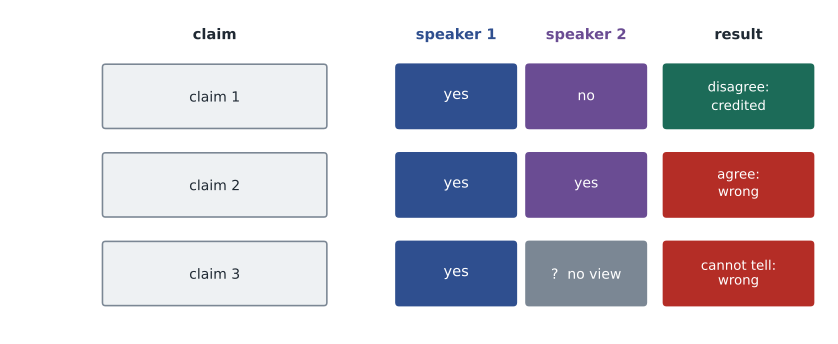
If either speaker has said nothing about a claim, they cannot be shown to disagree about it. Harriet called this "the two-yes test": for each answer choice, you must be able to say "yes, speaker one has a view on this" and "yes, speaker two has the opposite view."
A useful way to run the test is to imagine asking each speaker the choice as a yes-or-no question. If one would say yes and the other no, the choice is a point of disagreement. If either would say "I did not say anything about that," eliminate the choice.
Applying it to the rink dialogue
Harriet went through possible answers for the rink dialogue.
- "Whether the existing rinks are fully booked in the evenings." Élodie's speaker: yes. Dani's speaker: yes ("The rinks are booked"). They agree. Eliminate.
- "Whether the city should build a new rink in the east end." Élodie's speaker: yes. Dani's speaker: she never says the city should not build one. She argues that changing the booking rules would give families enough ice. Is she committed to "no"? This is the hard case. On the strict two-yes test, she has not stated a view on building the rink, so this is risky.
- "Whether families' lack of ice time shows that a new rink is needed." Élodie's speaker: yes; that is her argument. Dani's speaker: no; she says the problem can be solved by changing the booking rules, so a new rink is not needed to solve it. Both have expressed views, and they are opposite. This is the strongest candidate.
Marcus saw the point. 'Her objection is to the reasoning, not the conclusion. She disagrees that the full rinks show we need a new one.' Harriet said that this distinction appears again and again on the test: the second speaker often attacks the first speaker's reasoning without explicitly rejecting the conclusion. The point at issue is then whether the evidence supports the conclusion, not the conclusion itself.
Wrong answers
Wrong answers on disagreement questions usually fall into one of these types:
- Agreement: both speakers would say yes (or both no).
- One-sided: only one speaker has addressed the claim. This is the most common wrong answer.
- Neither: the claim is related to the topic but neither speaker addresses it.
- Overreach: one speaker addresses a weaker version of the claim, and the choice states a stronger one. If a speaker says "some of the evidence is unreliable," she has not taken a view on whether "all of the evidence should be discarded."
| Wrong-answer type | Speaker 1 | Speaker 2 |
|---|---|---|
| Agreement | Yes | Yes |
| One-sided | Yes | No view |
| Neither | No view | No view |
| Overreach | Yes to a weaker claim | No to the weaker claim, no view on the strong one |
| Credited | Yes | No (or the reverse) |
Implication versus commitment
Harriet returned to the word "implies." In everyday conversation, we read a lot into what people do not say. If someone responds to "We should build a rink" with "We should change the booking rules instead," we hear a rejection of the rink. The LSAT is stricter. A speaker is committed to a claim if it follows from what they said, not merely if it would be natural for someone who said it to believe it.
This does not mean that the credited answer must be stated word for word. A speaker who says "This plan will cost far more than it saves and should be abandoned" is committed to "The plan should not go ahead," even though those exact words do not appear. But a speaker who merely offers an alternative is not committed to rejecting the original plan; both could be pursued.
Élodie compared it to cross-examination. 'You cannot say "so you admit you hate the plan." You can only hold them to what they actually said.'
Worked problem
Sample question (written for this course)
Stimulus: "Rosa: Kestrel Ridge College should require every first-year student to take a course in statistics. Graduates in every field now need to evaluate data, and most of our first-years have never studied statistics. Jamal: Most first-years have never studied statistics, true. But many of them will take statistics within their majors anyway, so a separate first-year requirement would mostly duplicate what those students will learn later." Stem: "The dialogue provides the most support for the claim that Rosa and Jamal disagree over whether" (A) most first-year students at the college have never studied statistics. (B) graduates in every field now need to be able to evaluate data. (C) the college should offer more courses in its statistics department. (D) students who take statistics within their majors learn more than students in a general course. (E) a first-year statistics requirement would mostly duplicate what many students will learn in their majors.
Show solution
- (A) Both say yes; Jamal explicitly concedes it ("true"). Agreement. Eliminate.
- (B) Rosa says yes. Jamal says nothing about it. One-sided. Eliminate.
- (E) Jamal says yes, directly. Does Rosa have a view? Her argument for the requirement implies that it would add something: she recommends it because first-years lack statistics and graduates need it. If the requirement mostly duplicated later learning, her reason would be undercut. Rosa is committed, at least, to the requirement being worthwhile; of the choices, this is the only one on which both speakers clearly take positions, and they are opposed.
- (C) Neither speaker discusses the number of courses. (D) Neither compares how much students learn in each setting.
Answer: (E). It is the only choice that both speakers address, and their positions conflict.
Dani objected that Rosa never mentioned duplication. Harriet agreed that the question was a close one and explained the test-taking principle: on disagreement questions, the credited answer is the best of the five, and the best is the one where both speakers' positions are clearest. Every other choice failed outright. When a choice survives the two-yes test even partly and all the others fail it completely, choose it.
Agreement questions
Agreement questions run the same test with one change: both speakers must say yes (or both no). Wrong answers include claims only one speaker addresses, and claims on which they disagree. Agreement answers are often concessions: something the second speaker grants before disagreeing ("True, most first-years have never studied statistics, but…"). Watch for words like "granted," "admittedly," "of course" and "true" in the second speaker's response; they often mark the point of agreement.
Reading dialogues efficiently
Ji-won suggested a note-taking method that the group adopted: after reading each speaker, write their conclusion in a few words and the main reason in a few more. Then, before reading the choices, write a one-line prediction of the point at issue, usually either "whether [conclusion]" or "whether [reason] supports [conclusion]." Harriet added a final check: if the second speaker concedes anything, mark it, because it will be the basis of a wrong answer on disagreement questions and the right answer on agreement questions.
The November 15 set
The session ended with six point-at-issue questions (five disagreement, one agreement) in eight and a half minutes (Ji-won had twelve and three-quarters). Élodie got six. Ji-won and Thomas got five. Marcus got five. Dani got four; she missed two questions by choosing claims that only one speaker addressed. She wrote "two yeses" in large letters on her card.
Harriet reminded everyone that the capstone drill would be the following Sunday, November 22, the day after the Tuesday series capstone. 'Two drills on one weekend,' she said. 'Consider it a dress rehearsal for test day stamina.'
Practice: an agreement question
Worked problem
Sample question (written for this course)
Stimulus: "Kofi: The proposed wind farm off the coast will produce cheap electricity for decades, so the province should approve it. Leila: Granted, the wind farm would produce cheap electricity. But the construction would disrupt the fishing grounds that the coastal towns depend on, and the province should not approve a project that harms those towns." Stem: "Kofi and Leila are committed to agreeing with which one of the following?" (A) The province should approve the wind farm. (B) The wind farm would produce cheap electricity. (C) The fishing grounds are more important than cheap electricity. (D) The coastal towns support the wind farm. (E) Construction would disrupt the fishing grounds.
Show solution
- (B) Kofi asserts it; Leila concedes it ("Granted"). Both are committed. Agreement.
- (A) is the point of disagreement: Kofi yes, Leila no.
- (C) is implied by Leila's position but Kofi says nothing about it. (D) is not addressed. (E) only Leila addresses.
Answer: (B). The concession word "granted" marked the point of agreement.
Practice: a disagreement about reasoning
Worked problem
Sample question (written for this course)
Stimulus: "Hana: The museum's new audio guide is a success; nearly every visitor last month used it. Victor: Nearly every visitor used it because the museum removed the printed labels from the galleries. Visitors had no other way to learn about the works." Stem: "The dialogue provides the most support for the claim that Hana and Victor disagree over whether" (A) the high rate of use shows that the audio guide is a success. (B) nearly every visitor used the audio guide last month. (C) the museum removed the printed labels from the galleries. (D) the museum should restore the printed labels. (E) audio guides are better than printed labels.
Show solution
- Hana: high use shows success. Victor: high use reflects the lack of alternatives, so it does not show success.
- (A) Hana yes; Victor no. Credited.
- (B) Victor accepts that nearly every visitor used it. Agreement. (C) only Victor addresses.
- (D) and (E) are not addressed by both speakers. Victor may well think the labels should return, but he never says so.
Answer: (A). The second speaker accepted the first speaker's evidence and disputed what it showed.
The second speaker's first sentence
Harriet's last tip for point-at-issue questions concerned the second speaker's opening words. When the second speaker begins with a concession ("True," "Granted," "Admittedly," "Of course"), the conceded point is usually the basis of a wrong answer on a disagreement question. When the second speaker begins with a direct contradiction ("No," "That is not so," "On the contrary"), the contradicted claim is often the point at issue itself. And when the second speaker begins with "But" or "However," the disagreement usually concerns what the first speaker's evidence shows. Reading the first few words carefully often tells you where to look.
Common mistakes
MistakeChoosing a claim that only one speaker addresses.
InsteadBoth speakers must have expressed views; apply the two-yes test.
MistakeTreating a speaker's alternative proposal as a rejection of the first speaker's conclusion.
InsteadOffering an alternative is not the same as rejecting a plan; check what the speaker is committed to.
MistakeOverlooking a concession in the second speaker's response.
InsteadWords like "true" or "granted" mark points of agreement, which are wrong on disagreement questions.
MistakeAssuming the second speaker rejects the first speaker's conclusion.
InsteadOften the disagreement is about whether the evidence supports the conclusion.
Summary and key terms
- Point-at-issue questions ask what two speakers disagree (or agree) about.
- The credited answer must pass the two-yes test: each speaker has a view, and the views are opposite.
- One-sided choices, where only one speaker has a view, are the most common wrong answer.
- Speakers are committed to what follows from their words, not to what they merely imply.
- The second speaker often disputes the reasoning rather than the conclusion; concessions mark agreement.
- Point at issue
- The claim on which two speakers take opposite positions.
- Two-yes test
- Checking that each speaker has expressed a view on a claim and that the views conflict.
- Concession
- A point one speaker grants to the other, often marked by "true" or "granted."
- Commitment
- A claim that follows from what a speaker said.
Practice problems
Work each problem on paper first, then reveal the answer to check.
"Nadia: The new bus route is a success; ridership is up. Theo: Ridership is up, but only because the old route was cancelled." What do they agree about?
Show answer
That ridership on the new route is up (Theo concedes it).
Same dialogue. What do they disagree about?
Show answer
Whether the rise in ridership shows that the new route is a success.
Same dialogue. Do they disagree about whether the city should run more buses?
Show answer
No. Neither speaker addresses that claim.
Lesson quiz · 5 questions
Score 60% or more to complete this lesson.
Create a free account to save your progress, take quizzes and earn a certificate.