
LSAT-112 · Lesson 8 of 12 · 21 min
Parallel reasoning
▶ Video coming soon A video version of this lesson is on the way.
The Sunday clinic on November 8, 2026 was Marcus's last Sunday before his test on Thursday; the Tuesday workshop two days later would be his final session. He arrived early, camera on, with a printed copy of his error log and a slightly haunted expression. 'Parallel reasoning,' he said. 'The questions I skip.' Harriet said that was a perfectly reasonable strategy for a test four days away, and also exactly why this session existed: the rest of the group had nine weeks or more before their tests, and parallel questions are much less frightening once you have a method.
Parallel reasoning questions ask you to find the answer choice whose argument has the same logical structure as the argument in the stimulus. They are long (five full arguments in the answer choices, plus the stimulus), so they take time, and many students skip them on test day. This lesson gives you a method that makes them faster and more reliable, so that you can choose whether to skip them rather than being forced to.
What "parallel" means
Two arguments are parallel if they have the same form: the same kinds of premises, combined in the same way, leading to the same kind of conclusion. The subject matter does not matter. An argument about dolphins and an argument about tax law can be perfectly parallel.
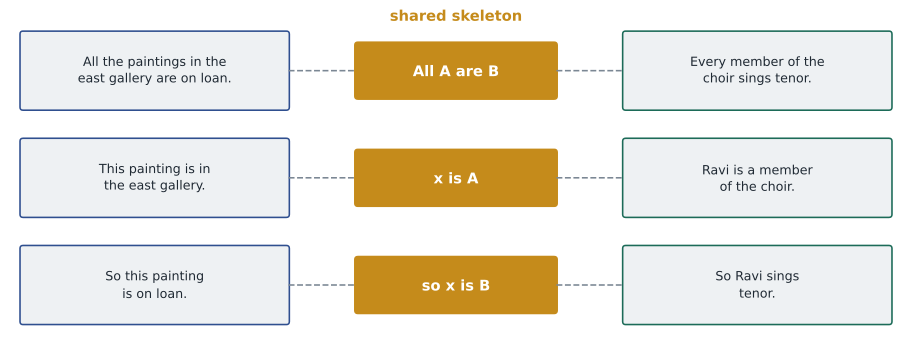
Consider: "All the paintings in the east gallery are on loan. This painting is in the east gallery. So this painting is on loan." Its form: All A are B; x is A; so x is B. A parallel argument: "Every member of the choir sings tenor. Ravi is a member of the choir. So Ravi sings tenor." Same form, different content.
An argument that is not parallel: "All the paintings in the east gallery are on loan. This painting is on loan. So it is in the east gallery." Its form is All A are B; x is B; so x is A. That is a reversal, and a flawed one. The content overlaps more with the original than the choir argument does, but the form is different.
Recognizing the question
Stems include:
- "Which one of the following arguments is most similar in its reasoning to the argument above?"
- "The pattern of reasoning in which one of the following is most similar to that in the argument above?"
- "Which one of the following most closely parallels the reasoning in the argument above?"
If the stem includes "flawed" ("The flawed pattern of reasoning in which one of the following…"), it is a parallel flaw question, which is the subject of the next lesson. This lesson focuses on parallel reasoning where the stimulus is valid or at least not identified as flawed.
Step 1: abstract the stimulus
Begin by stating the stimulus's structure in general terms. For formal arguments, use letters: "If A then B; A; so B." For informal arguments, use a plain description: "An analogy between two things is used to argue that what works for one will work for the other," or "A general trend is used to predict a particular case."
Harriet's advice was to write the skeleton down, not just think it. 'Parallel questions punish vague memory. You will read five arguments after the stimulus, and by the third one you will have forgotten what the original said unless the skeleton is on your scratch paper.'
Step 2: match the conclusion first
The fastest way to eliminate choices is to compare conclusions. The conclusion of the correct answer must match the stimulus's conclusion in type and strength.
- Type: is the conclusion a prediction, a recommendation, a causal claim, a definite fact, a probability, a comparison? A stimulus that concludes "so the project should be approved" needs a parallel answer that concludes with a recommendation.
- Strength: is it certain ("must," "will"), probable ("probably," "likely"), or possible ("may")? Is it universal ("all"), majority ("most"), or partial ("some")? Is it positive or negative?
Choices whose conclusions do not match can be eliminated without reading their premises. On most parallel questions, this step eliminates two or three choices.
| Stimulus conclusion | Matching conclusion | Non-matching conclusions |
|---|---|---|
| Ravi probably sings tenor | Lena probably takes the bus | Lena takes the bus; Lena should take the bus |
| No member was absent | No shipment was lost | Some shipments were lost; most shipments arrived |
| The council should reject the plan | The board should approve the hire | The plan will fail; the plan was rejected |
| Some students are not athletes | Some trees are not oaks | All trees are oaks; no trees are oaks |
Thomas asked about the third row. 'Reject and approve are opposites. Why do they match?' Harriet explained that what matters is the logical role. Both are recommendations about what a body should do. A negative conclusion matters when it is a logical negation, such as "no" versus "some," or "not B" versus "B" in a conditional argument; it does not matter when the action recommended merely happens to be a refusal.
Step 3: match the premises
For the choices that survive the conclusion check, compare the premises. Do they have the same types (conditional, quantity, factual, causal) and the same number? Are they combined in the same way?
Order does not matter. A parallel argument may state the conclusion first, or put the premises in the opposite order. Only the logical relationships count. "Ravi sings tenor, since every member of the choir does and Ravi is a member" is still parallel to the gallery argument.
Watch for one premise that is different in kind. If the stimulus uses "all" and a choice uses "most," the forms differ even if everything else matches. If the stimulus uses a conditional and the choice uses a causal claim, they differ too.
Step 4: confirm the whole form
Once one choice survives, confirm it by mapping each part to the skeleton: every premise, the conclusion, and any qualifier. Two choices may survive steps 2 and 3 on difficult questions; the full map separates them.
Worked problem
Sample question (written for this course)
Stimulus: "If the Tarnwick bakery wins the city contract, it will hire three new bakers. If it hires three new bakers, it will need a larger kitchen. So if the bakery wins the city contract, it will need a larger kitchen." Stem: "Which one of the following arguments is most similar in its reasoning to the argument above?" (A) If the river floods, the bridge will close. The bridge has closed. So the river has flooded. (B) If the store opens on Sundays, it will need more staff. It will not open on Sundays. So it will not need more staff. (C) If the team wins tonight, it will reach the final. The team will probably win tonight. So it will probably reach the final. (D) If Amara finishes her thesis, she will graduate in May. If she graduates in May, she will start her new job in June. So if Amara finishes her thesis, she will start her new job in June. (E) If the festival sells out, the organizers will add a second day. If the organizers add a second day, the festival will sell out again next year. So the festival will sell out next year.
Show solution
- Skeleton: If A then B; if B then C; so if A then C. A valid chain with a conditional conclusion.
- Match conclusions: the stimulus concludes with a conditional. (A), (B) and (E) conclude with definite claims; (C) concludes with a probability. Eliminate all four on the conclusion alone.
- (D): If Finish then May; if May then June; so if Finish then June. Identical skeleton.
- For comparison: (A) affirms the necessary condition (flawed). (B) denies the sufficient condition (flawed). (E) chains correctly but then drops the "if" from its conclusion, asserting the result outright without establishing that the festival sold out.
Answer: (D). The conclusion check alone left a single candidate.
Informal parallel arguments
Not every parallel question is formal. Some stimuli use analogies, generalizations from samples, arguments by elimination or appeals to a pattern. For these, the skeleton is a plain description.
- Argument by elimination: "Either A or B or C caused the outage. Not A and not B. So C."
- Analogy: "X and Y share features 1, 2 and 3. X has feature 4. So Y probably has feature 4."
- Generalization: "Most of the observed members of a group have a feature. So the next member observed will probably have it."
- Counterexample: "The claim that all A are B is false, because here is an A that is not B."
Élodie found these easier than formal ones. 'With letters I get lost. With a sentence like "uses an analogy to predict a feature," I can just ask whether each choice uses an analogy to predict a feature.'
Managing time
Parallel questions are long, and Harriet was frank about it. On a section of about twenty-five questions in thirty-five minutes, a parallel question can easily take two and a half minutes, nearly double the average. Two strategies help:
- Use the conclusion check aggressively. Many choices can be eliminated by reading only their last sentence.
- Consider skipping and returning. If a parallel question appears early in a section, flag it, answer the shorter questions first, and come back with the time you saved. This is not a requirement; some students do better taking questions in order. Experiment on practice sections.
Marcus asked whether he should skip them on Thursday. Harriet said that with four days to go, he should not change his strategy. If skipping had worked in his practice tests, he should keep doing it, and guess on any parallel question he did not return to, since the LSAT does not penalize wrong answers.
The November 8 set
The group worked through six parallel reasoning questions in nine minutes (Ji-won had thirteen and a half). Ji-won got six. Élodie got five. Thomas got five. Dani got four; both misses were on formal stimuli where she had not written the skeleton down. Marcus got five, and said it was the first time he had finished a parallel set without guessing.
Practice: an informal parallel argument
Worked problem
Sample question (written for this course)
Stimulus: "The Halloway and Brennick vineyards have similar soil, rainfall and grape varieties. The Halloway vineyard improved its yield by planting cover crops between its rows. So the Brennick vineyard would probably improve its yield by doing the same." Stem: "Which one of the following arguments is most similar in its reasoning to the argument above?" (A) The east and west branches of the library serve similar neighbourhoods, have similar budgets and hold similar collections. The east branch increased visits by adding evening hours. So the west branch would probably increase visits by adding evening hours. (B) Most vineyards in the valley use cover crops, so the Brennick vineyard probably does too. (C) The east branch of the library increased visits by adding evening hours, so every branch should add evening hours. (D) If the west branch adds evening hours, it will need more staff. It will add evening hours, so it will need more staff. (E) The west branch has fewer visitors than the east branch, so it must have shorter hours.
Show solution
- Skeleton: X and Y are similar in relevant ways; X achieved a result by an action; so Y would probably achieve the result by the same action (analogy, probable conclusion).
- Conclusion check: (C) is a recommendation for every branch; (D) is a definite prediction from a conditional; (E) is a certain conclusion. Eliminate.
- (B) is a probable conclusion, but from a generalization ("most vineyards"), not an analogy. Eliminate.
- (A) matches: similar in neighbourhood, budget and collection; one branch succeeded with an action; so the other probably would.
Answer: (A). For informal arguments, a plain-language skeleton ("analogy predicting a result") works as well as letters.
Dani said informal parallel questions felt like her day job. 'Two cases with the same facts should come out the same way. That is half of immigration law.' Harriet said that this kind of reasoning by analogy is also at the heart of how courts use precedent, which the group would meet again in law school.
Checking your skeleton
Before comparing choices, Harriet asked the group to check one thing about every skeleton: whether it captured the strength of the conclusion. Many students write "A, so B" when the stimulus actually concludes "A, so probably B" or "A, so B is not ruled out." A skeleton that drops a qualifier will match the wrong choice. Thomas made a habit of underlining every qualifier in the stimulus (probably, likely, may, must, all, most, some) and copying each one into his skeleton.
Common mistakes
MistakeChoosing the answer whose subject matter is closest to the stimulus.
InsteadContent is irrelevant; only the logical form matters.
MistakeReading every choice in full before comparing.
InsteadCompare conclusions first and eliminate mismatches immediately.
MistakeHolding the skeleton in memory.
InsteadWrite it down before reading the choices.
MistakeTreating a difference in sentence order as a difference in form.
InsteadOrder does not matter; logical relationships do.
MistakeOverlooking a change in strength ("all" to "most," "will" to "probably").
InsteadStrength and quantity must match for the arguments to be parallel.
Summary and key terms
- Parallel arguments share a logical form regardless of subject matter.
- Write a skeleton of the stimulus: letters for formal arguments, a plain description for informal ones.
- Match conclusions first by type, strength and polarity; this usually eliminates most choices.
- Then match the premises in kind and number; ignore order.
- Parallel questions are long; plan how you will manage your time on them.
- Parallel reasoning
- Reasoning that shares the same logical form as another argument.
- Skeleton
- An abstract statement of an argument's form, with the content removed.
- Conclusion check
- Eliminating choices whose conclusions differ in type, strength or polarity from the stimulus's.
- Argument by elimination
- Reasoning that rules out all but one option and concludes the remaining one holds.
Practice problems
Work each problem on paper first, then reveal the answer to check.
Give the skeleton: "Most of the hikers on the trail carried bear spray. Ana was a hiker on the trail. So Ana probably carried bear spray."
Show answer
Most A are B; x is A; so x is probably B.
Is this parallel to the hiker argument? "Most of the region's farms grow wheat. The Dunmore farm is in the region. So the Dunmore farm grows wheat."
Show answer
No. The conclusion is certain ("grows wheat") rather than probable.
Give a plain-language skeleton: "The leak is in the kitchen, the bathroom or the laundry room. It is not in the kitchen, and it is not in the bathroom. So it is in the laundry room."
Show answer
Argument by elimination: one of three options holds; two are ruled out; so the third holds.
Lesson quiz · 5 questions
Score 60% or more to complete this lesson.
Create a free account to save your progress, take quizzes and earn a certificate.