
LSAT-112 · Lesson 12 of 12 · 56 min
Capstone: a timed inference and principle drill
▶ Video coming soon A video version of this lesson is on the way.
On Sunday morning, November 22, 2026, the day after the capstone of the Tuesday series, the Thursday Circle met one more time for the Sunday clinic's own drill. Harriet had written fifteen new questions covering every type in this course: three must-be-true, two most-strongly-supported, two cannot-be-true, two principle questions, two parallel reasoning, one parallel flaw, two paradox and one point-at-issue question, shuffled as they would be on the test. The time limit was twenty-one minutes, about the pace of a real section. Ji-won had thirty-one and a half minutes under her accommodation.
Marcus, with ten days to go before his score release, said he was taking the drill "purely for the pleasure of it," which nobody believed. Dani had her cards lined up beside her laptop: "Guaranteed is still possible," "two yeses," and the negation pairs. Élodie had decided to take the drill without her bilingual glossary for the first time.
This lesson contains the full drill, with an explanation for every answer choice, followed by the group's results and Harriet's debrief. Take the drill yourself, timed, before reading the explanations.
How to take the drill
- Set a timer for 21 minutes (or your own accommodated time).
- Rewrite every stem in your head before reading the choices, especially EXCEPT and cannot-be-true stems.
- For inference questions, predict when the stimulus contains conditionals or quantity statements; otherwise test each choice against the stimulus.
- Flag any question you are unsure about, and answer every question; there is no penalty for wrong answers.
- When time is up, do blind review on the flagged questions before reading any explanations. Record your timed and blind review scores separately.
The drill
Worked problem
Drill question 1 (must be true)
Stimulus: "Every apprentice at the Brackenfold print shop learns to set type by hand. No one who learns to set type by hand is allowed to operate the shop's laser cutter without supervision. Some apprentices at the shop are also graphic design students." Stem: "If the statements above are true, which one of the following must also be true?" (A) No graphic design student learns to set type by hand. (B) Most apprentices at the shop are graphic design students. (C) Everyone who operates the laser cutter under supervision is an apprentice. (D) Some graphic design students are not allowed to operate the shop's laser cutter without supervision. (E) Some people who set type by hand are not apprentices.
Show solution
- Chain: Apprentice → Sets type → not Unsupervised cutter. Some apprentices are design students.
- (D) Those design students who are apprentices cannot operate the cutter unsupervised. So some design students cannot. Must be true.
- (A) contradicts the stimulus: the design students who are apprentices do learn to set type. (B) "Some" does not give "most."
- (C) reverses and adds a claim the stimulus never makes. (E) may be true but is not guaranteed; the stimulus says nothing about non-apprentices.
Answer: (D).
Worked problem
Drill question 2 (cannot be true)
Stimulus: "At the Corwin marathon, every runner who finished in under three hours received a gold medal. Every runner who received a gold medal was invited to the awards dinner. Fewer than half of the runners were invited to the awards dinner." Stem: "If the statements above are true, which one of the following CANNOT be true?" (A) Some runners who were invited to the awards dinner did not finish in under three hours. (B) Most of the runners finished in under three hours. (C) No runner who finished in over four hours was invited to the awards dinner. (D) Some runners who received a gold medal finished in exactly two and a half hours. (E) Every runner invited to the awards dinner received a gold medal.
Show solution
- Chain: Under 3 → Gold → Invited. Fewer than half were invited.
- (B) If most finished under three hours, most were invited, contradicting "fewer than half." Cannot be true.
- (A) is possible: invitations may also go to others. (C) is possible; nothing requires slow runners to be invited.
- (D) is possible. (E) is possible; the stimulus does not say the reverse, but does not rule it out either.
Answer: (B).
Worked problem
Drill question 3 (most strongly supported)
Stimulus: "In a study of 400 office workers, those who took a short walk after lunch reported feeling more alert in the afternoon than those who did not. Workers who chose to walk were also, on average, younger and reported sleeping more hours each night." Stem: "The statements above most strongly support which one of the following?" (A) Walking after lunch makes office workers more alert. (B) Younger workers are more likely than older workers to take walks for any reason. (C) Employers should encourage workers to walk after lunch. (D) Sleep has a greater effect on alertness than walking does. (E) The difference in reported alertness between the two groups may be due, at least in part, to factors other than walking.
Show solution
- The stimulus reports a correlation and then names two other differences between the groups.
- (E) is modest and supported: the other differences give reason to think factors besides walking may be involved.
- (A) is a causal leap. (B) generalizes beyond the study to "any reason." (C) is a normative leap.
- (D) is a comparative leap; the study does not measure the relative effects.
Answer: (E).
Worked problem
Drill question 4 (principle (apply))
Stimulus: "A newspaper should publish an anonymous source's claim only if the claim has been confirmed by at least one other independent source and publishing it serves the public interest." Stem: "Which one of the following judgments conforms most closely to the principle above?" (A) The Tarnwick Courier should not publish the anonymous claim about the mayor's finances, since no other source has confirmed it. (B) The Tarnwick Courier should publish the anonymous claim about the hospital, since two independent sources confirmed it and it concerns public safety. (C) The Tarnwick Courier should publish any claim that serves the public interest. (D) The Tarnwick Courier should not publish the anonymous claim about the school board, since its editor finds the source unreliable. (E) The Tarnwick Courier should publish the anonymous claim about the council, since readers have shown great interest in the story.
Show solution
- Translate: Publish → (Confirmed AND Public interest). Both are necessary; the principle never says they are sufficient.
- (A) The mayor claim lacks confirmation, so by the contrapositive it should not be published. Conforms.
- (B) meets both necessary conditions and concludes "publish," treating them as sufficient. Trap.
- (C) treats one necessary condition as sufficient. (D) relies on a factor (the editor's view) the principle does not mention.
- (E) treats reader interest as public interest and concludes "publish"; the principle cannot justify publication.
Answer: (A).
Worked problem
Drill question 5 (paradox)
Stimulus: "When the town of Ashmere replaced its streetlights with brighter LED lights, the number of reported night-time burglaries in the town rose, even though police and residents expected brighter streets to deter burglars." Stem: "Which one of the following, if true, most helps to resolve the apparent discrepancy described above?" (A) LED lights use less electricity than the lights they replaced. (B) Burglaries in neighbouring towns also rose during the same period. (C) The brighter lights led more residents to notice and report break-ins they would previously have missed or assumed were nothing. (D) Most burglaries in Ashmere occur during the day. (E) Some residents complained that the new lights were too bright.
Show solution
- How can reported burglaries rise when brighter streets should deter burglars?
- (C) separates actual burglaries from reported ones: brighter lights increase reporting. Both facts can be true.
- (A) is irrelevant. (B) suggests a regional trend but does not explain why brighter lights failed in Ashmere; it is at best partial.
- (D) does not address the rise in night-time burglaries. (E) is irrelevant to burglary numbers.
Answer: (C).
Worked problem
Drill question 6 (parallel reasoning)
Stimulus: "The leak is coming from the dishwasher, the sink or the refrigerator line. The plumber checked the dishwasher and the sink, and neither is leaking. So the leak is coming from the refrigerator line." Stem: "Which one of the following arguments is most similar in its reasoning to the argument above?" (A) The missing file is probably in the archive, since most missing files turn up there. (B) The missing file is in the archive, the main office or the director's desk. It is not in the archive and not in the main office. So it is in the director's desk. (C) If the file is in the archive, the clerk will find it. The clerk did not find it, so it is not in the archive. (D) The missing file is in the archive or the main office. It is in the archive. So it is not in the main office. (E) Every missing file this year was found in the archive. So this file will be found in the archive.
Show solution
- Skeleton: one of three options; two ruled out; so the third (elimination, certain conclusion).
- (B) matches exactly.
- (A) is a probabilistic generalization. (C) is a conditional contrapositive. (D) treats "or" as exclusive and has only two options.
- (E) generalizes from past cases.
Answer: (B).
Worked problem
Drill question 7 (parallel flaw)
Stimulus: "Everyone who attended the workshop received a certificate. Priyanka received a certificate, so she must have attended the workshop." Stem: "The flawed pattern of reasoning in which one of the following is most similar to that in the argument above?" (A) Every car in the lot has a parking permit. This car is in the lot, so it has a permit. (B) Most of the players are left-handed, so this player must be left-handed. (C) The team is the best in the league, so each player is among the league's best. (D) Every bakery on Main Street sells sourdough. Ruth's shop does not sell sourdough, so it is not a bakery on Main Street. (E) All of the volunteers wore green shirts. Tomas wore a green shirt, so he must have been a volunteer.
Show solution
- Flaw: Attended → Certificate; certificate, so attended. Necessary treated as sufficient (affirming the consequent).
- (E) Volunteer → Green shirt; green shirt, so volunteer. Same flaw.
- (A) is valid (affirms the sufficient condition). (D) is valid (contrapositive). These are valid twins.
- (B) treats "most" as "all," a different flaw. (C) is division, a different flaw.
Answer: (E).
Worked problem
Drill question 8 (point at issue)
Stimulus: "Mira: The city's new bike lanes have made cycling safer; bike injuries downtown fell by a quarter in the first year. Owen: Injuries did fall, but the number of people cycling downtown also fell by nearly half after parking fees were cut, so the lanes may not have made cycling any safer." Stem: "The dialogue provides the most support for the claim that Mira and Owen disagree over whether" (A) bike injuries downtown fell in the first year of the new lanes. (B) parking fees downtown should be raised again. (C) more people should cycle downtown. (D) the fall in bike injuries shows that the new lanes made cycling safer. (E) the bike lanes cost more than they were worth.
Show solution
- Mira: the fall in injuries shows the lanes made cycling safer. Owen: the fall may reflect fewer cyclists, so it does not show that.
- (D) Mira yes, Owen no. Both have views, and they conflict.
- (A) Owen concedes it ("Injuries did fall"). Agreement.
- (B), (C) and (E) are not addressed by both speakers (or by either).
Answer: (D).
Worked problem
Drill question 9 (must be true)
Stimulus: "Only members of the Fenwick Hiking Club may use the club's mountain cabin. Every member of the club has completed a wilderness first-aid course. Oren used the club's mountain cabin last weekend." Stem: "If the statements above are true, which one of the following must also be true?" (A) Oren has completed a wilderness first-aid course. (B) Everyone who has completed a wilderness first-aid course is a member of the club. (C) Oren goes hiking every weekend. (D) Most members of the club have used the mountain cabin. (E) No one who is not a member has ever visited the mountain cabin.
Show solution
- Translate: Uses cabin → Member; Member → First aid. Chain: Uses cabin → Member → First aid. Oren used the cabin.
- (A) follows from the chain.
- (B) reverses the second rule. (C) is new material. (D) is unsupported.
- (E) overreaches: the rule concerns using the cabin, not visiting it.
Answer: (A).
Worked problem
Drill question 10 (principle (identify))
Stimulus: "The Lindale Library waived Arun's overdue fines because he had been in hospital for the month during which his books became overdue, and he returned them within a week of being discharged." Stem: "Which one of the following principles is best illustrated by the library's decision?" (A) Libraries should waive fines for all borrowers who have been ill at any time. (B) Overdue fines should never be charged to long-time borrowers. (C) Fines should be waived when a borrower was prevented from returning items by circumstances beyond his control and returned them promptly once able. (D) Anyone whose fines have been waived must have been in hospital. (E) Libraries should extend all loan periods to two months.
Show solution
- Case: prevented by hospitalization (beyond his control); returned promptly after discharge; fines waived.
- (C) matches both conditions and the result.
- (A) is too broad ("at any time," with no link to the overdue period). (B) turns on a factor the case does not mention.
- (D) reverses the condition and result. (E) is a different policy.
Answer: (C).
Worked problem
Drill question 11 (cannot be true)
Stimulus: "All of the paintings in the Ardley Hotel's lobby are by local artists. Some of the paintings in the lobby are watercolours. None of the hotel's watercolours were purchased before 2010." Stem: "If the statements above are true, which one of the following CANNOT be true?" (A) Some paintings by local artists were purchased after 2010. (B) Some paintings in the lobby were purchased before 2010. (C) All of the hotel's watercolours are in the lobby. (D) Some watercolours by local artists hang in the hotel's restaurant. (E) Every painting in the lobby is a watercolour purchased before 2010.
Show solution
- Facts: Lobby → Local. Some lobby paintings are watercolours. Watercolour → not Before 2010.
- (E) If every lobby painting were a watercolour purchased before 2010, that would contradict "no watercolour was purchased before 2010." Cannot be true.
- (A) is possible (and supported by the lobby watercolours). (B) is possible: non-watercolour lobby paintings may be older.
- (C) and (D) are possible; nothing rules them out.
Answer: (E).
Worked problem
Drill question 12 (paradox)
Stimulus: "The Kestrel Ridge bakery raised the price of its sourdough loaf by twenty percent, yet the number of sourdough loaves it sold each week increased." Stem: "Which one of the following, if true, most helps to explain the apparent discrepancy described above?" (A) The bakery's rent increased during the same period. (B) At the same time as the price increase, the only other bakery in the area that sold sourdough closed. (C) Most customers buy their bread on weekends. (D) The bakery also raised the prices of its pastries. (E) Sourdough takes longer to make than other breads.
Show solution
- How can sales rise when the price rose?
- (B) A competitor's closure sent its customers to this bakery, raising demand enough to offset the price increase.
- (A) explains why the bakery raised prices, not why sales rose. (C) is irrelevant.
- (D) does not explain higher sourdough sales. (E) is irrelevant to demand.
Answer: (B).
Worked problem
Drill question 13 (most strongly supported)
Stimulus: "Records from the Corrin school district show that in each of the past five years, students who attended the district's summer reading program scored higher on fall reading tests than students who did not. Attendance in the program is voluntary, and parents must sign their children up." Stem: "The information above most strongly supports which one of the following?" (A) The summer reading program improves students' reading scores. (B) All students who attend the program score above average on fall reading tests. (C) The district should make the program mandatory. (D) In the district, attending the summer reading program has been associated with higher fall reading scores in each of the past five years. (E) Parents who sign their children up for the program read more at home.
Show solution
- The stimulus reports an association and notes that attendance is voluntary (a self-selection concern).
- (D) restates the association cautiously. Strongly supported.
- (A) is a causal leap. (B) is a universal leap. (C) is a normative leap.
- (E) adds a claim about parents' behaviour that the stimulus does not support.
Answer: (D).
Worked problem
Drill question 14 (parallel reasoning)
Stimulus: "Most of the region's vineyards use drip irrigation. The Halloway vineyard is in the region. So the Halloway vineyard probably uses drip irrigation." Stem: "Which one of the following arguments is most similar in its reasoning to the argument above?" (A) Most of the club's members live downtown. Inez is a member of the club. So Inez probably lives downtown. (B) Most of the club's members live downtown. Inez is a member of the club. So Inez lives downtown. (C) All of the club's members live downtown. Inez lives downtown. So Inez is probably a member of the club. (D) Most of the club's members live downtown. Most people who live downtown walk to work. So most of the club's members walk to work. (E) Some of the club's members live downtown. So some people who live downtown are members of the club.
Show solution
- Skeleton: Most A are B; x is A; so x is probably B.
- (A) matches exactly, including "probably."
- (B) draws a certain conclusion. (C) reverses an "all" statement.
- (D) chains two "most" statements. (E) reverses a "some" statement (valid, but a different form).
Answer: (A).
Worked problem
Drill question 15 (must be true)
Stimulus: "If the Tarnwick council approves the new transit budget, bus service will expand to the east end. Bus service will not expand to the east end unless the city hires at least twenty new drivers. The city will not hire twenty new drivers this year." Stem: "If the statements above are true, which one of the following must also be true?" (A) The council will approve a smaller transit budget. (B) Bus service will expand to the east end next year. (C) The council will not approve the new transit budget this year. (D) The city will hire some new drivers this year. (E) The east end has no bus service at present.
Show solution
- Translate: Approve → Expand. "Not expand unless hire" means not Hire → not Expand, i.e. Expand → Hire. Chain: Approve → Expand → Hire.
- Fact: not Hire (this year). Contrapositive of the chain: not Hire → not Expand → not Approve. So the council will not approve the budget this year. That is (C).
- (A) introduces a smaller budget the stimulus never discusses. (B) is a prediction about next year with no support.
- (D) is not guaranteed; the city might hire fewer than twenty, or none. (E) is not addressed; the stimulus concerns expansion.
Answer: (C).
Answer key
Answers by question number: 1 (must be true): D, 2 (cannot be true): B, 3 (most strongly supported): E, 4 (principle (apply)): A, 5 (paradox): C, 6 (parallel reasoning): B, 7 (parallel flaw): E, 8 (point at issue): D, 9 (must be true): A, 10 (principle (identify)): C, 11 (cannot be true): E, 12 (paradox): B, 13 (most strongly supported): D, 14 (parallel reasoning): A, 15 (must be true): C.
Results and debrief
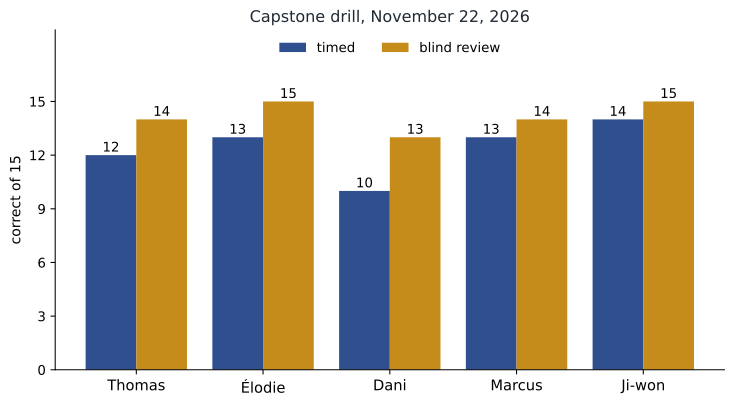
The timed scores, out of fifteen, were: Ji-won 14, Élodie 13, Marcus 13, Thomas 12 and Dani 10. After blind review: Ji-won 15, Élodie 15, Marcus 14, Thomas 14 and Dani 13.
Harriet went through the misses one by one, as she always did, and grouped them by the habit that would have prevented them.
- Not running the chain to the end. Thomas and Dani both missed question 15. Each had translated the conditionals correctly but stopped after the first link, so the credited answer (which required taking the contrapositive of the whole chain) looked unsupported. Harriet's fix: when there are two or more conditionals, always write out the full chain and its contrapositive before reading the choices.
- Choosing the valid twin. Dani missed question 7 by choosing the valid argument about cars in the lot. She caught it in blind review once she circled "flawed" in the stem.
- The one-sided disagreement. Marcus missed question 8, choosing a claim only Owen had addressed. He laughed: 'Two yeses. I know. I wrote the card for Dani.'
- The trap answer on an "only if" principle. Thomas initially chose the answer to question 4 that met both necessary conditions and concluded "publish." In blind review, he remembered Marcus's observation from November 1: an "only if" principle can only tell you when not to do something.
- Pace on parallel questions. Dani ran out of time and guessed on question 14. In blind review she got it right in under a minute, by checking conclusions first.
Élodie's only timed miss was question 3, where she chose the causal answer about walking. 'I knew it was a leap,' she said. 'I just liked it.' Harriet said that was the most honest description of an almost answer she had ever heard.
Ji-won's single timed miss was question 11, a cannot-be-true question where she found a choice that could not be guaranteed and stopped there. She got it right in blind review by sorting every choice into the three bins.
What the gaps mean
Harriet pointed to the chart. Every student's blind review score was close to fifteen, which meant the understanding was in place. The gaps between timed and blind scores, largest for Dani, smaller for the others, pointed to pacing and to a handful of habits that had not yet become automatic.
She gave each student one focus for the coming weeks. Thomas: write every chain to the end. Dani: conclusion first on parallel questions, and keep the cards in view until she no longer needs them. Élodie: name the leap in every almost answer before moving on. Ji-won: sort every choice into bins on cannot-be-true questions, rather than stopping at the first plausible one. Marcus: wait patiently for December 2.
Building the error log
Harriet asked each student to add their misses to the shared error log, using the same format as the earlier courses: the question type, the move they missed and the fix. For example: "Must be true, conditional chain. Missed move: stopped after the first link. Fix: write the full chain and its contrapositive before reading the choices."
Over the course of the three Logical Reasoning courses, the error log had become the group's most valuable study tool. Harriet noted that the entries from September were mostly about not understanding a question type; the entries from late November were mostly about not applying a method consistently. 'That is what progress looks like,' she said. 'The remaining work is making the methods automatic under time pressure.' That, she added, was the subject of the timing and test-day course still ahead (LSAT-140).
Common mistakes
MistakeStopping after the first link of a conditional chain.
InsteadWrite the full chain and its contrapositive before reading the choices.
MistakeChoosing the most similar-looking argument on a parallel flaw question.
InsteadName the flaw first; the most similar argument is often the valid twin.
MistakeChoosing a claim only one speaker addresses on a point-at-issue question.
InsteadApply the two-yes test.
MistakeStopping at the first plausible choice on a cannot-be-true question.
InsteadSort every choice into must, could and cannot bins.
Summary and key terms
- The capstone mixes every inference, principle, parallel, paradox and point-at-issue type.
- Take it timed, then do blind review, and compare the two scores.
- Most misses traced back to a method not applied: unfinished chains, valid twins, one-sided claims, almost answers.
- A small gap between timed and blind scores points to pacing; a large one points to habits not yet automatic.
- Record every miss in the error log as a type, a missed move and a fix.
- Blind review
- Revisiting flagged questions after a timed set, without seeing the answers, to decide on final choices with unlimited time.
- Error log
- A record of missed questions noting the type, the move missed and the fix.
- Stamina
- The ability to maintain accuracy across long, consecutive timed sections.
Practice problems
Work each problem on paper first, then reveal the answer to check.
Write an error log entry for missing question 2 by choosing (A).
Show answer
Example: "Cannot be true. Missed move: treated a possible claim as impossible; did not find the choice that contradicts 'fewer than half'. Fix: run the chain and check each choice against the quantity statement."
Your timed score is 10 and your blind review score is 14. What should you work on first?
Show answer
Pacing and making the methods automatic under time pressure; the understanding is largely in place.
Why does question 15 require the contrapositive of the whole chain?
Show answer
The given fact (no hiring) negates the last link, so only the contrapositive, run backwards through every link, reaches the council's approval.
Lesson quiz · 5 questions
Score 60% or more to complete this lesson.
Create a free account to save your progress, take quizzes and earn a certificate.