
LSAT-110 · Lesson 9 of 12 · 25 min
Necessary vs sufficient
▶ Video coming soon A video version of this lesson is on the way.
In the second half of the October 22 session, Harriet asked each member of the group to complete a sentence: "To get into law school, you need..." Thomas said a good LSAT score. Élodie said an undergraduate degree. Dani said an application. Marcus said money. Ji-won said all of those, and still might not get in. 'That,' said Harriet, 'is the difference between necessary and sufficient. Each of those things is necessary. None of them, on its own, is sufficient.'
The previous lesson introduced conditional statements and their arrows. This one goes deeper into the two ideas underneath them. Necessary and sufficient conditions are not just a topic in formal logic. They appear in ordinary arguments about policies, causes and requirements, and confusing them is one of the most common reasoning errors in the world, on the LSAT and off it.
The definitions
- A sufficient condition is enough to guarantee a result. If it holds, the result holds. Being a square is sufficient for having four sides.
- A necessary condition is required for a result. Without it, the result cannot happen. Having four sides is necessary for being a square.
The same relationship can be described from either end. "Being a square is sufficient for having four sides" and "Having four sides is necessary for being a square" say the same thing: Square → Four sides.
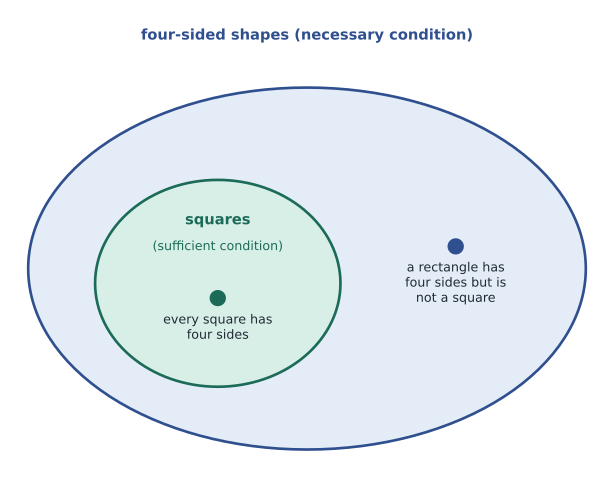
The circles show why reversal fails. Everything inside the small circle is inside the big one: every square has four sides. But the big circle has room outside the small one: a rectangle has four sides without being a square. Knowing that something is in the big circle does not tell you it is in the small one.
Necessary is not sufficient
The most common confusion treats a necessary condition as if it were sufficient. A city council says, "The stadium can be built only if the province contributes funding." The province announces funding. A reporter writes, "So the stadium will be built." But funding was necessary, not sufficient. The stadium might still need zoning approval, a contractor and a vote.
On the LSAT, this error appears in flawed arguments and in tempting wrong answers. A stimulus states a requirement, notes that it is met, and concludes that the result follows. The flaw is that a necessary condition was treated as sufficient.
Worked problem
Spotting the necessary-for-sufficient error
Stimulus: "A film can win the festival's top prize only if it premieres at the festival. Since Rowan Fields premiered at the festival, it will win the top prize." What is wrong with the reasoning?
Show solution
- Translate: Win → Premiered. Premiering is necessary.
- The argument notes that Rowan Fields premiered, then concludes it will win.
- That treats a necessary condition as sufficient: many films premiere; only one wins.
Answer: It takes a condition that is required for winning to be one that guarantees winning.
Sufficient is not necessary
The opposite confusion treats a sufficient condition as if it were necessary. "If you finish the race in under three hours, you qualify for the championship." Someone concludes, "Since Ines did not finish under three hours, she did not qualify." But a fast time was enough, not required. Ines might have qualified another way, for example by winning her age group.
This error matches the negation fallacy from the previous lesson: from "If A then B" and "not A", concluding "not B". It treats the one route to the result as the only route.
| Error | Pattern | Example |
|---|---|---|
| Necessary taken as sufficient | A → B; B is true; so A | Only members can vote; Sam is a member; so Sam can vote |
| Sufficient taken as necessary | A → B; A is false; so not B | Under three hours qualifies you; Ines was slower; so she did not qualify |
Several necessary conditions
Real situations usually have several necessary conditions, none sufficient alone. To get a driver's licence, you might need to be of a minimum age, pass a written test, pass a road test and pay a fee. Each is necessary. Together they might be sufficient. An argument that relies on one of them, and concludes the result, has ignored the rest.
Arguments also often state one sufficient condition among several. "Any student with a scholarship can live in residence." That does not mean only scholarship students can live there. Others might qualify by paying fees, by being in first year, or by some other route.
Words that signal each
Recognizing whether a statement presents a condition as necessary or sufficient is half the battle.
| Signals a sufficient condition | Signals a necessary condition |
|---|---|
| if | only if |
| when, whenever | requires, depends on, needs |
| all, every, any | only, the only |
| is enough to, guarantees, ensures | must, is essential for, is a prerequisite for |
| always results in | unless (the part after "unless") |
| without... not, cannot... without |
Notice "requires". "Success requires hard work" makes hard work necessary: Success → Hard work. Many students read it the other way, as if hard work guaranteed success. The sentence makes no such promise.
Worked problem
Sample question (written for this course)
Stimulus: "Every apprentice who completes the safety course is allowed to operate the press. Darnell has not completed the safety course. Therefore, Darnell is not allowed to operate the press." Stem: "The reasoning in the argument is flawed because the argument" (A) assumes that completing the safety course is the only way an apprentice can be allowed to operate the press (B) assumes that Darnell is an apprentice (C) relies on an unrepresentative sample of apprentices (D) confuses the press with other machines (E) assumes that all apprentices will complete the safety course
Show solution
- Translate: Completes course → Allowed. Completing the course is sufficient.
- The argument says Darnell has not completed it and concludes he is not allowed: a negation.
- The error is treating the sufficient condition as necessary, as if the course were the only route.
- (A) describes exactly that.
- (B) is worth a look: the argument never says Darnell is an apprentice. But even if he is, the conclusion does not follow, so (B) does not describe the central flaw.
- (C), (D) and (E) do not describe anything the argument does.
Answer: (A). The argument treats one sufficient route as the only route.
Necessary and sufficient in causal claims
Causal arguments use the same ideas, often without conditional words. "Smoking causes lung cancer" does not mean every smoker gets lung cancer (smoking is not sufficient) or that every lung cancer patient smoked (smoking is not necessary). It means smoking raises the risk. When an LSAT argument says that one thing "causes" or "leads to" another, be careful about converting it into a strict conditional. Some answer choices will claim that the cause always produces the effect, or that the effect never occurs without the cause, and those choices are usually too strong.
Harriet put it this way: 'A conditional is a rule. A causal claim is usually a tendency. Do not turn a tendency into a rule unless the stimulus does.'
Necessary conditions and assumptions
Here is why this lesson sits right before the lessons on assumptions. An argument's assumptions are its necessary conditions: things that must be true for the argument to work. The next lesson defines assumptions in exactly those terms. And the two kinds of assumption question on the LSAT, necessary and sufficient, map directly onto the two kinds of condition. A necessary assumption is something the argument requires. A sufficient assumption is something that, added to the premises, would guarantee the conclusion.
'Every time you see the word "assumption" in a stem,' Harriet said, 'ask yourself whether the question wants something necessary or something sufficient. They are different questions with different right answers, and lesson 11 will show you how different.'
Practising the distinction
For the week after October 22, Harriet gave the group twenty statements from newspapers, policies and product labels, and asked them to identify each condition as necessary or sufficient. "Valid only with receipt." "Free shipping on orders over 50 dollars." "Children under 12 must be accompanied by an adult." "Applicants who score above 160 will be interviewed."
Dani found the exercise easy with real signs and labels, and harder with LSAT stimuli. Harriet explained why: real signs are usually written so that people cannot misread them, and LSAT stimuli are written so that careless readers will. 'On the test, you translate every time,' she said, 'even when you think you know.'
Marcus noticed that engineering specifications had trained him well here. A specification lists requirements that are each necessary and, together, sufficient for a design to be accepted. He found he made fewer errors when he imagined each LSAT conditional as a line in a specification.
Worked problem
Necessary or sufficient?
Classify the condition named after each colon: (1) "Free shipping on orders over 50 dollars": an order over 50 dollars. (2) "Valid only with receipt": having a receipt. (3) "Applicants who score above 160 will be interviewed": scoring above 160.
Show solution
- (1) An order over 50 dollars guarantees free shipping. Sufficient (there may be other ways to get free shipping).
- (2) "Only with" makes the receipt a requirement. Necessary.
- (3) Scoring above 160 guarantees an interview. Sufficient (others may be interviewed too).
Answer: (1) sufficient, (2) necessary, (3) sufficient.
Sample question: a requirement treated as enough
Worked problem
Sample question (written for this course)
Stimulus: "To qualify for the city's home repair grant, a homeowner must have lived in the home for at least five years. Arjun has lived in his home for eight years. So Arjun qualifies for the grant." Stem: "Which one of the following most accurately describes a flaw in the argument?" (A) It treats a requirement for qualifying as if meeting it were enough to qualify. (B) It assumes that Arjun owns his home. (C) It relies on a definition of residence that is too broad. (D) It concludes that something is true of all homeowners from facts about one homeowner. (E) It treats a sufficient condition for qualifying as a necessary one.
Show solution
- Translate: Qualifies → Lived 5+ years. Five years is necessary ("must have").
- Arjun meets the necessary condition, and the argument concludes he qualifies. That treats necessary as sufficient.
- (A) describes exactly that error.
- (E) describes the opposite error.
- (B) points to something the argument does take for granted, but even if Arjun owns his home, meeting one requirement would not prove he qualifies. It is not the central flaw.
- (C) and (D) do not describe the reasoning.
Answer: (A). "Must have" made five years necessary; the argument treated it as sufficient.
The trap in (E) catches students who know the names of the two errors but mix them up. Harriet's memory aid: ask what the argument used as its evidence. If it used a requirement that was met, the error is treating necessary as sufficient. If it used a route that was not taken, the error is treating sufficient as necessary.
Necessary and sufficient in plans
Plans are a common place to find these confusions. An argument might say a plan "requires" funding, then conclude that because funding is secured, the plan will succeed. Or it might say that a plan "would" reduce costs, then conclude that without the plan costs cannot fall. In the first case funding was necessary but not sufficient; in the second the plan was sufficient but not necessary. Both errors are common in real policy debates, and both appear on the LSAT in flaw questions and as wrong answers elsewhere.
Marcus pointed out that building codes are written the same way. A code lists conditions a building must meet; meeting one does not make a building safe, and a building can be safe in ways the code does not mention. Harriet said that was exactly the right instinct to bring to the test.
A quick self-test
Before moving on, Harriet asked each member to answer one question without looking at their notes: "If a condition is necessary for a result, and you know the result happened, what do you know about the condition?" The answer is that the condition must have been met, because the result could not have happened without it. Then the reverse: "If the condition was met, what do you know about the result?" Nothing for certain. Everyone in the group answered both correctly, and Dani said it was the first time the difference had felt obvious rather than memorized.
Common mistakes
MistakeMeeting a necessary condition guarantees the result.
InsteadA necessary condition is required, not enough; other conditions may also be required.
MistakeA sufficient condition is the only way to get the result.
InsteadThere may be other sufficient conditions; failing one does not rule out the result.
Mistake"Success requires hard work" means hard work guarantees success.
Instead"Requires" makes hard work necessary: Success → Hard work.
MistakeA causal claim means the cause always produces the effect.
InsteadCausal claims usually describe tendencies, not strict rules.
MistakeNecessary and sufficient assumptions are the same thing.
InsteadA necessary assumption is required by the argument; a sufficient one guarantees the conclusion.
Summary and key terms
- A sufficient condition guarantees a result; a necessary condition is required for it.
- In A → B, A is sufficient for B and B is necessary for A; the sufficient condition sits inside the necessary one.
- Treating a necessary condition as sufficient, or a sufficient condition as necessary, are common flaws.
- Words like if, all and whenever signal sufficient conditions; only if, requires and only signal necessary ones.
- Causal claims usually describe tendencies; do not convert them into strict conditionals.
- The two kinds of condition correspond to necessary and sufficient assumption questions.
- Sufficient condition
- A condition that guarantees a result when it holds.
- Necessary condition
- A condition that must hold for a result to occur.
- Prerequisite
- Another name for a necessary condition.
- Necessary assumption
- Something an argument requires in order to work.
- Sufficient assumption
- Something that, added to the premises, guarantees the conclusion.
Practice problems
Work each problem on paper first, then reveal the answer to check.
"A passport is required to board an international flight." Hana has a passport. Can she board?
Show answer
Not necessarily. A passport is necessary, not sufficient; she may also need a ticket and boarding pass.
"Anyone who donates over 500 dollars receives a tote bag." Omar received a tote bag. Did he donate over 500 dollars?
Show answer
Not necessarily. A large donation is sufficient for the bag, not necessary; there may be other ways to get one.
Which word makes the following a necessary condition: "Admission ___ proof of vaccination"?
Show answer
"Requires": Admission → Proof of vaccination.
Lesson quiz · 5 questions
Score 60% or more to complete this lesson.
Create a free account to save your progress, take quizzes and earn a certificate.