
LSAT-110 · Lesson 5 of 12 · 23 min
Intermediate conclusions and complex arguments
▶ Video coming soon A video version of this lesson is on the way.
In the second half of the October 8 session, Harriet shared a stimulus that had tripped up every member of the group on a practice set the week before. "The proposed dam would flood the valley's only breeding ground for the marsh tern. Since the tern breeds nowhere else in the province, the dam would almost certainly eliminate the species from the province. The government should therefore reject the dam proposal." Asked for the main conclusion, four of the five had chosen the middle claim: that the dam would eliminate the tern from the province.
'It feels like the conclusion,' Élodie said. 'It has the strongest language, and it comes after "since".' Harriet agreed that it was a conclusion, just not the main one. 'It is concluded from the first sentence, and then it is used to support the recommendation. That makes it an intermediate conclusion. The main conclusion is where the argument ends up: the government should reject the proposal.'
This lesson teaches you to map arguments with more than one layer: intermediate conclusions, opposing views, concessions, and counter-arguments. These structures appear constantly on main point and role questions, and they are where most errors on those questions come from.
Intermediate conclusions
An intermediate conclusion (sometimes called a sub-conclusion) is a claim that is supported by a premise and then itself supports the main conclusion. It plays two roles at once: it is a conclusion relative to the premise beneath it, and a premise relative to the claim above it.
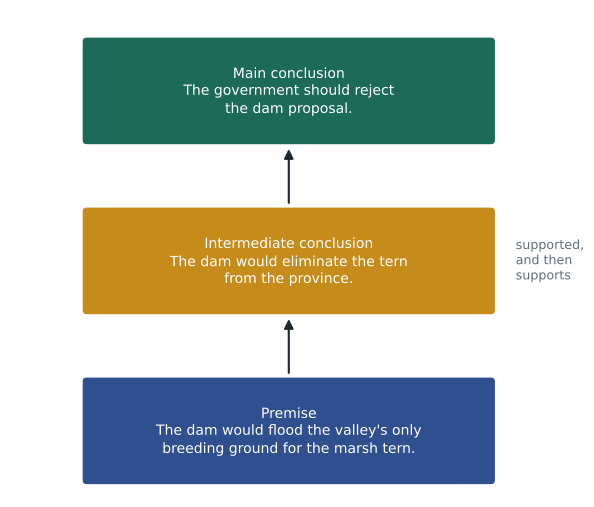
The test is the "therefore" test from lesson 3, applied to the two candidates. "The dam would eliminate the tern, therefore the government should reject it" makes sense. "The government should reject the dam, therefore it would eliminate the tern" does not. The claim that comes after "therefore" in the sensible version is the main conclusion.
Another useful test: the main conclusion is the claim that nothing else in the argument depends on. If you removed the intermediate conclusion, the main conclusion would lose its support. If you removed the main conclusion, the intermediate conclusion would be left with nothing to do.
Mapping an argument
Harriet asked the group to map hard arguments with a quick sketch: write each claim in a few words, then draw arrows from each premise to the claim it supports. Arguments on the LSAT rarely have more than four or five parts, so a map takes seconds once you are used to it. The common shapes are:
- A chain: premise supports intermediate conclusion, which supports main conclusion.
- Convergent support: two or more independent premises each support the conclusion directly. If one were removed, the others would still give some support.
- Linked support: two premises work only together. "All employees must complete training; Ana is an employee; so Ana must complete training." Neither premise supports the conclusion alone.
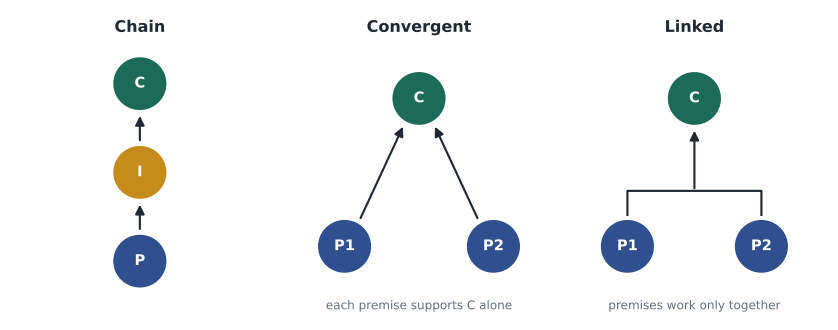
Recognizing the shape matters for later question types. In a convergent argument, weakening one premise leaves the others standing. In a linked argument, knocking out either premise collapses the support. In a chain, attacking the intermediate conclusion cuts off everything above it.
Opposing views
Many arguments open with a view the author rejects. "Some economists predict that raising the minimum wage will cause widespread job losses." The author then gives evidence against it and concludes that the prediction is wrong, or offers an alternative. The opposing view is part of the stimulus, but it is not the author's conclusion, and it is not a premise for the author's conclusion.
Opposing views are often introduced by phrases like "some argue", "it is often claimed", "critics say", "many people believe", or "according to the report". The turn to the author's view usually comes with "but", "however", "yet" or "in fact".
An opposing view can also have its own premises. "Critics say the bridge is unsafe because it sways in high winds. But the sway is within engineering limits, so the bridge is safe." The critics' reason (the sway) is part of their argument, not the author's. On a role question, it would be described as "evidence offered for a position the argument rejects."
Worked problem
Mapping an argument with an opposing view
Stimulus: "Some parents oppose the later school start time, saying it will make it harder for them to get to work. However, research on teenage sleep shows that later start times improve attendance and grades. Moreover, the district's survey found that most families could adjust their schedules. The district should adopt the later start." Map the argument.
Show solution
- Opposing view: parents oppose the later start, with their own reason (getting to work).
- "However" turns to the author's side.
- Premise 1: research shows improved attendance and grades.
- Premise 2 ("Moreover"): most families could adjust.
- Main conclusion: the district should adopt the later start.
- Shape: two convergent premises; Premise 2 also answers the opposing view.
Answer: Two premises support the recommendation; the parents' objection is an opposing view, and the survey result partly responds to it.
Concessions
A concession is a point the author admits counts somewhat against their position, before asserting the position anyway. Concessions are introduced by "although", "while", "admittedly", "granted", "it is true that", "even though" or "of course".
Concessions matter because they make an argument look balanced, and because role questions often ask about them. A concession is never the main conclusion, and it does not support the conclusion. It acknowledges a consideration on the other side.
- "Admittedly, the new software is harder to learn. But it will save each clerk an hour a day, so the office should adopt it." The difficulty of learning is a concession.
- "Although the trail is longer, hikers should take it, since it avoids the rockfall zone." The extra length is a concession.
| Part | Typical signals | Supports the main conclusion? |
|---|---|---|
| Premise | because, since, given that, moreover | Yes |
| Intermediate conclusion | so, therefore, thus (followed by a further claim) | Yes, and is itself supported |
| Main conclusion | therefore, thus, should, so (the final point) | It is what is supported |
| Opposing view | some claim, critics say, it is widely believed | No; the author rejects it |
| Concession | although, admittedly, granted, it is true that | No; it counts against the author |
| Background | often the first sentence, scene-setting | No |
Counter-arguments within the argument
Sometimes an author anticipates an objection and answers it. "One might object that the program is too expensive. But its cost will be recovered within three years through lower hospital admissions." The objection is like an opposing view, and the answer to it is a premise that defends the conclusion. On role questions, the answer is described as "a response to an anticipated objection."
Harriet warned the group about a frequent trap. When an author answers an objection, the answer is usually a premise, not the main conclusion. The main conclusion is still whatever the author was arguing for in the first place.
Worked problem
Sample question (written for this course)
Stimulus: "The town should convert the old rail line into a walking trail. Admittedly, a few property owners along the line worry about trespassers. But trails of this kind in neighbouring towns have not increased crime, and the trail would give residents a safe place to exercise away from traffic. The conversion would therefore improve residents' health without making their homes less safe." Stem: "The claim that the conversion would improve residents' health without making their homes less safe plays which one of the following roles in the argument?" (A) It is the main conclusion of the argument. (B) It is an intermediate conclusion offered in support of the argument's main conclusion. (C) It is a concession to the property owners' concern. (D) It is evidence offered for a view the argument rejects. (E) It is background information.
Show solution
- Map it. Concession: some owners worry about trespassers.
- Premises: no crime increase in neighbouring towns; a safe place to exercise.
- "Therefore" introduces a conclusion: health improves without less safety.
- Does that claim support anything? Yes: it explains why the town should convert the line, stated in the first sentence.
- So the first sentence is the main conclusion and the "therefore" claim is intermediate.
- (A) is wrong: the recommendation is the main conclusion. (C) misdescribes it: the concession is the owners' worry. (D) and (E) do not fit.
Answer: (B). The "therefore" claim is concluded from the premises and in turn supports the recommendation stated first.
When the main conclusion comes first and an intermediate conclusion comes last
The example above shows one of the LSAT's favourite structures: main conclusion first, then support, with a "therefore" near the end introducing an intermediate conclusion. Students who rely on the last-sentence habit, or who trust the word "therefore" blindly, pick the intermediate conclusion. The "therefore" test between the two candidates prevents this.
Ji-won asked how to spot this structure quickly. Harriet's rule of thumb: if the first sentence is a recommendation or a strong judgment and nothing before it supports it, treat it as the main conclusion until proven otherwise. Then check whether the late "therefore" claim supports it.
Practising maps
For homework after October 8, Harriet assigned fifteen complex arguments to map. Each map was to label every sentence with one of six roles: premise, intermediate conclusion, main conclusion, opposing view, concession or background. Then each member was to check their maps against her answer key and log any disagreement.
Dani found the drill hard but useful. Her immigration work involved reading decisions that summarized one side's argument before rejecting it, and she realized that she had been treating the summarized argument as the decision-maker's own view on LSAT stimuli too. 'The LSAT writes like a judge,' she said. 'First the other side, then "however".'
Marcus found that maps helped him with something he had not expected: speed. Once he could see the shape, he could predict what the answer choices would look like. On a role question about a concession, he knew to look for a choice with words like "acknowledges" or "concedes".
Sample question: two statements, two roles
Worked problem
Sample question (written for this course)
Stimulus: "Some nutritionists claim that eating late at night causes weight gain. However, studies that controlled for total daily calories found no difference in weight between late and early eaters. So the timing of meals does not by itself cause weight gain. People who eat late may simply eat more overall." Stem: "Which one of the following describes the roles played by the claim that eating late at night causes weight gain and the claim that the timing of meals does not by itself cause weight gain?" (A) The first is the main conclusion; the second is a premise. (B) The first is a view the argument rejects; the second is the main conclusion. (C) The first is a premise; the second is an intermediate conclusion. (D) The first is a concession; the second is a view the argument rejects. (E) The first is a view the argument rejects; the second is evidence for that view.
Show solution
- The nutritionists' claim is introduced with "Some... claim", and "However" turns against it. It is an opposing view.
- "So" introduces the author's conclusion: meal timing does not by itself cause weight gain.
- The last sentence offers a possible explanation for why late eaters might weigh more, which fits with and clarifies the conclusion rather than being supported by it.
- (B) matches both roles.
- (A) gets both wrong. (C) and (D) misdescribe the first. (E) misdescribes the second: the author's conclusion opposes the nutritionists, not supports them.
Answer: (B). Both statements needed mapping; a choice that got one right and the other wrong was still wrong.
Two-statement role questions reward complete maps. Ji-won made a habit of labelling every sentence before reading the choices, even when the question asked about only one. It took a few extra seconds and saved her from choices that described a neighbouring sentence instead of the one asked about.
Maps in your head
By the end of October, nobody in the group was drawing maps for every question. Harriet had expected that. The point of drawing them for a few weeks was to build the habit of seeing structure, so that a map forms in your head as you read. On test day, a quick margin note on a hard question, such as "MC = should reject; IC = eliminate tern", is plenty. Marcus said it reminded him of learning to read circuit diagrams: after enough practice, he no longer traced each wire, he just saw the circuit.
If you find yourself confused on a hard question, return to the full sketch. The few seconds it costs are almost always repaid on role and main point questions, and later on flaw and parallel questions too.
Common mistakes
MistakeThe claim after "therefore" is always the main conclusion.
InsteadIt may be an intermediate conclusion that supports a further claim; test both candidates.
MistakeAn opposing view is a premise.
InsteadAn opposing view is a position the author rejects; it does not support the author's conclusion.
MistakeA concession supports the conclusion.
InsteadA concession acknowledges a point against the author's view.
MistakeAn author's answer to an objection is the main conclusion.
InsteadThe answer is usually a premise defending the conclusion.
MistakeAll premises work independently.
InsteadSome premises are linked and support the conclusion only together.
Summary and key terms
- An intermediate conclusion is supported by a premise and in turn supports the main conclusion.
- Use the "therefore" test between two candidates; the main conclusion is the one that supports nothing else.
- Arguments take common shapes: chains, convergent premises and linked premises.
- Opposing views (often "some claim", then "but") are rejected positions, not premises.
- Concessions ("although", "admittedly") acknowledge points against the author and do not support the conclusion.
- A common hard structure puts the main conclusion first and an intermediate conclusion near the end after "therefore".
- Intermediate conclusion
- A claim supported by premises that is then used to support the main conclusion.
- Convergent premises
- Premises that each independently support the conclusion.
- Linked premises
- Premises that support the conclusion only in combination.
- Counter-argument
- An objection to the author's view that the author raises and answers.
- Argument map
- A quick sketch of an argument's claims with arrows showing what supports what.
Practice problems
Work each problem on paper first, then reveal the answer to check.
Map: "Our team lost its two best players, so it will struggle this season. The coach should therefore lower expectations for the playoffs."
Show answer
Premise: lost two best players. Intermediate conclusion: the team will struggle. Main conclusion: the coach should lower expectations.
In "Granted, the course is demanding. But students who finish it earn higher wages, so it is worth taking," what role does "the course is demanding" play?
Show answer
A concession: a point against taking the course that the author admits.
Are these premises linked or convergent? "Every licensed pilot passed a medical exam. Rafael is a licensed pilot. So Rafael passed a medical exam."
Show answer
Linked: neither premise supports the conclusion alone.
Lesson quiz · 5 questions
Score 60% or more to complete this lesson.
Create a free account to save your progress, take quizzes and earn a certificate.