
LSAT-110 · Lesson 12 of 12 · 29 min
Capstone: a timed argument drill
▶ Video coming soon A video version of this lesson is on the way.
On Thursday, November 5, 2026, the Thursday Circle took the drill that closed its six weeks on arguments. Harriet had written fifteen Logical Reasoning questions covering everything in the course: main point, role, method of reasoning, necessary assumption and sufficient assumption questions, with a few conditional reasoning items mixed in. The time limit was 21 minutes, the same pace as a 25-question section in 35 minutes. Ji-won worked to her accommodation, 31 and a half minutes. Marcus, a week before his November test, took it as a warm-up. 'Treat it as a rehearsal of your methods,' Harriet said. 'Map, predict, eliminate, flag, move on.'
This capstone works through six of the fifteen questions in full, with an explanation for every answer choice. Try each question before reading the explanation. Then it shows the group's results and how each member debriefed, and ends with what carries forward into the next course. As before, every question here was written for this course; none is an LSAC question.
The rules
- Read the stem first and name the question type.
- Map the argument and predict the answer before reading the choices.
- For necessary assumptions, negate the finalists. For sufficient assumptions, add the choice and check that the conclusion must follow.
- Flag any question you answer with less than full confidence, and keep moving.
- Answer every question. Blind review all flagged questions before checking answers.
Question 2 (main point)
Worked problem
Question 2
Stimulus: "Some council members argue that the city should sell its downtown parking garage to close the budget gap. But the garage earns more each year in parking fees than the sale would save in interest on the city's debt. Selling it would therefore leave the city worse off within a few years. The council should keep the garage." Stem: "Which one of the following most accurately expresses the main conclusion of the argument?" (A) The garage earns more in fees each year than the sale would save in interest. (B) Selling the garage would leave the city worse off within a few years. (C) The council should keep the downtown parking garage. (D) The city has a budget gap. (E) Some council members want to sell the garage.
Show solution
- Map: opposing view (sell the garage); "But" premise (fees exceed interest savings); "therefore" intermediate conclusion (selling leaves the city worse off); main conclusion (keep the garage).
- (A) is the premise.
- (B) is the intermediate conclusion: it supports the recommendation. This was the most popular wrong answer.
- (C) is the main conclusion, the recommendation everything builds to.
- (D) is background implied by the opposing view.
- (E) is the opposing view.
Answer: (C). The "therefore" test settles it: "Selling would leave us worse off, therefore keep the garage" makes sense; the reverse does not.
Question 5 (role)
Worked problem
Question 5
Stimulus: "Admittedly, the new bus route will take ten minutes longer than the old one. Even so, the transit authority was right to adopt it. The new route serves two hospitals that the old route bypassed, and ridership surveys show that most riders value access over speed." Stem: "The statement that the new route will take ten minutes longer plays which one of the following roles in the argument?" (A) It is the main conclusion. (B) It is a premise offered in support of the main conclusion. (C) It is a consideration acknowledged as counting against the conclusion. (D) It is an opposing view that the argument shows to be false. (E) It is an intermediate conclusion.
Show solution
- "Admittedly" introduces a concession; "Even so" turns to the author's claim.
- Main conclusion: the authority was right to adopt the route. Premises: the hospitals and the survey.
- (A) and (E) are wrong: the extra time is neither concluded nor supported.
- (B) is wrong: the extra time counts against adopting the route.
- (C) describes a concession exactly.
- (D) is wrong: the author accepts that the route is longer; nothing is shown false.
Answer: (C). Concessions are acknowledged, not refuted.
Question 8 (method of reasoning)
Worked problem
Question 8
Stimulus: "Talia claims that no restaurant in Wendell can stay open without serving alcohol, because alcohol sales are where restaurants make their profit. But the Larkspur Café has served no alcohol for fifteen years and has been profitable throughout." Stem: "The argument proceeds by" (A) questioning the reliability of the source of Talia's claim (B) presenting a case that contradicts a general claim (C) showing that Talia's claim would lead to an absurd consequence (D) arguing that alcohol sales are not profitable for any restaurant (E) proposing an alternative explanation for why restaurants close
Show solution
- Talia makes a general claim: no restaurant here can stay open without alcohol.
- The argument presents one restaurant that has done exactly that: a counterexample.
- (B) matches.
- (A): nothing is said about Talia's reliability.
- (C): no absurd consequence is derived.
- (D) is too strong: the argument says nothing about alcohol's profitability elsewhere.
- (E): no closures are explained.
Answer: (B). One case is enough to contradict "no restaurant".
Question 10 (necessary assumption)
Worked problem
Question 10
Stimulus: "Since the company introduced flexible start times, the number of employees arriving late has fallen by more than half. Flexible start times have therefore made employees more punctual." Stem: "The argument depends on assuming which one of the following?" (A) Employees prefer flexible start times to fixed ones. (B) The company did not change its definition of arriving late so that fewer arrivals count as late. (C) Every employee now arrives on time. (D) Flexible start times have improved productivity. (E) Other companies have also introduced flexible start times.
Show solution
- Premise: recorded late arrivals fell. Conclusion: employees became more punctual.
- Gap: with flexible start times, what counts as "late" may have changed. Fewer late arrivals might reflect a looser standard, not better punctuality.
- Negate (B): "The company did change its definition so fewer arrivals count as late." Then the drop could be due to the definition alone; the argument collapses. Required.
- Negate (C): "Not every employee arrives on time." The argument survives; punctuality can improve without being perfect. Too strong.
- (A), (D) and (E) are irrelevant to whether punctuality improved.
Answer: (B). A defender assumption ruling out a measurement change, the explanation the argument must exclude.
Question 12 (sufficient assumption)
Worked problem
Question 12
Stimulus: "Every exhibit in the museum's north wing is on loan from another institution. Therefore, no exhibit in the north wing may be photographed." Stem: "The conclusion follows logically if which one of the following is assumed?" (A) Some exhibits on loan from other institutions may not be photographed. (B) No exhibit on loan from another institution may be photographed. (C) Every exhibit that may not be photographed is on loan. (D) The museum owns no exhibits in the north wing. (E) Photography damages some exhibits.
Show solution
- Premise: North wing → On loan. Conclusion: North wing → not Photographed.
- Missing link: On loan → not Photographed.
- (B) states it: no loaned exhibit may be photographed. The chain is complete.
- (A) uses "some"; it cannot guarantee anything about every north wing exhibit.
- (C) reverses the link: not Photographed → On loan.
- (D) restates a consequence of the premise; it adds no link to photography.
- (E) is a possible reason for a rule, not a rule that guarantees the conclusion.
Answer: (B). It bridges "on loan" to "may not be photographed" in the right direction.
Question 14 (conditional reasoning)
Worked problem
Question 14
Stimulus: "A grant application will be reviewed only if it includes a budget. The application from the Seaton Arts Collective was reviewed." Stem: "If the statements above are true, which one of the following must also be true?" (A) The Seaton application will be funded. (B) The Seaton application included a budget. (C) Every application that includes a budget is reviewed. (D) The Seaton application was the only one reviewed. (E) Applications without budgets are sometimes reviewed.
Show solution
- Translate: Reviewed → Budget. "Only if" introduces the necessary condition.
- The Seaton application was reviewed, so it included a budget.
- (B) follows.
- (A): funding is never discussed.
- (C) is a reversal: Budget → Reviewed.
- (D) is unsupported.
- (E) contradicts the rule.
Answer: (B). Affirming the sufficient condition (reviewed) guarantees the necessary one (budget).
Results
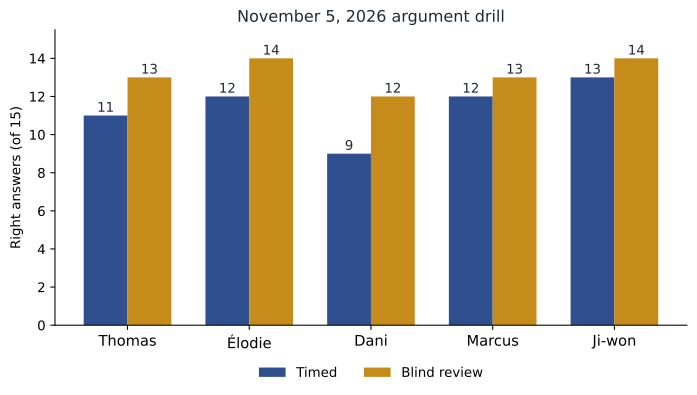
| Member | Timed (of 15) | Blind review (of 15) | Most missed type |
|---|---|---|---|
| Thomas | 11 | 13 | Sufficient assumption (reversed conditional) |
| Élodie | 12 | 14 | Main point (intermediate conclusion trap) |
| Dani | 9 | 12 | Necessary assumption (negation too strong) |
| Marcus | 12 | 13 | Method of reasoning (one clause wrong) |
| Ji-won | 13 | 14 | Role (two-statement question) |
Question 2 was the most missed: three members chose the intermediate conclusion. Question 10 was second: two members chose (C), the strong "every employee" choice, before blind review led them to negate it properly.
The debrief
Harriet ran the debrief the same way every time: first the gap between timed and blind review, then the patterns in the error log, then one habit to keep and one to fix.
Thomas
Thomas's two remaining errors were both sufficient assumption questions where he had picked a reversed conditional. He had mapped the premises correctly and seen the missing link, then grabbed the first choice with the right terms. His fix: after finding the link, write the arrow, then check each candidate's direction against it. His assumption accuracy across all types was now about 70 percent, up from 41 percent in September.
Élodie
Élodie missed question 2, choosing the intermediate conclusion, despite having fixed the habit in October. She had been rushing at the start. Her blind review caught it at once. Her plan: slow down on the first five questions, where her accuracy should be close to perfect, and save her speed for later.
Dani
Dani's timed score of 9 rose to 12 in blind review. Two of her errors were necessary assumption questions where she had negated "every" as "none" and seen the argument collapse when it would not have. Under time, her negations got too strong. She made a card with the negation table and practised ten negations a day for the next week.
Marcus
Marcus's one missed method question had a two-part answer choice; he had matched the first part and skimmed the second. He said the drill reassured him before his test. 'I know what I do wrong now,' he said. 'I just have to not do it on Thursday.' He tested on November 12.
Ji-won
Ji-won missed one role question that asked about two statements. She had identified the first correctly and assumed the second was a premise when it was an intermediate conclusion. Her fix was simple: map every statement on two-statement role questions, not just the first.
What carries forward
Harriet closed the course by listing the habits it had built and how each one would matter in the next two courses.
- Finding the main conclusion precisely is the first step in every flaw, strengthen and weaken question in LSAT-111.
- Finding the gap is the core of flaw questions: a flaw is usually an assumption the argument makes without justification.
- Strengthen questions often support an assumption, and weaken questions often attack one.
- Conditional translation and the necessary versus sufficient distinction are central to the inference and principle questions in LSAT-112.
- Mapping arguments makes parallel reasoning questions manageable, because you compare structures, not topics.
The session ended with Marcus's question about what to do in his last week. Harriet's answer applied to everyone: 'No new methods. Keep using the ones you trust, sleep properly, and do one short timed set each day to stay sharp.'
Your own drill
To reproduce this capstone yourself, take fifteen Logical Reasoning questions from an official LawHub practice test that you have not seen, choosing a mix of main point, role, method and assumption questions. Time yourself at 21 minutes (or your accommodation equivalent). Blind review every flagged question. Then log every error with its type, cause and lesson, and compare your timed and blind review scores. A large gap means your methods are sound but rushed; a small gap with many errors means there are concepts to revisit in this course.
Questions the group asked afterward
After the debrief, Thomas asked whether fifteen questions told him anything about his likely score. Harriet said no: a set that small swings too much to convert to a scaled score, which was why the debrief mattered more than the number. Élodie asked how often to repeat a drill like this. Harriet suggested one mixed argument drill a week until test day, with blind review every time, and a fresh error log column for any type that kept reappearing. Dani asked whether she should keep practising untimed. Harriet said yes, for new question types, but that every type from this course should now be practised under time.
Common mistakes
MistakeA timed drill is mainly about the score.
InsteadIts value is in the debrief: the gap between timed and blind review and the patterns in your errors.
MistakeOnce you have fixed a habit, you will not repeat the error.
InsteadOld habits return under time pressure; keep checking for them.
MistakeOn a two-statement role question, getting one role right is enough to narrow the choices safely.
InsteadMap both statements; choices often get one right and one wrong.
MistakeThe week before a test is the time to learn new methods.
InsteadUse the methods you trust and keep sharp with short timed sets.
MistakeBlind review is optional once you are scoring well.
InsteadBlind review keeps separating knowledge gaps from timing problems at every level.
Summary and key terms
- The capstone drill tested all the argument skills from this course under realistic time.
- The most common error was choosing an intermediate conclusion on a main point question.
- Necessary assumption errors came mostly from negating too strongly; sufficient assumption errors came from reversed conditionals.
- Each member used the timed versus blind review gap and their error log to choose one fix.
- The skills in this course are the foundation for flaw, strengthen, weaken, inference, principle and parallel questions.
- Drill
- A short timed set of questions used to practise methods and expose errors.
- Debrief
- A structured review of a practice set to find patterns and choose fixes.
- Two-statement role question
- A role question that asks about the parts played by two different statements.
Practice problems
Work each problem on paper first, then reveal the answer to check.
Your timed score on a drill is 9 of 15 and your blind review score is 14. What does the gap suggest?
Show answer
You mostly know the material but are rushing or second-guessing under time; work on pacing and confidence rather than new concepts.
You chose a reversed conditional on a sufficient assumption question. What check prevents this?
Show answer
Write the missing link as an arrow, then check each candidate's direction against it.
On a main point question, you are torn between a "therefore" claim near the end and a recommendation at the start. What do you do?
Show answer
Use the "therefore" test: the claim that the other supports is the main conclusion.
Lesson quiz · 5 questions
Score 60% or more to complete this lesson.
Create a free account to save your progress, take quizzes and earn a certificate.