
LSAT-110 · Lesson 10 of 12 · 23 min
Assumptions
▶ Video coming soon A video version of this lesson is on the way.
On Thursday, October 29, 2026, Harriet opened the session by reading out a number from Thomas's error log, with his permission. In September, he had answered 41 percent of assumption questions correctly. By the third week of October, the figure was 64 percent. 'He did not get there by learning tricks,' she said. 'He got there by finding the right conclusion, and then by learning what an assumption actually is. Today is the second part.'
Assumptions are at the centre of Logical Reasoning. Assumption questions test them directly. Flaw questions usually describe an assumption the argument makes without justification. Strengthen questions often support an assumption; weaken questions often attack one. Learning to find assumptions precisely is the single most valuable skill in this course, and the reason the earlier lessons spent so long on conclusions and conditions.
What an assumption is
An assumption is an unstated premise that the argument needs. It is something the author takes for granted in moving from the stated premises to the conclusion. If the assumption were false, the argument would fall apart, or at least be much weaker.
Three features define an assumption on the LSAT.
- It is unstated. If the stimulus says it, it is a premise, not an assumption.
- It connects the premises to the conclusion. It is not just any belief the author might hold; it is a link the argument relies on.
- It is required. Without it, the reasoning does not work.
The gap
The most reliable way to find an assumption is to look for the gap between the premises and the conclusion. Very often the conclusion contains an idea, a term or a claim that does not appear in the premises. The argument assumes that something connects what is in the premises to what is new in the conclusion.
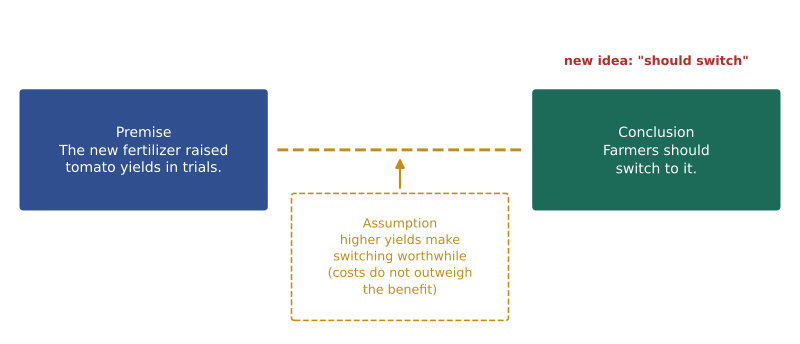
Take this argument: "The new fertilizer increased tomato yields by twenty percent in field trials. So farmers should switch to it." The premise is about yields. The conclusion is about what farmers should do. The gap is between "higher yields" and "should switch". The argument assumes that higher yields make switching worthwhile: for instance, that the fertilizer's cost does not outweigh the extra revenue, and that the trial results apply to farmers' own fields.
Harriet called this "looking for the new term". 'Circle any word in the conclusion that the premises never mention. The assumption almost always involves it.'
Worked problem
Finding the new term
Stimulus: "Over the past decade, the number of bookstores in Halbridge has fallen by half. Clearly, people in Halbridge are reading fewer books." Find the gap and state an assumption.
Show solution
- Premise: fewer bookstores.
- Conclusion: people are reading fewer books.
- New idea in the conclusion: reading. The premise is about where books are sold, not how many are read.
- Assumption: people are not getting books in other ways, such as online, from libraries, or as e-books, in numbers that make up for the closed stores.
Answer: The argument assumes that fewer bookstores means fewer books read, which requires that other sources of books have not taken up the slack.
Common gaps by type of argument
Lesson 2 listed common kinds of support. Each tends to produce a predictable assumption. Knowing these patterns lets you anticipate the gap before you see the answer choices.
| Kind of argument | Typical assumption |
|---|---|
| Causal: A is linked to B, so A causes B | No other factor explains the link; B did not cause A; the link is not coincidence |
| Sample: some members of a group, so the group | The sample represents the whole group |
| Analogy: X is like Y, so X will behave like Y | The two are alike in the ways that matter |
| Plan: doing A will achieve goal G | Nothing will prevent A from working, and A will not create a bigger problem |
| Recommendation: A has a benefit, so we should do A | The benefit is not outweighed by costs or drawbacks |
| Principle: rule R applies, so case C should be treated a certain way | Case C falls under rule R |
| Comparison over time: things were X, now Y, so something changed | Measurement was consistent; the comparison is fair |
Assumptions that defend against objections
Many assumptions take a defensive form: they rule out a possibility that would wreck the argument. In the bookstore example, one assumption is that online sales did not replace the stores. In a causal argument, an assumption might be that some third factor did not cause both things. These are sometimes called "defender" assumptions, because they defend the argument against an alternative.
Defender assumptions often appear in answer choices in negative form: "Residents of Halbridge have not significantly increased their purchases of books online." Students sometimes skip such choices because they sound minor. But a choice that rules out the most obvious alternative explanation is often exactly what the argument requires.
Assumptions are not the conclusion and not a premise
Two kinds of answer choice look like assumptions but are not.
- A restatement of the conclusion. "People in Halbridge read less than they used to" is just the conclusion again. An argument cannot assume its own conclusion and still be an argument.
- A restatement of a premise. "Halbridge has fewer bookstores than it did ten years ago" is already stated. An assumption must be unstated.
A third kind is subtler: a claim that is relevant to the topic but does not connect premise to conclusion. "Bookstores in other towns have also closed" is about bookstores, but it does nothing to link Halbridge's store closures to how much people there read.
Worked problem
Sample question (written for this course)
Stimulus: "Employees at Verano Software who took the company's optional time-management course completed more projects on schedule last year than employees who did not. So the course improves employees' ability to meet deadlines." Stem: "Which one of the following is an assumption on which the argument depends?" (A) The time-management course was expensive to offer. (B) Employees who took the course were not already better at meeting deadlines before they took it. (C) All Verano employees should be required to take the course. (D) Employees who took the course completed more projects on schedule. (E) Time-management skills are valued by employers.
Show solution
- Premise: course-takers met more deadlines.
- Conclusion: the course improves the ability to meet deadlines (causal).
- Gap: the comparison might reflect who chose the course. Since it was optional, better-organized people may have signed up.
- (B) rules out that alternative. If course-takers were already better, the result would not show the course helped.
- (A) is about cost, out of scope. (C) is a recommendation the argument does not make. (D) restates the premise. (E) is irrelevant.
Answer: (B). It defends against the most obvious alternative: self-selection.
How to think about required
An assumption must be required, which means the argument depends on it. A useful way to feel this is to imagine the assumption is false and see what happens. If the course-takers were already better at deadlines, the argument collapses: the data no longer suggests the course did anything. That collapse tells you the assumption is required. The next lesson turns this idea into a formal test, the negation test.
Compare a choice that would help the argument but is not required. "The course was taught by an expert in time management" makes the course sound good, and might make the conclusion more believable. But if it were false, if the teacher were not an expert, the data would still suggest the course helped. So it is not required. It is a strengthener, not an assumption.
Assumption questions and their stems
There are two kinds of assumption question, and the next lesson treats them in detail. For now, learn to tell them apart by their stems.
- Necessary assumption: "The argument depends on assuming which one of the following?", "Which one of the following is an assumption required by the argument?", "The argument relies on which one of the following assumptions?"
- Sufficient assumption: "The conclusion follows logically if which one of the following is assumed?", "Which one of the following, if assumed, enables the conclusion to be properly drawn?"
The words "depends on", "requires" and "relies on" point to necessary assumptions. The words "follows logically if" and "enables the conclusion to be properly drawn" point to sufficient ones. They call for different answers, because what an argument needs is not always enough to prove it, and what would prove it is often more than it needs.
Thomas's turnaround
Thomas described his own change to the group. In September, he said, he had been choosing answers that were "about the topic" or that he agreed with. He would read an argument about fertilizer and pick a choice about farming that seemed sensible. Now he did three things every time: he found the conclusion, he circled the new term, and he asked what would break the argument if it were false. He had stopped asking whether an answer was true and started asking whether the argument needed it.
Élodie said she had the opposite problem. She found the gap quickly but then talked herself out of the right answer because it seemed too obvious. Harriet said that was common among strong readers. 'The LSAT is not hiding the assumption in a riddle. Often the right answer just says the obvious thing the author forgot to say.'
Sample question: an assumption about a comparison
Worked problem
Sample question (written for this course)
Stimulus: "Last year, the town of Brisco had fewer reported bicycle thefts than the town of Calder, even though Calder has a larger police force. Therefore, Brisco's bicycle-registration program is more effective at preventing theft than Calder's policing." Stem: "The argument relies on which one of the following assumptions?" (A) Brisco has fewer bicycles than Calder. (B) The difference in reported thefts is not mainly explained by other differences between the towns, such as how many bicycles each has or how often thefts are reported. (C) Calder should adopt a bicycle-registration program. (D) Every bicycle in Brisco is registered. (E) Police forces are not useful in preventing theft.
Show solution
- Premise: Brisco had fewer reported thefts. Conclusion: Brisco's program is more effective than Calder's policing.
- Gap: many differences between the towns could explain the numbers: fewer bikes, fewer residents, less reporting.
- Negate (B): "The difference is mainly explained by other differences." Then the program may have nothing to do with it. The argument collapses.
- (A), if true, would actually weaken the argument. (C) is a recommendation. (D) is too strong. (E) is too strong and not needed.
Answer: (B). Comparisons between groups assume that the groups are comparable in the ways that matter.
This argument shows a pattern worth memorizing: when an argument compares two groups and credits one factor for the difference, it assumes the groups are otherwise comparable. Answer choices that say so, often in the form "the difference is not explained by X", are usually the required assumption.
Predict, then confirm
Harriet's method for assumption questions follows the one for main point questions: predict first. Find the conclusion, find the new term, and write one sentence starting "The author assumes that..." before reading the choices. You will not always predict the exact wording, but you will usually predict the idea, and that makes the right choice stand out. When it does not, the negation test in the next lesson resolves the close calls.
Assumptions and the rest of the course sequence
Assumptions will follow you through the next two courses. A flaw question often describes an assumption the argument makes without support, in language like "takes for granted that" or "fails to consider the possibility that". A strengthen question's right answer often confirms an assumption; a weaken question's right answer often shows one is false. Even inference questions sometimes depend on noticing what an argument would need to assume. Harriet told the group that every hour they spent on assumptions now would pay off across a dozen question types later.
Common mistakes
MistakeAn assumption is any belief the author probably holds.
InsteadAn assumption is an unstated link the argument needs to get from premises to conclusion.
MistakeA choice that restates the conclusion can be an assumption.
InsteadAn argument does not assume its own conclusion; look for the link instead.
MistakeA choice that makes the argument sound better must be an assumption.
InsteadAn assumption is required; many helpful facts are not.
MistakeNegative-sounding choices that rule out alternatives are unlikely answers.
InsteadDefender assumptions that rule out alternatives are often exactly what is required.
MistakeNecessary and sufficient assumption questions have the same kind of answer.
InsteadNecessary assumptions are what the argument needs; sufficient ones are what would prove it.
Summary and key terms
- An assumption is an unstated premise the argument needs to connect its premises to its conclusion.
- Find the gap by looking for a new term or idea in the conclusion that the premises do not mention.
- Common argument types produce predictable assumptions: no other cause, a representative sample, a relevant analogy, no outweighing cost.
- Defender assumptions rule out alternatives that would wreck the argument.
- An assumption is required: if it were false, the argument would collapse. Helpful but unrequired facts are strengtheners.
- Stems with "depends on" or "requires" ask for necessary assumptions; "follows logically if" asks for sufficient ones.
- Assumption
- An unstated premise that an argument needs in order to work.
- Gap
- The distance between what the premises establish and what the conclusion claims.
- New term
- A word or idea in the conclusion that does not appear in the premises.
- Defender assumption
- An assumption that rules out an alternative that would undermine the argument.
- Self-selection
- When people choose whether to join a group, so differences between groups may reflect who chose, not the treatment.
Practice problems
Work each problem on paper first, then reveal the answer to check.
Find the new term: "Ticket prices at the zoo rose last year. So the zoo's revenue increased."
Show answer
"Revenue." The argument assumes attendance did not fall enough to offset the higher prices.
Is this an assumption of the zoo argument? "Ticket prices at the zoo rose last year."
Show answer
No. It is a stated premise.
Name the typical assumption: "Patients who drank green tea had fewer colds, so green tea prevents colds."
Show answer
That nothing else about the tea drinkers, such as diet or sleep, explains why they had fewer colds.
Lesson quiz · 5 questions
Score 60% or more to complete this lesson.
Create a free account to save your progress, take quizzes and earn a certificate.