
LSAT-110 · Lesson 1 of 12 · 24 min
How Logical Reasoning sections work
▶ Video coming soon A video version of this lesson is on the way.
On Thursday, September 24, 2026, two weeks after the Thursday Circle took its diagnostics, Harriet Nakamura-Fox opened the group's first session on Logical Reasoning with a number. 'Two out of three,' she said. 'That is how much of your scored LSAT is Logical Reasoning. Two of the three scored multiple-choice sections. If you get better at one thing this fall, make it this.'
Thomas Okafor-Reid, who had scored 151 on his diagnostic, had already noticed it. He had done well on the reading passage and poorly on the short arguments, especially the questions that asked what an argument assumed. Dani Ruiz said her problem was different: she could usually tell what was wrong with an argument, but the answer choices used words like "necessary" and "sufficient" that she had never had to define precisely. Ji-won Park wanted to know why she sometimes ran out of time even with her extended timing. Élodie Brassard and Marcus Feld wanted to know whether there were patterns worth learning, or whether every question was new.
'All four of those questions are what this course is about,' Harriet said. 'We will start with how the section is built, then spend most of our time on arguments: what they are made of, how to find the conclusion, how to describe the reasoning, and what an argument takes for granted. The flaws, strengthening and weakening come in the next course. Inference questions come in the one after that. But all of them rest on what we do here.'
This lesson explains how a Logical Reasoning section is put together, what every question has in common, the main families of questions, and the habits that will carry through the rest of the course. All sample questions in this course were written for it. They are not LSAC questions, but they test the same skills in the same way.
Where Logical Reasoning fits on the test
Through June 2027, the multiple-choice LSAT has four 35-minute sections. Two are scored Logical Reasoning sections, one is a scored Reading Comprehension section, and one is an unscored section that can be either type. You are not told which section is unscored, so you treat every section as if it counts. From August 2027, LSAC has announced a three-section format in which unscored questions are embedded inside the sections rather than gathered into a separate one, and each Logical Reasoning section runs 45 minutes. The number of scored Logical Reasoning questions stays about the same in both formats, so everything in this course applies to either.
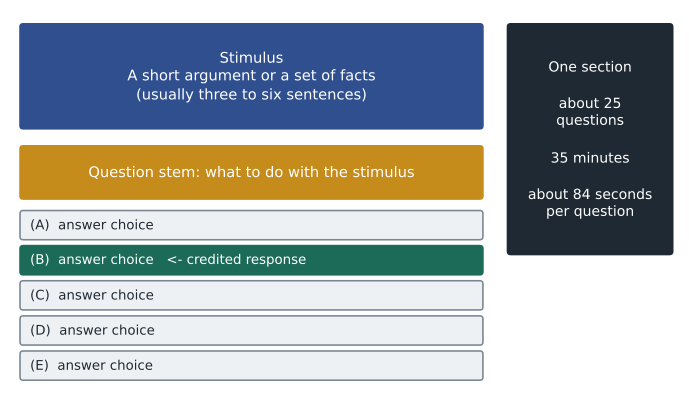
A Logical Reasoning section usually contains 25 or 26 questions. In 35 minutes, that is an average of about 80 to 84 seconds per question. That average hides a lot of variation. Some questions take 40 seconds; some hard ones deserve two minutes or more. Learning to spend time where it earns points is one of the skills this course builds, and the last lesson practises it under a timer.
The three parts of every question
Every Logical Reasoning question has three parts.
- The stimulus is a short passage, usually between three and six sentences. Most stimuli are arguments: someone gives reasons for a conclusion. Some are not arguments at all but a set of facts, from which you will be asked to draw an inference.
- The question stem tells you what to do with the stimulus. It might ask for the main conclusion, an assumption, a flaw, something that would strengthen or weaken the argument, or something that must be true.
- The five answer choices, labelled (A) through (E). Exactly one is the credited response. The other four are wrong for a reason, and part of getting good at this section is learning to say what that reason is.
There is no outside knowledge on the LSAT. A stimulus might be about archaeology, a city council's budget, a medical study or a philosophical principle, but you never need to know anything about the topic beyond what the stimulus tells you. In fact, outside knowledge can hurt you. If a stimulus says that a certain bird migrates in winter and you know that it does not, the stimulus wins. Your job is to work with what is written.
Read the stem first
Harriet asked the group to read the question stem before the stimulus, for every question. The stem tells you what kind of reading to do. If it asks for the main conclusion, you read to find the claim everything else supports. If it asks for an assumption, you read to find the gap between the evidence and the conclusion. If it asks what must be true, you read to collect facts and do not look for an argument at all.
Marcus objected that reading the stem first meant reading it twice. Harriet agreed that it did, briefly. 'The stem is one sentence. Reading it first costs you three seconds and saves you from reading the stimulus the wrong way. Think of it as reading the instructions before assembling the furniture.'
The main families of questions
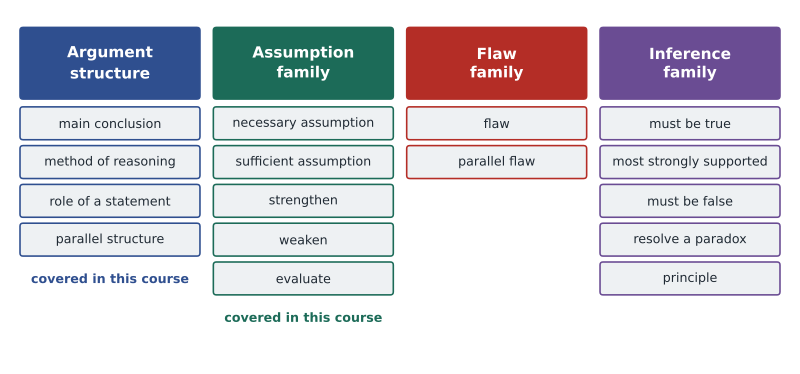
LSAC does not publish an official list of question types, and the names used in prep books differ. But the questions fall into a handful of families, based on what they ask you to do. Learning the families matters because each one calls for a different way of reading.
| Family | What you are asked to do | Where it is taught |
|---|---|---|
| Argument structure | Identify the main conclusion, describe how the argument works, or say what role a statement plays | This course, lessons 4 to 7 |
| Assumption | Find what the argument takes for granted, either what it needs or what would prove it | This course, lessons 10 and 11 |
| Strengthen, weaken and evaluate | Find new information that helps, hurts or would help you judge the argument | LSAT-111 |
| Flaw | Describe the error in the reasoning | LSAT-111 |
| Inference | Draw a conclusion that the stimulus supports or guarantees | LSAT-112 |
| Principle and parallel | Match the reasoning to a general rule or to another argument | LSAT-112 |
Two of these families depend directly on everything in this course. Assumption questions require you to find the conclusion, the premises and the gap between them. Flaw, strengthen and weaken questions do too, because a flaw is usually a gap that the argument ignores, and strengthening or weakening an argument usually means closing or widening that gap. That is why Harriet called this course the foundation.
How stems signal the task
You will learn each family's stems in detail later, but a few patterns are worth seeing now.
- Main conclusion: "Which one of the following most accurately expresses the main conclusion of the argument?" or "The overall conclusion drawn in the argument is that..."
- Method of reasoning: "The argument proceeds by..." or "Which one of the following most accurately describes the technique of reasoning employed by the argument?"
- Role of a statement: "The claim that X plays which one of the following roles in the argument?"
- Necessary assumption: "The argument depends on assuming which one of the following?" or "Which one of the following is an assumption required by the argument?"
- Sufficient assumption: "The conclusion follows logically if which one of the following is assumed?"
- Inference: "If the statements above are true, which one of the following must also be true?"
Notice the small words. "Required" and "depends on" signal what an argument needs. "Follows logically if" signals what would be enough to guarantee the conclusion. These are different tasks, and lesson 11 explains why the difference matters so much.
Worked problem
Sample question: reading the stem first
Stimulus: "The city's new recycling program collected forty percent more material in its first six months than the old program did in the same period last year. Clearly, residents are recycling more because the new program is easier to use." Stem: "Which one of the following most accurately expresses the main conclusion of the argument?" (A) The new recycling program collected forty percent more material than the old one. (B) Residents are recycling more because the new program is easier to use. (C) The old recycling program was difficult to use. (D) Recycling programs succeed only if they are easy to use. (E) The city should expand the new recycling program.
Show solution
- Read the stem first: it asks for the main conclusion, so read to find the claim the rest supports.
- The first sentence is a fact about collection totals. The word "Clearly" introduces the claim drawn from it. That claim is the conclusion.
- (A) restates the premise, the evidence, not the conclusion.
- (B) matches the claim introduced by "Clearly": residents recycle more because the program is easier. This is the credited response.
- (C) is not stated. The argument implies the new program is easier, but never says the old one was difficult.
- (D) is a broad general rule the argument never states.
- (E) is a recommendation. The argument explains a result; it does not recommend anything.
Answer: (B). Finding the conclusion first made the wrong choices easy to sort: one is evidence, two go beyond the argument, and one is unstated.
Wrong answers are wrong for a reason
Harriet's strongest advice for the first month was about wrong answers. 'Never pick an answer because it sounds good,' she said. 'Pick it because you can say why the other four are wrong.' On an easy question you may see the right answer at once, but on a hard one, the fastest route is often eliminating four choices you can disprove.
Across all families, wrong answers tend to fail in a few ways.
- Out of scope: the choice brings in something the stimulus never discusses, such as cost, fairness or a different group of people.
- Too strong: the choice says "all", "always", "never" or "only" where the stimulus supports something weaker.
- Reversed: the choice swaps cause and effect, or swaps a condition and what it is a condition for.
- Wrong part: the choice describes a premise when the stem asks for the conclusion, or the opposing view when it asks for the author's.
- True but irrelevant: the choice might be true, and might even be stated, but it does not do what the stem asks.
In the sample above, (A) was the wrong part, (C) and (D) went beyond what was stated, and (E) answered a different question. You will see these patterns in every lesson.
Time, order and difficulty
Questions in a Logical Reasoning section are not in strict order of difficulty, but the early questions tend to be easier and the hardest questions tend to cluster in the second half, often around the middle to the last third of the section. That pattern matters for timing. If you spend three minutes on question 6, you are spending time you will want later.
Harriet gave the group a simple checkpoint rule for the first weeks: be at about question 10 by the 11-minute mark and question 18 by about 22 minutes. Those numbers are not magic; they reflect the fact that the early questions go faster. If you are behind, skip a question you are stuck on, mark your best guess, flag it and move on. Every question is worth the same, and there is no penalty for a wrong answer, so never leave a question blank.
Ji-won, who tests with 50 percent extra time, asked how the checkpoints apply to her. Harriet scaled them: with 52 and a half minutes per section, she should be at about question 10 by 16 minutes and question 18 by 33. 'The proportions stay the same,' Harriet said. 'The trap is the same too. Extra time does not make it safe to spend five minutes on one question.'
Accuracy first, then speed
For the first several weeks, Harriet asked the group to practise untimed, or with generous timing, and to aim for accuracy. Speed comes from understanding: a test taker who can find a conclusion in ten seconds because they know exactly what to look for is faster than one who reads quickly and rereads three times. Timed practice starts once the methods in this course feel natural.
She also asked every member to keep an error log, the template from the first course, with one line per missed or guessed question: the question type, what they chose, what was right, why they chose wrong, and the lesson to take away. 'If you only check whether you were right,' she said, 'you are practising, not learning.'
Blind review
The group also adopted blind review for every practice set. After a timed set, before checking any answers, you go back to every question you flagged and work it again with no time limit, writing down why you think your answer is right. Only then do you check. The gap between your timed score and your blind review score tells you something important. A big gap means you know the material but are rushing or second-guessing. A small gap with many errors means you have concepts to learn.
Worked problem
Reading an error log entry
Thomas's error log for September 24 includes this line: "Q7, assumption. Chose (C) because it was relevant to the topic. Correct (A). (A) connected the premise about cost to the conclusion about the decision; (C) was about a different group. Lesson: an assumption must link the evidence to the conclusion, not just discuss the topic." What does this entry show about Thomas's error?
Show solution
- He identified the question type, which lets him see patterns across many entries.
- He recorded why he chose the wrong answer: it was "relevant to the topic." That is a reasoning error, not a careless one.
- His lesson is a rule he can apply next time: look for the choice that links premise and conclusion.
Answer: It is a concept error about assumptions, not a timing error. Over several weeks, entries like this showed Thomas that assumption questions were his biggest weakness, and he focused his practice there.
What this course covers
The rest of this course moves from the parts of an argument to the questions that test them.
- Lessons 2 to 5 teach the anatomy of arguments: premises, conclusions, indicator words, and complex arguments with intermediate conclusions and opposing views.
- Lessons 6 and 7 apply that to main point, method of reasoning and role questions.
- Lessons 8 and 9 teach conditional statements and the difference between necessary and sufficient conditions, which appear throughout the test.
- Lessons 10 and 11 teach assumptions and the two assumption question types.
- Lesson 12 is a timed drill with a full debrief.
Dani asked whether she really needed formal logic. Harriet's answer was that she needed a little, used precisely. 'You do not need symbols or truth tables. You need to know what "only if" means, and to be sure of it at nine o'clock on a Saturday morning with the clock running.'
Common mistakes
MistakeLogical Reasoning questions require background knowledge of the topic.
InsteadEverything you need is in the stimulus; outside knowledge can mislead you.
MistakeThe right answer is the one that sounds most reasonable.
InsteadThe right answer does exactly what the stem asks; be able to say why each other choice fails.
MistakeQuestions get steadily harder from first to last.
InsteadThe early questions tend to be easier, but hard questions are spread through the second half and difficulty is not strictly ordered.
MistakeLeaving a hard question blank saves time without cost.
InsteadA blank earns nothing and there is no penalty for wrong answers; guess, flag and move on.
MistakeTimed practice from day one builds speed fastest.
InsteadBuild accurate methods first; speed follows from understanding.
Summary and key terms
- Logical Reasoning makes up two of the three scored multiple-choice sections, about two-thirds of the scored test.
- A section has about 25 questions in 35 minutes; from August 2027 sections run 45 minutes with embedded unscored questions.
- Every question has a stimulus, a question stem and five answer choices; read the stem first so you know how to read the stimulus.
- Questions fall into families: argument structure, assumption, strengthen and weaken, flaw, inference, and principle and parallel.
- Wrong answers fail for recognizable reasons: out of scope, too strong, reversed, wrong part, or true but irrelevant.
- Use pacing checkpoints, never leave a question blank, and review with an error log and blind review.
- Stimulus
- The short passage, usually an argument or a set of facts, that a Logical Reasoning question is based on.
- Question stem
- The sentence that states the task, such as finding the conclusion or an assumption.
- Credited response
- The one answer choice that LSAC scores as correct.
- Blind review
- Reworking flagged questions without a time limit and before checking answers, to separate knowledge gaps from timing problems.
- Error log
- A record of each missed or guessed question, with the type, the cause of the error and the lesson learned.
Practice problems
Work each problem on paper first, then reveal the answer to check.
About how many seconds per question does a 35-minute section with 25 questions allow on average?
Show answer
About 84 seconds (2,100 seconds divided by 25).
A stem asks, "The argument depends on assuming which one of the following?" Which family is this, and what should you read for?
Show answer
The assumption family (a necessary assumption question). Read to find the conclusion, the premises and the gap between them.
A stimulus says that a certain lake never freezes. You know that it froze in 2019. Which do you rely on?
Show answer
The stimulus. The LSAT tests reasoning about what is stated, not outside knowledge.
Lesson quiz · 5 questions
Score 60% or more to complete this lesson.
Create a free account to save your progress, take quizzes and earn a certificate.