
LSAT-110 · Lesson 2 of 12 · 21 min
Anatomy of an argument
▶ Video coming soon A video version of this lesson is on the way.
Harriet started the second half of the September 24 session by putting a sentence on the shared screen: "The library should open on Sundays, since many students work weekdays and have no other time to study there." She asked the group what kind of thing the sentence was. Marcus said it was an opinion. Élodie said it was a recommendation. Dani said it was an argument. 'All three of you are partly right,' Harriet said. 'But only Dani named the thing the LSAT cares about.'
An argument, in the LSAT's sense, is not a quarrel. It is a set of statements in which some are offered as reasons for believing another. The library sentence is an argument because it gives a reason (students work weekdays and have no other time) for a claim (the library should open on Sundays). The claim happens to be a recommendation, and it might reflect an opinion, but what makes it an argument is the relationship of support between the parts.
This lesson introduces the parts of an argument, explains the difference between an argument and a set of facts, and shows why almost every Logical Reasoning question starts with taking an argument apart.
Premises and conclusions
Every argument has two kinds of statement.
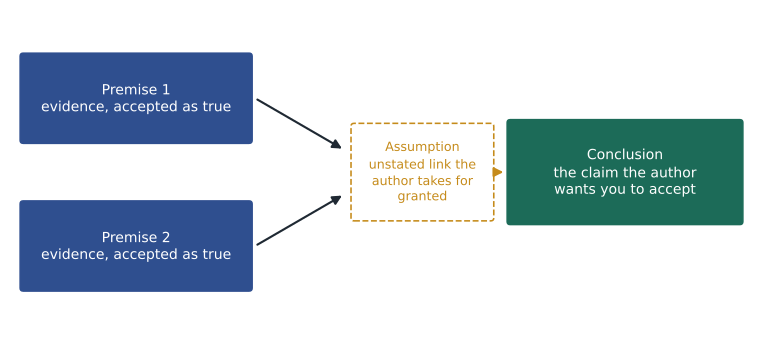
- The conclusion is the claim the argument is trying to establish. It is what the author wants you to accept.
- The premises are the reasons offered in support of the conclusion. They are the evidence.
In the library argument, the conclusion is "The library should open on Sundays." The premises are "many students work weekdays" and "they have no other time to study there." The word "since" tells you that what follows is a reason.
On the LSAT, you accept the premises as true. You do not argue with the evidence. If a stimulus says that a survey found most residents favour a new park, you do not ask whether the survey was real. The question is whether the evidence, taken as true, supports the conclusion. This is the single most important habit in Logical Reasoning: treat the premises as facts and test the connection.
The unstated part: assumptions
Most arguments on the LSAT are incomplete. The premises do not fully prove the conclusion; something unstated is needed to connect them. That unstated something is an assumption: a claim the author takes for granted without saying so.
Go back to the library. Suppose students do work weekdays and have no other time. Does it follow that the library should open on Sundays? Only if, for example, students would actually use the library on Sundays, and only if nothing makes Sunday opening a bad idea, such as a cost the library cannot afford. The author has assumed these things. You will spend lessons 10 and 11 learning to find assumptions precisely, but the idea starts here: an argument is premises, a conclusion and a gap.
Arguments and non-arguments
Not every stimulus is an argument. Some simply state facts: "Ninety percent of the town's households have internet access. Of those, most use a cable provider. The town has two cable providers." There is no conclusion here, no claim offered on the strength of others. Stimuli like this appear with inference questions, which ask what the facts support. You will meet them in LSAT-112.
The difference matters because the question stems call for different work. If a stem asks for a flaw, an assumption or the main conclusion, the stimulus will be an argument. If a stem asks what must be true, the stimulus may be a set of facts, and looking for a conclusion is wasted effort. This is one more reason to read the stem first.
| Feature | Argument | Set of facts |
|---|---|---|
| Has a conclusion? | Yes: one claim is supported by others | No: statements stand side by side |
| Typical signal words | "therefore", "so", "because", "since" | Few or none; often "some", "most", "all" |
| Typical question types | Conclusion, assumption, flaw, strengthen, weaken | Must be true, most strongly supported |
| Your reading goal | Find the conclusion and the gap | Collect facts and combine them |
Claims that are neither premise nor conclusion
Real arguments contain more than premises and a conclusion. A stimulus might include background information that sets the scene but supports nothing, a view the author is arguing against, or a concession that admits a point against the author's position. These pieces matter, especially for questions about the role a statement plays. Lessons 5 and 7 treat them in detail. For now, notice that a sentence's position in the stimulus does not tell you its job. Conclusions can come first, last or in the middle.
Worked problem
Taking apart a short argument
Stimulus: "Critics say the new highway will increase traffic in the downtown core. But the highway bypasses downtown entirely, and the city's transportation study projects that through-traffic downtown will fall by a quarter. So the critics are mistaken." Identify the conclusion, the premises and the other parts.
Show solution
- Conclusion: "the critics are mistaken." The word "So" introduces it.
- Premise 1: the highway bypasses downtown entirely.
- Premise 2: the study projects downtown through-traffic will fall by a quarter.
- The first sentence is the opposing view: the claim the author argues against. It is neither premise nor conclusion.
- One assumption: the projection is reliable enough to show the critics are wrong.
Answer: The author's conclusion is that the critics are mistaken; two premises support it; the critics' view is the position being rejected.
Two ways support can work
Support between premises and conclusion comes in different strengths. In a deductive argument, if the premises are true, the conclusion must be true. "All members of the club are students. Rana is a member. So Rana is a student." There is no gap; the conclusion is guaranteed.
In most LSAT arguments, the support is weaker. The premises make the conclusion more likely, but do not guarantee it. "Sales rose after the advertising campaign, so the campaign increased sales." The premise is evidence for the conclusion, but other explanations are possible. Arguments like this are called inductive, or simply non-deductive. They are the ones with gaps to find, and they are the majority on the test.
Harriet told the group not to worry about labels. 'What matters is the question: if the premises were true, would the conclusion have to be true? If not, what is missing?'
Common kinds of support
LSAT arguments tend to rely on a handful of kinds of evidence. Recognizing them helps you spot what the author is taking for granted.
- Causal reasoning: one thing is said to cause another, often on the basis of a correlation. "Towns with more parks have healthier residents, so parks make people healthier." The assumption is usually that nothing else explains the link.
- Sampling: a conclusion about a group is drawn from part of it. "Of the students we surveyed, most favour the change, so most students favour it." The assumption is that the sample represents the group.
- Analogy: two things are said to be alike in one way because they are alike in others. "This drug worked in mice, so it will work in people." The assumption is that the similarities matter.
- Prediction and planning: a plan will achieve a goal. "Raising fares will raise revenue." The assumption is that nothing will undercut the plan, such as fewer riders.
- Principle and application: a general rule is applied to a case. "Public officials should disclose gifts; Mayor Leung received a gift; so she should disclose it." The assumption is that the case falls under the rule.
Recommendations, predictions and explanations
Conclusions also come in different forms, and the form affects what counts as support.
- A recommendation says what should be done: "The council should repair the bridge." Watch for words like "should", "ought" and "must".
- A prediction says what will happen: "Ticket sales will fall next year."
- An explanation says why something happened: "The fish died because the water warmed."
- A judgment says what is true or what something is like: "The study is unreliable."
A recommendation needs more than facts about benefits. It needs some reason to think the benefits outweigh the costs, or that the action is permissible. A prediction needs a reason to think conditions will hold. An explanation needs a reason to rule out other explanations. When you know which kind of conclusion you are dealing with, you know where to look for the gap.
Worked problem
Sample question (written for this course)
Stimulus: "The museum should stop charging admission. When the city art gallery dropped its admission fee, attendance doubled within a year." Stem: "Which one of the following most accurately describes the role played in the argument by the statement that attendance at the city art gallery doubled?" (A) It is the conclusion of the argument. (B) It is a premise offered in support of the argument's conclusion. (C) It is a claim the argument attempts to refute. (D) It is background information that does not support the conclusion. (E) It is a prediction about what will happen at the museum.
Show solution
- Find the conclusion first: "The museum should stop charging admission," a recommendation.
- The gallery's doubled attendance is offered as the reason, so it is a premise, evidence by analogy.
- (A) is wrong: the conclusion is the recommendation about the museum.
- (B) is right: the doubled attendance supports the recommendation.
- (C) is wrong: the author does not argue against it; the author relies on it.
- (D) is wrong: it does support the conclusion; it is the only support.
- (E) is wrong: it is a past fact about the gallery, not a prediction about the museum.
Answer: (B). Notice the assumption too: that the museum is relevantly like the gallery, and that more attendance is the goal.
Why this matters for every question type
Dani asked whether taking arguments apart would slow her down. Harriet said it would, for about three weeks, and then it would speed her up. Almost every question in the assumption, flaw, strengthen and weaken families asks you to do something with the relationship between premises and conclusion. If you cannot find the conclusion quickly and accurately, you cannot do any of them reliably.
Marcus said it reminded him of reading engineering reports. A good report states its conclusion, gives the data, and you test whether the data supports it. A bad report buries the conclusion and assumes things it should have measured. 'Exactly,' Harriet said. 'The LSAT is a test of reading reports critically. They just happen to be very short reports.'
Practising the habit
For the week after the session, Harriet assigned a simple drill. For twenty arguments, write three things in the margin: the conclusion, in your own words; the premises, in a few words each; and one thing the author assumes. Do not answer the questions yet. The goal is to make the anatomy automatic.
Élodie found she could do the first two quickly but kept writing assumptions that were really restatements of the conclusion. Harriet's note on her work: 'An assumption is not the conclusion said again. It is the missing link. If you added it to the premises, the argument would be much stronger, or would work completely.'
Ji-won found something else: when she wrote the conclusion in her own words, she noticed that some arguments drew a stronger conclusion than the evidence warranted. Evidence about "some residents" led to a conclusion about "residents" generally. Harriet told her she had just discovered a flaw, and that LSAT-111 would give her a name for it.
Arguments in everyday life
Harriet ended the session by asking everyone to find one argument in their own week and take it apart. Thomas brought an email from his credit union's head office: "Branch visits have fallen for three years, so we will reduce branch hours." Premise: fewer visits. Conclusion: reduce hours. Assumption: the remaining visitors can be served in the shorter hours, and the change will not drive away customers who still need branches. Ji-won brought a sentence from a software release note: "No crashes were reported during beta testing, so the update is stable." She pointed out the assumption at once: that the beta testers used the software the way ordinary users would. Practising on real arguments, Harriet said, makes the habit automatic, because arguments are everywhere once you start noticing them.
Common mistakes
MistakeYou should question whether the premises are true.
InsteadAccept the premises as true and test whether they support the conclusion.
MistakeThe conclusion is always the last sentence.
InsteadThe conclusion can appear anywhere; find it by its role, not its position.
MistakeEvery stimulus is an argument.
InsteadSome stimuli are sets of facts with no conclusion; they go with inference questions.
MistakeAn assumption is the conclusion restated.
InsteadAn assumption is an unstated link between the premises and the conclusion.
MistakeA strong opinion in the stimulus is the same as an argument.
InsteadAn argument needs reasons offered for a claim; opinion alone is not an argument.
Summary and key terms
- An argument is a set of statements in which some (premises) are offered as reasons for another (the conclusion).
- Accept premises as true on the LSAT; your task is to judge whether they support the conclusion.
- Most LSAT arguments have a gap between premises and conclusion, filled by an unstated assumption.
- Some stimuli are sets of facts with no conclusion; they go with inference questions.
- Stimuli can also contain background, opposing views and concessions, which are neither premises nor the conclusion.
- Common kinds of support (causal, sampling, analogy, planning, principle) each tend to rely on a typical assumption.
- Argument
- A set of statements in which one or more are offered as reasons for another.
- Premise
- A statement offered as evidence or a reason for the conclusion.
- Conclusion
- The claim an argument tries to establish.
- Assumption
- An unstated claim the argument takes for granted to connect premises to conclusion.
- Deductive argument
- An argument in which true premises guarantee a true conclusion.
- Opposing view
- A position mentioned in the stimulus that the author argues against.
Practice problems
Work each problem on paper first, then reveal the answer to check.
Identify the conclusion: "Because the bakery's new oven uses less gas, its monthly costs will fall."
Show answer
"Its monthly costs will fall." The word "Because" introduces the premise about the oven.
Is this an argument? "Most of the volunteers are retired. Some of the volunteers drive. None of the drivers works full time."
Show answer
No. It is a set of facts with no conclusion drawn from the others.
Name one assumption in: "Our survey of gym members found most want longer hours, so most residents want the gym open longer."
Show answer
That gym members represent residents generally (a sampling assumption).
Lesson quiz · 5 questions
Score 60% or more to complete this lesson.
Create a free account to save your progress, take quizzes and earn a certificate.