
LES-212 · Lesson 9 of 12 · 20 min
Victims in court: protections, testimony and evidence-based prosecution
▶ Video coming soon A video version of this lesson is on the way.
In mid-April, seven weeks after the assault, Megan Hollis called Nadia Brooks's office and said she wanted the charges dropped. She said Tyler had written to her from jail through a friend, that he was sorry, that he was getting help, and that Ava missed her father. She said she could not stand the idea of testifying. Brooks tells the class she has had that call hundreds of times. 'It almost never means the violence did not happen. It means the victim is frightened, exhausted, under pressure, or all three. Our job is not to argue her out of it. Our job is to explain what will happen, keep her safe, and make sure the case does not depend on her alone.'
This lesson is about what happens to victims of intimate partner and sexual violence when their cases go to court: the legal protections that exist to make testifying possible and fair, the special rules of evidence in sexual offence cases, and how prosecutors can proceed when a victim cannot or will not testify. Desjardins tells the class that officers are part of this stage too, both as witnesses and as the people whose investigation decides what evidence the prosecutor has.
Why victims recant
Recantation, in which a victim withdraws or changes an account, and reluctance to testify are common in intimate partner violence cases. Research that has examined jail phone calls between abusers and victims, including a 2011 study led by Amy Bonomi, found a recognizable pattern: the abuser minimizes the violence, appeals to the victim's sympathy by describing his own suffering, invokes their shared history and their children, and gradually persuades the victim that the two of them are on the same side against the system. Victims recant out of fear, love, financial need, concern for the children, pressure from family, or the belief that the abuser has changed. Some recant because they cannot face the court process itself. None of these reasons means the original account was false, and officers should not treat a recantation as proof of a false report.
In Ontario, the Crown, not the victim, decides whether to continue a prosecution, and Crown policy in intimate partner violence cases is not to withdraw charges simply because the victim asks. The Crown considers whether there is a reasonable prospect of conviction on the evidence and whether the prosecution is in the public interest, taking into account the victim's safety and wishes. When Megan asked for the charges to be dropped, Brooks explained this, arranged for her to speak with the Crown, and reviewed her safety plan. The Crown told Megan the case would continue, that it was built on evidence other than her testimony, and that she would be supported whatever she decided about testifying. Megan later said that hearing the decision was not hers was, in a strange way, a relief.
Preserving the victim's account
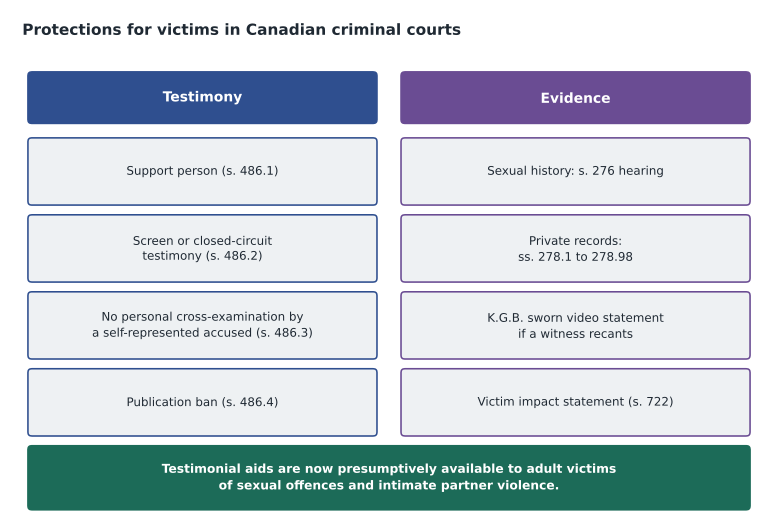
Because recantation is common, good investigators take steps early to preserve the victim's account in a form that can be used if the victim later recants. Under the principled approach to hearsay, a prior inconsistent statement can be admitted for the truth of its contents if it is necessary and reliable. In R. v. B.(K.G.) (1993), the Supreme Court of Canada held that reliability is strongly supported when the statement was video-recorded in full, made under oath or solemn affirmation after a warning about the consequences of lying, and the witness is available for cross-examination at trial. Many services now take a sworn, video-recorded statement, often called a K.G.B. statement, in serious intimate partner violence cases. Detective Sergeant Mendes took one from Megan on February 24, the same day she photographed the bruising. Statements made in the heat of the moment, such as a 9-1-1 call or what a victim says to the first officer, may also be admissible under the spontaneous statement exception or the principled approach.
Evidence-based prosecution
Prosecutors increasingly build intimate partner violence cases so that they can proceed with or without the victim's testimony, an approach often called evidence-based prosecution. The evidence comes from the investigation: the 9-1-1 recording, body-worn camera footage of the scene and the victim's first account, photographs of injuries and the scene, medical records, statements from neighbours and other witnesses, the suspect's own statements and messages, jail call recordings, and the history of earlier calls and orders. Desjardins tells the class that this is why Lesson 3 emphasized gathering evidence that stands on its own. 'An officer who records the first account properly, photographs the injuries, finds the neighbour and preserves the 911 call has given the prosecutor a case. An officer who writes down only what the victim said has given the prosecutor a witness who may not come.'
In the Hollis case, the Crown's file included Doreen Pike's 9-1-1 call, the body-worn camera footage of Megan's first words to Constable Malhotra, Megan's K.G.B. statement, the nurse examiner's strangulation documentation, the scene and follow-up photographs, Okeke's observations of Kerr's knuckle and his comment that Megan was 'being dramatic,' Doreen's statement, the forty-three messages and the account records linking them to Kerr. Kerr's lawyer saw the disclosure in July. On September 21, 2026, Kerr pleaded guilty.
Protections for testifying victims
The Criminal Code contains several protections for witnesses. Under section 486.1, a witness may have a support person present while testifying. Under section 486.2, a witness may testify from behind a screen or from outside the courtroom by closed-circuit television. These aids have long been presumptively available to witnesses under eighteen and witnesses with disabilities, and the Protecting Victims Act made them presumptively available to adult victims of sexual offences, intimate partner violence, human trafficking and criminal harassment, and allowed requests for a support animal. Under section 486.3, in sexual offence and certain other cases, a self-represented accused may not personally cross-examine the complainant if the prosecutor or the complainant applies, and the court appoints a lawyer to do it. Under section 486.4, a judge must, on application, make an order banning publication of any information that could identify the complainant in a sexual offence case. Ontario also funds an independent legal advice program that gives sexual assault survivors free advice from a lawyer, and complainants have the right to their own lawyer at hearings about their sexual history and private records.
Sexual history and private records
Lesson 6 introduced section 276, which prohibits evidence of a complainant's other sexual activity to support the twin myths. Evidence of other sexual activity is admissible for another purpose only if the judge, after a hearing held in the absence of the public, finds that it is relevant to an issue at trial, is of specific instances of activity, and has significant probative value that is not substantially outweighed by the danger of prejudice to the administration of justice. Since 2019, the complainant may attend the hearing, make submissions and have a lawyer. The 2019 amendments also created a regime in sections 278.92 to 278.94 for private records about the complainant that are in the accused's possession, such as messages, diaries or photographs, which the accused must apply to use. In R. v. J.J. (2022), the Supreme Court upheld both regimes. Separately, sections 278.1 to 278.91, upheld in R. v. Mills (1999), govern applications by the accused for private records held by third parties, such as counselling, medical or school records. In the Reyes case, the defence applied in September to introduce evidence that Sofia and Brandon had kissed at a different party in February. The judge held a hearing under section 276 at which Sofia's independent lawyer made submissions, and ruled the evidence inadmissible because it had no relevance to whether she was capable of consenting on March 8.
Delay and the victim
Delay is hard on everyone in a criminal case, and especially on victims, who often describe waiting for trial as an ordeal that keeps the assault in the present. In R. v. Jordan (2016), the Supreme Court of Canada set presumptive ceilings for the time from charge to the end of trial: eighteen months in provincial court and thirty months in superior court, or in provincial court after a preliminary inquiry. Delay beyond the ceiling, not caused by the defence or by exceptional circumstances, violates the right to be tried within a reasonable time under section 11(b) of the Charter. Several sexual assault cases have been stayed for delay. The Protecting Victims Act added guidance on how complexity is assessed and requires courts to consider remedies other than a stay for breaches of section 11(b).
| Canada | Ohio | |
|---|---|---|
| Charge or arrest | April 21, 2026 | April 21, 2026 |
| Trial | January 18, 2027 | January 18, 2027 |
| Days elapsed | 272 | 272 (released on bond, so no days counted triple) |
| Limit | 30 months (Jordan ceiling, superior court) | 270 days (Revised Code 2945.71) |
| Result | About 8.9 months: well within | Beyond 270 days unless tolled or waived |
The 272 days are counted month by month: 9 days left in April, then 31, 30, 31, 31, 30, 31, 30 and 31 for May to December, and 18 in January. Dividing by the average month length of about 30.44 days gives about 8.9 months.
The example shows how the same trial date can look different under the two systems. In Canada, the January 2027 trial in the Reyes case is far inside the thirty-month ceiling. In Ohio, the date is beyond 270 days, which means the case could proceed only because the defence's own motions tolled the time and Brandon's lawyer filed a written waiver of the statutory speedy trial time, which is common in serious cases. Desjardins tells the class that officers contribute to delay more than they realize: late disclosure, incomplete reports and unavailable witnesses all cost months.
Officers as witnesses
Officers will testify in many of these cases, and the principles from the evidence course apply: prepare by reviewing notes, video and reports; testify accurately and fairly; and do not overstate or understate. Some issues are particular to these cases. Officers should describe what they observed about the victim's demeanour, injuries and words without characterizing the victim's credibility, which is for the court. They should be ready to explain why they asked the questions they asked, such as strangulation questions, and why they made the decisions they made, such as identifying the primary aggressor. And they should expect cross-examination about anything that could suggest bias, including whether they had decided the accused was guilty before investigating. The best answer is a careful investigation that considered other explanations and recorded why they were rejected.
Sentencing and the victim's voice
At sentencing, victims have the right to describe the impact of the crime. Under section 722, the court must consider a victim impact statement, which the victim may read aloud, present with a photograph, or have read by someone else, and which may be presented from behind a screen or by video. Kerr was sentenced on November 2, 2026. Megan read her statement herself. She said the night of February 22 was the first time she had understood that he could kill her, and that the hardest part since had been explaining to Ava why her father was not coming home. The court imposed fourteen months' imprisonment, less credit for the time Kerr had spent in custody since March, followed by three years' probation with conditions that included completing the Partner Assault Response program and having no contact with Megan except as permitted by a family court order, and a mandatory weapons prohibition under section 109.
Worked problem
Preparing a case that can proceed without the victim
An officer arrests a man for assaulting his girlfriend, who has a split lip and is crying at the scene. She says, 'He hit me because I wouldn't give him my car keys.' A neighbour says she heard a slap and shouting. The girlfriend tells the officer she does not want to go to court. What should the officer do to give the prosecutor the best chance of proceeding if she does not testify?
Show solution
- Make sure the body-worn camera captured her first account in full, including the exact words and her appearance, and note the time it was made relative to the assault.
- Photograph her injuries, the scene and the suspect, including his hands, and arrange follow-up photographs in one to three days.
- Take a full statement from the neighbour and preserve any 911 recording and dispatch records.
- Ask whether she will give a sworn, video-recorded statement, explaining that it is her choice.
- Record the suspect's statements and any messages, check the history of earlier calls, and connect her with victim services, explaining that the decision to proceed belongs to the prosecutor.
Answer: Gather the first account, photographs, witness statements, recordings and history so the case can stand without her testimony.
Common mistakes
MistakeA recantation proves the original report was false.
InsteadVictims recant for many reasons, including fear, pressure and love; recantation is common and does not show the report was false.
MistakeIf the victim will not testify, the case is over.
InsteadEvidence-based prosecution can proceed on recordings, photographs, witnesses, medical records and the accused's own words.
MistakeThe defence can use the complainant's sexual history if it is relevant to anything.
InsteadSection 276 bars the twin myths and admits other sexual activity only after a hearing on strict criteria.
MistakeDelay only affects the accused.
InsteadDelay harms victims and can end prosecutions; prompt, complete police work reduces it.
Summary and key terms
- Recantation and reluctance are common in intimate partner violence cases and do not mean the report was false; the prosecutor decides whether to proceed.
- Sworn, video-recorded K.G.B. statements and spontaneous statements can preserve a victim's account if she recants.
- Evidence-based prosecution relies on recordings, photographs, medical records, witnesses, messages and the accused's words.
- Testimonial aids, now presumptive for adult victims of sexual offences and intimate partner violence, bans on personal cross-examination and publication bans protect witnesses.
- Sections 276 and 278.1 to 278.98 control the use of sexual history and private records, with complainant participation upheld in J.J.
- Victims have a voice at sentencing through impact statements.
- K.G.B. statement
- A sworn, video-recorded statement that may be admitted for its truth if the witness later recants.
- Testimonial aid
- A support person, screen, closed-circuit testimony or other measure that helps a witness testify.
- Jordan ceiling
- The presumptive limit of eighteen or thirty months from charge to the end of trial.
- Recantation
- A victim's withdrawal or change of an earlier account.
- Evidence-based prosecution
- Building a case that can proceed using evidence other than the victim's testimony.
- Victim impact statement
- A statement describing the harm caused by the crime, considered at sentencing.
Practice problems
Work each problem on paper first, then reveal the answer to check.
What pattern did research on jail calls find?
Show answer
The abuser minimizes the violence, seeks sympathy, invokes shared history and children, and persuades the victim they are on the same side against the system.
What makes a K.G.B. statement reliable?
Show answer
It is video-recorded in full, made under oath or affirmation after a warning, and the witness can be cross-examined at trial.
In the code example, how many days passed from charge to trial?
Show answer
272 days.
Why was the defence's application about an earlier kiss refused?
Show answer
It was not relevant to whether Sofia was capable of consenting on March 8.
Lesson quiz · 5 questions
Score 60% or more to complete this lesson.
Create a free account to save your progress, take quizzes and earn a certificate.