
LES-212 · Lesson 11 of 12 · 19 min
Coordinated community response and officer wellbeing
▶ Video coming soon A video version of this lesson is on the way.
On Tuesday, March 3, 2026, nine days after Tyler Kerr's arrest, twelve people sat around a table in a meeting room at Port Ardent General Hospital. They included Detective Sergeant Mendes, Nadia Brooks, a manager from Juniper Place shelter, a probation officer, a worker from the children's aid society, a nurse examiner, a representative of the Crown attorney's office and a school board social worker. The Hollis case was one of four on the agenda. In fifteen minutes, the group confirmed that Megan's address and her sister's address were flagged for priority response, that Ava's school had a copy of the order and a photograph of Kerr, that Juniper Place would hold a room for Megan if she needed one, and that Brooks's office would call her weekly. When Kerr breached his order at the end of the month, the group met again within three days. 'No one agency could have done all of that,' Desjardins tells the class. 'The table did it because everyone at it had a piece of the picture.'
This lesson is about how police work with other agencies to respond to intimate partner and sexual violence, an approach usually called a coordinated community response. It also returns to a subject Brooks raised in the first class: the effect this work has on the people who do it, and what officers and organizations can do to stay healthy and effective over a career.
Why coordination matters
Intimate partner and sexual violence touch many systems at once: police, prosecutors, courts, probation, shelters, victim services, health care, child protection, schools, housing, immigration and employers. Each system sees part of the picture and controls part of the response. Without coordination, victims are passed from one agency to another, repeat their stories many times, receive contradictory advice, and fall through gaps. Abusers, meanwhile, exploit the gaps: they reoffend while one agency waits for another, use family court against criminal court, or charm one professional while threatening the victim through another. Death reviews repeatedly identify poor communication between agencies as a factor in preventable homicides.
The best-known model of coordination began in Duluth, Minnesota, in 1981, when the Domestic Abuse Intervention Project brought police, prosecutors, courts, probation and advocates together to agree on policies that put victim safety and offender accountability at the centre of every agency's response. The Duluth approach, which has been adapted in many countries, rests on a few principles: shared written policies across agencies, so that each step of the response is predictable; a focus on the safety of victims and on holding offenders accountable; a central role for independent victim advocates; regular monitoring of how cases are actually handled; and a commitment to change practices when monitoring shows they are failing victims. Brooks tells the class that the Duluth model is sometimes criticized, particularly its approach to working with abusers, but that its central idea, that agencies must work as a system rather than separately, has been accepted almost everywhere.
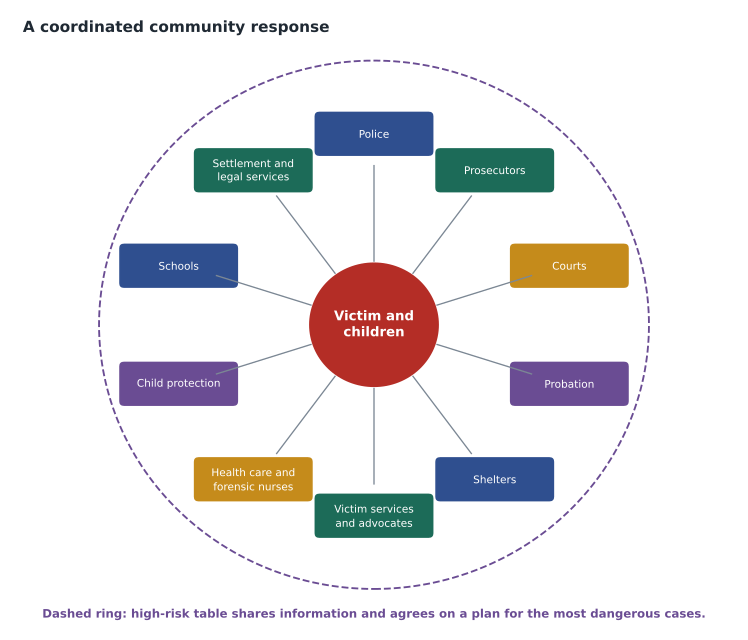
The parts of a coordinated response
Ontario has several structures that support coordination. Since the late 1990s, the province has operated specialized domestic violence courts, now in every court jurisdiction, which bring together trained Crown attorneys, police, victim and witness assistance staff, and the Partner Assault Response program, a specialized counselling and education program for people who have assaulted partners, often required as a condition of a sentence or of early resolution for low-risk first offenders. Many communities have domestic violence coordinating committees and high-risk tables. Sexual assault response is coordinated through the hospital-based treatment centres, sexual assault centres and police specialized units. Ontario's Occupational Health and Safety Act requires employers to take every reasonable precaution to protect a worker when they become aware, or ought reasonably to be aware, that domestic violence that would likely expose the worker to physical injury may occur in the workplace.
Research on programs for abusers has produced mixed results. Some evaluations find modest reductions in reoffending among men who complete programs, especially when the program is part of a firm, coordinated response with close supervision and quick consequences for non-compliance. Others find little difference between men who attend and men who do not. Many men drop out, and dropout itself is a warning sign. Desjardins tells the class that the lesson for police is not that programs are useless, but that a program is not a safety plan. 'The program does its part. Probation, the court and the police have to do theirs, especially when someone stops attending or breaches a condition.'
Information sharing
Coordination depends on sharing information, and information sharing is governed by privacy laws and professional duties. Ontario's privacy laws, including the Municipal Freedom of Information and Protection of Privacy Act and the Personal Health Information Protection Act, allow disclosure of personal information without consent in compelling circumstances affecting health or safety and to eliminate or reduce a significant risk of serious bodily harm. High-risk tables operate under written protocols that set out what may be shared, by whom and for what purpose. Brooks emphasizes that advocates' confidentiality rules are not obstacles to be worked around. Victims often tell advocates things they will not tell police, precisely because they know the advocate will not pass it on without their consent. That trust keeps victims connected to help. Police should respect it, ask advocates to seek the victim's consent when information is needed, and remember that victims share more when they trust the system.
Sexual assault response teams in practice
In the Reyes case, coordination began when Constable Teague called the unit and the unit called the hospital. When Sofia arrived at Port Ardent General Hospital on March 10, the nurse examiner, Kim Oduya, and an advocate from the sexual assault centre were waiting. Oduya explained each step of the examination and asked Sofia's consent for each part. The advocate stayed with Sofia throughout, explained her options for reporting, and arranged follow-up counselling. Mendes waited until the examination was done. Over the following months, the advocate kept Sofia informed of the investigation and the court process, attended the pretrial hearing with her, and helped her arrange academic accommodations at her college. Sofia later told the advocate that what made the difference was that 'nobody made me tell it more times than I had to, and everyone knew what the others were doing.'
Prevention
Police are mostly involved after violence has occurred, but they also contribute to prevention. They speak in schools about healthy relationships and dating violence, support bystander programs on campuses and in workplaces, work with community groups, and share data that helps agencies understand where and when violence occurs. Prevention research suggests that bystander programs, which teach people to recognize and safely intervene in situations that may lead to sexual or partner violence, can change attitudes and behaviours, and that programs addressing attitudes that excuse violence can reduce perpetration among young people. Brooks reminds the class that every well-handled call is also prevention: it tells the victim, the abuser, the children and the neighbours that the violence is taken seriously.
The cost of the work
Desjardins turns to the officers themselves. Intimate partner and sexual violence calls are among the most emotionally demanding in policing. Officers see injured and terrified people, frightened children, and the same addresses again and again. They hear detailed accounts of sexual violence. They sometimes watch victims return to abusers, recant or refuse help, and they sometimes learn months later that someone they tried to help has been seriously hurt or killed. Over time, this exposure can lead to vicarious trauma, sometimes called secondary traumatic stress, in which the helper develops symptoms similar to those of trauma survivors; to compassion fatigue, a reduced capacity to care; and to burnout, a state of exhaustion and detachment caused by chronic workplace stress.
One sign of these effects is cynicism, which is dangerous in this work. An officer who starts to think of a victim as a 'frequent flyer' who 'will just go back to him anyway' is likely to do a thinner investigation, ask fewer questions and miss the signs of escalating risk. Brooks says she has seen this happen to good officers. 'They didn't stop caring because they were bad people. They stopped caring because nobody helped them carry what they were carrying.'
# Cumulative exposure: partner and sexual violence calls an officer might attend (illustrative numbers)
calls_per_shift = 0.8          # average such calls per shift for a patrol officer
shifts_per_year = 180
career_years = [1, 5, 10, 20]
for y in career_years:
    total = calls_per_shift * shifts_per_year * y
print(f"after {y:2d} years: about {total:5.0f} calls")after 1 years: about 144 calls after 5 years: about 720 calls after 10 years: about 1440 calls after 20 years: about 2880 calls
The numbers are illustrative, but the scale is real. An officer who attends fewer than one such call a shift may attend thousands over a career. Desjardins tells the class that nobody can absorb that much distress without support, and that admitting it is not weakness. Ontario recognized this in 2016 by creating a presumption that post-traumatic stress disorder diagnosed in a police officer or other first responder is work-related for the purpose of workers' compensation.
Staying well
Officers and organizations share responsibility for wellbeing. Organizations can provide peer support teams, confidential counselling through employee assistance programs, regular check-ins with supervisors, debriefing after critical incidents, manageable workloads in specialized units, rotation out of the most intense assignments, and training that helps officers recognize the signs of vicarious trauma. They can also build a culture in which seeking help is normal and does not harm a career. Individual officers can pay attention to their own warning signs, such as irritability, sleep problems, intrusive thoughts, withdrawal, increased drinking or numbness; maintain relationships and activities outside work; use physical exercise and rest; talk with trusted colleagues or professionals; and remember that they are one part of a system and cannot single-handedly save every victim.
After the Hollis call, Okeke and Malhotra's sergeant, Sergeant Haddad, held a short debrief at the end of the shift. Okeke told the class that the most useful part was hearing Haddad say that the call had been handled well and that it was normal to keep thinking about it. Malhotra said she had gone home and could not stop thinking about the small girl in the bedroom. She spoke with a peer support officer the next week. Desjardins says that both responses, talking about it and getting support, are signs of officers who will still be doing good work in twenty years.
Worked problem
Recognizing vicarious trauma
A detective who has worked in a sexual assault unit for six years notices that she sleeps badly, feels irritable with her children, avoids news stories about violence, and has started to feel flat when interviewing victims. She tells herself she is just tired. What might be happening, and what should she do?
Show solution
- Her symptoms, poor sleep, irritability, avoidance and emotional numbness, are common signs of vicarious trauma and burnout after long exposure to traumatic material.
- The emotional flatness in interviews may affect her work, because victims notice detachment and interviews may become less thorough.
- She should talk with someone she trusts, such as a peer support officer, a counsellor through the employee assistance program, or her own doctor.
- She could speak with her supervisor about workload, debriefing and the possibility of rotation or a break from the most intense cases.
- Taking these steps early is a sign of professionalism and helps her remain effective; ignoring the signs risks more serious harm to her health and her work.
Answer: These are signs of vicarious trauma; she should seek support early and discuss workload and rotation.
Common mistakes
MistakeEach agency should handle its own part of the case independently.
InsteadCoordination through shared policies and high-risk tables catches what single agencies miss.
MistakeAdvocates' confidentiality rules get in the way of investigations.
InsteadConfidentiality keeps victims connected to help; police should ask advocates to seek consent when information is needed.
MistakeA program for abusers makes the victim safe.
InsteadPrograms are one part of a firm, coordinated response with supervision and consequences.
MistakeGood officers are not affected by these calls.
InsteadVicarious trauma and burnout affect good officers; support and self-care are part of professional practice.
Summary and key terms
- Coordinated community responses bring police, prosecutors, courts, probation, advocates, health, child protection and others together around victim safety and offender accountability.
- The Duluth model began in 1981 and rests on shared policies, advocacy, monitoring and change.
- Ontario's domestic violence courts, the Partner Assault Response program, high-risk tables, treatment centres and workplace duties under the Occupational Health and Safety Act support coordination.
- Privacy laws allow sharing to prevent serious harm under written protocols.
- Vicarious trauma, compassion fatigue and burnout are real risks; cynicism weakens investigations.
- Peer support, counselling, debriefing, manageable workloads and a supportive culture help officers stay well and effective.
- Partner Assault Response program
- An Ontario program for people who have assaulted partners, often required by the court.
- Domestic violence court
- A specialized court program with trained Crowns, police and victim services.
- Coordinated community response
- An approach in which agencies work together under shared policies to protect victims and hold offenders accountable.
- Vicarious trauma
- Trauma symptoms that develop in helpers through repeated exposure to others' traumatic experiences.
- Burnout
- Exhaustion, detachment and reduced effectiveness caused by chronic workplace stress.
- Duluth model
- A coordinated community response developed in Duluth, Minnesota, in 1981.
Practice problems
Work each problem on paper first, then reveal the answer to check.
What did the high-risk table do for Megan in fifteen minutes?
Show answer
Confirmed priority response flags, gave the school the order and a photo, held a shelter room and arranged weekly victim services calls.
Why are advocates' confidentiality rules important?
Show answer
Victims tell advocates things they would not tell police, and that trust keeps them connected to help.
In the code example, about how many calls would an officer attend after twenty years?
Show answer
About 2,880.
Name three signs of vicarious trauma.
Show answer
Any three of: irritability, sleep problems, intrusive thoughts, withdrawal, increased drinking, numbness, avoidance.
Lesson quiz · 5 questions
Score 60% or more to complete this lesson.
Create a free account to save your progress, take quizzes and earn a certificate.