
LES-212 · Lesson 2 of 12 · 21 min
Intimate partner violence and the Criminal Code
▶ Video coming soon A video version of this lesson is on the way.
Desjardins puts a photograph of a kitchen on the screen. A chair lies on its side, a mobile phone is in pieces on the tile, and there is a fist-sized hole in the drywall beside the fridge. 'This is the Hollis kitchen on Willow Crescent, a little before midnight on Sunday, February 22, 2026,' he says. 'Before we talk about what the officers did, I want you to answer a simple question. If you were the officer standing here, what offences might you be looking at?' The students call out answers: assault, mischief, threats. Brooks adds one more. 'And what about the forty minutes before anyone called? The police usually arrive at the end of something.'
Unlike some countries, Canada does not have a single offence called domestic violence. Police charge the same Criminal Code offences that apply to anyone, and the intimate relationship matters in other ways: in how police respond, in bail, in risk assessment and in sentencing. A specific coercive control offence has now been enacted, as Lesson 1 explained, but it is not yet in force. This lesson sets out the main offences, the special rules that apply when the victim is a partner, and the policies that govern charging.
Offences against the person
The most common charge in intimate partner violence cases is assault under section 266 of the Criminal Code. Under section 265, a person commits an assault when, without consent, they intentionally apply force to another person directly or indirectly, attempt or threaten by an act or gesture to apply force while having or appearing to have the present ability to carry it out, or accost or impede someone while openly wearing or carrying a weapon or an imitation. The force does not need to cause injury; a push, a grab or a slap is enough. Assault is a hybrid offence, which means the Crown may proceed summarily or by indictment.
More serious forms of assault carry higher penalties. Under section 267, assault with a weapon or imitation weapon, assault causing bodily harm, and assault in which the accused chokes, suffocates or strangles the complainant are all more serious offences. The strangulation provision was added in 2019, when Parliament recognized that strangulation is one of the most dangerous forms of violence in intimate relationships. Aggravated assault under section 268 covers wounding, maiming, disfiguring or endangering life. Sexual assault, including the aggravated forms under sections 272 and 273, is covered in Lesson 6; strangulation during a sexual assault is also an aggravated form under section 272.
Other offences that often arise include uttering threats to cause death or bodily harm, or to damage property or harm an animal, under section 264.1; criminal harassment under section 264; mischief to property under section 430; forcible confinement under section 279(2); and the distribution of intimate images without consent under section 162.1. The Protecting Victims Act changed criminal harassment so that the question is whether a reasonable person in the victim's circumstances would fear for their safety, and made clear that harassing conduct includes conduct through technology such as electronic monitoring. It also raised the maximum penalty for distributing intimate images and created an offence of threatening to distribute them, including sexual deepfakes. Officers should check the current wording of each section, because several changed in 2026.
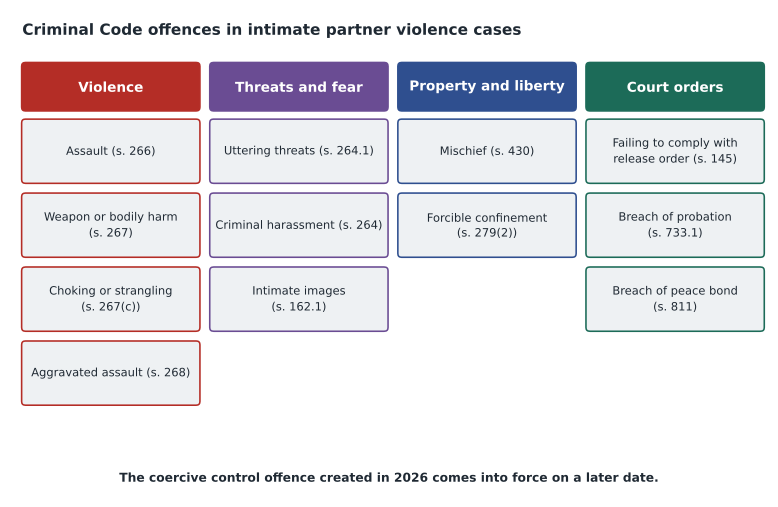
Several offences protect the court process. Failing to comply with a release order or undertaking, under section 145, is one of the most common charges in intimate partner violence cases, because abusers often contact the victim after being released on a no-contact condition. Breach of probation under section 733.1 and breach of a peace bond under section 811 work the same way. These breaches matter: contact in breach of a court order is often a sign that the abuser is unwilling to accept the end of the relationship, which is itself a risk factor.
Special rules when the victim is a partner
Several provisions of the Criminal Code treat intimate partner violence more seriously than other violence. Section 718.2(a)(ii) makes evidence that the offender abused an intimate partner or a member of the victim's or offender's family an aggravating factor at sentencing. Section 718.201 requires the court to consider the increased vulnerability of female persons who are victims of intimate partner violence, giving particular attention to the circumstances of Indigenous female victims. Section 718.3(8) allows a higher maximum sentence for an offender who has previously been convicted of an offence involving violence against an intimate partner. At bail, section 515(6)(b.1) places the onus on an accused charged with an offence involving violence against an intimate partner who has a previous conviction for such an offence, so that the accused must show why detention is not justified. The Protecting Victims Act added that murder committed in the context of coercive control, sexual violence or certain other circumstances is first-degree murder, which the government described as making femicide first-degree murder.
Desjardins explains why these provisions exist. Intimate partner violence is repetitive, and the person most at risk is the same person each time. The offender knows where the victim lives, works and takes the children to school. Repeat offending is common, and violence often escalates. Ordinary rules that treat each offence on its own, and each accused as a first offender until convicted, do not fit that reality well. 'The law has slowly been catching up with what victims have known for a long time,' he says. 'Your job is to give the court the information it needs to apply these rules, and that means the history, the relationship and the risk need to be in your report.'
Firearms
Firearms are a central concern, because access to a firearm greatly increases the risk that intimate partner violence will become lethal. Under the Criminal Code, police may seize firearms without a warrant where there are reasonable grounds to believe it is not desirable in the interests of safety for a person to possess them and it is not practicable to obtain a warrant, under section 117.04, and must then apply to a justice for a disposition. Courts must impose a weapons prohibition after conviction for certain offences, including many involving violence, under section 109, and may impose one in other cases under section 110. Release orders almost always include a condition not to possess weapons and to surrender any firearms and licences. Federal firearms law changes made in 2023 also allow anyone to apply to a court for an emergency weapons prohibition order against a person who poses a danger. Officers should check the Canadian Firearms Program records for licences and registered firearms on every intimate partner violence call.
In the Hollis case, Tyler Kerr held a firearms licence and owned two hunting rifles, stored in a locked cabinet in the basement. Megan told the officers about them when they asked. Constable Femi Okeke seized them that night under section 117.04, because it was not practicable to get a warrant at midnight and Kerr was about to be released by the morning. Brooks tells the class that when Megan was asked weeks later what had helped most, she said it was knowing the guns were out of the house.
Charging policies and discretion
Since the early 1980s, every province has adopted policies directing police to lay charges in intimate partner violence cases where there are reasonable grounds to believe an offence has been committed, rather than leaving the decision to the victim. Ontario's policing standards and the Crown prosecution manual follow that approach: officers lay the charge when the grounds exist, and the Crown decides whether to continue based on the evidence and the public interest, not simply on whether the victim wants the charge to proceed. The policies were adopted because leaving the decision to victims put them in danger, since abusers could pressure them to withdraw, and because treating partner violence as a private matter had failed.
These policies are sometimes controversial. Some victims want the violence to stop but do not want their partner arrested, perhaps because they depend on the partner's income or fear the consequences of a charge. Research on mandatory and preferred arrest has been mixed: some studies found that arrest reduced repeat violence, and others found little effect or that the effect depended on the offender's circumstances. Critics argue that strict policies can lead to the arrest of victims who used force in self-defence, and that they can discourage some victims from calling. Supporters argue that the policies send a clear message that the violence is a crime, take the decision and the blame off the victim, and allow the system to intervene before the violence escalates. Brooks tells the class that the answer is not to abandon the policies but to apply them carefully: identify the person actually responsible, explain to the victim what will happen and why, and connect the victim with support. 'The worst outcome is a victim who calls, watches the wrong person get arrested, and never calls again.'
# Checking whether a records history changes the charge (illustrative rules only)
def charge_level(country, prior_ipv_convictions, strangulation):
    if country == "ca":
        base = "assault by choking (s. 267(c))" if strangulation else "assault (s. 266)"
        bail = "reverse onus at bail" if prior_ipv_convictions > 0 else "Crown onus at bail"
        return base + "; " + bail
    if strangulation:
        return "strangulation 2903.18, felony of the fourth degree (household member)"
    if prior_ipv_convictions == 0:
        return "domestic violence 2919.25(A), misdemeanor of the first degree"
    return "domestic violence 2919.25(A), raised to a felony by prior conviction"

for c in ("ca", "us"):
    for priors, strang in ((0, False), (1, False), (0, True)):
print(c, priors, strang, "->", charge_level(c, priors, strang))ca 0 False -> assault (s. 266); Crown onus at bail ca 1 False -> assault (s. 266); reverse onus at bail ca 0 True -> assault by choking (s. 267(c)); Crown onus at bail us 0 False -> domestic violence 2919.25(A), misdemeanor of the first degree us 1 False -> domestic violence 2919.25(A), raised to a felony by prior conviction us 0 True -> strangulation 2903.18, felony of the fourth degree (household member)
The function is a simplification, but it makes a point that Kwan, the Crown attorney from the last course, made to the class: 'The charge depends on facts the officer has to find. Was there strangulation? Is there a prior conviction? Is the victim a partner? If you do not ask, I do not know, and the court does not know.'
What happened in the Hollis case
Megan Hollis, thirty-one, is a dental hygienist. She and Tyler Kerr, thirty-five, who runs a small renovation business, had lived together for six years and have a daughter, Ava, who was six in February. Megan told Okeke that she had decided a month earlier to end the relationship and had told Tyler so on the Friday. On the Sunday night, after Ava was in bed, he took her phone from the counter and began reading her messages. When she tried to take it back, he threw it on the floor, pushed her against the wall and put his hands around her neck. She said she could not breathe or call out, and that she thought she was going to die. When he let go, he punched the wall beside her head. The neighbour downstairs, Doreen Pike, heard the crash and called 9-1-1.
Okeke and his partner, Constable Asha Malhotra, arrested Kerr at the house. He was charged with assault by choking under section 267(c) and mischief under section 430 for the phone and the wall. A month later he was charged with failing to comply with his release order after he sent Megan messages from a new account, which Lesson 5 will cover. Desjardins asks why the strangulation detail made such a difference. Priya Sandhu answers: it raised the charge, it raised the risk assessment, and it meant the case was about the most dangerous thing he had done, not just the hole in the wall.
Worked problem
Choosing charges from the facts
Officers attend a call in which a woman says her ex-boyfriend came to her apartment uninvited, refused to leave, grabbed her wrist hard enough to leave red marks when she tried to close the door, and said, 'If I can't have you, nobody will.' He left before officers arrived. She shows them forty text messages he has sent in the past two days, many saying he is watching her. She has no protection order. What offences might apply?
Show solution
- The wrist grab is an application of force without consent, which is an assault under sections 265 and 266.
- The statement 'If I can't have you, nobody will' may be a threat to cause death or bodily harm under section 264.1, depending on the words and context.
- The repeated messages saying he is watching her, together with the visit, may support criminal harassment under section 264 if a reasonable person in her circumstances would fear for her safety.
- The threat 'if I can't have you, nobody will' is also a serious risk indicator and must be recorded word for word and considered in the risk assessment.
- Officers should look for him, preserve the messages, check records for priors and firearms, and connect her with victim services and information on protection orders.
Answer: Assault or domestic violence for the grab, threat-based offences for the statement, and harassment or stalking for the pattern, with the statement treated as a serious risk factor.
Common mistakes
MistakeCanada has no law against domestic violence.
InsteadCanada has no separately named domestic violence offence, but the ordinary offences apply and many provisions treat partner violence more seriously.
MistakeThe victim decides whether charges are laid.
InsteadCharging policies direct police to lay charges when grounds exist, and the Crown decides whether to proceed.
MistakeStrangulation is just another kind of assault.
InsteadChoking, suffocating or strangling is an aggravated form of assault under section 267(c) and a major risk factor.
MistakeFirearms are only relevant if they were used.
InsteadAccess to firearms greatly increases the risk of homicide, so officers should ask about, check for and document firearms on every call.
Summary and key terms
- Canada has no separate domestic violence offence; police charge ordinary offences such as assault, assault by choking, uttering threats, criminal harassment and mischief.
- Strangulation is an aggravated form of assault under section 267(c).
- Partner violence is aggravating at sentencing, raises the maximum for repeat offenders, and can reverse the onus at bail.
- Firearms greatly increase lethal risk; officers should ask, check records and use their seizure powers.
- Charging policies direct officers to lay charges when grounds exist; the Crown decides whether to proceed.
- Breaches of no-contact orders are common and are both offences and risk indicators.
- Hybrid offence
- An offence the Crown may prosecute summarily or by indictment.
- Reverse onus
- At bail, the accused must show why detention is not justified.
- Charging policy
- A provincial directive that police lay charges in partner violence cases when grounds exist.
- Strangulation
- Pressure on the neck or covering of the nose and mouth that impedes breathing or blood flow.
- Primary aggressor
- The person most responsible for the violence when both partners have used force.
Practice problems
Work each problem on paper first, then reveal the answer to check.
Why did the strangulation detail matter so much in the Hollis case?
Show answer
It raised the charge, raised the risk assessment and focused the case on the most dangerous conduct.
Under section 515(6)(b.1), when does the onus shift to the accused at bail?
Show answer
When the accused is charged with an offence involving violence against an intimate partner and has a prior conviction for such an offence.
What did the code example show about records checks?
Show answer
That prior convictions can change the charge or the bail position, so officers must check before charging.
Why are breaches of no-contact orders treated as serious?
Show answer
They are offences, and they often show the abuser will not accept the end of the relationship, which is a risk factor.
Lesson quiz · 5 questions
Score 60% or more to complete this lesson.
Create a free account to save your progress, take quizzes and earn a certificate.