
LES-212 · Lesson 4 of 12 · 21 min
Risk assessment, lethality and strangulation
▶ Video coming soon A video version of this lesson is on the way.
Brooks opens the lesson with a list of names and dates on the screen, with no other information. There are twelve of them, all from a single year in a single province or state, and every one is a person killed by a current or former partner. 'When review committees looked at cases like these,' she says, 'they did not usually find a homicide that came out of nowhere. They found people who had called police, gone to doctors, told friends, filed for custody or left a shelter. They found risk factors that were known to someone. What they often did not find was anyone who had put the pieces together.' Desjardins adds, 'That is what risk assessment is for. Not to predict the future perfectly, but to make sure the pieces get put together.'
This lesson is about how police identify the risk that intimate partner violence will continue, escalate or become lethal, and how that assessment shapes what officers, prosecutors, courts and support agencies do next. It also takes a close look at strangulation, which research has shown to be one of the most important warning signs of all.
What death reviews teach
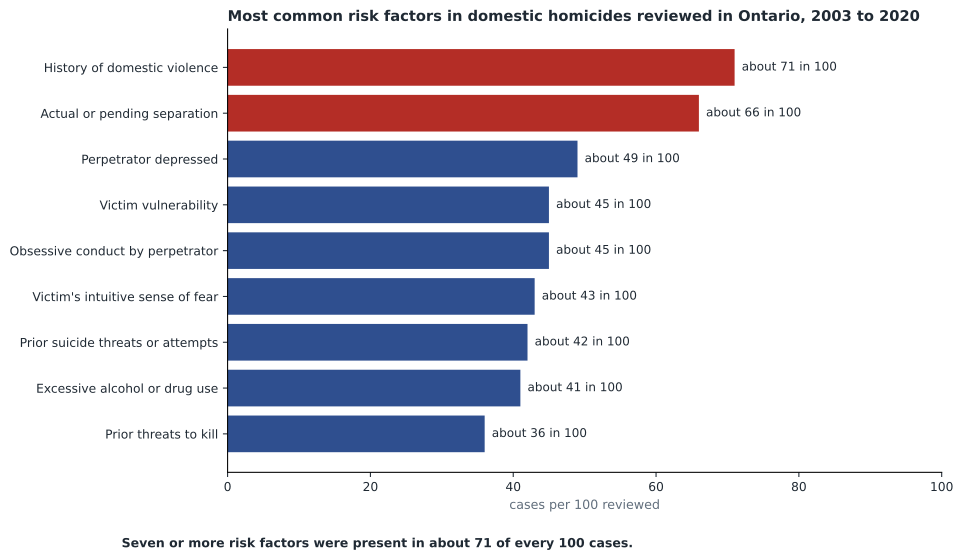
Ontario's Domestic Violence Death Review Committee, created in 2003 and supported by the Office of the Chief Coroner, reviews every domestic homicide in the province and looks for what might have prevented it. It uses a list of forty-one risk factors. In the cases it reviewed between 2003 and 2020, about seven in ten couples had a history of domestic violence, and about two in three involved an actual or pending separation. Close to half involved a perpetrator who was depressed, a victim who was particularly vulnerable, or obsessive behaviour by the perpetrator, and in more than four in ten the victim had an intuitive sense of fear. Other common factors included prior threats or attempts at suicide by the perpetrator, excessive alcohol or drug use, prior threats to kill the victim and sexual jealousy. In about seven in ten cases, seven or more risk factors were present, which the committee treats as a sign that the homicide may have been predictable and preventable. Desjardins tells the class that the lists from different places look remarkably alike, and that this is good news: it means the warning signs are known and can be looked for.
What risk assessment is and is not
Risk assessment in intimate partner violence means gathering information about factors that research has linked to repeated or more serious violence, and using it to estimate how likely and how serious future violence might be, so that the response can match the risk. There are two broad approaches. Actuarial tools score a set of items and place the case in a risk category based on how similar cases turned out in research samples. Structured professional judgment tools guide the assessor through a list of evidence-based factors but leave the final judgment of risk to the assessor, who considers how the factors fit together in the particular case. Police generally use short tools designed for the front line, and specialists use longer tools for higher-risk cases.
No tool predicts the future with certainty. A low score does not mean a victim is safe, and a high score does not mean violence will happen. Tools miss factors that the victim does not disclose or the officer does not ask about, and they are only as good as the information put into them. Brooks adds that the victim's own sense of danger is one of the most important pieces of information. Research has found that victims' predictions of their own risk are often accurate, although some victims underestimate it, especially if they have been abused for a long time and the danger has become normal to them. 'If a victim tells you she thinks he will kill her, you write that down, and you believe it,' she says. 'If she says she is not worried but the factors say otherwise, you tell her what you see, gently and honestly.'
Tools used by police in Canada
The tool most widely used by Ontario police is the Ontario Domestic Assault Risk Assessment, or ODARA, an actuarial tool developed by researchers at the Waypoint Centre for Mental Health Care and the Ontario Provincial Police and published in 2004. It contains thirteen yes-or-no items about the offender's history of domestic and other violence, the circumstances of the current incident, and the victim's circumstances, and it can be scored by a trained officer from information available at the time of the investigation. The total score places the case in one of several risk categories that correspond to how often similar offenders in research samples assaulted a partner again. Many Ontario services require officers to complete an ODARA for every eligible intimate partner violence assault and to include the result in the bail package for the Crown. Other provinces use other tools, including the B-SAFER guide, a structured professional judgment tool, and some tools developed provincially.
Desjardins stresses that the tool is not the assessment. It is a structured way to ask the right questions and record the answers. Officers must also consider anything the tool does not capture, such as a recent custody dispute, a suspect who has just lost a job, a threat made to someone else, or the victim's fear. Tools should be used consistently, by trained officers, and the results should be shared with the people who make the next decisions: the Crown attorney at bail, victim services, and, in the highest-risk cases, a multi-agency risk management table.
Strangulation: the warning sign that is easy to miss
Strangulation is pressure on the neck that blocks the flow of blood to or from the brain or blocks the airway. It can cause unconsciousness within seconds and brain damage or death within minutes, and as Lesson 3 explained, it can cause internal injuries that are dangerous even when there are no visible marks. It is also a crime of control. An abuser who strangles a partner is showing the partner that he can take her life with his hands. Victims often describe it as the moment they believed they were going to die.
Research has shown that strangulation is a strong predictor of future lethal violence. A study led by Nancy Glass, published in 2008, found that women who had previously been strangled by a partner had about seven times the odds of later being the victim of an attempted or completed homicide by that partner, compared with other abused women. Many people who kill partners, and some who kill police officers, have a history of strangling partners. That is why both Canada and Ohio now treat strangulation as a serious offence in its own right, as Lesson 2 described, and why every risk assessment asks about it. Brooks warns that victims often do not use the word. They say 'he choked me,' 'he grabbed my throat,' 'he held me down by the neck' or 'he put his arm around my neck.' Some describe it only when asked directly. Officers should always ask, using plain language, and should ask whether it has happened before.
Using the assessment
Risk assessment is only useful if it changes what happens. The results should shape the immediate response: whether to arrest, whether to seek detention or strict conditions at bail, whether to seize firearms, whether the victim needs emergency shelter. They should shape safety planning, which Lesson 5 covers, and the support offered to the victim. In high-risk cases, they should trigger coordinated action. Many Ontario communities have high-risk committees or tables that bring police, victim services, shelters, probation, child protection and health agencies together to share information and agree on a plan for the most dangerous cases, under information-sharing rules that allow disclosure to prevent serious harm. Lesson 11 returns to these coordinated responses.
Risk is not fixed. It changes when circumstances change, and some moments are especially dangerous: when the victim leaves or announces the intention to leave, when the abuser is released from custody, when a court date or custody hearing approaches, when the victim begins a new relationship, and when the abuser breaches an order. Assessments should be repeated at these points. A victim who was moderate risk in February may be very high risk in March if the abuser has started stalking her.
Risk in the Hollis case
Megan's interview at the hospital, and her follow-up interview with Detective Sergeant Mendes two days later, revealed several risk factors that had not appeared in the records. She said Tyler had grabbed her by the neck once before, about two years earlier, during the argument that led to her quiet February 2024 call. He checked her phone every night, had installed a location-sharing app on it and turned up at her workplace when she was late. When she told him she was leaving, he said that if she tried to take Ava he would 'make sure she regretted it,' and the next day he said he had 'nothing to live for' without them. He owned firearms. She said that when his hands were on her neck she believed she was going to die, and that she was more afraid of him now than she had ever been.
# Counting known risk factors in the Hollis case against a general list (not a scored instrument)
factors = {
    "history of domestic violence":            True,   # 2024 calls, earlier neck grab disclosed
    "actual or pending separation":            True,   # Megan told him on Friday she was leaving
    "prior or current strangulation":          True,
    "obsessive or controlling conduct":        True,   # phone checks, location app, workplace visits
    "threats about the children":              True,
    "perpetrator suicide threats":             True,   # 'nothing to live for'
    "access to firearms":                      True,
    "victim's intuitive sense of fear":        True,
    "excessive alcohol or drug use":           False,
    "prior threats to kill":                   False,
    "violence outside the family":             False,
}
present = [k for k, v in factors.items() if v]
print("factors present:", len(present), "of", len(factors))
for k in present:
    print(" -", k)
print("seven or more present:", len(present) >= 7)factors present: 8 of 11 - history of domestic violence - actual or pending separation - prior or current strangulation - obsessive or controlling conduct - threats about the children - perpetrator suicide threats - access to firearms - victim's intuitive sense of fear seven or more present: True
The count is not a scored instrument, and Desjardins reminds the class that the purpose is not the number. The purpose is to see how many serious warning signs were present together: a history of violence, a separation, strangulation, obsessive control, threats about the child, suicidal statements, firearms and a terrified victim. Okeke completed an ODARA at the station that night from the information he had, which placed Kerr in one of the highest risk categories, and he included it in the bail package with a summary of the other factors. The service's intimate partner violence unit flagged the case as high risk, and Brooks's office contacted Megan the next morning.
Desjardins asks the class what the 2024 officers might have done differently if they had asked the same questions two years earlier. Jesse Morningstar says they might have learned about the first neck grab. Amara Okafor says that even if Megan had not wanted to talk then, they could have given her information, recorded the call properly and flagged the address. 'That is the point,' Desjardins says. 'Risk assessment is not only for the night of the arrest. It is for every call, because every call is a chance to see the pattern before it becomes a homicide.'
Worked problem
Re-assessing risk after a change
Three weeks after an arrest for assault, a victim calls her victim services worker. The accused, who was released on a no-contact condition, has been driving past her apartment, and yesterday he left a card on her car that said, 'We need to talk about the kids. I'm not going away.' She has just started proceedings for custody. How should risk be reassessed?
Show solution
- Driving past her home and leaving a card are contact in breach of the release condition, which is an offence and a sign that he will not accept the separation.
- The custody proceedings are a known period of elevated risk, especially where the abuser uses the children to maintain control.
- The message 'I'm not going away' suggests obsession and persistence, which are recognized risk factors.
- Police should investigate the breach, consider arresting him and seeking detention or stricter conditions, and update the risk assessment with the new information.
- The victim services worker and police should review her safety plan, consider referral to a high-risk table or team, and make sure she knows to call immediately if he appears.
Answer: Risk has increased: the breach, the custody dispute and the persistent contact all call for a new assessment and a stronger response.
Common mistakes
MistakeA low risk score means the victim is safe.
InsteadTools miss undisclosed factors; a low score never means no risk, and the victim's own fear matters.
MistakeStrangulation without marks is a minor assault.
InsteadPrior strangulation is one of the strongest predictors of later homicide, whatever the visible injuries.
MistakeRisk is assessed once, at the time of arrest.
InsteadRisk changes; reassess at release, breaches, separation, court dates and custody hearings.
MistakeThe tool's score is the assessment.
InsteadThe tool structures the questions; officers must also consider what it does not capture and share the results.
Summary and key terms
- Ontario's Domestic Violence Death Review Committee finds the same risk factors repeatedly, led by a history of domestic violence and separation.
- Risk assessment uses evidence-based factors to estimate future violence so the response can match the risk; no tool is certain.
- Ontario police widely use the ODARA, a thirteen-item actuarial tool scored from investigation information.
- Strangulation is a strong predictor of later homicide; always ask about it in plain words, including past incidents.
- Results must shape arrest, bail, firearms, safety planning and coordinated responses to high-risk cases.
- Risk changes; reassess at separation, release, breaches, court dates and custody proceedings.
- ODARA
- The Ontario Domestic Assault Risk Assessment, a thirteen-item actuarial tool used by Ontario police.
- High-risk committee
- A multi-agency table that shares information and plans responses for the most dangerous cases.
- Risk factor
- A characteristic of the offender, victim, relationship or situation linked by research to repeated or more serious violence.
- Structured professional judgment
- An approach that guides the assessor through evidence-based factors but leaves the final judgment of risk to the assessor.
- Death review
- An examination of a domestic homicide to identify warning signs and missed opportunities.
Practice problems
Work each problem on paper first, then reveal the answer to check.
Why does Brooks say homicides reviewed by committees rarely 'came out of nowhere'?
Show answer
Because the victims had usually contacted police, health care, friends or courts, and risk factors were known to someone.
In the code example, how many risk factors were present in the Hollis case?
Show answer
Eight of the eleven listed.
Name three moments when risk should be reassessed.
Show answer
Any three of: separation, release from custody, a breach, a court date, a custody hearing or a new relationship.
What did the Glass study find about prior strangulation?
Show answer
Women previously strangled by a partner had about seven times the odds of later being victims of attempted or completed homicide by that partner.
Lesson quiz · 5 questions
Score 60% or more to complete this lesson.
Create a free account to save your progress, take quizzes and earn a certificate.