
LES-212 · Lesson 5 of 12 · 21 min
Bail, peace bonds, protection orders and safety planning
▶ Video coming soon A video version of this lesson is on the way.
Brooks hands each student a single sheet of paper. On it is a list of forty-three messages, with times, sent to Megan Hollis from a social media account she did not recognize between six in the evening on Saturday, March 28, 2026 and two the next morning. The first says, 'Can we just talk.' The fourteenth says, 'You're doing this to Ava, not me.' The thirty-first says, 'I know you're not at your sister's.' The last says, 'I'm not going away.' 'He had been ordered not to contact her in any way,' Brooks says. 'He knew it. He did it anyway, from an account he made that afternoon. What does that tell you?' Marco DiSanto answers: that the order was not enough on its own, and that he was getting worse.
Arrest is not the end of the police role in an intimate partner violence case. In many ways the most dangerous period for the victim begins when the accused is released. This lesson covers the legal tools that restrict an abuser's contact with the victim while the case is before the courts and afterward, the officer's role in enforcing them, and the safety planning that helps victims stay safe in ways no court order can guarantee.
Release and bail
After an arrest, police must decide whether to release the accused or hold them for a bail hearing, called a show cause hearing, before a justice. Since 2019, officers can release an accused on an undertaking with conditions, such as not contacting the victim and not possessing weapons. In intimate partner violence cases where the risk is significant, many services' policies direct officers to hold the accused for a show cause hearing so that a justice, informed by the Crown, can decide on release and conditions. At the hearing, the Crown usually has to show why detention is justified, but the onus is reversed under section 515(6)(b.1) for an accused charged with an offence involving violence against an intimate partner who has a prior conviction for such an offence, and under section 515(6)(c) for an accused charged with failing to comply with a release order while on release. Under section 515(13), a justice who makes a release or detention order must state in the record that they considered the safety and security of every victim. Detention can be justified on three grounds: to ensure attendance in court, for the protection or safety of the public, including the victim, and to maintain confidence in the administration of justice.
The officer's role at this stage is to give the Crown and the court the information they need. That means a complete synopsis of the incident, the history of earlier calls and orders, the risk assessment, the victim's concerns, the presence of firearms and whether they have been seized, and specific recommendations for conditions. Vague requests, such as 'no contact,' are less useful than specific ones, such as 'no contact directly or indirectly, including through social media, third parties or the child; not to attend within 200 metres of the victim's residence, her workplace at 14 Harbour Road and the child's school; no weapons; reside with the surety at a named address.' The victim should be asked what conditions would make her feel safe and whether there are places she needs to be protected, and she should be told the outcome promptly.
Kerr was held for a show cause hearing, which took place on Tuesday, February 24. The Crown filed the ODARA and the synopsis, and asked for detention. The justice released Kerr on a release order with his brother, Wes, as surety, on conditions that he live with Wes in Millbrook, forty minutes away; have no contact or communication, direct or indirect, by any means, with Megan; not attend within 200 metres of her home, her workplace or Ava's school; not possess weapons; and have contact with Ava only under a family court order or written agreement through a lawyer. Brooks's office told Megan the result within the hour.
Peace bonds and family court orders
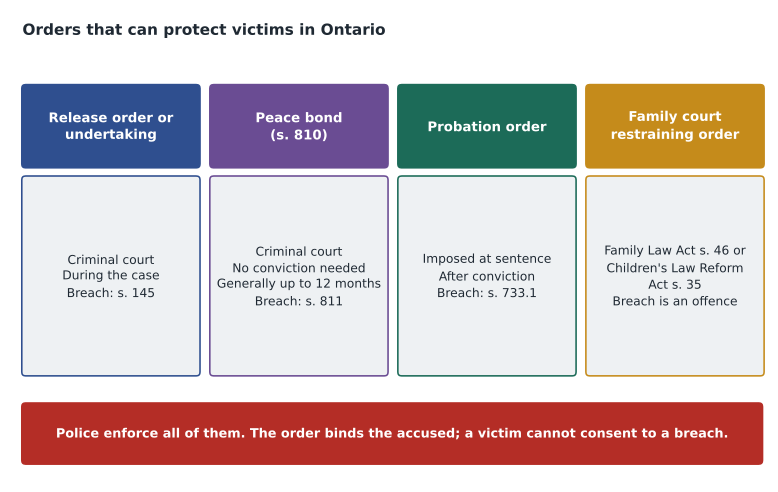
Several other orders can protect victims. A peace bond under section 810 of the Criminal Code is an order in which a person promises to keep the peace and be of good behaviour, with conditions such as no contact, for a period that is generally up to twelve months. A peace bond can be sought by anyone who fears on reasonable grounds that another person will cause personal injury to them, their intimate partner or child, or damage their property, and it does not require a criminal conviction. Peace bonds are sometimes used to resolve less serious charges, with the Crown withdrawing the charge in exchange. Breaching a peace bond is an offence under section 811. In Ontario, family courts can also make restraining orders under section 46 of the Family Law Act and section 35 of the Children's Law Reform Act, which prohibit a person from contacting or coming near the applicant and children; breaching one is an offence, and police can arrest without a warrant. Several other provinces and the territories have civil emergency protection order laws that let a justice issue an order quickly, often by phone, in an emergency; Ontario passed such a law in 2000 but never brought it into force.
Several provinces, including Saskatchewan, Alberta, Manitoba, Newfoundland and Labrador and Nova Scotia, have also adopted Clare's Law disclosure schemes, named after a woman killed in England in 2009 by a former partner with a history of violence she did not know about. Under these schemes, a person can ask police whether their partner has a history of violence, and police can proactively disclose information to a person at risk. Ontario does not have such a scheme, although there have been calls for one, and Quebec announced in 2026 that it would introduce one.
Enforcing orders
Orders only protect victims if they are enforced promptly and consistently. When a victim reports a breach, officers should treat it as a serious offence: document it fully, gather the evidence, such as messages, call logs, video and witness statements, and arrest where grounds exist. A breach is often the first sign that the abuser is escalating. Officers should verify the order's terms and status, which are recorded in the Canadian Police Information Centre, and should not assume a breach is minor because it involved 'only' messages or a drive-by. Officers must also never tell a victim that she has breached the order herself by contacting the accused. The order binds the accused, not the victim, and a victim cannot consent to a breach. Victims who contact the abuser often do so for reasons connected to safety, children or coercion, and treating them as wrongdoers drives them away from help.
When Megan showed Detective Sergeant Mendes the forty-three messages on Sunday morning, March 29, Mendes had the account preserved by sending a preservation demand to the platform, obtained a production order for the account's subscriber information, and arrested Kerr in Millbrook that afternoon for failing to comply with his release order. Because he was charged with failing to comply while on release, the onus at his second show cause hearing was on him under section 515(6)(c). The justice detained him on the secondary ground, finding that there was a substantial likelihood he would commit an offence or interfere with the administration of justice if released. He remained in custody until his guilty plea. Brooks notes that the GPS condition and the no-contact condition did what they were designed to do in one sense: they kept him physically away. But they could not stop a determined abuser from finding another way to reach her. 'That is why the order is never the whole safety plan.'
Safety planning
A safety plan is a personalized plan that helps a victim reduce risk, whether they are staying in the relationship, preparing to leave, or have already left. Safety planning is usually done with a shelter worker, victim services worker or advocate, but officers should know the basics so they can start the conversation and make the referral. A good plan is the victim's plan: it is built around the victim's own knowledge of the abuser and their own priorities, not a checklist imposed by someone else.
Common elements of safety planning while still living with the abuser include identifying the safest places in the home during an incident, away from rooms with weapons and with a way out; deciding how to get out and where to go; arranging a code word with a trusted neighbour, friend or the children to signal that help is needed; teaching children how and when to call for help and where to go; and keeping a phone charged and accessible. Preparing to leave might include gathering important documents, such as identification, health cards, birth certificates, immigration papers, bank information and court orders, along with money, medications, keys and a few items of importance to the children, and keeping them somewhere safe or with someone trusted. After leaving, a plan might include changing locks and routines, telling a workplace and the children's school about the situation and any orders, planning safe routes, and keeping copies of orders on hand.
Technology safety is now an essential part of any plan. Abusers commonly monitor partners through phones, shared accounts, location-sharing apps, cloud backups, smart home devices, vehicle tracking and hidden trackers. Victims may need help checking their devices and accounts, changing passwords from a safe device, turning off location sharing and reviewing who has access to their accounts. Brooks warns that suddenly cutting off an abuser's monitoring can itself escalate risk, because the abuser notices and reacts, so changes should be planned with an advocate. Megan's advocate helped her find the location-sharing app Tyler had installed and plan when to remove it.
Officers contribute to safety in practical ways. They can make sure the victim knows the exact terms of any order and what to do if it is breached; give a direct number for the investigating officer or unit; flag the address in dispatch records so that calls are treated as urgent; tell the victim promptly when the accused is released; and make referrals to shelters and victim services every time. In Ontario, the Victim Quick Response Program+ can pay for emergency expenses such as changing locks, safety devices and short-term accommodation. Megan stayed with her sister for two weeks, then moved with Ava into Juniper Place, Port Ardent's shelter for women and children, for six weeks while she arranged a new apartment with a security system.
# Checking a proposed exclusion zone: is each protected place at least 200 m from where the accused must live?
import math
def dist_m(a, b):  # positions on a city grid, in m (illustrative coordinates)
    return math.hypot(a[0] - b[0], a[1] - b[1])
protected = {"home": (1200, 800), "workplace": (2650, 1900), "school": (900, 1500)}
proposed_residences = {"brother in Millbrook": (31000, 12000), "friend on Elm St": (1300, 900)}
for res, p in proposed_residences.items():
    close = [name for name, q in protected.items() if dist_m(p, q) < 200]
print(res, "->", "conflicts with " + ", ".join(close) if close else "no conflict")brother in Millbrook -> no conflict friend on Elm St -> conflicts with home
The example is simple, but it reflects a real problem. Conditions that let an accused live a few blocks from the victim, or that ignore the child's school or the victim's workplace, can be technically sound and practically useless. Desjardins tells the class that the officer who knows the geography of the victim's life is often the only person in the courtroom who can point this out.
Worked problem
Responding to a reported breach
A woman calls to say that her former partner, who is on a release order prohibiting contact, has been sending her messages through his sister. The sister's messages say, 'He just wants to know you're okay. He says sorry.' The woman says she is frightened because he knows where she is staying. What should the officer do?
Show solution
- Indirect contact through a third party is still contact and is prohibited by a no-contact condition that covers direct and indirect communication.
- The officer should confirm the exact terms of the order and gather the messages, with dates, times and the sister's account information.
- The officer should consider whether the sister knew about the order and whether she is acting on his instructions, which may be relevant to her own liability.
- The woman's statement that he knows where she is staying is a serious risk factor and should trigger a reassessment and an update to her safety plan.
- The officer should take steps to arrest the accused for the breach where grounds exist, inform the Crown or prosecutor of the risk, and make sure the woman is connected with victim services.
Answer: Treat it as a breach: gather the evidence, arrest where grounds exist, reassess risk and update the safety plan.
Common mistakes
MistakeA no-contact order makes the victim safe.
InsteadOrders reduce risk only if enforced, and they cannot stop a determined abuser; safety planning is still essential.
MistakeA victim who contacts the accused has breached the order.
InsteadThe order binds the accused; a victim cannot breach it or consent to a breach.
MistakeMessages are a minor breach.
InsteadAny contact in breach is an offence and often a sign of escalation.
MistakeThe officer's job ends at arrest.
InsteadOfficers supply the information for bail and conditions, enforce orders, keep victims informed and make referrals.
Summary and key terms
- At a show cause hearing the Crown usually bears the onus, but it shifts under section 515(6)(b.1) and (c) in some partner violence and breach cases; justices must consider victim safety under section 515(13).
- Officers should give the prosecutor specific information and specific recommended conditions, and tell the victim the outcome promptly.
- Peace bonds under section 810, family court restraining orders and release and probation conditions all protect victims; several provinces also have Clare's Law schemes.
- Breaches must be investigated and enforced promptly; the order binds the accused, not the victim.
- Safety plans are the victim's own plans for during an incident, preparing to leave, after leaving and technology safety.
- Officers support safety by explaining orders, flagging addresses, giving direct contacts, notifying victims of release and referring every time.
- Show cause hearing
- A bail hearing at which a justice decides whether to release an accused and on what conditions.
- Peace bond
- An order under section 810 to keep the peace and follow conditions, which does not require a conviction.
- Clare's Law
- A scheme allowing police to disclose a partner's history of violence to a person at risk.
- Safety plan
- A personalized plan to reduce risk, built around the victim's knowledge and priorities.
- Exclusion zone
- An area around protected places that the accused must not enter, sometimes enforced by GPS monitoring.
- Indirect contact
- Contact through another person, a social media account or any other means, which no-contact conditions usually prohibit.
Practice problems
Work each problem on paper first, then reveal the answer to check.
What did the forty-three messages show about Kerr?
Show answer
That he was ignoring the order, would not accept the separation and was escalating.
Why was the onus on Kerr at his second show cause hearing?
Show answer
Because he was charged with failing to comply with a release order while on release, under section 515(6)(c).
In the code example, which proposed residence conflicted with the protected places?
Show answer
The friend's place on Elm Street, which was within 200 metres of the victim's home.
Why should changes to an abuser's monitoring of a victim's phone be planned with an advocate?
Show answer
Because suddenly cutting off monitoring can escalate risk when the abuser notices.
Lesson quiz · 5 questions
Score 60% or more to complete this lesson.
Create a free account to save your progress, take quizzes and earn a certificate.