
LES-212 · Lesson 3 of 12 · 25 min
Responding to intimate partner violence calls
▶ Video coming soon A video version of this lesson is on the way.
Desjardins plays the start of Doreen Pike's 9-1-1 call. She is seventy-four and lives in the lower unit of the duplex on Willow Crescent. 'There's screaming upstairs, the girl upstairs, Megan,' she says. 'I heard her yell stop and then something big hit the floor. It's gone quiet. It's never been this bad.' The call-taker asks whether she can see anyone, whether there are weapons in the house, and whether there are children. Doreen says there is a little girl. The call-taker keeps her on the line until the first car pulls up. Desjardins stops the recording. 'That call-taker did three things right in ninety seconds,' he says. 'Can anyone name them?'
This lesson follows an intimate partner violence call from the moment it reaches dispatch to the moment officers clear the scene. Desjardins tells the class that these calls are among the most varied an officer will attend. Some are arguments in which no offence has occurred. Some are crimes in progress. A few are the last chance to prevent a homicide. Officers often cannot tell which kind they are attending until they are inside, and the same address may produce all three kinds over the years. The response needs to be safe, thorough and fair every time.
Dispatch and the information officers need
The response begins with the call-taker. Good call-taking gathers the information officers need to arrive safely and to start the investigation correctly: the address and the exact unit; whether the caller is the victim, a child, a neighbour or the suspect; whether anyone is injured; whether weapons are present or in the home, especially firearms; whether children are present; whether the suspect is still there and, if not, the suspect's description, vehicle and direction; and whether alcohol or drugs are involved. A call-taker who can safely keep the caller on the line can update officers as they approach. If the line disconnects, the call-taker should call back, and a disconnected call from a residence should never be treated as a reason to cancel the response.
Dispatch should also check records before officers arrive: previous calls to the address, previous incidents involving the people named, existing court orders such as release conditions, probation orders or protection orders, and firearms licences and registered firearms through the Canadian Firearms Program. In the Hollis call, the records check showed two earlier calls: a February 2024 call in which Megan said quietly that Tyler had taken her phone, then hung up, and an October 2024 call from a neighbour about shouting. Both had been cleared with no offence found. The check also showed that Tyler Kerr held a firearms licence. The three things the call-taker did right, Linh Tran says, were asking about weapons, asking about children and staying on the line.
Approach and arrival
Officers should attend intimate partner violence calls with at least two officers whenever possible, and the approach should be planned. Officers should avoid parking directly in front of the address, approach in a way that lets them see doors and windows, and pause outside to listen before knocking, because what they hear can establish grounds to enter and gives information about what is happening inside. They should knock to the side of the door rather than standing in front of it. These are basic officer safety practices taught at every academy, and they matter because these calls involve people in intense emotional states, sometimes with weapons, sometimes intoxicated, in confined spaces with which the suspect is familiar and the officers are not.
Police in Canada have the power to enter a home without a warrant to respond to an emergency, including a disconnected 9-1-1 call, to find out whether someone inside needs help. In R. v. Godoy (1999), the Supreme Court of Canada held that the importance of the police duty to protect life justifies forced entry to ascertain the health and safety of a caller, but that the entry is limited to that purpose: police may find the caller and determine the reason for the call, but they may not search the premises or intrude further on privacy than necessary. In the Hollis call, Okeke and Malhotra heard nothing as they reached the door. Kerr opened it, calm and polite, and said, 'We just had words. She's upstairs, she's fine.' Okeke told him they needed to see her to make sure, and Kerr stepped aside.
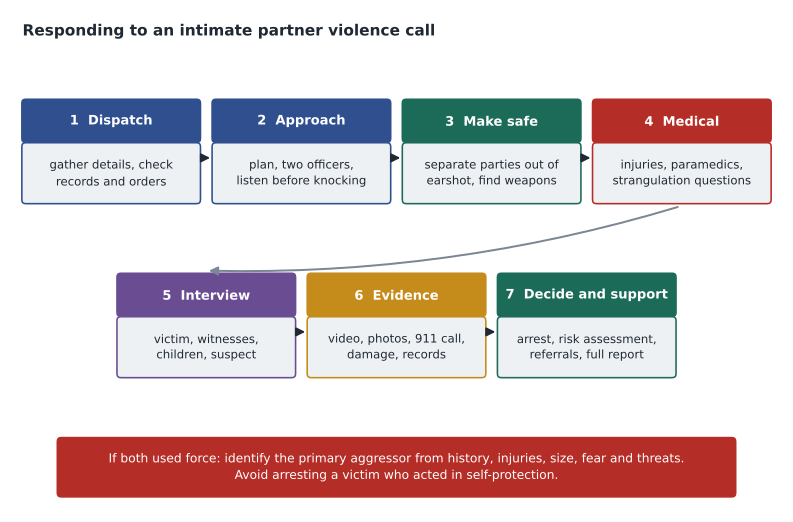
Making the scene safe and separating the parties
Once inside, officers should identify everyone present, check for injuries and locate weapons. They should separate the parties into different rooms, out of earshot of each other but within sight of the officers, so that each can speak freely without being overheard or intimidated, and so that the officers can see what is happening. The suspect should not be left in a kitchen or a room where knives or other weapons are within reach. Officers should keep the parties separated for the whole investigation, including when they leave the scene. Victims speak very differently when the abuser can hear them.
Malhotra found Megan in the upstairs hallway, sitting on the floor with her back against the wall. Her voice was hoarse and she kept touching her throat. Malhotra crouched to her level, introduced herself, told her she was safe for now and asked whether she was hurt. Megan said, 'He had his hands on my neck. I couldn't breathe.' Malhotra immediately asked for paramedics. In the kitchen, Okeke asked Kerr to sit at the table, away from the knife block, and asked what had happened. Kerr said Megan had 'come at him' over the phone and he had 'held her off.' He said, 'She's being dramatic.' Okeke noted that Kerr had a fresh abrasion across the knuckles of his right hand and no visible marks on his face, neck or arms.
Injuries and strangulation
Officers should look for injuries, ask about injuries that may not be visible, and get medical attention for anyone who needs it. This is especially important after strangulation. Strangulation often leaves few or no visible marks, particularly in the first hours, but it can cause serious internal injuries, including damage to the airway and to the blood vessels of the neck, which can lead to a stroke or death hours or days later. Victims may not realize they were close to losing consciousness. Officers should ask specific, plain questions: Did he put his hands or anything else on your neck? Could you breathe? Did you lose consciousness or feel faint? Is your voice different? Is it hard to swallow? Do you have pain in your neck or throat? Did you notice any change in your vision? These questions are part of a standard strangulation assessment, and the answers should be recorded in the victim's own words.
Signs that officers may observe include redness or scratches on the neck, sometimes in the shape of fingers; small red spots on the face, around the eyes or in the whites of the eyes; a hoarse or raspy voice; difficulty swallowing; coughing; and changes in behaviour such as confusion or memory gaps. Many of these signs are subtle or appear later. Officers should strongly encourage medical assessment, explain why, and record whether the victim accepted or declined. Megan first said she did not want to go to hospital because of Ava. Malhotra told her that strangulation can cause hidden injuries and that the paramedics recommended she be checked. Megan agreed once her sister, Dana, arrived to take Ava. At the hospital, a nurse examiner from the Sexual Assault and Domestic Violence Treatment Centre documented her injuries using a standard strangulation form.
Interviewing the victim
The first account a victim gives is often the most important. Officers should let the victim tell what happened in their own words before asking specific questions, using open prompts such as 'Tell me what happened tonight.' They should then ask follow-up questions to fill gaps, including the history: Has this happened before? Has it been getting worse? Has he ever threatened to kill you? Has he ever strangled you before? Does he have access to weapons? Has anything changed recently, such as a separation? Is there a court order? Officers should record exact words where possible, especially statements made in the first minutes, and note the victim's demeanour. Body-worn camera footage of the first account is powerful evidence, because it captures the victim's words, voice, appearance and emotional state as they were in the moment.
Statements a victim makes in the immediate aftermath of an event can sometimes be admitted at trial even if the victim later refuses to testify or recants, under the spontaneous statement exception to the hearsay rule or the principled approach. Lesson 10 will cover how these rules work in intimate partner violence cases. For now, Desjardins tells the class, the practical lesson is to capture the first account fully and accurately, because the officer may never get a second one.
Brooks adds a reminder about how to ask. Victims of intimate partner violence are often ashamed, frightened and exhausted, and they may be protective of the abuser. They may minimize what happened or blame themselves. Questions that sound like judgments, such as 'Why didn't you leave?' or 'What did you do to make him angry?', will end the conversation. A calm, patient manner, an explanation of what the officer is doing and why, and plain statements such as 'This is not your fault' and 'We take this seriously' make it more likely that the victim will tell the whole story, tonight and in the future.
Children, witnesses and the suspect
Children in the home need attention. Officers should make sure they are safe and uninjured, find a safe adult to care for them if needed, and speak with them gently and briefly to learn whether they saw or heard anything, without conducting a detailed interview at the scene. If a child may be an important witness, a formal interview should be arranged later with trained interviewers, often at a child advocacy centre. Malhotra knelt to talk to Ava in her bedroom. Ava said she heard 'a big bang' and her mommy crying. Malhotra told her that the police were there to help, that her mom was going to see a nurse, and that her Aunt Dana was coming. The children's aid society was notified the next morning.
Officers should also identify and speak with other witnesses, such as neighbours who heard or saw something, and preserve the 9-1-1 recording. Doreen Pike told Okeke she had heard Megan shout 'stop' twice, then a thud, then a crash 'like a fist through a wall,' then silence. She said she had heard shouting before but never like this. The suspect should be treated as any suspect: informed of the reason for detention or arrest and of the right to counsel, cautioned, and given the opportunity to speak with a lawyer before any questioning. Spontaneous statements made before any questioning, such as Kerr's comment that Megan was 'being dramatic,' should be recorded word for word.
When both partners have used force
Sometimes both partners have injuries or both say the other started it. Arresting both is rarely the right answer, because in most such cases one partner is the abuser and the other used force in self-defence or in reaction to long-term abuse. Arresting the victim can put the victim at greater risk, discourage future calls and hand the abuser a weapon in family court. Officers should identify the primary aggressor, sometimes called the dominant or predominant aggressor: the person who poses the most serious ongoing threat. Factors include the history of abuse between them, the relative size and strength of each person, the severity and location of injuries, whether injuries are offensive or defensive, which person is afraid of the other, whether either made threats, and whether force was used in self-defence. Many Canadian police services' intimate partner violence policies direct officers to determine the primary or dominant aggressor and to avoid dual charging where one party acted defensively.
Defensive injuries tend to be on the hands, forearms and the backs of the arms, and scratches on a suspect's face or neck can mean the victim was fighting to breathe. A suspect who is much larger, calm, controlled and dismissive while the other partner is frightened, injured and hesitant tells officers a great deal. In the Hollis call, the analysis was not difficult. Kerr's knuckle abrasion matched the hole in the wall, he had no injuries consistent with being attacked, Megan had marks on her neck and a hoarse voice, and the history and Doreen's account all pointed the same way. Okeke arrested Kerr at nine minutes past midnight.
Gathering and preserving evidence
Good intimate partner violence investigations gather evidence that does not depend on the victim's testimony, because the victim may not be able or willing to testify later. The core evidence includes the body-worn camera recording of the first accounts; photographs of the victim's injuries, of the suspect, including the hands, and of the scene, taken before anything is moved; the 9-1-1 recording and dispatch records; physical evidence such as the broken phone; statements from neighbours and other witnesses; medical records, with the victim's consent or by court order; messages, call logs and social media posts; and records of earlier calls and court orders. Injuries such as bruising often become more visible over the following one to three days, so follow-up photographs should be arranged. Detective Sergeant Carla Mendes of the service's intimate partner violence and sexual assault unit met Megan on February 24 and photographed the bruising on her neck and upper arm, which had darkened considerably.
# Hollis call: elapsed times from the first 911 ring (times from the CAD log)
def minutes(t):
    h, m = t.split(":")
    return int(h) * 60 + int(m)
events = [("911 call from downstairs resident", "23:47"), ("officers dispatched", "23:48"),
          ("officers arrive", "23:55"), ("Kerr arrested", "00:09"),
          ("paramedics arrive", "00:12"), ("Megan to hospital", "00:41")]
t0 = minutes(events[0][1])
for name, t in events:
    mins = minutes(t) - t0
    if mins < 0:
        mins += 24 * 60   # the call ran past midnight
print(f"{t} +{mins:3d} min {name}")23:47 + 0 min 911 call from downstairs resident 23:48 + 1 min officers dispatched 23:55 + 8 min officers arrive 00:09 + 22 min Kerr arrested 00:12 + 25 min paramedics arrive 00:41 + 54 min Megan to hospital
The timeline helps the officers write an accurate report and, months later, testify about it. It also shows how quickly a well-run call moves: from the first ring to the arrest took twenty-two minutes. Desjardins notes that the time stamp for 'paramedics arrive' is after the arrest, which is a reminder that the victim's medical needs and the investigation run at the same time and that officers must not let either crowd out the other.
Before clearing the scene
Before leaving, officers should make sure the victim has a safe place to stay, information about what happens next, and contact information for victim services, shelters and crisis lines. In Ontario, officers refer victims to the local victim services agency and give them information about the Victim Quick Response Program+, which can help with immediate costs such as emergency accommodation and changing locks. Officers should tell the victim what will happen to the suspect, including when the suspect might be released, and that they will be told if the suspect is released. Every intimate partner violence call should end with a thorough report, including the history, the risk factors, the injuries, the victim's exact words and a clear account of why officers did or did not arrest. Many services require a domestic violence supplementary report form that captures this information in a consistent way.
Worked problem
Primary aggressor at a two-injury scene
Officers attend a call from a man who says his wife attacked him. He has three fresh scratches on his neck. His wife, who is much smaller, has a red mark across her throat, a bruise on her upper arm and a torn sleeve, and she is crying and says she is afraid of him. She says he pinned her to the bed by the neck and she scratched him to get free. Records show two previous calls in which she was the complainant. He says she has 'anger problems.' Who is the primary aggressor?
Show solution
- The man's neck scratches are consistent with a person fighting to get free from a hold on her neck, which would be defensive.
- The wife's injuries, a mark across the throat and a grip bruise on the arm, are consistent with being restrained and strangled.
- The history shows earlier calls with the wife as the complainant, and she says she is afraid of him; he expresses no fear of her.
- The size difference and the nature of the injuries make his account of being attacked much less likely.
- The man is the primary aggressor. The wife's use of force appears to be self-defence, and officers should not charge her. Strangulation questions, medical assessment and a risk assessment should follow.
Answer: The man is the primary aggressor; the wife's scratches were defensive.
Common mistakes
MistakeA calm suspect and a hysterical victim mean the victim is probably exaggerating.
InsteadAbusers are often calm and controlled with police; victims are often distressed. Demeanour must be weighed with the evidence.
MistakeNo marks on the neck means strangulation did not happen.
InsteadStrangulation often leaves few visible marks at first, and internal injuries can be dangerous; ask specific questions and arrange medical assessment.
MistakeIf both have injuries, arrest both.
InsteadIdentify the primary aggressor; defensive injuries do not make a victim an offender.
MistakeThe victim's statement is the whole case.
InsteadGather evidence that stands on its own: video, photographs, 911 recordings, witnesses, physical evidence and records.
Summary and key terms
- Good dispatch gathers information about weapons, children and the suspect, keeps the caller on the line and checks records and orders before arrival.
- Police may enter a home without a warrant to respond to an emergency, but under Godoy the entry is limited to finding and helping the person in need.
- Separate the parties out of earshot, check for injuries and weapons, and get medical help, especially after strangulation.
- Capture the victim's first account on video and in exact words, ask about history and risk, and speak to children gently and briefly.
- When both partners used force, identify the primary aggressor; avoid dual arrests where one acted defensively.
- Gather evidence that stands without the victim, arrange follow-up photographs, connect the victim with support and document everything.
- Primary aggressor
- The person who poses the most serious ongoing threat when both partners have used force.
- Defensive injury
- An injury consistent with trying to protect oneself or escape, often on the hands, forearms or the attacker's face and neck.
- Strangulation assessment
- A standard set of questions and observations about breathing, consciousness, voice, swallowing, pain and vision after pressure on the neck.
- First account
- The victim's initial description of events, which officers should capture fully and accurately.
- Follow-up photographs
- Pictures taken one to three days later, when bruising is often more visible.
Practice problems
Work each problem on paper first, then reveal the answer to check.
What three things did the call-taker in the Hollis call do right?
Show answer
Asked about weapons, asked about children and kept the caller on the line.
Why should parties be separated out of earshot but within sight of officers?
Show answer
So each can speak freely without intimidation while officers can still see and protect everyone.
How long passed from the 911 call to the arrest in the code example?
Show answer
Twenty-two minutes.
Name two signs of strangulation an officer might observe.
Show answer
Any two of: neck redness or scratches, small red spots on the face or eyes, a hoarse voice, difficulty swallowing, coughing, confusion or memory gaps.
Lesson quiz · 5 questions
Score 60% or more to complete this lesson.
Create a free account to save your progress, take quizzes and earn a certificate.