
LES-202 · Lesson 5 of 12 · 20 min
Character, prior convictions and other-acts evidence
▶ Video coming soon A video version of this lesson is on the way.
Shane Brennan had a record. In 2021 he had been convicted of breaking into a convenience store on the east side of Port Ardent at about three in the morning, through a rear window, and stealing cigarettes and cash. He had served a conditional sentence and had no new charges until March 2026. When Whitlock read the old file, he said to Kwan, 'Same time of night, same kind of business, back window, small stuff he can sell. That's him.' Kwan told him that might well be true, and that the judge would almost certainly never hear about it.
Desjardins writes two sentences on the board. 'He did it before, so he probably did it again.' 'He is the kind of person who does this.' He tells the class that most people find both sentences persuasive, and that the law of evidence treats both as dangerous. This lesson explains why, and when the law makes exceptions.
The general rule against bad character evidence
The prosecution generally may not prove that the accused committed the offence by showing that he has a bad character or a disposition to commit crimes of that kind. This is one of the oldest and most important rules of criminal evidence. The reason is not that character is irrelevant; a person who has committed burglaries is, as a matter of statistics, somewhat more likely than a random person to commit another. The reason is that juries and judges tend to give such evidence far more weight than it deserves, and that it invites them to convict a person for who he is or what he did before rather than for what is proved about this offence. Courts call these the dangers of moral prejudice, the risk of convicting because the accused is a bad person who deserves punishment anyway, and reasoning prejudice, the risk of distraction and overvaluing the evidence.
In Canada, the rule is a common law rule, and the Supreme Court of Canada has described evidence of general bad character or disposition as presumptively inadmissible when offered by the Crown. Desjardins points out that the rule protects people with records most, because they are the people police are most likely to suspect and juries are most likely to convict. Without it, a person with a prior conviction would face a much greater risk of being wrongly convicted.
When the accused puts character in issue
The rule is relaxed if the accused chooses to make character an issue. An accused may call evidence of good character, for example witnesses who say he is known in the community as honest or peaceful, to suggest he is unlikely to have committed the offence. If he does, the prosecution may respond with evidence of bad character in the same respect, including, in some circumstances, his criminal record. An accused who attacks the character of a prosecution witness, or of the victim, may also open the door to evidence about his own character in some situations. Defence lawyers make these choices carefully, because good character evidence can backfire badly. In the Bayview trial, Marchetti called no character evidence.
Similar fact and other-acts evidence
Evidence of other misconduct by the accused is sometimes admissible, not to show general bad character, but for a specific purpose where its value is high. The classic examples are identity, where the other acts share a distinctive signature with the offence charged; a pattern of conduct that rebuts a defence of accident or innocent explanation; motive; opportunity; and knowledge or intent.
In R. v. Handy (2002), the Supreme Court of Canada set out the test for similar fact evidence. It is presumptively inadmissible. The Crown must show, on a balance of probabilities, that its probative value in relation to a particular issue outweighs its potential prejudice. Probative value depends on the issue it is offered to prove and on factors such as how close in time and place the acts were, how similar they are in detail, how many there are, whether there are intervening events, and whether there is any risk of collusion between complainants. Where the issue is identity, the similarities must be so striking, so distinctive, that they amount to something like a signature, so that it would be an affront to common sense to believe that two different people committed the acts.
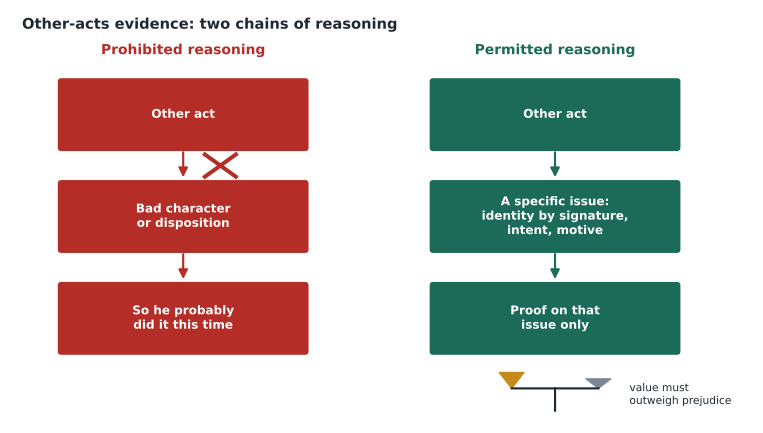
Kwan explains why he did not try to use the 2021 break-in. Both offences were late-night break-ins of small businesses through a rear window, with small, saleable items taken. 'That describes half the commercial break-ins in the city,' he says. 'There's nothing distinctive about it. It would only prove that Brennan is the kind of person who breaks into stores, and that is exactly what the rule forbids.' If the 2021 break-in had involved something unusual, such as the same rare tool marks or the same unusual method of disabling an alarm, the analysis might have been different.
# A rough checklist for whether an earlier act is distinctive enough to help prove identity
features = {
    "late at night":                      (True,  "common"),
    "small business":                     (True,  "common"),
    "entry through rear window":          (True,  "common"),
    "small saleable items taken":         (True,  "common"),
    "same unusual tool marks":            (False, "distinctive"),
    "same unusual alarm bypass":          (False, "distinctive"),
    "same distinctive item left behind":  (False, "distinctive"),
}
shared = [f for f, (match, kind) in features.items() if match]
distinctive = [f for f, (match, kind) in features.items() if match and kind == "distinctive"]
print("features shared with the 2021 break-in:", len(shared))
print("distinctive shared features:", len(distinctive))
print("signature for identity?", "possibly" if distinctive else "no; shared features are common to many break-ins")features shared with the 2021 break-in: 4 distinctive shared features: 0 signature for identity? no; shared features are common to many break-ins
The checklist is a teaching device, not a legal test, but it captures the idea. Four features were shared, but every one of them is common. The number of similarities matters less than their distinctiveness. Courts look at the acts as a whole, and a combination of individually common features can sometimes be distinctive, but nothing in this combination came close.
Cross-examining the accused on prior convictions
A separate rule applies when the accused testifies. The accused then becomes a witness like any other, and the prosecution may challenge his credibility. One way is to ask about prior convictions. This is not allowed to show that he is the type of person who commits crimes, only that his word should be weighed with his record in mind.
Section 12 of the Canada Evidence Act permits any witness, including the accused, to be questioned about prior convictions. In R. v. Corbett (1988), the Supreme Court of Canada held that this is constitutional, but that the trial judge has discretion to exclude some or all of an accused's convictions, or limit the questions, if the prejudice would outweigh their value on credibility. Factors include the nature of the prior convictions, with crimes of dishonesty more relevant to credibility than crimes of violence; how old they are; whether they are similar to the offence charged, since similarity increases the risk that the jury will use them improperly; and whether the defence has attacked the credibility of Crown witnesses. Defence lawyers usually bring a Corbett application before deciding whether the accused will testify.
Before the defence decided whether Brennan would testify, Marchetti asked the court to rule on his 2021 conviction. Justice Abernathy ruled that if Brennan testified, the Crown could ask whether he had a conviction for break and enter in 2021, without details, because a break-and-enter involves dishonesty relevant to credibility, but noted the similarity and said she would remind herself not to use it as evidence of propensity. Brennan did not testify. Desjardins notes that many accused people with records do not testify for this reason, and that the trier of fact may not draw any inference of guilt from that choice.
The character of victims and witnesses
Character rules also protect victims and witnesses. The defence may challenge a witness's credibility, including by asking about the witness's own prior convictions or prior inconsistent statements, but it cannot roam freely into a witness's private life. In sexual offence cases, section 276 of the Criminal Code strictly limits evidence of a complainant's other sexual activity, and bars its use to support the inferences that the complainant is more likely to have consented or is less worthy of belief. In other cases, evidence of a victim's violent character may be relevant to a defence such as self-defence, under rules of its own. Officers should record what witnesses say about each other accurately, but understand that much of it will never be admissible.
Police officers are witnesses too, and their own character can become an issue. The McNeil disclosure discussed in lesson 3 exists because an officer's serious misconduct, such as a finding of deceit or of fabricating evidence, may be used to challenge the officer's credibility in court. An officer with a sustained finding of dishonesty may find that every prosecutor who calls them must tell the defence about it, and some prosecutors stop calling such officers as witnesses at all. Desjardins tells the class that an officer's credibility is a career-long asset that can be spent only once.
Why police still collect background information
If so much character evidence is inadmissible, why do investigators look into a suspect's background? Because the rules govern what the trier of fact may hear, not what investigators may consider. Prior records, known associates and past methods are legitimate leads. Brennan's 2021 conviction was why the fingerprint search returned his name so quickly: his prints were on file. The danger is tunnel vision, where an officer treats a record as proof and stops investigating. Whitlock's comment, 'That's him,' was the kind of reaction the last course warned about. To his credit, he kept working, and the fingerprint and video evidence, not the record, proved the case.
Officers must also be careful about what they say in court. An officer who mentions, unprompted, that the accused is 'known to police' or that he was found in a 'database of known offenders' may cause a mistrial in a jury case, because the jury has heard bad character evidence that the judge would never have admitted. Okeke had been told by Kwan before testifying that he must not mention the source of the fingerprint match as a criminal record, and should refer only to known fingerprints on file. Liu was given the same instruction.
| Evidence | General rule | Possible exception |
|---|---|---|
| Accused's general bad character | Inadmissible for the prosecution | Rebuttal if the accused puts good character in issue |
| Other crimes or acts of the accused | Presumptively inadmissible (Handy) | Admissible for a specific purpose if probative value outweighs prejudice |
| Accused's prior convictions | Not evidence of guilt | Cross-examination on credibility if the accused testifies, subject to Corbett |
| Witness's prior convictions | May be used on credibility | Subject to the judge's control |
| Complainant's sexual history | Inadmissible for the twin myths (s. 276) | Only through the statutory procedure |
Worked problem
Deciding whether other acts are admissible
A man is charged with a series of four thefts from parked cars. In each, the thief broke the rear passenger window with a spring-loaded centre punch, took only phone chargers and loose coins, and left a folded parking receipt from the same downtown garage on the driver's seat. The accused was caught in the act on the fifth occasion with a centre punch and a garage receipt in his pocket. The prosecution wants to prove the four earlier thefts at a single trial. What should the court consider?
Show solution
- The issue for the earlier thefts is identity: who committed them.
- Several features are common (breaking a window, taking small items), but leaving a folded receipt from the same garage is highly unusual and distinctive.
- The thefts are close in time and place and similar in detail, which increases probative value.
- There is no risk of collusion, because the victims did not know each other and the evidence is physical.
- A court would likely find that the combination is a signature and that probative value on identity outweighs prejudice, with a limiting instruction to a jury.
Answer: Likely admissible on identity because of the distinctive signature, subject to the weighing of probative value against prejudice.
Common mistakes
MistakeA prior conviction for the same offence proves the accused did it again.
InsteadPrior misconduct is generally inadmissible to show propensity.
MistakeSimilar fact evidence just needs several similarities.
InsteadFor identity, the similarities must be distinctive, amounting to a signature.
MistakeIf the accused has a record, the jury will hear about it.
InsteadOnly if he testifies, and then only on credibility and subject to the judge's ruling.
MistakeOfficers may mention that the accused is known to police.
InsteadUnprompted references to a record or police databases can cause a mistrial.
Summary and key terms
- The prosecution generally cannot prove guilt through bad character or disposition, because of moral and reasoning prejudice.
- The accused may put good character in issue, which opens the door to rebuttal.
- Similar fact evidence is presumptively inadmissible and admitted only if its probative value on a specific issue outweighs prejudice (Handy).
- For identity, other acts must share a distinctive signature with the offence.
- An accused who testifies may be cross-examined on prior convictions, subject to a Corbett ruling.
- Officers must not mention an accused's record or police databases in testimony unless the court has ruled it admissible.
- Similar fact evidence
- Evidence of other misconduct by the accused offered on a specific issue.
- Corbett application
- A request to limit cross-examination of the accused on prior convictions.
- Propensity reasoning
- Inferring that because a person acted badly before, they probably did so again.
- Moral prejudice
- The risk of convicting because the accused seems a bad person.
- Reasoning prejudice
- The risk of distraction and giving the evidence too much weight.
- Signature
- A distinctive combination of features linking offences to the same person.
Practice problems
Work each problem on paper first, then reveal the answer to check.
Why did Kwan decide not to offer the 2021 break-in?
Show answer
Its features were common to many break-ins, so it would only show propensity.
In the code example, how many distinctive features were shared?
Show answer
None.
What did the court rule about Brennan's 2021 conviction if he testified?
Show answer
The prosecution could ask about the fact of the conviction, without details, on credibility.
Why must officers avoid saying an accused is known to police?
Show answer
It is bad character evidence the jury should not hear and can cause a mistrial.
Lesson quiz · 5 questions
Score 60% or more to complete this lesson.
Create a free account to save your progress, take quizzes and earn a certificate.