
LES-202 · Lesson 9 of 12 · 19 min
Expert and forensic evidence
▶ Video coming soon A video version of this lesson is on the way.
Grace Liu had examined latent fingerprints for fourteen years, and she had testified more than sixty times. She still prepared for the Bayview trial as if it were her first. She reread her bench notes, the photographs of the glass in place, the enlargements of the lift, and the record of her comparison. She checked that the verification by her colleague, Raj Varma, had been done blind, without access to her conclusion. She reviewed the questions she expected Marchetti to ask, about error rates, about contextual bias, and about what a fingerprint can and cannot say about when it was left. 'Most of my testimony,' she told Desjardins's class, 'is about the limits of what I know.'
Desjardins tells the students that expert evidence is the area of evidence law where police have most often contributed to wrongful convictions, not through dishonesty but through overconfidence. A forensic examiner who overstates a conclusion, or a court that accepts a technique without asking how reliable it is, can turn a weak case into a conviction. This lesson explains when expert evidence is allowed, how courts test it, and what officers and forensic specialists must do to make it trustworthy.
The opinion rule and lay opinion
Witnesses generally testify to facts they perceived, not to opinions or inferences drawn from those facts, because drawing inferences is the job of the trier of fact. But the line between fact and opinion is not sharp, and the law allows ordinary witnesses to give opinions on matters within common experience, such as a person's approximate age, speed, sobriety, emotional state or identity, where the opinion is a compact way of describing what they perceived. In R. v. Graat (1982), the Supreme Court of Canada held that a police officer could give a lay opinion that a driver's ability to drive was impaired by alcohol, based on his observations, because it is the kind of judgment ordinary people make every day. Mrs. Shaw's statement that the man was 'tall' was a lay opinion of this kind. So was Okeke's testimony that Brennan 'appeared calm'.
When expert opinion is admissible
Expert evidence is opinion evidence on matters outside ordinary knowledge, given by someone with special training or experience. It is an exception to the opinion rule, and because it can be so persuasive, courts treat it carefully. In R. v. Mohan (1994), the Supreme Court of Canada set out four criteria: the evidence must be relevant, necessary to assist the trier of fact, not subject to any other exclusionary rule, and given by a properly qualified expert. In White Burgess Langille Inman v. Abbott and Haliburton Co. (2015), it described a two-stage test. At the first stage, the party offering the evidence must meet the Mohan criteria, including that the expert is independent, impartial and willing to carry out the duty to give fair, objective and non-partisan evidence. At the second, the judge acts as gatekeeper and weighs the benefits of admitting the evidence against its costs, such as the risk that the trier of fact will defer to it uncritically, or that it will lengthen the trial out of proportion to its value. For novel scientific techniques, the judge must also be satisfied that the underlying science is reliable, as the Court held in R. v. J.-L.J. (2000). Under section 657.3 of the Criminal Code, a party intending to call an expert must give notice, the expert's name and qualifications, and, for the Crown, a copy of the report within a reasonable time before trial.
Qualifying the expert
At trial, the party calling an expert first asks the court to qualify the witness in a specific field. The witness describes their training, experience, certifications, proficiency testing and previous testimony, and the other side may cross-examine on qualifications before the judge rules. Kwan asked that Liu be qualified to give opinion evidence in the analysis, comparison and evaluation of friction ridge impressions. Marchetti did not contest her qualifications but asked questions about her proficiency testing and the section's quality assurance procedures, to lay the groundwork for cross-examination on weight. Desjardins notes that the field of expertise must be defined precisely, because an expert may give opinions only within it. A fingerprint examiner can say whose finger left a print; she cannot say when or why it was left, or whether the person was the burglar.
Fingerprint evidence and its limits
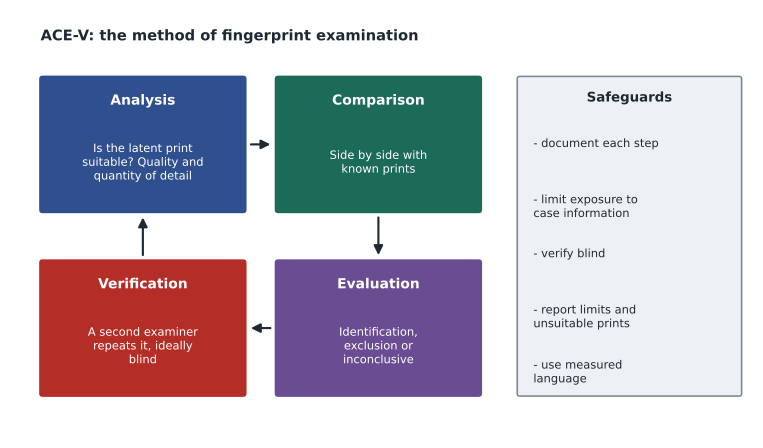
Fingerprint examiners use a method called ACE-V: analysis, comparison, evaluation and verification. In analysis, the examiner studies the latent print to decide whether it has enough clear detail to be compared. In comparison, she compares it side by side with known prints. In evaluation, she reaches a conclusion: identification, exclusion or inconclusive. In verification, a second examiner repeats the process. The method depends on the examiner's judgment; there is no fixed number of matching features that defines an identification, and most agencies abandoned numerical standards years ago.
Major reviews have criticized the way fingerprint evidence was sometimes presented in the past. The 2009 report of the United States National Academy of Sciences on forensic science, and the 2016 report of the President's Council of Advisors on Science and Technology, concluded that latent print examination is a valid method, but that its error rate is not zero, that examiners can be influenced by contextual information about the case, and that claims of absolute certainty or zero error are not scientifically supportable. Studies of examiners working under controlled conditions have found false identifications to be rare but real. The best-known modern error was the 2004 Madrid train bombing case, where FBI examiners wrongly identified a latent print as belonging to Brandon Mayfield, an Oregon lawyer, and verifiers confirmed the error because they knew the first conclusion. Canadian forensic identification sections have adopted the same reforms as most agencies in other countries. The reforms include documenting each step, verifying blind, limiting the examiner's exposure to unnecessary case information, and reporting conclusions in measured language.
| Rank | Candidate | Similarity score | Examiner's result |
|---|---|---|---|
| 1 | A | 3,120 | identification |
| 2 | B | 2,985 | exclusion |
| 3 | C | 2,410 | not compared |
| 4 | D | 2,366 | not compared |
| 5 | E | 2,201 | not compared |
| 6 | F | 2,150 | not compared |
| 7 | G | 2,098 | not compared |
| 8 | H | 1,990 | not compared |
One identification was made by the examiner, not by the database, and it was verified blind by a second examiner.
The scores themselves have no fixed meaning. They depend on the database, the quality of the latent and the software, and a different search of the same latent might rank the candidates differently. That is why examiners treat the list as a set of leads to compare, why they may compare several candidates before reaching a conclusion, and why the report describes the comparison and the examiner's reasons rather than the score. Investigators who receive a candidate list should never treat the top name as a suspect until an examiner has completed and verified the comparison.
The automated search did not identify anyone. It ranked candidates from the database by how similar their recorded prints were to the latent. Liu compared the latent with the known prints of the first two candidates. She excluded the second and identified the first, Brennan, then documented her reasons. Varma, given only the latent and a set of known prints and told nothing about her result, reached the same conclusion. Desjardins asks why Liu compared more than one candidate. Jesse Morningstar says it shows she was testing the result rather than confirming it, and that a high score does not mean a match. That is exactly the point.
Testimony about the Bayview print
Liu testified that the latent print on exhibit 4A, lifted from the inside face of a glass shard that remained in the lower window frame, was made by the right middle finger of Shane Brennan. She explained the method, showed enlargements of corresponding features, and said that her conclusion was verified by a second examiner. On cross-examination, Marchetti asked whether fingerprint identification was infallible. Liu said no. She asked whether Liu could say when the print was left. Liu said she could not. She asked whether the till drawer print had been identified. Liu said it was not suitable for comparison, and that she had reported that. Marchetti asked whether Liu had known, when she did the comparison, that Brennan had been found with stolen property. Liu said she had not; she had received the lift and the candidate list from the system and nothing else.
The question of when the print was left mattered. A fingerprint on the outside of a shop window could have been left by anyone at any time. But this print was on the inside face of the glass, on a rear window that opened into the pharmacy's back storage room, where customers never went. Whitaker testified that the window had been installed in 2023, was cleaned every month, and could not be reached from inside without moving shelving. Liu could not say when the print was made, and properly refused to. But Whitaker's evidence gave the court a basis to infer that the only reasonable explanation for Brennan's fingerprint on the inside of that glass was that he had reached through the broken window. The expert evidence and the ordinary evidence together proved what neither proved alone.
Confrontation and forensic reports
In Canada, an expert's report can sometimes be filed without the expert testifying, if notice is given and the other side does not require attendance, and certificates of analysis for drugs and some other matters are admissible under specific statutes. But where identity or another central issue depends on the expert's opinion, the defence will usually require the expert to attend for cross-examination, and the court can order it. Liu and Varma both attended, though only Liu was asked substantive questions.
Other forensic and technical experts
The same principles apply to every kind of expert police rely on: DNA analysts, firearms examiners, toxicologists, collision reconstructionists, digital forensic examiners and medical examiners. Some fields rest on strong science, such as single-source DNA analysis; others, such as bite-mark comparison, have been widely discredited. The Inquiry into Pediatric Forensic Pathology in Ontario, led by Justice Stephen Goudge and reported in 2008, found that a pathologist's flawed and overstated opinions had contributed to wrongful convictions and recommended that experts be trained on their duty to the court and report the limits of their conclusions. Officers who commission expert work should give the expert the materials needed and nothing that might bias the result, should never pressure an expert toward a conclusion, and should disclose every report, including those that are unhelpful or inconclusive.
Worked problem
Testing an expert opinion
In a burglary trial, a police officer with five years in a property crime unit is offered as an expert to testify that pry marks on a door frame 'were made by the screwdriver found in the accused's car, to the exclusion of all other tools'. He has no formal training in tool mark examination, his comparison was not verified, and he did not test any other screwdrivers. How should the court approach this?
Show solution
- The officer's experience in property crime does not qualify him in tool mark comparison, which is a specialized forensic field.
- The claim 'to the exclusion of all other tools' overstates what any tool mark examination can support; reliable examiners use measured language.
- There was no verification and no testing of other tools, so the reliability of the method as applied is doubtful.
- Under Mohan and White Burgess, the evidence likely fails at the first stage on qualifications and reliability, and at the second because its prejudice would outweigh its value.
- A qualified examiner with a documented, verified comparison, reporting in measured terms, could provide admissible evidence.
Answer: The opinion should be excluded; a qualified examiner using a verified method and measured language should be used instead.
Common mistakes
MistakeA fingerprint identification is certain.
InsteadIt is a reliable method with a low but real error rate, and examiners should say so.
MistakeAn automated search identifies the suspect.
InsteadIt produces a ranked list; only an examiner's comparison can identify, and it must be verified.
MistakeExperience alone makes an officer an expert.
InsteadQualification is in a defined field and requires training, testing and a reliable method.
MistakeAn expert can say the accused committed the offence.
InsteadAn expert gives opinions within their field; the trier of fact decides guilt.
Summary and key terms
- Lay witnesses may give opinions on matters of common experience based on their perceptions.
- Expert evidence must meet the Mohan criteria and the White Burgess gatekeeping test, with notice under section 657.3.
- Experts must be qualified in a defined field and give opinions only within it.
- Fingerprint examination uses ACE-V; it is valid but not infallible, and safeguards include blind verification and limited case information.
- In the Bayview case, the print's location on the inside of a rear window, together with the pharmacist's evidence, supported the inference of guilt.
- Police must give experts what they need, avoid biasing them, never pressure them and disclose all reports.
- Gatekeeper
- The judge's role in deciding whether expert evidence is reliable and worth admitting (White Burgess).
- Lay opinion
- An opinion by an ordinary witness based on what they perceived.
- Expert opinion
- Opinion evidence on matters outside ordinary knowledge from a qualified witness.
- ACE-V
- Analysis, comparison, evaluation and verification, the method of fingerprint examination.
- Blind verification
- A second examination done without knowing the first examiner's conclusion.
- Contextual bias
- The influence of irrelevant case information on an examiner's judgment.
Practice problems
Work each problem on paper first, then reveal the answer to check.
What could Liu not say about the print?
Show answer
When or why it was left.
In the worked example, how many candidates did Liu compare, and with what results?
Show answer
Two: one identification (Brennan) and one exclusion.
Why did the location of the print matter?
Show answer
It was on the inside of a rear window customers could not reach, so its presence was best explained by reaching through the broken glass.
Name one safeguard against contextual bias.
Show answer
Blind verification, or limiting the examiner's exposure to case information.
Lesson quiz · 5 questions
Score 60% or more to complete this lesson.
Create a free account to save your progress, take quizzes and earn a certificate.