
LES-202 · Lesson 7 of 12 · 20 min
Excluding evidence under section 24(2) of the Charter
▶ Video coming soon A video version of this lesson is on the way.
Okeke testified about the backpack on the second morning of the trial. Kwan asked him to describe the stop in his own words, and he did, carefully. Then Marchetti stood up. She asked him what description he had from dispatch. 'Male, tall, grey hoodie, on a bicycle,' he said. She asked whether he knew about anything on the back of the hoodie. He said no; he had seen the logo on the video afterward, but at the time he had not noticed it and dispatch had not mentioned it. She asked how far Crescent Street was from the pharmacy. 'About a kilometre.' She asked whether he believed, when he took the backpack off Brennan's shoulder, that he had grounds to arrest him. Okeke paused. 'I thought he might be the guy. I wanted to see what was in the bag before I decided.' Marchetti said, 'Thank you, Constable. Nothing further.'
Desjardins stops the recording of the testimony at that point and tells the class that the answer was honest, and that it decided the issue. This lesson explains why. It covers the constitutional limits on searches during an investigative detention, how courts decide whether to exclude evidence obtained in breach of constitutional rights, and how that analysis played out in the Bayview case.
Detention, frisks and the limits of a protective search
In R. v. Mann (2004), the Supreme Court of Canada held that police may detain a person for investigation if they have reasonable grounds to suspect, in all the circumstances, that the person is connected to a particular crime and the detention is reasonably necessary. During such a detention, an officer who has reasonable grounds to believe that their own safety or the safety of others is at risk may conduct a protective pat-down search. The search must be limited to that purpose. In Mann, the officer patted down a man stopped near a break-in, felt a soft object in his pocket, reached in and found marijuana. The Court held that reaching into the pocket was not justified by safety, because a soft object was not a weapon, and excluded the drugs. A search to find evidence, as opposed to protecting safety, requires reasonable and probable grounds and usually an arrest or a warrant.
Okeke's pat-down of Brennan's clothing was lawful. He was alone with a detained suspect at night, near the scene of a break-in where a tool might have been used, and a brief pat-down for weapons was justified. He felt nothing in Brennan's clothing. He then took the backpack off Brennan's shoulder. If he had set it on the hood of the cruiser, out of Brennan's reach, nobody would have objected. Instead he unzipped it and looked inside, and he testified that he did so to see what was in it before deciding whether to arrest. That was a search for evidence, not a protective search.
Was there a lawful arrest before the search?
Kwan argued that Okeke had grounds to arrest Brennan before he opened the bag, so the search was lawful as a search incident to arrest, even though the arrest was announced afterward. In Canada, a search incident to arrest requires a lawful arrest, and an arrest without a warrant requires that the officer subjectively believe there are reasonable and probable grounds and that those grounds are objectively reasonable, as the Supreme Court of Canada held in R. v. Storrey (1990). Courts have accepted that a search can come shortly before the formal arrest if the grounds already existed. But Okeke testified that he had not decided, and that he wanted to see the bag's contents first. The subjective element was missing. Justice Abernathy also found that the grounds were not objectively strong enough: a generic description, a kilometre away, eighteen minutes later.
import math
# How specific was it to find a cyclist 1.1 km from the pharmacy 16 minutes after he left the lane?
left_lane, stopped = 13, 29                 # minutes after 02:00 (laundromat video, in-car video)
minutes = stopped - left_lane
distance_km = 1.1
speed_kmh = distance_km / (minutes / 60)
print("implied average speed to Crescent Street:", round(speed_kmh, 1), "km/h")
for v in (10, 15, 20):                      # ordinary cycling speeds
    r = v * minutes / 60
print(f"at {v} km/h he could have been anywhere within {r:.1f} km (area about {math.pi * r * r:.0f} square km)")implied average speed to Crescent Street: 4.1 km/h at 10 km/h he could have been anywhere within 2.7 km (area about 22 square km) at 15 km/h he could have been anywhere within 4.0 km (area about 50 square km) at 20 km/h he could have been anywhere within 5.3 km (area about 89 square km)
The calculation shows why location alone did not amount to probable grounds. A cyclist leaving the lane at 02:13 could have been anywhere within a radius of several kilometres by 02:29, an area of dozens of square kilometres. Finding a man in a grey hoodie on a bicycle a kilometre away was consistent with his being the burglar, which is why it gave reasonable suspicion. But it was not specific enough on its own to make it probable, especially when the officer did not know about the logo that would have linked him much more strongly. Desjardins notes that the missing detail was the dispatcher's, not Okeke's: Mrs. Shaw had mentioned the logo in the first thirty seconds of her call, and it never made it into the broadcast. Lesson 10, on preparing for court, comes back to that.
Section 24(2) and R. v. Grant
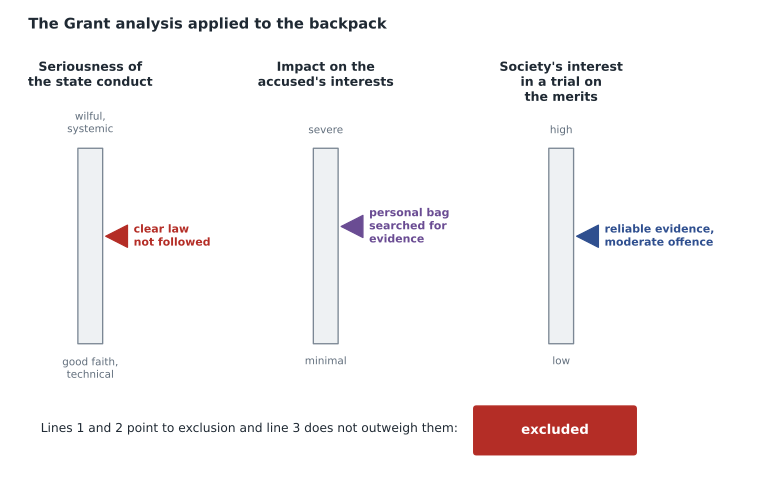
Section 24(2) of the Charter provides that where evidence was obtained in a manner that infringed a Charter right, it shall be excluded if it is established that, having regard to all the circumstances, its admission would bring the administration of justice into disrepute. In R. v. Grant (2009), the Supreme Court of Canada set out three lines of inquiry. First, the seriousness of the Charter-infringing state conduct: was it a minor, technical or good-faith error, or a wilful, reckless or systemic disregard of rights? Ignorance of well-established law, or negligence, is not good faith. Second, the impact of the breach on the Charter-protected interests of the accused: how much did it intrude on privacy, bodily integrity, liberty or the right not to incriminate oneself? Third, society's interest in an adjudication on the merits: how reliable is the evidence, and how important is it to the Crown's case? The court balances all three. Exclusion is not a punishment for the police; the question is whether admitting the evidence would, in the long term, damage public confidence in the justice system. When the first two lines both favour exclusion, the third will rarely tip the balance the other way. Evidence is 'obtained in a manner' that infringed the Charter if it has a temporal, contextual or causal connection to the breach that is not too remote.
The ruling on the backpack
Justice Abernathy found that the search of the backpack breached section 8 and excluded the pry bar, the gloves and the six boxes of gum. On seriousness, she found that Okeke was not acting in bad faith, but that Mann had been the law for more than twenty years and that every officer is trained on it; a search of a bag to look for evidence during a detention was not a grey area. The failure to give the right to counsel immediately, a separate breach of section 10(b), showed a pattern of putting the investigation ahead of the detainee's rights during the stop. On impact, she found that a personal bag carries a real expectation of privacy, and the search was for evidence rather than safety. On society's interest, she found that the evidence was reliable and important to the charge of possessing break-in instruments, but that the offence, while serious to the victim, was not among the gravest. The first two lines favoured exclusion, and the third did not outweigh them.
Marchetti also asked the court to exclude the fingerprint identification as derivative of the unlawful search, arguing that Brennan's fingerprints were taken at booking only because he had been arrested on the strength of the bag. The argument failed. Grace Liu had searched the latent print from the glass through the national automated fingerprint system on March 16, and the candidate it produced, Brennan, was identified from known prints on file from his 2021 conviction, not from the booking prints. The connection between the breach and the fingerprint evidence was too remote; the evidence would have been found exactly the same way if the bag had never been opened. The video, the 911 call, and Okeke's observation of Brennan and his hoodie before the bag was touched were also unaffected.
What exclusion cost
Because the bag's contents were excluded, Brennan was acquitted of possession of break-in instruments under section 351(1). The tools charge depended entirely on the pry bar. The break-in charge survived because the fingerprint, the video and the 911 call, taken together, proved identity beyond a reasonable doubt. Kwan tells the class that the margin was smaller than it should have been. If Liu had not found a usable print on the glass, the remaining evidence might have left a reasonable doubt, and Brennan would have been acquitted of everything. 'One unzipped bag nearly cost us the case,' he says. 'And if he had just put it on the hood and kept talking to dispatch for two more minutes, he would probably have heard about the logo and had all the grounds he needed.'
| Option at the roadside | Lawful? | Likely result in court |
|---|---|---|
| Pat down outer clothing for weapons | Yes, with a safety concern | No issue |
| Move the backpack out of reach | Yes | No issue |
| Ask dispatch for more of the caller's description | Yes | Could provide grounds to arrest |
| Ask for consent to search the bag, clearly and without pressure | Yes, if consent is informed and voluntary | Admissible if consent is proved |
| Open the bag to see what is inside before deciding to arrest | No | Excluded |
| Arrest on reasonable grounds, then search incident to arrest | Yes | Admissible |
Lessons for officers
Desjardins draws three lessons from the ruling. First, know the limits of a protective search and stay inside them; if what you want is evidence, you need grounds and usually an arrest or a warrant. Second, when you are not sure whether you have grounds, the answer is to get more information, not to search to find out. A call to dispatch, a look at the video, or a few more minutes of lawful questioning after the right to counsel often supplies what is missing. Third, if you make a mistake, say so. Okeke's honest answer on cross-examination made the ruling straightforward, but it also meant the judge believed everything else he said, including his description of the hoodie and the bicycle, which was part of the proof of identity. 'A judge who catches an officer shading the truth on one point starts wondering about every other point,' Kwan adds. 'Okeke lost a bag and kept his credibility. That was the right trade.'
Worked problem
Analyzing a search during a stop
Officers stop a woman walking away from a jewellery store five minutes after its alarm sounded, because she matches the description 'woman, dark coat, carrying a large purse'. One officer pats down her coat and feels nothing. He then takes her purse, opens it and finds three rings with store tags. She is arrested. She is later linked to the break-in by video showing her face inside the store. Analyze the search and its consequences.
Show solution
- The detention was likely lawful: reasonable suspicion based on a matching description close in time and place.
- The pat-down of the coat was lawful if there was a reasonable safety concern.
- Opening the purse was a search for evidence, not safety, and there were no grounds to arrest before it; it was unlawful.
- Under Grant, the court would weigh a clear breach of well-established law and a significant privacy intrusion against reliable evidence; exclusion of the rings is likely.
- The video showing her face is an independent source of identity evidence and would not be excluded.
Answer: The rings would likely be excluded; the video would remain and could still prove the case.
Common mistakes
MistakeA pat-down allows officers to check bags for evidence.
InsteadA protective search is limited to finding weapons; searching for evidence needs grounds and usually an arrest or warrant.
MistakeIf the accused turns out to be guilty, the search was justified.
InsteadGrounds are judged by what the officer knew before the search, not what it found.
MistakeEvidence is excluded to punish the police.
InsteadSection 24(2) asks whether admission would bring the administration of justice into disrepute.
MistakeOnce one piece of evidence is excluded, the whole case is lost.
InsteadEvidence with an independent source, or too remote from the breach, remains admissible.
Summary and key terms
- Investigative detention requires reasonable suspicion; a protective pat-down is limited to safety (Mann).
- Searching a bag for evidence requires grounds to arrest, consent or a warrant.
- An arrest without a warrant requires subjective and objectively reasonable grounds (Storrey).
- Section 24(2) exclusion turns on the seriousness of the conduct, the impact on the accused and society's interest (Grant).
- In the Bayview case, the bag's contents were excluded and the tools charge failed, but the fingerprint evidence was unaffected.
- When unsure of grounds, get more information rather than searching to find out, and testify honestly about what you did.
- Reasonable grounds to suspect
- The standard for investigative detention.
- Section 24(2)
- The Charter provision requiring exclusion where admission would bring the administration of justice into disrepute.
- Discoverability
- Whether the evidence would have been obtained without the breach, a factor in Grant.
- Protective search
- A limited pat-down for weapons during a detention, justified by safety.
- Search incident to arrest
- A search following a lawful arrest, for safety, evidence or escape.
- Derivative evidence
- Evidence found as a result of earlier evidence or a breach.
Practice problems
Work each problem on paper first, then reveal the answer to check.
Why did Okeke's answer about the bag decide the issue?
Show answer
It showed he lacked the subjective belief in grounds to arrest, so the search could not be incident to arrest.
In the code example, what was Brennan's implied average speed?
Show answer
About 4.1 km/h.
Why was the fingerprint evidence not excluded?
Show answer
It came from prints on file from the 2021 conviction, independent of the bag search.
What could Okeke have done instead of opening the bag?
Show answer
Set it out of reach, asked dispatch for more of the description, or asked for consent.
Lesson quiz · 5 questions
Score 60% or more to complete this lesson.
Create a free account to save your progress, take quizzes and earn a certificate.