
LES-202 · Lesson 6 of 12 · 20 min
Statements of the accused: voluntariness and the Charter
▶ Video coming soon A video version of this lesson is on the way.
At 02:29:40 on Crescent Street, Constable Okeke told Shane Brennan that he was being detained in connection with a break-in on Bayview Avenue. Ten seconds later, before patting him down, Okeke asked, 'Where are you coming from tonight?' Brennan answered, 'Just riding home from my girlfriend's place on Elm.' It was the only thing Brennan said about the night that ever mattered in court, and the two countries' versions of the trial treated it in completely different ways. In Ontario, Kwan never offered it in evidence. He told Desjardins's class why: 'I would have lost the voir dire, and I would have deserved to.'
Desjardins tells the students that a statement by the accused is often the most powerful evidence in a case, and for that reason it is the most closely regulated. A confession is enormously persuasive to a jury, and the history of wrongful convictions shows that people sometimes confess to crimes they did not commit. The law therefore requires the prosecution to prove that a statement was obtained fairly before the trier of fact may hear it. This lesson covers the rules that govern that proof and the hearing where it happens.
The confessions rule
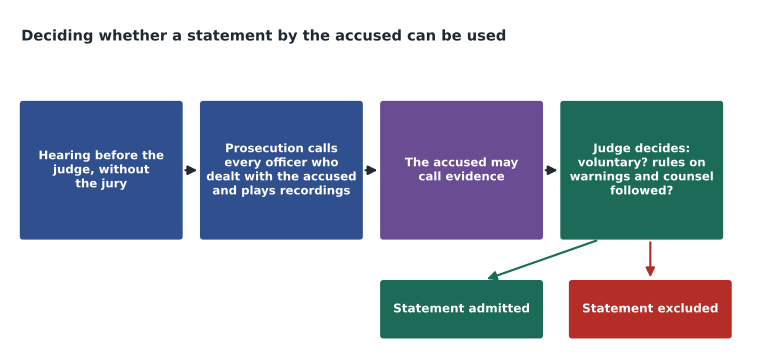
At common law, a statement by an accused to a person in authority is inadmissible unless the Crown proves beyond a reasonable doubt that it was voluntary. A person in authority is someone the accused reasonably believes is involved in the arrest, detention, examination or prosecution, which almost always includes police officers. In R. v. Oickle (2000), the Supreme Court of Canada explained that voluntariness is assessed in context, considering threats or promises, oppression, the accused's operating mind, and police trickery that would shock the community. Threats and promises are the most important: an offer of leniency, or a suggestion that things will go worse if the person does not talk, can make a statement involuntary if it is a strong enough inducement. Oppression includes depriving the person of food, sleep or clothing, or excessively aggressive or prolonged questioning. An operating mind requires only that the person knew what they were saying and that it could be used against them. The rule applies to all statements to persons in authority that the Crown wants to use, inculpatory or exculpatory, and a voir dire is required unless the defence waives it.
The right to counsel on detention: section 10(b)
Section 10(a) of the Charter requires that everyone who is arrested or detained be told promptly the reasons, and section 10(b) requires that they be told of the right to retain and instruct counsel without delay. In R. v. Suberu (2009), the Supreme Court of Canada held that 'without delay' means immediately upon detention, subject only to concerns for officer or public safety, and that this applies to investigative detentions as well as arrests. The purpose is to prevent the detainee from incriminating themselves before they have a chance to get legal advice. Once a detainee asks to speak to a lawyer, police must give them a reasonable opportunity to do so and must hold off questioning until they have. A statement obtained in breach of section 10(b) is not automatically excluded, but it is a strong candidate for exclusion under section 24(2), because self-incrimination goes to the heart of the right.
What happened on Crescent Street
The in-car video showed the timeline precisely. Okeke pulled up at 02:29:05, got out, and told Brennan to stop and get off the bike. At 02:29:40 he said, 'You're being detained, I'm investigating a break-in on Bayview.' At 02:29:50 he asked where Brennan was coming from. At 02:30:10 he began the pat-down. At 02:31:15 he opened the backpack. At 02:32:00 he told Brennan he was under arrest for break and enter. He did not tell Brennan about his right to a lawyer, or read him any warning, until 02:44:30, in the cruiser, when he read from his card.
Kwan's analysis was simple. Brennan was detained at 02:29:40 at the latest, when Okeke told him so. Suberu required Okeke to tell him about his right to counsel immediately, unless there was a safety reason to delay. There was none at that moment: Brennan was standing beside his bicycle, calm, with his hands visible, and Okeke had not yet decided to pat him down. Instead, Okeke asked an investigative question, and Brennan answered it. That was a clear breach of section 10(b), and the answer was obtained directly by the breach. Kwan also knew the voluntariness rule would apply: the statement was to a person in authority, so he would have to prove it voluntary. He thought he could prove that, because there were no threats or promises, but voluntariness would not save it from the Charter. He decided not to offer it. When Okeke asked him why later, Kwan said, 'You can ask questions on a detention. You just have to give the right to counsel first, or have a good reason not to yet.'
# Time from the start of detention to each event on Crescent Street (from the in-car video)
from datetime import datetime
t = lambda s: datetime(2026, 3, 14, *map(int, s.split(":")))
detained = t("02:29:40")
events = [
    ("question: where are you coming from?", "02:29:50"),
    ("pat-down begins", "02:30:10"),
    ("backpack opened", "02:31:15"),
    ("arrest announced", "02:32:00"),
    ("rights to counsel / warnings read", "02:44:30"),
]
for name, when in events:
    secs = int((t(when) - detained).total_seconds())
    print(f"{secs:5d} s after detention  {name}")
gap = (t("02:44:30") - detained).total_seconds() / 60
print("minutes between detention and rights to counsel:", round(gap, 1))10 s after detention question: where are you coming from? 30 s after detention pat-down begins 95 s after detention backpack opened 140 s after detention arrest announced 890 s after detention rights to counsel / warnings read minutes between detention and rights to counsel: 14.8
The gap of almost fifteen minutes between detention and the right to counsel did not cause any further statement, because Okeke asked nothing more after the arrest. But the question at ten seconds produced the only statement there was. Desjardins tells the class that most of the Charter problems he saw as a supervisor came from that kind of habit: an officer, focused on the investigation, asks the natural question first and thinks about rights second. He suggests a simple discipline: reasons, rights, then questions.
Who is a person in authority
The rules above apply to statements obtained by the state. Statements an accused makes to ordinary people, such as a friend, a family member or another inmate, are not subject to the voluntariness rule or to the right to counsel, though they may still be excluded if they are unreliable or obtained by abusive state conduct. In Canada, an undercover officer posing as a fellow criminal is not a person in authority, because the accused does not know he is dealing with the state. But in R. v. Hart (2014), the Supreme Court of Canada held that confessions obtained in so-called Mr. Big operations, where undercover officers pose as a criminal organization and offer the suspect inducements to confess, are presumptively inadmissible unless the Crown shows their probative value outweighs their prejudicial effect, and may be excluded as an abuse of process.
Statements, recordings and the voir dire record
In any case where a statement may be used, the prosecution must be able to account for all the contact between police and the accused leading up to it. Every officer who dealt with the accused may have to testify about what was said and done, because an inducement or threat by one officer can taint a statement given to another. Recording solves many of these problems. A complete recording, from the first contact through the end of questioning, shows the court exactly what happened and protects officers from false allegations. Police services in Ontario routinely video-record interviews at the station, and courts have said that the absence of a recording where one could easily have been made can make it harder for the Crown to prove voluntariness. The in-car video in the Bayview case was the best evidence the court had of what happened on Crescent Street, and both sides relied on it.
Silence and the accused at trial
The accused has a right to remain silent before trial and a right not to testify at trial. Pre-trial silence in the face of police questioning generally cannot be used as evidence of guilt, as the Supreme Court of Canada held in R. v. Chambers (1990), and the trier of fact cannot draw an inference of guilt from the accused's decision not to testify, as it held in R. v. Noble (1997). Section 4(6) of the Canada Evidence Act prohibits the judge and the Crown from commenting on the accused's failure to testify. Officers testifying should never volunteer that the accused refused to give a statement or asked for a lawyer, unless the prosecutor has told them it is relevant and admissible for a specific purpose. Doing so can cause a mistrial.
Recording what the accused says
Whatever the rules allow, a statement is only as useful as the record of it. Officers should write down the accused's exact words, in quotation marks, as soon as possible, together with the question that prompted them and the time. A paraphrase such as 'suspect denied involvement' is almost useless in court, because the trier of fact cannot judge what was actually said, and the defence can suggest the officer's summary was coloured by what he believed. Police in Ontario give a standard caution after the right to counsel, telling the person they are not obliged to say anything and that anything they say may be given in evidence, and a secondary caution telling them that anything said to them earlier by other officers should not influence them. Officers should read both from a card and note the time. Unsolicited statements, which the accused volunteers without being asked anything, should be recorded just as carefully, with a note that they were not in response to a question. They are usually admissible if voluntary, but the officer will be asked whether anything was said to prompt them.
Okeke's notes recorded Brennan's answer accurately, in quotation marks, with the question that prompted it. That was the one thing about the roadside the defence never challenged. Desjardins tells the class that the accuracy of that note is a good example of how careful note-taking protects everyone: if the statement had been important to the result, the court would have had the exact words, and it would have had them whichever way they cut.
False explanations
In Ontario, if Kwan had offered Brennan's statement and shown it to be false, the court could have treated it as evidence of guilt only if there was independent evidence that it had been fabricated, not merely disbelieved; a statement that is simply rejected adds nothing. Desjardins says that is a common result. Statements that seem important at the roadside often turn out to matter less in court than the physical evidence.
Worked problem
Applying the rules to a roadside question
An officer stops a car at 1:15 a.m. because it matches the description of a car seen leaving a gas station robbery five minutes earlier. She tells the driver he is being detained for a robbery investigation, then asks, 'Were you at the Shell on King Street tonight?' He says, 'I just bought gas there.' She then sees a mask on the passenger seat and arrests him. Analyze the statement.
Show solution
- The driver was detained when she told him so, so section 10(b) required her to tell him of his right to counsel immediately, unless there was a safety concern.
- Asking an investigative question before giving the right to counsel breached section 10(b), and the answer was obtained by the breach.
- There were no threats or promises, so voluntariness is likely provable.
- The Crown would face a strong argument for exclusion under section 24(2); the safer practice was to give the right to counsel first.
- The mask is not a statement; its admissibility depends on whether it was in plain view, which it appears to be.
Answer: The statement would likely be excluded because of the 10(b) breach; the mask in plain view would not be affected.
Common mistakes
MistakeA statement to police is admissible if the accused was not threatened.
InsteadVoluntariness is necessary but not enough; a Charter breach can still exclude it.
MistakeOnly confessions need to be proved voluntary.
InsteadThe rule applies to any statement to a person in authority the Crown offers, including exculpatory ones.
MistakeIt helps the prosecution to mention that the accused refused to talk.
InsteadUsing the accused's silence is prohibited and can cause a mistrial.
MistakeRecording interviews only helps the defence.
InsteadA complete recording protects officers and makes voluntariness easier to prove.
Summary and key terms
- The Crown must prove beyond a reasonable doubt that a statement to a person in authority was voluntary (Oickle).
- Section 10(b) requires the right to counsel immediately on detention, subject only to safety (Suberu).
- Brennan's answer, obtained by a 10(b) breach, was never offered by the Crown.
- Undercover and informant statements follow special rules.
- Complete recordings are the best evidence of what happened.
- The accused's silence before trial and decision not to testify cannot be used as evidence of guilt.
- Person in authority
- Someone the accused reasonably believes is involved in the arrest, detention, examination or prosecution.
- Operating mind
- Awareness of what one is saying and that it may be used against one.
- Voir dire
- A hearing within a trial to decide whether evidence is admissible.
- Mr. Big operation
- An undercover scenario in which officers pose as a criminal organization to obtain a confession.
- Voluntariness
- The requirement that a statement was not obtained by threats, promises, oppression or coercion.
- Inducement
- A threat or promise that may cause a person to make a statement.
Practice problems
Work each problem on paper first, then reveal the answer to check.
When was Brennan detained, and when was he told about his right to counsel?
Show answer
Detained at 02:29:40; rights read at 02:44:30.
In the code example, how many seconds after detention was the question asked?
Show answer
Ten seconds.
Why did Kwan decide not to offer the statement?
Show answer
It was obtained by a clear breach of section 10(b) and would likely be excluded.
What simple discipline does Desjardins suggest?
Show answer
Reasons, rights, then questions.
Lesson quiz · 5 questions
Score 60% or more to complete this lesson.
Create a free account to save your progress, take quizzes and earn a certificate.