
IRW-220 · Lesson 9 of 12 · 23 min
Stressing and safety around tendons
▶ Video coming soon A video version of this lesson is on the way.
The third Saturday ended with a demonstration. Aurelio Santangelo, Stratline's stressing foreman, had set up a test block in the yard: a concrete beam about 5 m long with a single unbonded tendon cast in it. Before he started the pump, he walked everyone to the side of the block, well clear of both ends, and pointed at a row of orange barricades and a sign behind the jack. "Nobody goes there while I'm stressing," he said. "Not me, not you, not your foreperson. If a strand lets go, everything in line with it moves." Then he hung the jack on the strand tail, ran the pump, and the gauge needle climbed. Shay watched a paint mark on the strand creep away from the block as the strand stretched.
Stressing is the moment a post-tensioned structure starts working. It is also the most dangerous moment of the job, because each strand is pulled to about 147 kN and a group of tendons stores enormous energy. This lesson covers when a tendon may be stressed, the equipment, the stressing procedure and elongation, lock-off, the sequence, and the safety rules that every worker on a post-tensioned deck must follow, including the rules about cutting and drilling into stressed slabs.
When a tendon may be stressed
A tendon is stressed only when the concrete around its anchors can take the force. The drawings or the specification set the concrete strength required before stressing, often a set fraction of the design strength or a stated value, and the general contractor confirms it, usually by testing cylinders cured on the deck beside the slab, before the stressing crew starts. Stressing too early can crush the concrete behind the anchors and blow out the slab edge.
Other conditions must also be met before stressing starts.
- The edge forms are stripped from the stressing edges and the pocket formers are removed.
- The anchors and wedge cavities are clean, and the concrete around each anchor is sound, with no honeycomb, cracks or voids. Defects are reported to the engineer before stressing.
- The stressing tails are clean and undamaged, and their length is enough for the jack.
- The shoring and the formwork below are in place as the engineer requires; stressing can change the loads on the shores.
- The stressing area and the area below are barricaded and signed.
Stressing equipment
Monostrand tendons are stressed with a centre-hole ram jack that slides over the strand tail and grips it, powered by a hydraulic pump through high-pressure hoses. The jack's force is read from a pressure gauge on the pump. Because the gauge reads pressure, not force, every jack and gauge are calibrated together as a pair by a testing laboratory, which provides a calibration chart that converts gauge pressure to jacking force. Specifications require the calibration to be current, often within the last six months or a year, and redone whenever the jack or gauge is repaired or dropped.
Worked problem
From force to gauge pressure
A 13 mm strand (98.7 mm², 1,860 MPa) is jacked to 80 in 100 of its specified tensile strength. What is the jacking force, and what gauge pressure would a jack with an effective ram area of 2,130 mm² need?
Show solution
- Jacking force = 0.80 × 1,860 × 98.7 = 146,900 N ≈ 146.9 kN.
- Pressure = force ÷ ram area = 146,900 ÷ 2,130 ≈ 69.0 MPa.
Answer: About 147 kN and 69 MPa. In practice the stressing foreman reads the target pressure from the jack's calibration chart, not from this simple division, because friction inside the jack makes the real relationship slightly different.
Pressures like these are far higher than ordinary hydraulic tools. A pinhole leak in a hose can inject oil through the skin, and a burst hose whips. Hoses and fittings are inspected before every shift, kept off sharp edges, never run under loads and never handled by the hose while under pressure. A worker who finds a leak shuts the pump off and reports it; nobody feels for a leak with a hand.
The stressing procedure
Stratline's procedure, like most suppliers', follows these steps for each monostrand tendon.
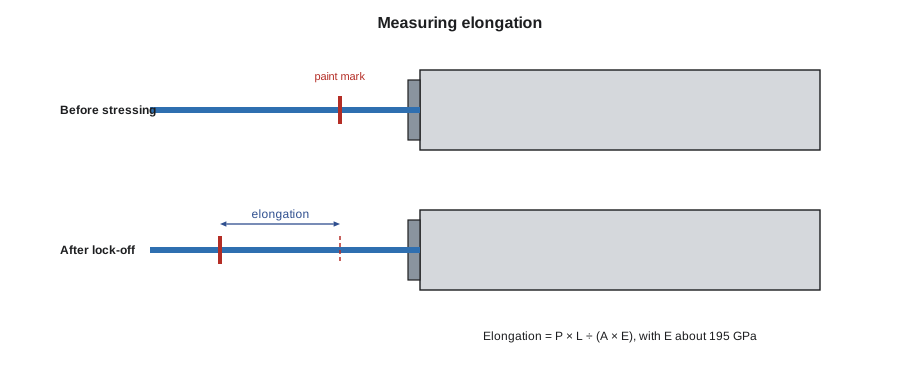
- Mark the strand. Before jacking, a paint mark is made on the strand tail at a fixed distance from the slab edge or anchor, as a reference for measuring elongation.
- Hang the jack. The jack is slid over the tail and seated on the anchor, with its gripping wedges closed on the strand.
- Stress. The pump is run until the gauge reaches the target pressure from the calibration chart. The operator stands to the side of the jack, never behind it.
- Lock off. The pressure is released, and the strand's wedges are pushed into the anchor's tapered hole, by the jack's power seating or by the strand pulling back. The strand moves back slightly as the wedges seat; this seating loss, typically a few millimetres, is part of the calculation.
- Measure. The distance from the reference to the paint mark is measured again, and the difference is the measured elongation. It is recorded against the tendon's number on the stressing record.
- Compare. The measured elongation is compared with the calculated elongation on the shop drawing (lesson 11).
Why elongation matters
The gauge tells how hard the jack pulled. The elongation tells how far the strand actually stretched, and therefore how much force reached the tendon along its length. If the two agree with the calculation, the tendon has the force the designer expects. If the elongation is too short, part of the force may have been lost to friction, a kink or a tendon caught in the concrete; if it is too long, the strand may have slipped at the anchor or the tendon may be longer than shown. Steel stretches in proportion to the force on it, so the elongation can be estimated with one formula.
Here P is the average force along the tendon, L its length, A the strand area and E the strand's modulus of elasticity, which for prestressing strand is typically about 195 GPa and is given on the supplier's certificate. The supplier's calculation also accounts for friction along the curves, seating loss and the stressing tail inside the jack.
Worked problem
Calculated elongation of one tendon
A tendon of 13 mm strand (98.7 mm²) is 30.5 m long. After allowing for friction, the supplier's calculation gives an average force of 133 kN along it. Take E = 195,000 MPa. What is the calculated elongation, and what range is within 7 in 100 of it?
Show solution
- Δ = 133,000 × 30,500 ÷ (98.7 × 195,000).
- Numerator = 4,056,500,000; denominator = 19,246,500.
- Δ ≈ 210.8 mm.
- Range: 0.93 × 210.8 = 196.0 mm to 1.07 × 210.8 = 225.5 mm.
Answer: About 211 mm, with an acceptable range of about 196 to 226 mm if the specification uses a 7 in 100 tolerance. A tendon this long stretches about the length of a hand.
Stressing sequence
Tendons are stressed in the order the shop drawing shows. Common rules are that tendons in beams or bands are stressed before the distributed tendons that cross them, that stressing alternates from side to side or from the middle outward so that the slab is squeezed evenly, and that tendons longer than a set length are stressed from both ends. In parking structures, the decks are often stressed in two stages: a partial stress a day or two after the pour, to control early shrinkage cracking, and the final stress once the concrete reaches full stressing strength. The stressing record shows each tendon, its end, its stage and its elongation.
The hazards of stressing
A stressed strand is like a stretched spring with a great deal of energy in it. If something fails during stressing, that energy is released in a fraction of a second. The common failures are these.
- A strand breaks, usually at a damaged or nicked wire, or at the jack's grip.
- The wedges slip or the jack's grip fails, and the strand snaps back.
- The anchor bursts through weak or honeycombed concrete behind it.
- A hose or fitting fails under pressure.
In each case, things move along the line of the tendon: the jack, the strand and pieces of anchor or concrete can be thrown backward out of the slab edge, and a broken strand can whip or shoot out of the far end. That is why the rule for everyone on site, in every jurisdiction, is the same: nobody stands behind the jack or in line with a tendon being stressed, and the area is barricaded.
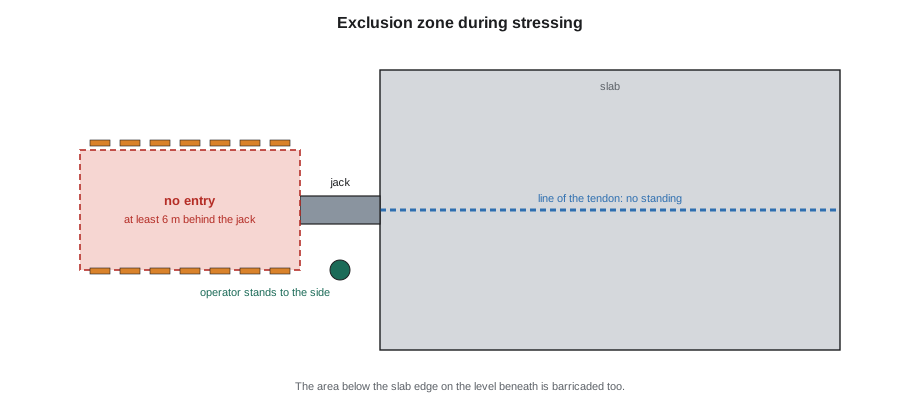
Ontario's construction regulation has no section written only for post-tensioning; the general duties of the Occupational Health and Safety Act and O. Reg. 213/91 to protect workers apply, and the supplier's written procedure and PTI's field guidance fill in the details. Stratline's procedure, which Crossbeam follows on its jobs, sets an exclusion zone of at least 6 m behind the jack and the whole line of the tendon while it is being stressed, barricaded and signed, with the area below the edge on the level beneath barricaded as well. Only the stressing crew may be inside it.
Even the stressing crew stands to the side. The operator controls the pump from beside the jack, and the worker who measures elongations waits until the jack has been removed and the wedges are seated. Face shields or safety glasses, gloves and hard hats are worn throughout.
After stressing: cutting the tails
Once the elongations are accepted by the engineer or inspector, the strand tails are cut off inside the pocket, leaving a short length beyond the wedges as the supplier specifies. Tails are cut by the method the supplier allows, typically an abrasive saw or plasma cutter, without heating the wedges and anchor, and never before the elongations are approved, because a tendon that needs to be restressed needs its tail. The pockets are then sealed, as lesson 10 describes.
Never cut, drill or core a stressed slab without approval
A post-tensioned slab looks like any other slab once the concrete is finished, but it is full of stressed strands. Cutting a stressed tendon, by a core drill, a saw, an anchor drill or a careless torch, releases its force in an instant. The strand can burst out of the slab top or bottom, or fly out of the slab edge, and the slab loses part of its strength. This hazard lasts for the life of the building, which is why parking structures and post-tensioned buildings often have warning signs or stamps on their slabs.
- No hole is drilled or cored in a post-tensioned slab, and no saw cut is made, without the engineer's written approval.
- The tendons are located first, usually by ground-penetrating radar or other scanning, and marked on the slab, and the hole is placed clear of them by the distance the engineer sets.
- Only the post-tensioning supplier's trained crew ever detensions or cuts a stressed tendon, following a written procedure.
Ruairi told the group about a parking structure where a sub-trade drilled a post-installed anchor for a sign through a tendon. The strand burst out of the slab soffit with a bang that emptied the level. Nobody was hurt, but the repair took a week and an engineer's design.
What the rod gang does during stressing
Crossbeam's rodbusters do not stress tendons, but they work on and below decks where stressing is going on. Their rules at Quarry Point will be simple: stay out of every barricaded zone, never walk behind a jack or along the line of a tendon being stressed, keep material and tools off the stressing edges, and report any damaged tendon, sheathing or anchor seen while placing. When the stressing crew calls a deck, the rod gang moves to another one.
Jack and hose checks before each shift
Before each shift, Aurelio's crew checks the jack's gripping wedges for wear and cleanliness, the hoses and couplings for cuts, kinks and leaks, the gauge for a needle that returns to zero, and the calibration label against the certificate. A worn gripping wedge can let the strand slip inside the jack, which shows up as a long elongation or a sudden drop on the gauge. The crew replaces gripping wedges at the interval the jack maker sets, and a dropped jack goes back for recalibration before it is used again.
Common mistakes
MistakeStressing before the concrete strength is confirmed.
InsteadConfirm the required strength by tests before any tendon is stressed.
MistakeUsing a jack with an out-of-date calibration chart.
InsteadUse only a jack and gauge pair with a current calibration.
MistakeStanding behind the jack to watch the gauge.
InsteadStand to the side; nobody is behind the jack or in line with the tendon.
MistakeCutting tails before the elongations are approved.
InsteadCut tails only after the elongations are accepted.
MistakeDrilling a post-tensioned slab without locating the tendons.
InsteadGet written approval, scan and mark tendons, and drill clear of them.
Summary and key terms
- Tendons are stressed only after the specified concrete strength is confirmed and the anchors are clean and sound.
- Jacks and gauges are calibrated as pairs, and the target pressure comes from the calibration chart.
- The procedure is mark, hang the jack, stress, lock off, measure and compare.
- Elongation is Δ = PL ÷ AE, with E typically about 195 GPa.
- Tendons are stressed in the order on the shop drawing, sometimes in two stages.
- Nobody stands behind the jack or in line with a tendon; the area is barricaded and signed under Stratline's procedure and the general duties of O. Reg. 213/91.
- Stressed slabs are never cut, drilled or cored without approval and tendon scanning.
- Stressing
- Pulling a tendon to its design force with a hydraulic jack.
- Calibration chart
- The chart that converts a jack-and-gauge pair's pressure reading into force.
- Lock-off
- Releasing the jack so that the wedges seat and hold the force.
- Seating loss
- The small movement of the strand back into the anchor as the wedges seat.
- Elongation
- How far the strand stretches when it is stressed.
- Modulus of elasticity
- The stiffness of a material, relating its stress to its stretch.
- Exclusion zone
- The barricaded area behind the jack and along the tendon where nobody may stand during stressing.
- Detensioning
- Releasing the force in a stressed tendon, done only by trained crews under a procedure.
Practice problems
Work each problem on paper first, then reveal the answer to check.
A tendon is 20.0 m long with an average force of 135 kN, A = 98.7 mm², E = 195,000 MPa. What is the elongation?
Show answer
135,000 × 20,000 ÷ (98.7 × 195,000) ≈ 140.3 mm.
A calculated elongation is 180 mm. What is the 7 in 100 range?
Show answer
167.4 to 192.6 mm.
Who may stand behind the jack during stressing?
Show answer
Nobody; the stressing crew stands to the side.
When may the strand tails be cut?
Show answer
After the elongations are accepted.
What must happen before a hole is cored in a post-tensioned slab?
Show answer
Written approval, and the tendons located and marked by scanning.
Lesson quiz · 5 questions
Score 60% or more to complete this lesson.
Create a free account to save your progress, take quizzes and earn a certificate.