
IRW-220 · Lesson 7 of 12 · 21 min
Post-tensioning: how it works
▶ Video coming soon A video version of this lesson is on the way.
Ruairi began the post-tensioning part of the course on November 7 with a stack of books. He held the stack between his flat hands and lifted it off the bench. "Squeeze hard enough and the books carry themselves," he said. "Squeeze too little and they fall out the middle. That's post-tensioning. We squeeze the concrete with steel, so it can carry load without cracking." Then he picked up a short length of greased strand in its plastic sheath, cut cleanly so the seven wires showed, and passed it round. Shay noticed how heavy it was for its size, and how slippery.
This lesson explains what post-tensioning does, the difference between unbonded and bonded systems, the parts of a tendon and an anchor, how tendons are laid out in slabs and beams, and the standards that govern the work. Lessons 8 to 11 then follow a tendon from placing to stressing to protection and records.
What post-tensioning does
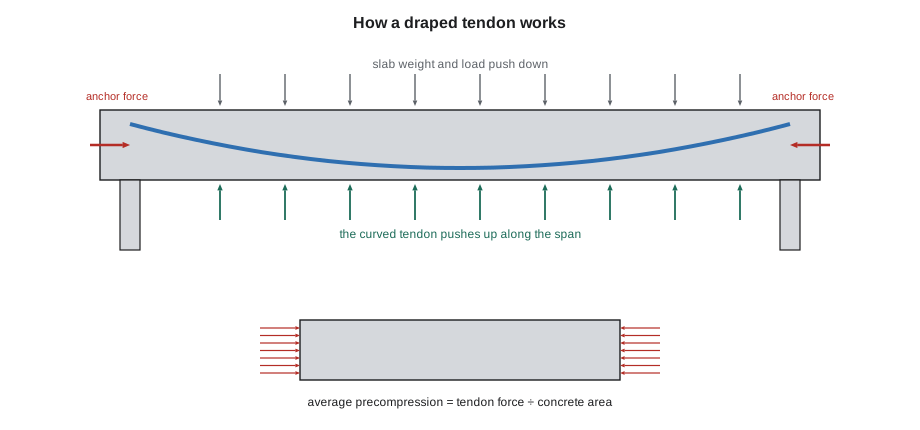
Concrete is strong in compression and weak in tension. In an ordinary reinforced slab, the bottom of the slab cracks under load, and the bars across the cracks carry the tension. In a post-tensioned slab, high-strength steel tendons are placed in the slab, the concrete is poured around them, and once the concrete has gained enough strength, the tendons are stretched with a hydraulic jack and locked off against anchors at the slab edges. The stretched tendons squeeze the slab, so that under normal loads it stays in compression or close to it, and it does not crack the way an ordinary slab would.
Tendons also push upward. Between supports, a tendon is draped: high over the columns or beams and low near midspan, following a curve. When a curved tendon is pulled tight, it pushes up on the concrete along its length, like a bowstring pushing on a bow. The designer chooses the drape and the force so that this upward push balances a large part of the slab's own weight. That is why post-tensioned slabs can be thinner and span farther than ordinary slabs, and why the tendon's height at every point matters so much (lesson 8).
Post-tensioned slabs are common in parking structures, apartment and office buildings, slabs on grade over poor soils, and bridges. In a parking structure, the thin crack-resistant decks help keep salt water out, and the long spans leave room for cars between columns.
Unbonded and bonded post-tensioning
There are two families of post-tensioning systems.
- Unbonded tendons. Each tendon is a single strand, coated in a corrosion-inhibiting grease and enclosed in a seamless plastic sheath. The strand is free to move inside the sheath, so it never bonds to the concrete; its force reaches the slab only at the anchors. Unbonded monostrand tendons are the common system in building slabs and parking structures in North America, including Quarry Point Centre.
- Bonded tendons. Several strands are placed together inside a duct, a corrugated metal or plastic tube, and anchored together in a multistrand anchorage. After stressing, the duct is filled with cementitious grout, which bonds the strands to the duct and the duct to the concrete. Bonded systems are used in bridges, heavy transfer girders, tanks and some slabs, especially where the designer wants the strand bonded along its length.
Pretensioning, from lesson 4, is the third way of prestressing, but it is done in plants, not on site.
Prestressing strand
The strand used for post-tensioning is seven-wire strand: six wires wound around a straight centre wire. It is made to ASTM A416, which Canadian work also uses, and the common sizes are 13 mm strand, about 12.7 mm across with an area of about 99 mm², and 15 mm strand, about 15.2 mm across with an area of about 140 mm². Its specified tensile strength is usually 1,860 MPa, and it is low-relaxation strand, which loses little of its force over time once stressed. A 13 mm strand breaks at about 184 kN.
Strand must be kept clean, dry and undamaged. It is never welded, never used as a ground for welding, and never heated or nicked, because a damaged wire can break under stress. Welding or cutting with a torch near strand is one of the things a post-tensioning supplier will stop a job for.
The parts of an unbonded tendon
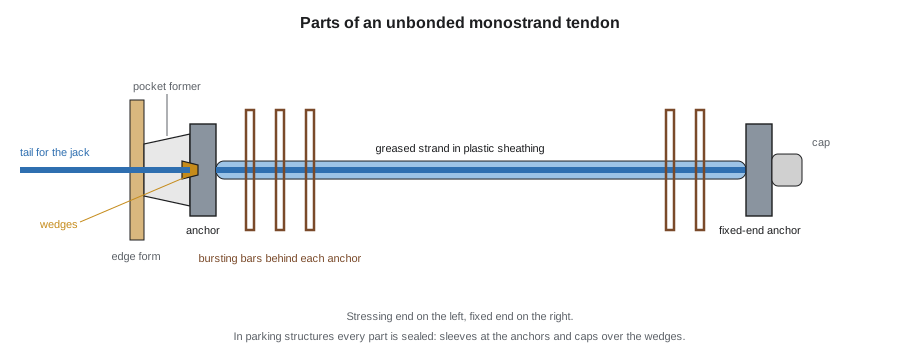
- Strand: the seven-wire steel strand that carries the force.
- Coating: a corrosion-inhibiting grease applied in the plant, which also lets the strand slide in the sheath.
- Sheathing: a continuous plastic tube, extruded around the greased strand, that keeps the grease in and water and concrete out.
- Fixed or dead-end anchor: the anchor at the end of the tendon that is not jacked. Its wedges are usually seated in the plant, and the tendon arrives with it attached.
- Stressing or live-end anchor: the anchor at the end that is jacked. It is nailed to the edge form, with the strand passing through it and a tail sticking out through the form for the jack to grip.
- Wedges: two or three tapered steel pieces with teeth inside, which grip the strand and seat in the anchor's tapered hole when the jack releases.
- Pocket former: a plastic piece that leaves a recess in the slab edge in front of the stressing anchor, so that the strand tail can be cut off inside the slab face and the recess filled afterwards.
- Intermediate anchor: an anchor partway along a tendon, used where the deck is poured in stages.
- Encapsulation: in aggressive environments such as parking structures, every part of the tendon, including the anchors, is sealed in plastic: sleeves connect the sheathing to the anchors, and caps cover the wedges, so that no steel is exposed. Lesson 10 explains these systems.
Behind every anchor, in the concrete, there is bursting steel: bars or spirals that hold the concrete together where the large tendon force spreads out from the small anchor. The rod gang places this steel from the bar lists, and it is one of the places where the mild steel and tendon drawings must agree.
Bonded systems in brief
A bonded multistrand tendon has a duct, usually corrugated galvanized steel or plastic, held on supports at the profile shown, with several strands threaded through it before or after the pour. At each end there is a cast trumpet that connects the duct to a bearing plate, and an anchor head with a wedge hole for each strand. Grout vents and drains, short tubes, rise from the duct at the high and low points so that air and water can escape and the grout can be checked. A multistrand jack stresses all the strands at once. Lesson 10 covers grouting.
Tendon layouts
Tendons are arranged to suit the floor system.
- Two-way flat plates, common in apartment buildings: in one direction, tendons are banded, gathered into a narrow band of several tendons over the column lines; in the other direction they are distributed, spread out evenly across the slab. The banded tendons are usually placed first and the distributed ones drape over them.
- One-way slabs on beams, common in parking structures: the beams have bundles of tendons, often draped deep in the beam, and the slab between them has distributed tendons running across the beams at a set spacing, plus temperature tendons the other way.
- Slabs on grade: tendons in both directions, usually flat, to keep the slab in compression and limit cracking.
Quarry Point Centre will have long-span post-tensioned beams with a one-way post-tensioned slab between them, the usual form for a parking structure, with each beam carrying a bundle of tendons and the slab carrying distributed tendons across them.
How much does the slab get squeezed
Designers describe the squeeze as the average precompression: the total tendon force divided by the area of concrete it acts on. For slabs it is usually a fraction of what concrete can take, but enough to control cracking.
CSA A23.3 and the designer's practice set the levels used; many building slabs are designed for an average precompression of roughly 0.8 to 2 MPa.
Worked problem
Average precompression from tendon spacing
A slab is 200 mm thick. Distributed tendons of 13 mm strand have an effective force, after losses, of about 120 kN each. What is the average precompression if they are spaced at 750 mm, and what spacing would give 1.0 MPa?
Show solution
- Force per metre of slab = 120 kN ÷ 0.750 m = 160 kN/m.
- Area per metre = 1,000 mm × 200 mm = 200,000 mm².
- Precompression = 160,000 N ÷ 200,000 mm² = 0.80 MPa.
- For 1.0 MPa: spacing = 120,000 ÷ (1.0 × 200) = 600 mm.
Answer: 0.80 MPa at 750 mm, and 600 mm spacing for 1.0 MPa. A tendon left out or bunched up changes the squeeze locally, which is why tendon spacing is checked as closely as bar spacing.
Standards, suppliers and certification
In Canada, post-tensioned concrete is designed to CSA A23.3 and built to CSA A23.1, which includes requirements for prestressing materials, placing, stressing and grouting, and to the project specification. The Post-Tensioning Institute (PTI), a North American industry body, publishes specifications and field manuals for unbonded and bonded systems that Canadian specifications often reference.
PTI also runs certification programs for field personnel, with levels for installing unbonded tendons, for inspecting them and for bonded post-tensioning, and many specifications require that the installers, the stressing crew or the inspectors hold them. Ruairi holds PTI's installer and inspector certifications for unbonded work, and Stratline's stressing foreman, Aurelio Santangelo, is certified for both unbonded and bonded systems.
On a post-tensioned job, the post-tensioning supplier usually designs the tendon layout to the engineer's forces, makes the shop drawings and the elongation calculations, supplies the tendons and anchors, and often places and stresses them with its own crew. The rod gang places the mild steel around the tendons. Who does what at Quarry Point is set out in the contracts: Stratline supplies, places and stresses; Crossbeam places all the mild steel, including the bursting steel and the bars that support the tendons.
Losses: why the effective force is less than the jacking force
A tendon is jacked to a high force, but the force that stays in it for the life of the structure is lower. The difference is called the prestress losses, and the supplier's calculations account for each one.
- Friction: as the strand slides through its sheath or duct during stressing, friction along the curves and the slight wobble of the tendon reduce the force with distance from the jack. This is why long tendons are stressed from both ends.
- Seating loss: the small slip of the strand as the wedges seat, which matters most near the stressing end and on short tendons.
- Elastic shortening: the concrete shortens slightly as it is squeezed, so tendons stressed first lose a little force when later tendons squeeze the slab further.
- Long-term losses: over months and years, concrete shrinks and creeps under load, and the strand relaxes slightly, all of which reduce the force.
The effective force used in design, after all these losses, is typically a good deal less than the jacking force. A common rule of thumb for a 13 mm monostrand is an effective force of about 120 kN, against a jacking force of about 147 kN. The rod gang does not calculate losses, but it causes them if tendons are placed with kinks, sharp sweeps or wobble between supports, because every one adds friction.
Shoring and post-tensioned decks
A post-tensioned deck carries its own weight only after it is stressed. Before that, the formwork and shoring carry it. When the tendons are stressed, the slab lifts slightly off the forms in the spans and pushes down harder at the supports, and the loads on the shores change. That is why the shoring and reshoring sequence for a post-tensioned structure is designed with the stressing sequence, and why forms and shores under a deck are never removed before its tendons are stressed and the engineer allows it. Rod gangs working on the deck above need to know this too: a stack of bundles set on an unstressed deck adds load to shores that were designed for a particular weight.
Shoring under Quarry Point's decks will be designed by the general contractor's formwork engineer with Stratline's stressing sequence, and the rod gang will be told the maximum load allowed on each deck before it is stressed.
Common mistakes
MistakeThinking a post-tensioned slab has no mild steel.
InsteadPost-tensioned slabs still have bars at anchors, columns, openings and edges.
MistakeWelding near strand or using it as a welding ground.
InsteadNever weld on, near or through strand.
MistakeTreating tendon height as a rough guide.
InsteadThe drape sets the upward balance; heights are checked at every support point.
MistakeConfusing banded and distributed tendons.
InsteadBanded tendons are gathered over column lines; distributed ones are spread evenly.
MistakeLeaving the bursting steel off because it is not on the tendon drawing.
InsteadBursting steel is on the mild steel bar lists; place it behind every anchor.
Summary and key terms
- Post-tensioning squeezes concrete with stressed tendons so that it resists cracking, and draped tendons push up to balance load.
- Unbonded tendons are greased, sheathed monostrands anchored only at their ends; bonded tendons are multistrand in grouted ducts.
- Strand is seven-wire, ASTM A416, usually 13 mm or 15 mm at 1,860 MPa.
- An unbonded tendon has strand, grease, sheathing, fixed and stressing anchors, wedges, pocket formers and, in parking structures, full encapsulation.
- Slabs use banded and distributed tendons; parking structures often use tendons in beams with distributed slab tendons.
- Average precompression is tendon force divided by concrete area.
- The PT supplier designs the layout, supplies and often places and stresses; the rod gang places the mild steel, including bursting steel.
- Post-tensioning
- Stressing tendons after the concrete has hardened, against anchors cast into it.
- Tendon
- A strand or group of strands with its anchors, used to prestress concrete.
- Drape
- The curved profile of a tendon between supports.
- Unbonded tendon
- A greased, sheathed strand that is anchored only at its ends.
- Bonded tendon
- Strands in a duct that is filled with grout after stressing.
- Wedge
- A toothed, tapered piece that grips the strand and seats in the anchor.
- Pocket former
- A plastic piece that leaves a recess at a stressing anchor.
- Bursting steel
- Bars or spirals behind an anchor that hold the concrete together where the force spreads out.
- Precompression
- The average compressive stress the tendons put on the concrete.
Practice problems
Work each problem on paper first, then reveal the answer to check.
A 200 mm slab has tendons at 900 mm with 120 kN effective each. What is the precompression?
Show answer
120,000 ÷ (900 × 200) = 0.67 MPa.
What is the area of a 13 mm strand?
Show answer
About 99 mm².
Where are banded tendons placed in a two-way flat plate?
Show answer
In narrow bands over the column lines.
What fills the duct in a bonded tendon?
Show answer
Cementitious grout.
Who usually makes the elongation calculations?
Show answer
The post-tensioning supplier.
Lesson quiz · 5 questions
Score 60% or more to complete this lesson.
Create a free account to save your progress, take quizzes and earn a certificate.