
IRW-110 · Lesson 9 of 12 · 23 min
Hazards of steel erection
▶ Video coming soon A video version of this lesson is on the way.
On Tuesday, September 29, Grace's toolbox talk began with a photograph of a partly erected steel frame folded over like a pack of cards. "Nobody fell," she said. "Nobody got hit by a load. The frame just went over in the wind, because the bracing wasn't in yet. Two people were on it." Falls are the biggest killer in ironwork, but they are not the only one. This lesson covers the other main hazards of steel erection: collapse of the structure, struck-by and caught-between injuries, crane and rigging hazards, hot work, weather and the slow injuries that build up over years. The point of studying them is to recognize them early, while they can still be controlled.
Collapse of the structure
A steel frame is designed to be stable when it is finished: when the columns are anchored, the beams are bolted, the bracing or moment connections are complete and the floor decks act as diaphragms that tie everything together. While it is going up, it has none of that. A column standing on its anchor rods with one beam attached can be pushed over by the wind, by a load swinging into it or by a crane pulling on it. A bay with no bracing can rack sideways. A beam connected at one end only can twist and drop.
Erection is therefore planned in an order that keeps the frame stable at every stage. The erection drawings and the erection plan show the sequence, the temporary bracing and guying, and the points at which permanent bracing must be complete before work moves up. Ironworkers follow the sequence and do not skip ahead.
- Columns are set on anchor rods that the general contractor has confirmed are in the right place and strong enough, in concrete that has cured enough to carry the loads. Never set a column on anchor rods that have been cut, bent or modified without the engineer of record's approval.
- Columns are plumbed and held by their anchor rods, temporary guys or bracing before the crane lets go and before anyone climbs them.
- Beams are bolted with at least the minimum number of bolts at each end, tightened by hand, before the load is released.
- Temporary bracing and guy cables are installed where the erection plan shows, and they are removed only when the permanent bracing or connections that replace them are complete and the person in charge says so.
- Bundles of deck, joists or bolts are landed only where the structure can carry them, as the erection plan shows.
The Ontario regulation has specific requirements for erecting structural steel and precast concrete, including that the erection be done according to a procedure, that temporary bracing and guying be used to keep the structure stable, and that the structure not be loaded beyond what it can safely carry. Where the stability of a structure during erection depends on temporary supports, they must be designed by a professional engineer.
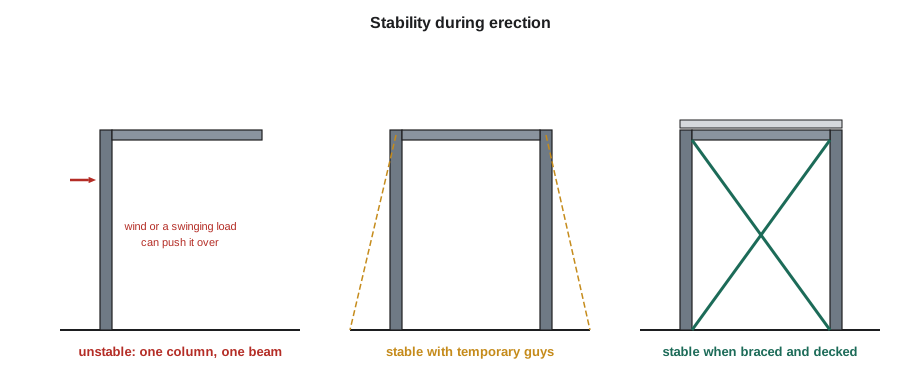
The signs of trouble are often small: a column that will not plumb up, a connection that is noisy or moving, bolts that will not seat, a beam that sags or twists when loaded, a crack in concrete at an anchor rod. When steel moves or deforms in a way it should not, stop, get off it, and tell the foreperson. This is the lesson of the Quebec Bridge in lesson 2.
Struck-by hazards
Being struck by a moving or falling object is the second biggest cause of serious injury in ironwork. The objects include:
- Suspended loads: steel swinging or dropping from the crane, especially during landing and when a load turns in the wind.
- Falling objects: tools, bolts, drift pins, spud wrenches, spent tension-control splines, cut pieces and slag dropped from above.
- Flying objects: grinder fragments, chips from driving pins, a sling that breaks or a tag line that snaps back.
- Moving equipment: trucks delivering steel, forklifts and telehandlers sorting it, and the crane's counterweight swinging.
Loads must not be carried over workers. The Ontario regulation requires that a load not pass over a worker, and the erection plan and the signaller must route loads to avoid people. Connectors and the hooker-on are close to loads by the nature of their work, so they stay out from under the load and handle it with tag lines until it is near enough to guide by hand.
Below the work, controlled access zones are taped or fenced off so nobody walks under the connectors or a cutting operation. Overhead protection, such as a covered walkway or a protected entrance, is built where people must pass. Tools are tethered and small parts are carried in tied-off buckets or bags.
Caught-in and caught-between hazards
Hands and feet are caught between a load and the steel, between two pieces as they come together, between a sling and the load as it tightens, and in moving parts of tools. Fingers are lost in bolt holes when a piece shifts. Feet are crushed when a load is landed. A worker can be pinned between a swinging load and a column, or between the crane's turning counterweight and something fixed.
- Never put fingers in a bolt hole to check alignment; use a pin or a spud.
- Keep hands on the outside of the load, not between it and the steel or between sling and load.
- Land loads on blocking, never on feet; keep feet clear of the landing area.
- Stay outside the barricade around the crane's counterweight swing radius.
Crane and rigging hazards
The crane is at the centre of every steel job, and its failures are catastrophic: overturning from overload or poor ground, boom collapse, two-blocking (the hook block pulled into the boom tip), contact with power lines, and dropped loads from failed rigging. IRW-120 covers cranes and rigging in detail. At this stage, every ironworker should know that the crane operator is responsible for the crane and has the right to refuse a lift, that only one qualified signal person gives signals for a lift (anyone may give the stop signal), and that rigging is inspected before each use.
On Ontario projects, multiple pieces are hoisted together only where the rigging, the lift plan and the crane allow it; IRW-120 covers when this is acceptable.
Hot work and fire
Lesson 4 covered cutting and grinding. On a steel job, the fire hazard is not only to the ironworkers: slag and sparks fall into areas where other trades store combustibles, and a fire in a partly built structure can spread fast. Hot work needs a permit, a fire watch, slag control, an extinguisher at hand and a check of the area below and behind the work, during the work and for the time the site rules require after.
Weather
Ironworkers work outdoors, high up, on bare steel. Weather changes the hazards:
- Wind: loads swing and turn, sheets of deck become sails, and workers are pushed off balance. Cranes have wind limits set by their makers, and steel erectors set their own limits for connecting and decking.
- Rain, ice, frost and snow: steel and deck become slippery. Steel coated with ice, frost or snow must be cleared before anyone walks on it, and work may stop until it can be.
- Lightning: steel attracts it, and workers on steel are exposed. Stop work and get off the steel when thunder is heard or lightning is near, and wait until it has passed for the time the site rule requires, commonly 30 minutes.
- Heat and cold: heat stress causes dizziness, poor judgement and collapse; cold numbs hands and slows reactions. Both make falls and dropped tools more likely.
Crossbeam's rule at Ashcroft was to stop connecting when gusts reached 50 km/h and to stop laying deck when gusts reached 40 km/h, or sooner if the foreperson or the crane operator judged conditions unsafe. These are company rules; the crane maker's limits always apply.
Worked problem
Wind on a deck sheet
A single deck sheet at Ashcroft is about 0.9 m by 6.0 m. Using the simple wind pressure formula q = 0.613 × v², with v in m/s and q in pascals, what force does a gust of 50 km/h put on the flat sheet, if it acts on the whole sheet face?
Show solution
- Speed: 50 km/h ÷ 3.6 ≈ 13.9 m/s.
- Pressure: 0.613 × 13.9² = 0.613 × 193.2 ≈ 118 Pa.
- Area: 0.9 × 6.0 = 5.4 m².
- Force: 118 × 5.4 ≈ 640 N, about the weight of 65 kg.
Answer: About 640 N, the weight of a person, on a sheet that a worker is holding or that has not been fastened. That is why deck stops in high wind and why bundles are not opened until they are secured.
Injuries that build up over time
Not every injury happens in a moment. Ironworkers suffer back and shoulder injuries from lifting and carrying, knee damage from climbing and kneeling, hearing loss from noise, hand-arm vibration syndrome from impact wrenches and grinders, and skin damage from sun. Good lifting technique, mechanical help such as hoists and carts, rotating tasks, hearing protection, anti-vibration gloves and tools, and sunscreen all help. A long career depends on looking after your body from the first year.
Spotting hazards before the work starts
The general safety course covered task hazard analysis. On a steel job, the raising gang reviews each day's work at the start of the shift: the pieces to be lifted, their weights, the crane setup, the sequence, the fall protection and anchors, the access, the weather and the rescue plan. Any worker who sees a hazard that has not been controlled stops the work and says so. At Crossbeam, an apprentice who stops a lift for a good reason is thanked, not teased.
Working near other trades
On most jobs, ironworkers are not alone. Concrete crews may be forming walls on one side of the building while steel goes up on the other; electricians and plumbers start on the lower floors as soon as the deck is down; curtain wall crews follow the steel up. Each trade brings its own hazards and is exposed to the ironworkers' hazards in turn. The general contractor coordinates the trades, and the steel erector must tell the general contractor and other trades where the controlled access zones are and when they move. Ironworkers in turn watch for other trades' hazards: open trenches, formwork, materials stacked near edges and temporary power cords on the deck.
Fatigue, rushing and distraction
Many serious accidents in ironwork happen late in the day, near the end of a job or when a crew is behind schedule. Tired workers miss signals, take shortcuts and misjudge distances. Rushing to finish a lift before the wind picks up, or before quitting time, leads to releasing a beam with too few bolts or stepping onto steel before tying off. Phones and conversations pull attention away from loads and footing. Crossbeam's rule is simple: if you feel yourself rushing, stop and look again, and if a coworker looks tired or distracted, say so.
Worked problem
Wind pressure rises with the square of the speed
On Wednesday morning at Ashcroft the gusts reached 70 km/h. How many times greater is the wind pressure at that speed than at Crossbeam's decking limit of 40 km/h?
Show solution
- Pressure ratio = (70 ÷ 40)² = 1.75² ≈ 3.1.
Answer: About 3 times as much. Because pressure rises with the square of the speed, a gust that is less than twice as fast pushes about three times as hard.
Reporting near misses
A near miss is an event that could have caused an injury but did not: a bolt dropped into an empty controlled zone, a load that swung closer than planned, a beam released with one bolt too few that held anyway. Near misses are free lessons. At Crossbeam, every near miss is reported to the foreperson the same day and discussed at the next toolbox talk, without blame, so that the cause is fixed before it causes an injury.
Common mistakes
MistakeLeaving a column standing without guys, bracing or enough anchor rods.
InsteadHold columns with their anchor rods and the planned guys or bracing before the crane lets go.
MistakeRemoving temporary bracing because it is in the way.
InsteadRemove it only when the permanent bracing replaces it and the person in charge says so.
MistakeWalking under the connectors to save time.
InsteadStay out of controlled access zones below overhead work.
MistakePutting a finger in a bolt hole to feel the alignment.
InsteadUse a pin or a spud; fingers are lost that way.
MistakeWorking on frosty steel because the sun will clear it soon.
InsteadClear ice, frost and snow before walking on steel.
MistakeStaying on the steel when thunder is heard.
InsteadGet off the steel and wait out the storm.
Summary and key terms
- A partly erected frame is unstable; follow the erection sequence, use guys and bracing, and bolt before releasing loads.
- The Ontario regulation requires erection to follow a procedure with temporary bracing where needed.
- Struck-by hazards include suspended, falling and flying objects and moving equipment; loads are not carried over workers.
- Caught-between injuries happen at pinch points, landing areas and the crane's counterweight.
- Wind, ice, lightning, heat and cold change the hazards; stop work when limits are reached.
- Look after your body to avoid injuries that build up over years.
- Erection sequence
- The planned order of erecting steel that keeps the structure stable at every stage.
- Temporary bracing
- Bracing or guys installed during erection to hold the frame until permanent bracing is complete.
- Guy cable
- A cable from the steel to an anchor that holds a column or frame plumb and stable.
- Anchor rod
- A rod cast into concrete that holds a column base plate down.
- Controlled access zone
- An area below or around hazardous work that only authorized workers may enter.
- Two-blocking
- Pulling the hook block into the boom tip, which can break the hoist line.
- Hand-arm vibration syndrome
- Damage to the nerves and blood vessels of the hands from long use of vibrating tools.
Practice problems
Work each problem on paper first, then reveal the answer to check.
Why is a partly erected frame unstable?
Show answer
Bracing, connections and decks that make the finished frame stable are not yet complete.
What should you do if a connection starts moving or making noise?
Show answer
Stop, get off the steel and tell the foreperson.
What force does a 50 km/h gust put on a 5.4 m² sheet?
Show answer
About 118 Pa × 5.4 m² ≈ 640 N.
Name three struck-by hazards on a steel job.
Show answer
Suspended loads, falling tools and bolts, flying grinder fragments, moving trucks and equipment.
When should workers come off the steel because of weather?
Show answer
When thunder is heard or lightning is near, and when wind or ice limits are reached.
Lesson quiz · 5 questions
Score 60% or more to complete this lesson.
Create a free account to save your progress, take quizzes and earn a certificate.